
Facial fat transfer recovery needs a plan for the treated face and the area where fat was collected. A face that feels ready for a video call does not establish that bending, carrying luggage or returning to exercise is permitted. Start with the actual surgical regions, written care instructions, help at home and the tasks you need to resume. Keep early swelling, everyday independence and later assessment of facial volume separate. A calendar cannot tell you how much transferred fat will remain or whether a new symptom is harmless.
This guide helps organize questions for your surgical team. It does not prescribe massage, pressure, medicines, washing or a graft-protection routine. Fat grafting performed alongside eyelid surgery, a facelift or another operation needs coordinated instructions for the complete procedure. Ask which instruction applies if advice for one area seems to conflict with advice for another. The most useful answer describes an actual task and an actual surgical site, rather than a universal recovery week.
What should a facial fat transfer recovery plan identify?
Begin with a simple region list. Record the facial areas treated and each donor area identified by the team. Add any accompanying operation, the planned setting after surgery and the person responsible for discharge instructions. The purpose is to prevent the visible face from becoming the only part of the plan. Donor-site questions may be easy to forget when the main goal is facial appearance, yet those questions belong in the same conversation about clothing, movement and support.
Write down where information will be kept. A phone note may suit one person; a printed discharge sheet may be easier for a helper. Include the routine contact, out-of-hours contact and follow-up arrangement. Ask what to do if you cannot reach the office, and which symptoms should bypass an office message entirely. This practical preparation does not predict a complication or replace the team’s own monitoring instructions.
The NHS surgical fat transfer overview describes fat collection and transfer as parts of one procedure. Its recovery estimates cover surgical fat transfer broadly. They are not a facial-area-specific permission schedule, and guidance about buttock grafting should not be imported into facial aftercare.
Translate the operation into ordinary needs
List the ordinary things you expect to do: getting dressed, preparing food, reaching storage, using a laptop, wearing work equipment and attending appointments. For each, identify the physical demand and the question it raises. Avoid writing “normal activity” as if everyone has the same normal day. A quiet desk morning and a commute followed by lifting supplies need different answers. This list is an editorial planning aid, not a tested medical scoring system.
How should facial fat transfer recovery milestones be interpreted?
The NHS gives broad context of a couple of weeks away from work and several weeks of bruising or swelling, with the full effect taking up to six months. These are general fat-transfer estimates, not a forecast for a particular face, graft volume, donor site or occupation. Its appearance endpoint is especially different from returning to a task. The same source notes that some transferred fat may be reabsorbed; an early photograph therefore cannot establish final retained volume.
| Facial fat transfer recovery question | Published context | What still needs an individual answer |
|---|---|---|
| Work planning | NHS general fat transfer: a couple of weeks may be wanted | Actual duties, donor site, accompanying operations and review |
| Early appearance | Bruising and swelling may last several weeks | Expected pattern for each treated region and contact instructions |
| Later effect | Up to six months in the general overview | When the surgeon will assess appearance and retained volume |
| Specific activities | No universal permission established here | Task-specific surgical instructions |
Use the table to avoid combining unlike endpoints. A work estimate can help with an initial conversation about leave; it cannot authorize contact pressure, vigorous training or a long journey. An appearance estimate can help explain why the first mirror check is not the final assessment; it cannot diagnose a change that worries you.
The ASPS cheek augmentation recovery guidance emphasizes individual site-care, activity and follow-up instructions. That page covers fat grafting and cheek implants, so implant-specific mouth care is not assumed for facial fat transfer recovery. Ask for the instructions that match your own operation, including whether any other facial procedure changes them.
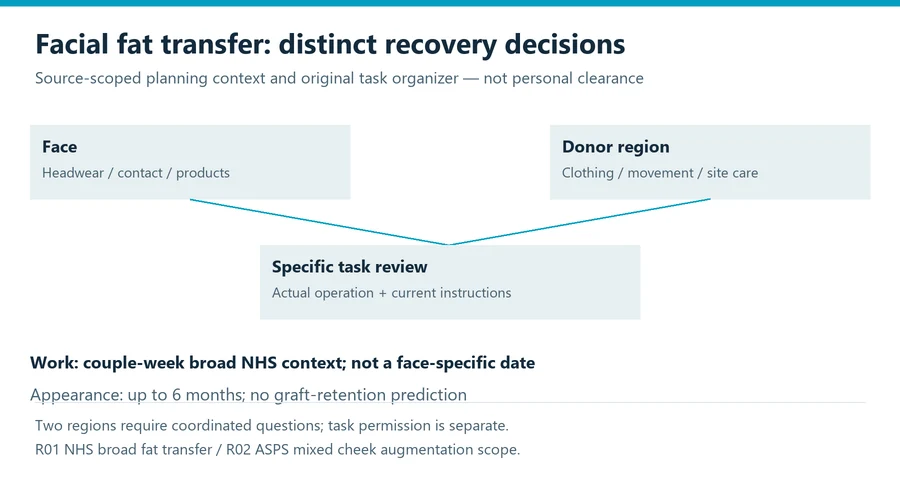
What should be clarified about face care and donor-site care?
Bring the two regions into one discussion without assuming they need the same care. Ask whether there are dressings, garments or other items at either site, who may handle them and when the next review will occur. If an item is supplied, ask for its purpose and the exact instructions for using it. A photograph of someone else’s garment or a product description is not a substitute for a fitted postoperative plan.
For facial fat transfer recovery, questions about pressure can be practical rather than theoretical. Mention glasses, protective headwear, masks required at work, headphones and the position of a phone against the cheek. The team can determine whether a particular item matters for the areas treated. Do not assume that an accessory is prohibited, or that a softer version is automatically suitable. Ask for the actual answer and any change point.
At the donor area, clarify clothing, bathing, care of any small incisions and the follow-up process. This guide does not supply a compression duration or tell you to remove a dressing. If instructions use an unfamiliar term, ask the team to demonstrate what it means within your own care plan. A helper should understand their role without taking on treatment decisions that have not been assigned to them.
Keep product questions specific
If you want to resume skin care, cosmetics or a supplement, bring the actual product name and reason for using it. Ask whether it belongs in the current plan and who will authorize a change. Do not create a home massage or “fat survival” routine from internet anecdotes. A useful product question asks about compatibility with the operation; it does not assume that adding more steps improves the outcome.
How can facial fat transfer recovery at work be organized?
Separate the workday into demands. Screen work may involve little lifting but still require concentration, a commute, long meetings and a particular headset. Customer-facing work may raise concerns about visible swelling without creating the same physical demands as manual work. Describe both kinds of concern. The team can address physical readiness, while you can decide how much privacy and scheduling flexibility you want.
If leave is available, ask your employer about a provisional arrangement and a way to revise it after review. You do not need to promise a final facial appearance on the first day back. Consider whether a shorter meeting schedule, camera flexibility or a temporary change in equipment would make an approved return more manageable. These are workplace planning options, not clinical recommendations or promises of a faster recovery.
Remote work still needs a task description. Mention whether you must remain available continuously, handle urgent decisions or take calls without breaks. Being at home does not make care appointments disappear. A plan can identify the hours you hope to work, the tasks someone else could cover and the point at which you will confirm arrangements with the clinical team.
For physical work, describe reaching, bending, pushing, lifting, repeated movements and any required protective gear. Ask about those duties rather than requesting a single date for “work.” If a temporary restriction is given, clarify its scope and how it will be reviewed. Do not convert a restriction for one task into a rule for every task, or treat the absence of a named restriction as permission.
How should transport, home help and exercise be discussed?
Arrange the discharge journey according to the facility’s actual instructions. Identify who is available, where you will be going and how you will obtain help if the arrangement changes. The NHS overview says a ride home is needed. Its driving discussion is general; your own decision also belongs with the team responsible for anesthesia, medicines and postoperative restrictions. Feeling willing to drive is different from having the required clearance.
For later trips, describe duration, carrying requirements, seating and access to follow-up. A short passenger journey and a flight with luggage are different tasks. Ask whether travel would interfere with a planned review or make care harder to obtain. This guide does not provide a waiting period for flying or an independent blood-clot prevention regimen.
Home help can be matched to specific demands. A friend might arrange meals, collect groceries or handle a pet’s supplies while you remain responsible for communicating with the clinical team. If a task involves face or donor-site care, clarify who is permitted to do it and what training is needed. General assistance should not quietly become unsupervised treatment.
For exercise during facial fat transfer recovery, identify the activity itself: walking for transport, an exercise class, resistance training, swimming or a contact sport. Ask how the face, donor area and any accompanying operation affect that activity. Do not treat appearance improvement as an exercise milestone. The return plan should come from the actual instructions and review, not from a general fat-transfer timeline.
Plan for a change in help
If your helper is available only briefly, say so before surgery. Decide which ordinary tasks can be deferred and which need another arrangement. A plan with one reliable contact and a clear handover can be more useful than a long list of people who do not know what is expected. This is a logistics suggestion, not evidence that a particular support arrangement changes graft retention.
Which symptoms should interrupt the recovery plan?
Do not use a general swelling timeline to dismiss a concerning change. The NHS advises returning to the treating surgeon for problems such as increasing swelling, redness or pain. Describe where the change is occurring, when it began and what is different from the instructions you received. Facial fat transfer recovery can involve more than one region, so name the face or the particular donor site rather than saying only that recovery feels wrong.
For surgical wounds, CDC infection guidance says to contact a healthcare provider immediately for redness or pain at the site, drainage or fever. This is general postoperative guidance, not a diagnosis or a facial fat-transfer complication rate. Do not wait for the next photograph or routine appointment to decide whether to call.
New breathing difficulty, chest pain or fainting needs immediate emergency assessment. CDC blood-clot guidance distinguishes urgent limb symptoms from possible lung-clot symptoms needing immediate help. In the United States, call 911 for an emergency. New limb swelling, pain or warmth warrants prompt medical assessment; the guide cannot determine its cause.
If you cannot reach the treating office, use the alternative care route supplied at discharge or seek appropriate urgent help. A photo message may support a clinician’s assessment if requested, but it does not replace assessment or guarantee that a message is monitored immediately. The immediate question is who should evaluate the symptom, not whether it fits someone else’s recovery story.
How can facial fat transfer recovery questions be prioritized at review?
A review conversation can be more useful if you bring the actual decisions that are approaching. For example, you may need to confirm a work headset before a shift, decide who will carry bags for an appointment, or clarify whether a donor-site instruction still applies. Put those questions ahead of a general request to know whether everything is normal. The team can then address a task or examine a concern with its full context.
For facial fat transfer recovery, a practical note can contain four fields: the task, the treated region it involves, the instruction currently understood and the answer still needed. You do not need to score pain or assign a readiness number to make that note useful. If a symptom is present, use the clinical contact route rather than holding it for the next task discussion. This organizer is original editorial planning, not a validated recovery instrument.
If you receive a qualified answer, preserve the qualification. Permission for a short, specific activity should not become a general statement that every activity is allowed. Ask whether the answer applies only to the facial region, only to the donor site or to the operation as a whole. If another procedure is involved, make sure the answer includes that procedure rather than assuming the word fat transfer covers it.
You can also ask how the team wants follow-up questions submitted. Some offices use telephone triage, some request a particular message route and some need an appointment. Knowing the route helps avoid sending a time-sensitive concern to an unmonitored channel. It does not guarantee a response within a particular period, so keep the urgent and emergency options separate.
Finally, decide what information a helper needs. They may need to know who is collecting groceries or taking you to review, without needing access to appearance photographs or private clinical discussions. A facial fat transfer recovery plan can preserve that privacy while keeping practical responsibilities clear. The aim is a current answer to each real task, not a long record that nobody can use.
What should follow-up clarify about function and appearance?
Take a short list of unresolved questions to follow-up. Start with care responsibilities and tasks you cannot yet plan confidently. Ask whether an instruction has changed, whether the change applies to both regions and when it will be reconsidered. Keeping the current instruction separate from an old instruction avoids a situation where a helper follows one version while you follow another.
Appearance questions deserve their own discussion. Ask which changes the surgeon is assessing now, which remain unsettled and when later assessment is planned. A diary can record concerns without claiming to measure retained fat. If photographs are requested, follow the team’s method; informal differences in angle, expression and lighting cannot establish a medical outcome.
If you are worried about asymmetry or volume, describe the concern without trying to resolve it with pressure, massage or another intervention. Ask whether examination is needed and which decisions should wait. A later appearance estimate is not a promise that every concern will disappear. It also does not mean that an unexpected symptom must be ignored until months have passed.
For the broader operation, see the facial fat transfer guide. Use the general recovery planning guide for help coordinating ordinary tasks. The central facial fat transfer recovery goal is a usable, current plan: the right instructions for both regions, specific answers for your daily demands and a clear route to care when the plan needs attention.
Sources and review scope
Plastic Surgery Editorial Team. Source records checked through October 12, 2026. Review scope: source and editorial checks for general education. No individual clinical assessment is represented.
- NHS surgical fat transfer. nhs.uk. Source date: 2023-10-19. Checked 2026-10-12.
- ASPS cheek augmentation recovery. plasticsurgery.org. Publication/update date not stated. Checked 2026-10-12.
- CDC blood-clot guidance. cdc.gov. Source date: 2025-03-05. Checked 2026-10-12.
- CDC surgical infection guidance. cdc.gov. Source date: 2024-04-11. Checked 2026-10-12.