
Facial fat transfer uses fat taken from your own body to add volume to selected facial areas. It is also called facial fat grafting or lipofilling. The decision involves a donor area as well as the face, and the amount injected is not a guarantee of the volume visible later. Ask which contour concern the treatment addresses, how the result will be assessed and what further treatment might involve. Your own tissue does not make the procedure risk free or ensure an unchanged lifelong appearance.
ASPS describes fat injections as a more extensive process than using an off-the-shelf filler because a donor area is selected and fat is collected before facial grafting. It also notes donor-area discomfort and less predictable results, with further treatment sometimes needed. Treat a broad educational retention estimate as context rather than a promise for your face. ASPS facial fat injection overview
Identify a volume goal before comparing treatment names
Describe where you notice a contour change and what you hope to improve. A hollow area, a crease, loose tissue and an uneven surface are different observations. Ask the clinician to explain which part of the concern is reasonably addressed by adding volume and which would remain. This avoids assuming that a volumizing procedure will perform every task associated with facial rejuvenation.
Include the appearance you want to preserve. You may prefer a subtle change, want to retain natural angularity or accept a remaining crease rather than add more fullness. Those preferences deserve attention alongside the areas you would like treated. A goal defined only as looking younger may be too broad to guide a specific volume decision.
ASPS facelift guidance describes treatment of sagging tissue and related facial changes. Fat transfer may be discussed alongside lifting, but the two components should have separate purposes in a combined plan. Ask what the lifting component changes and what the added volume contributes. A photograph after both procedures cannot establish the independent effect of the graft. ASPS facelift scope
| Concern or preference | Clarification to request | What should not be assumed |
|---|---|---|
| A hollow or shallow contour | What volume change is feasible in the selected region? | Every contour concern needs added volume |
| Loose tissue or a fold | Which part is a volume issue and which is a position issue? | Fat transfer duplicates a lifting operation |
| Unevenness between sides | How will baseline differences and residual variation be assessed? | Both sides will become perfectly identical |
| Preference for a limited change | Which features and proportions should be preserved? | More injected volume produces a better result |
| Combined facial treatment | What is the purpose of each component? | A combined photograph proves the effect of one component |
Use this worksheet to make the explanation more precise. It is not a facial injection map. A safe and suitable plan requires an examination and a qualified clinician’s assessment of the area, your history and the available options.
The donor area is part of the operation
Ask where fat would be collected and why that area is appropriate. Discuss the expected local care, potential contour change and possible scars. If you have previous liposuction or other treatment there, bring the records and explain any existing irregularity. The donor area should not disappear from consent because the face is the feature you want to change.
Separate the amount of collection needed for the facial plan from an optional body-contouring goal. Ask whether the proposed donor work is intended simply to obtain graft material or also to reshape a larger area. If additional contouring is offered, request its own scope, recovery explanation and cost. Do not assume that the facial procedure includes a meaningful body-liposuction result.
Plan care for both areas. Will you have separate dressings or garment instructions? Which area may affect sitting, clothing or activity? Who will assess a donor-site concern? A consultation focused only on facial swelling may leave these practical questions unanswered. Write the donor and facial responsibilities in separate columns in your recovery notes.
The Australian Society of Plastic Surgeons describes fat transfer as individualized surgery, with health, stable weight, expectations and donor availability among the considerations. Ask how those factors apply to your proposed treatment. Its general guidance spans several body regions and should not be read as a fixed schedule or eligibility rule for every facial graft. Australian society fat injection guidance
Injected volume and measured later volume are different
An operative volume records what was introduced during treatment. A later assessment asks what change remains visible or measurable. Those values answer different questions. Before comparing a retention percentage, ask what the investigators measured, what they used as the starting reference and which facial regions were included.
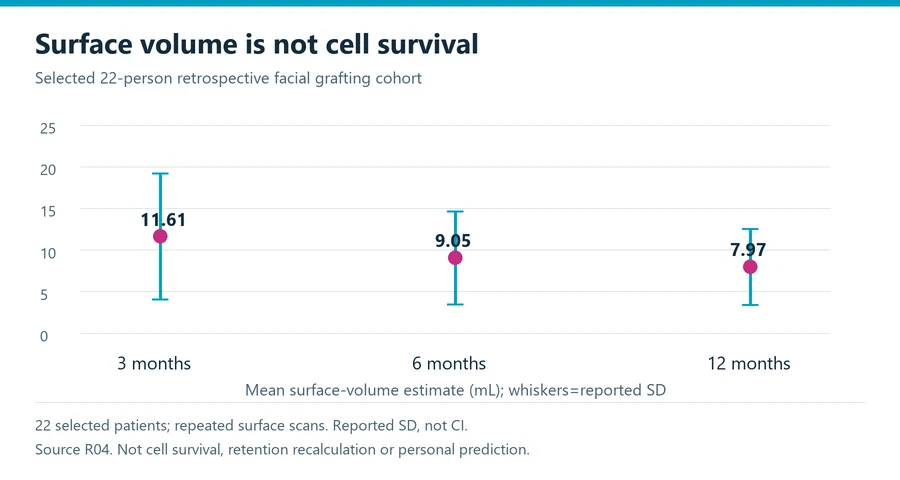
A 2016 study, first published online in October 2015, retrospectively examined 22 patients using three-dimensional surface scans. Mean injected volume was 18 mL. Reported mean later volumes were 11.61 mL at three months, 9.05 mL at six months and 7.97 mL at twelve months. The reported average twelve-month retention was 44.53%, with variation between patients. These are results of that selected technique and cohort, not a volume prescription or your predicted retention. Original three-dimensional volume study
| Reported measurement | Mean value in that study | Context to retain |
|---|---|---|
| Injected volume | 18 mL | An operative input, not the final facial result |
| Three-month measured volume | 11.61 mL | A surface-imaging estimate in the studied patients |
| Six-month measured volume | 9.05 mL | A later assessment, not an individual guarantee |
| Twelve-month measured volume | 7.97 mL | A group mean with variation, not a universal target |
A surface-volume estimate is not a count of surviving cells
A retention number needs its measurement method and time point. A surface scan, a photograph, a clinician rating and a satisfaction questionnaire do not automatically measure the same thing. When a claim uses the word survival, ask whether it refers to measured contour volume or direct biological evidence. Do not convert an appearance measurement into a precise cell-survival claim.
Also distinguish an average of individual retention percentages from a ratio calculated using two group means. They can differ. If a paper reports its own average percentage, retain that definition rather than replacing it with a new calculation because the arithmetic looks simpler. A clear graphic should label measured volume separately from any calculated proportion.
If someone predicts your final result by multiplying a planned injected amount by a study average, ask why that estimate is appropriate and how uncertainty is handled. The visible change you want is not captured by a single arithmetic result. Distribution, anatomy and your preferences still need assessment. A number can support the conversation without deciding the entire plan.
Longer follow-up adds questions about weight and selection
A 2025 study assessed twelve patients using three-dimensional surface imaging and satisfaction measurements five years after facial fat grafting. Facial volume change was associated with weight gain rather than injected volume. This small selected group does not establish that gaining weight is a treatment strategy, that grafting stops working for everyone or that all patients need repeated treatment. It highlights a limitation in interpreting long-term visible volume. Original five-year study
Ask how your weight history and future plans affect timing and follow-up. If ongoing weight change is likely, explain it during assessment instead of assuming that a contour measurement will isolate the graft’s effect. Record relevant changes over time if the team requests them. Do not try to manipulate weight to obtain a particular retention percentage from a small observational report.
Longer-term studies also need clear inclusion and follow-up rules. Were people who had another facial procedure included? Were additional grafting sessions counted? How many original participants supplied the later measurements? Those details affect what the result can tell you about a first treatment. An impressive follow-up duration does not remove selection limitations.
Keep the practical question in view: does the proposed treatment offer a change you value, with uncertainty you are willing to accept? Evidence may be informative without supplying a fixed expiry date or a guarantee of permanence. Ask how the clinician explains the range of possible courses and when reassessment would be useful.
Satisfaction and contour measurements should both be considered
A measured increase in volume is not automatically a better personal result. You might prefer less fullness in one area or care more about balance than size. Before treatment, record the priorities that would make the procedure worthwhile. Afterward, discuss those same priorities rather than using volume alone as the definition of success.
Ask whether the team uses a suitable patient-reported measure and how it fits with photographs or other assessment. If a score is reported, find out what higher or lower values mean and whether the same instrument was used at the relevant visits. A questionnaire can document your experience without functioning as a measurement of graft volume.
For photographs, seek consistent views, lighting and expression. Ask how long after treatment the images were taken and whether other procedures occurred. A selected gallery can illustrate particular results, but it is not a complete denominator of satisfaction or complications. A digitally altered preview should be identified as an illustration of a goal, not proof of what your tissues will do.
Keep the question being measured consistent across visits. If your original priority was a hollow contour in one area, an overall impression of a fuller face may not answer that question. Ask whether the assessment records the relevant region separately and whether the same boundary was used each time. If the region changes between measurements, a larger number may reflect a different measurement area rather than a larger treatment effect.
Record any intervening procedure alongside the assessment date. Additional grafting, a filler treatment or a lifting operation changes the question that later photographs can answer. They may show the appearance after a course of combined care, but they cannot automatically show what the first graft alone achieved. Keep those descriptions separate when reviewing a gallery or your own follow-up record.
You can also separate a visible change from its importance to you. Write down which remaining concerns are acceptable, which affect your satisfaction and which deserve reassessment. A measurable difference that you do not value should not become the sole reason to pursue more treatment. Conversely, a result you appreciate should not be dismissed simply because it does not match an advertised retention percentage. Ask for an explanation that relates the evidence to your original goal, while acknowledging what cannot be measured reliably or predicted individually.
Compare fat transfer with the actual alternatives
If an injectable product is an option, ask for its exact name, approved use and expected course. FDA guidance explains that filler products have different materials, indications and durations, and that removal can require additional intervention with its own risks. “Filler” is not one interchangeable product. Likewise, facial fat transfer should not be represented as a simple substitute with identical benefits and risks. FDA filler information
Compare the treatment burden that matters to you. Fat transfer involves collection from another area. A product-based option has its own material and follow-up considerations. Lifting addresses a different set of goals. Ask what each option can reasonably change, what it cannot change and what happens if you later dislike the result.
Discuss revision or reduction possibilities before treatment rather than assuming every volume change can be easily reversed. Ask what additional procedures might involve and what uncertainty remains. A claim of naturalness does not answer that question. Your comfort with a longer-lasting change may differ from your comfort with a shorter-course product, and the plan should reflect that preference.
Avoid comparing only the first appointment price. Include likely reassessment, possible repeated treatment, anesthesia or facility services, donor-area care and time away from ordinary activities. Keep speculative future treatment separate from a committed plan, but do not hide it from the financial discussion.
Know the important risks, including the uncommon serious ones
ASPS cheek-augmentation safety guidance lists asymmetry, bleeding, infection, lumpiness, fatty cysts, fat necrosis, donor-site appearance concerns, poor healing and possible revision. It specifically identifies blindness as a rare fat-transfer complication. Ask how the clinician discusses the risks relevant to the planned facial regions and how urgent concerns would be handled. ASPS cheek augmentation and fat-transfer risks
Do not interpret a small study reporting no serious event as proof that the event cannot occur. A study designed mainly to measure volume may not be large enough to quantify uncommon harm. Ask whether a cited safety figure comes from all treated patients, selected follow-up cases or published reports of complications. Those denominators answer different questions.
Avoid choosing treatment based on a claim that one instrument or preparation method makes every facial area safe. Ask about the team’s relevant qualifications, experience, consent process and emergency arrangements. This guide does not provide needle placement, depth or a map of safe injection zones. Technique decisions belong to appropriately trained clinicians performing an individual assessment.
Recovery should cover the face and donor site separately
ASPS cheek recovery guidance describes dressings and individualized instructions about care, medication, concerns and follow-up. Ask what specifically applies to grafting rather than an implant procedure. A general cheek-augmentation page includes more than one treatment type, so its instructions should not be copied indiscriminately. ASPS cheek recovery guidance
Request a written plan for facial care and a separate plan for the donor area. Clarify what to do about pressure, clothing, sleeping, exercise and normal work activities in your actual proposal. Use the team’s instructions rather than an online rule about massage, cooling or a universal return date. Coordinate prescribed-medication changes with the responsible clinicians.
ASPS’s January 2024 facial-grafting article emphasizes following the treating team’s postoperative instructions and allowing time for the result to settle. It is an expert interview, not a controlled comparison of every care schedule. Ask what milestones the team will assess and which changes warrant earlier contact. ASPS facial grafting discussion
Know who handles routine questions and who can arrange urgent assessment. Vision changes or other urgent symptoms should not wait for a scheduled photograph review. Ask the team for warning signs and the appropriate contact or emergency pathway. If traveling, clarify how an in-person examination can occur after you return home.
Price the complete treatment, not an isolated volume
The ASPS cheek cost page distinguishes its broad implant-based average from other cheek-enhancement choices. It does not establish a verified total price for panfacial fat transfer. Request a written quote for the donor work, selected facial regions and any combined procedure. ASPS cheek cost scope
| Quote item | Clarification to request | Why it matters |
|---|---|---|
| Donor collection | Intended area and included contour work | Collection is not automatically a larger body-liposuction treatment |
| Facial treatment | Named regions and agreed goals | Equal volume figures do not define an equal treatment plan |
| Combined procedures | Separate purpose and price for each component | A package result cannot isolate the graft’s contribution |
| Facility and anesthesia | Included services and billing | A professional fee may exclude other costs |
| Further sessions or revision | Planned, optional and additional charges | More treatment is not necessarily included or inevitable |
Ask whether the quote describes one session or an anticipated course. If another session might be considered, find out what assessment would lead to that decision and how it would be priced. Keep a planned reassessment distinct from a promise that a particular final volume will be achieved by repeatedly adding tissue.
Keep a useful baseline and a clear decision record
ASPS consultation guidance includes goals, medication and health history, prior treatment, examination and discussion of options and risks. Bring records of previous facial procedures or injectable products where available. Identify unknown details rather than guessing. The team needs accurate context for a new volume plan. ASPS cheek consultation
Leave with the intended facial regions, donor scope, limits, assessment schedule, recovery responsibilities and complete quote. Record which changes you value most and what uncertainty you accept. That plan is more useful than a fixed retention promise, an unlabeled before-and-after photograph or the assumption that your own tissue eliminates surgical risk.
For related guidance, see the facelift guide, the liposuction guide and complete cost planning.
Sources and review scope
Plastic Surgery Editorial Team. Source records checked through October 12, 2026. Review scope: source and editorial checks for general education. No individual clinical assessment is represented.
- ASPS facial fat injection overview. plasticsurgery.org. Publication/update date not stated. Checked 2026-10-12.
- ASPS facelift scope. plasticsurgery.org. Publication/update date not stated. Checked 2026-10-12.
- Australian Society of Plastic Surgeons fat injection. plasticsurgery.org.au. Publication/update date not stated. Checked 2026-10-12.
- Original noninvasive three-dimensional facial fat volumetric study. pubmed.ncbi.nlm.nih.gov. Source date: 2015-10-09. Checked 2026-10-12.
- Original Volume and patient satisfaction, 5 years of follow up after facial fat grafting. pubmed.ncbi.nlm.nih.gov. Source date: 2025. Checked 2026-10-12.
- FDA filler information. fda.gov. Publication/update date not stated. Checked 2026-10-12.
- ASPS cheek and fat-transfer risks. plasticsurgery.org. Publication/update date not stated. Checked 2026-10-12.
- ASPS cheek recovery. plasticsurgery.org. Publication/update date not stated. Checked 2026-10-12.
- ASPS facial grafting expert discussion. plasticsurgery.org. Source date: 2024-01-18. Checked 2026-10-12.
- ASPS cheek cost scope. plasticsurgery.org. Publication/update date not stated. Checked 2026-10-12.
- ASPS cheek consultation. plasticsurgery.org. Publication/update date not stated. Checked 2026-10-12.