
Facial fat transfer cost should describe the assessed donor-harvesting and facial-grafting task, its related charges and the financial scope of any later session if one is separately proposed. A quoted recipient-site fee is not automatically the complete additional-session price. Ask which harvesting, setting, anesthesia and care obligations would recur. Do not treat a conditional financial scenario as evidence that another session is needed or appropriate.
This guide offers an original hypothetical session ledger. It separates a first assessed plan from the complete added obligation of a later independently assessed session. Every dollar amount is invented arithmetic, not an observed clinic price, national total or forecast of treatment frequency. The worksheet does not prescribe injected volume, a retention target or a return date. Its purpose is to make the denominator behind “touch-up price” explicit.
Is there a verified national facial fat transfer cost average here?
The ASPS dermal-filler cost page, checked October 12, 2026, displays figures for hyaluronic-acid and non-hyaluronic-acid fillers and lip augmentation with fillers. Those figures are not identified as facial fat-grafting averages. This guide therefore does not relabel them as the price of harvesting and transferring your own fat. No facial-fat-transfer-specific national average is established by the sources used here.
The distinction matters because a donor-harvesting task introduces scope that an off-the-shelf filler price may not contain. Dividing a filler average by a syringe volume and multiplying by a proposed fat volume does not estimate that scope. Nor does a fee for fat grafting to the breasts establish the price of a facial plan. Different recipient tasks and billing arrangements require their own assessed estimates.
Ask for a complete first-session quote based on your examination, intended facial changes and relevant donor task. A general advertised facial package may still contain provisional related charges or exclusions. Record the professional components, facility or setting, anesthesia where relevant, specified care and your own practical arrangements. Leave unconfirmed items visible rather than adding a universal percentage to make an apparently complete national range.
Why facial fat transfer cost must include donor scope
The ASPS fat-injection overview explains that fat is harvested from a donor area and transferred to the face. It describes a more extensive task than using an off-the-shelf filler and notes donor-area discomfort and less predictable results. This guide does not adopt its broad retention percentage or permanent-result wording as a guarantee for an individual patient.
Ask the surgeon what donor site is proposed and what objective is included in harvesting. Do not assume that obtaining fat promises an independent body-contouring result at that site. Likewise, do not assume that a facial quote includes every facial region simply because the procedure uses your own tissue. The financial description should match the clinician’s specific proposal, not an unlimited volume or area interpretation of a marketing phrase.
Record whether harvesting and facial grafting appear as one professional package or separate descriptive lines. A separately named task is not necessarily an additional bill if it is already included in the professional total. Ask which amounts are payable and which describe the package’s contents. This prevents counting harvesting twice in one estimate while omitting it entirely from a second estimate.
Can measured retention predict facial fat transfer cost over a lifetime?
A retrospective three-dimensional study, online October 9, 2015 and in the February 2016 journal issue, examined 22 patients using a particular technique. It reported group injected and measured follow-up volumes. Those observations do not establish your retained volume, the number of future sessions or a lifetime price. Its methods and selected population limit any attempt to convert group measurements into a personal financial prediction.
A study’s measured facial surface-volume change is also not a unit of guaranteed tissue purchased from a clinic. The operation involves harvesting, preparation, grafting and care rather than a contractual sale of a stable retained milliliter. Do not divide a quote by a study’s average retained volume and call that your price per lasting result. It combines your unrelated quote with someone else’s group outcome denominator.
The clinically meaningful question is what the surgeon expects for your assessed goals, how uncertainty is explained and when reassessment would be appropriate. The financial question is what the current quote covers and how any later independently proposed task would be priced. Keeping those questions distinct avoids both a one-session lifetime guarantee and an invented assumption that everyone will need a fixed number of repeats.
Which fields belong in a facial fat transfer cost session ledger?
Give each actually proposed session its own scope, date and quote. For a later session, ask whether donor harvesting is included, whether the recipient work differs and which related charges recur. Do not copy the first session’s entire amount without an assessment, but do not assume a smaller recipient fee eliminates harvesting or setting obligations. The actual proposal determines the components.
| Facial fat transfer cost field | First assessed plan | Later session, only if proposed |
|---|---|---|
| Donor task | Named scope and inclusion | New assessed scope and price |
| Recipient task | Regions and objective | Specific later objective |
| Professional components | Package or payable lines | Complete new inclusion boundary |
| Facility or setting | Issuing entity and amount | Applicable new amount |
| Anesthesia and care | Actual proposed arrangement | Applicable reassessed arrangement |
| Personal logistics | Your verified inputs | Separate actual arrangements |
Keep the conditional session outside the current committed bill until it is actually proposed and accepted. A financial planning scenario can show what an added obligation would mean without asserting that it will occur. If the later task remains unknown, the conditional total remains an illustration rather than a quote. No probability-weighted lifetime estimate is supplied because no relevant personal probability or future price has been established.
Original facial fat transfer cost worksheet: the full added session
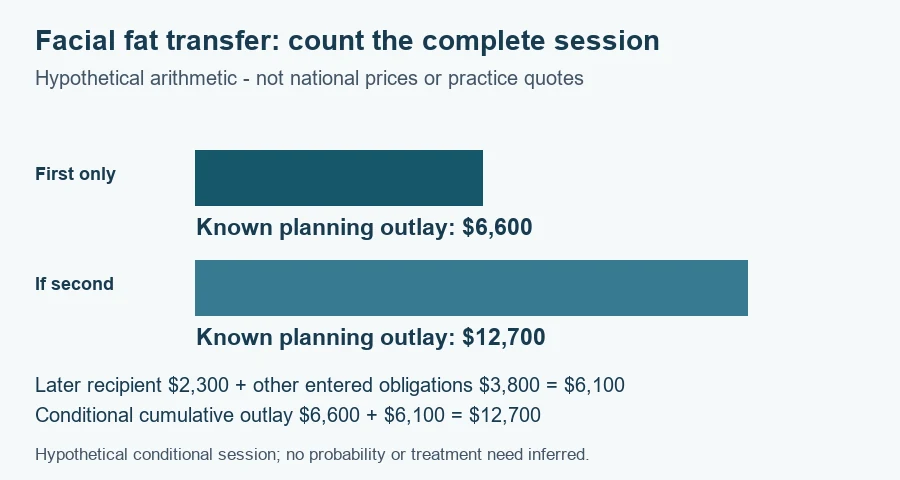
Assume a hypothetical first-session plan with $4,500 professional charges including its assessed donor and recipient tasks, $1,100 facility, $600 anesthesia, $150 specified care and $250 personal logistics. Its known planning total is $6,600. All these numbers are fictional inputs. They do not describe a standard setting, a usual extent of harvesting or an individual medical plan.
Now assume a later independently assessed session is proposed, with $1,800 harvesting-related professional work, $2,300 recipient-related professional work, $1,100 facility, $600 anesthesia, $100 care and $200 logistics. Its complete added obligation is $6,100. A headline naming only the $2,300 recipient component would omit $3,800 of other entered obligations. This does not mean a second session normally costs those amounts or is necessary.
| Hypothetical later-session line | Amount | Financial role |
|---|---|---|
| Harvesting-related professional work | $1,800 | Assessed donor task |
| Recipient-related professional work | $2,300 | Assessed facial task |
| Facility | $1,100 | New setting obligation |
| Anesthesia | $600 | New relevant arrangement |
| Specified care | $100 | Named care scope |
| Personal logistics | $200 | Separate practical outlay |
| Complete added-session obligation | $6,100 | All model lines counted |
If both hypothetical sessions occur under those exact assumptions, cumulative known planning outlay is $6,600 plus $6,100, or $12,700. Reporting $8,900 by adding only $2,300 to the first total would understate cumulative outlay by $3,800. The chart compares one-session outlay with conditional two-session outlay; it does not compare cosmetic effectiveness or imply that the second scenario is a likely patient journey.
The omitted $3,800 is approximately 62.30% of the complete $6,100 increment. That percentage is arithmetic for this model, not a survey of hidden fees. Its value is diagnostic: a recipient-only headline may have a different denominator from a complete-session proposal. Ask the office which lines actually apply and enter the confirmed amounts before using the example to evaluate an actual offer.
How should facial fat transfer cost handle waived components?
Suppose the actual hypothetical agreement expressly waives the $2,300 recipient professional component while every other later-session line remains payable. The complete additional obligation would then be $3,800 and the cumulative total $10,400. The waiver would reduce the model’s additional bill, but it would not make the later session free. The actual agreement must establish the scope and conditions of any waiver.
If harvesting-related professional work were also expressly included without a new charge, the remaining model increment would be $2,000: facility, anesthesia, care and logistics. That is a different inclusion rule. Do not combine a recipient waiver from one offer with a harvesting inclusion from another and present the resulting total as an actual package. Confirm every relevant line under one coherent proposal.
| Hypothetical later-session inclusion | Added obligation | Conditional cumulative outlay |
|---|---|---|
| No waiver of entered lines | $6,100 | $12,700 |
| Recipient component waived only | $3,800 | $10,400 |
| Both professional components expressly included | $2,000 | $8,600 |
| Actual scope or rule unknown | Unresolved | No confirmed cumulative amount |
The table describes alternative contractual assumptions, not services generally owed by a practice. Ask whether a stated touch-up policy has a defined time period, qualifying conditions and related-charge exclusions. This guide makes no conclusion about a particular agreement or legal entitlement. Financial clarity should explain the actual proposal while leaving the need for further treatment to clinical reassessment.
Does a stored-fat promise determine facial fat transfer cost?
Do not assume that a later session can omit donor harvesting merely because a marketing statement mentions stored tissue. Ask the surgeon about the actual proposed clinical process and the relevant evidence, and ask the office what its quote includes. The worksheet supplies no storage technique, licensing conclusion or recommendation to use stored material. Its donor line changes only when the actual assessed task and financial inclusion are confirmed.
A claim that more material will be collected initially also does not establish a financial entitlement to future treatment. Collection, storage, later use and clinical suitability are different questions. Do not translate an initial volume into a prepaid number of sessions or an assurance that no new charges can arise. Obtain a written explanation of any financial arrangement without treating it as a guarantee about tissue performance or future clearance.
The same caution applies to an offer expressed as unlimited regions or a price per milliliter. Ask what professional task and care scope the offer actually describes. A larger amount of injected tissue is not automatically a better result, and dividing price by proposed volume does not assess safety or appropriateness. This guide does not supply an injection amount or justify increasing one to improve an apparent unit price.
How can facial fat transfer cost comparisons preserve clinical differences?
If a proposal combines a facelift with fat grafting, request the description of both tasks and their shared or separately payable components. A combined professional fee may not be separable into reliable standalone prices. Do not subtract an unrelated facelift average and call the remainder the grafting price. Ask what the actual office can identify and retain any inseparable package scope explicitly.
Similarly, a quote for an off-the-shelf filler is not a clinically matched substitute simply because both discussions concern facial volume. Ask the clinician whether the alternatives are suitable and what each is intended to accomplish. If comparing appropriate alternatives financially, use their actual inclusion lists and related amounts. Do not rank them by an assumed lifespan, study-derived retention fraction or a guaranteed future treatment count.
Donor-site and recipient-site care should both remain visible. A low recipient professional component does not establish that donor-related assessment or care has disappeared. Ask which follow-up, medicines or supplies are included in the actual proposal and what would be separately billed. Necessary care should not be omitted to make the financial comparison look favorable. Optional retail products can be recorded separately without confusing them with clinical requirements.
What practical inputs belong beside facial fat transfer cost?
Use your actual transport, scheduling and assistance arrangements, informed by the clinician’s instructions. The worksheet’s $250 and $200 logistics entries are not universal allowances and do not establish a shorter second-session recovery. A later assessment may involve different circumstances and requirements. Record them anew rather than treating the later session as automatically quicker or less disruptive.
Employment effects, if relevant, should have their own verified inputs. A clinic quote does not establish paid-leave eligibility or an income gap. A general statement that a procedure is minor also does not establish clearance for your job. Ask the treating team about relevant duties and obtain the actual employment arrangement before entering its financial effect. This page does not prescribe time away from work.
Payment timing is another separate record. A first-session advance reduces its remaining balance when credited correctly; it does not automatically become a credit toward an independently quoted future session. Ask which bill each payment settles and whether an actual agreement provides a transferable credit. Keep complete cost, prior payments and remaining balances distinct so a credit is neither omitted nor subtracted twice.
How can you audit a facial fat transfer cost claim?
Identify the denominator first. Does the claim name a recipient component, a professional package, a complete session or a conditional series? Then identify whether the source is an actual written quote, a published fee category or a hypothetical calculation. Those evidence types cannot be swapped simply because they contain dollar signs. A good comparison states what each number measures and what it leaves unresolved.
Check outcome wording separately. A source can report follow-up volume for a limited study without proving a permanent individual result. An office can quote a financial inclusion without guaranteeing tissue retention. This guide’s original model links assessed tasks with hypothetical obligations; it makes no inference about clinical quality from price. Claims about expected results require relevant clinical evidence and the treating clinician’s explanation, not a favorable cost-per-volume ratio.
Preserve each dated quote and any later revision. If the clinical task changes, ask for a revised financial scope rather than silently carrying forward the old total. If an inclusion changes, record which line was added, removed or waived. After actual payments, reconcile receipts and confirmed credits against the ledger. That record is more useful than a supposed lifetime saving derived from an unrelated study average.
Facial fat transfer cost questions before committing
Is a touch-up recipient fee the entire added-session price? Only if the actual written proposal confirms that all other relevant obligations are included or absent. The original model shows how a $2,300 recipient component can coexist with a $6,100 complete increment. The example is a question-generating tool, not evidence of your practice’s charges.
Can a retention study tell me how many sessions to budget? A limited group’s measurements cannot establish your future treatment need or prices. Discuss expectations and reassessment with the clinician, and obtain a separate estimate if another task is actually proposed. Keep conditional arithmetic conditional rather than turning it into a personal probability or an inevitable treatment schedule.
For clinical context, see the facial fat transfer guide. For the financial decision, record each assessed donor and recipient task, related charges, exact inclusions, actual credits and unresolved future scope. That makes facial fat transfer cost understandable without borrowing a filler average, promising permanent volume or treating a partial touch-up headline as a complete lifetime bill.
Sources and review scope
Plastic Surgery Editorial Team. Source records checked through October 12, 2026. Review scope: source and editorial checks for general education. No individual clinical assessment is represented.
- ASPS filler fee-category boundary. American Society of Plastic Surgeons. Publication/update date not stated. Checked 2026-10-12.
- ASPS donor and facial grafting task. American Society of Plastic Surgeons. Publication/update date not stated. Checked 2026-10-12.
- Original limited three-dimensional facial graft follow-up study. Journal of Plastic, Reconstructive & Aesthetic Surgery / PubMed. Source date: 2015-10-09. Checked 2026-10-12.