
Facelift cost needs two separate answers: the complete amount for the proposed operation and the amounts due at each payment date. A smaller remaining balance does not mean a lower total if more money has already been paid. The ASPS cost page displays an $11,395 partial average, checked October 12, 2026, excluding anesthesia, facilities and related expenses. Your own quote must define the surgical scope, all billers and deposit credits before that figure can provide useful context.
This guide gives an original hypothetical payment-timing worksheet for comparing two schedules with the same total. It is not a national price survey or a recommendation to pay a larger deposit. Clinical scope, medical suitability and the care plan require individual consultation. The example dollar amounts and due-date categories are accounting assumptions only; they do not prescribe an operation, recovery timetable, borrowing arrangement or payment policy for any real practice.
What does the published facelift cost average establish?
The ASPS facelift cost page displays $11,395 while excluding anesthesia, operating facilities and related expenses. It notes variation with clinician experience, procedure and location. The page does not state the underlying fee year. That makes its number limited fee context, not a complete national price or a dated fee-year benchmark for the specific operation you are considering.
Do not add invented facility and anesthesia averages to this figure and label the result an all-in price. Ask the office for the actual amounts and billing entities. A package may include some of those charges, while another proposal may leave them outside. Comparing a partial professional amount with a complete quotation would confuse an inclusion difference with a rate difference before examining the actual operative plan.
Keep the retrieval date distinct from the observation period. This guide checked the source on October 12, 2026; it does not establish that the fee data were collected in 2026. Likewise, a procedure-volume report does not date a separate cost endpoint unless the connection is explicitly documented. Record unknown source years as unknown rather than giving an undated average an unsupported appearance of precision.
Which operation belongs in a facelift cost quotation?
The ASPS procedure description distinguishes traditional and limited-incision approaches and discusses related facial or neck procedures. It indicates that more limited approaches may have more limited results. Those distinctions show why different package names do not establish equivalent scope. The educational description does not identify the appropriate approach for an individual reader or justify paying for an additional operation.
Ask the clinician to name the proposed work and explain which concerns it is intended to address. Record whether neck work, fat transfer, eyelid surgery, resurfacing or another separately discussed service is included. If a technique label appears in an advertisement, ask what it means in that clinician’s actual proposal. A named technique is not a universal billing unit or evidence that every other quote offers the same operation.
For the financial comparison, preserve a base proposal and any independently assessed additional scope. Do not treat an attractive combined amount as proof that the extra service is needed. If the plans differ, keep that difference beside the amounts rather than normalizing it away. A price worksheet can identify an exclusion or duplicate charge; it cannot choose a surgical approach or establish equal clinical outcomes.
| Facelift cost scope question | Obtain in writing | Why it changes the calculation |
|---|---|---|
| What operation is actually proposed? | Named clinician-confirmed scope | Technique or package names may represent different work |
| Which additional services are included? | Separately discussed service list | Combined price is not automatically the base price |
| Who bills for anesthesia and the facility? | Entity, amount and inclusion terms | A professional quote may leave major charges unresolved |
| Which payments are credited? | Deposit and consultation credit rules | Remaining balance is not the complete purchase amount |
Why are facelift cost and remaining balance different numbers?
The complete amount describes what the defined purchase costs. The remaining balance describes what is still unpaid at a particular moment. A credited deposit lowers the remaining balance without reducing the total. If an office displays a lower preoperative payment because it collected more earlier, that is a change in timing, not necessarily a discount. Reconcile both numbers before comparing offers or planning how much cash needs to be available.
Use a row for each biller and a separate column for payments already credited. Include a consultation fee only once. If it is credited toward the professional amount, it belongs inside that amount rather than on top. If it is noncredited, it is a separate expense. The same distinction applies to booking charges, facility deposits and other advance payments. Ask for the actual rule instead of assuming every upfront payment receives credit.
A payment schedule can be clear even when the complete price is fixed. The office should identify each due date and what happens if the operation is rescheduled or the plan changes. These terms do not establish clinical clearance. Paying a deposit cannot make a provisional medical plan final, and a smaller later balance should not conceal a larger earlier commitment or an unresolved refund condition.
Original facelift cost worksheet: equal totals, different timing
All amounts in this example are hypothetical US-dollar inputs, not current practice rates. Imagine a complete clinical amount of $18,000 for the same confirmed operative scope: $12,500 professional service, $3,000 facility and $2,500 anesthesia. We separately assign $100 for testing, $400 for specified supplies and medication planning, and $1,000 for practical support. The known planning amount is $19,500 in both schedules.
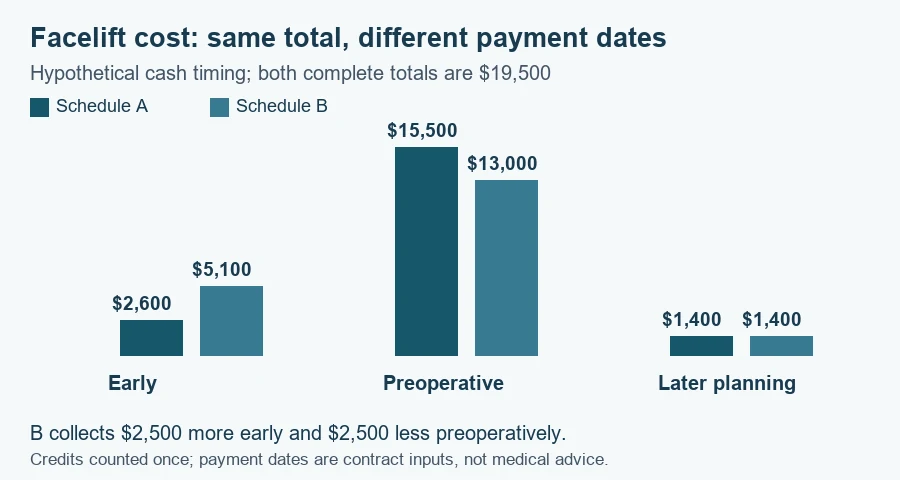
Schedule A credits a $200 consultation and a $1,800 professional deposit against the $12,500 professional amount. It also credits a $500 facility deposit. With the separate $100 testing input paid early, the early cash amount is $2,600. The remaining professional amount is $10,500, facility balance is $2,500 and anesthesia amount is $2,500. Together they produce a $15,500 preoperative payment under the hypothetical terms.
Schedule B instead credits the same $200 consultation and a $4,300 professional deposit, with the same $500 facility deposit and $100 early testing input. Its early amount is $5,100. The remaining professional amount becomes $8,000, while facility and anesthesia balances remain $2,500 each. The preoperative amount is therefore $13,000. Both schedules also include the same $1,400 of later practical planning inputs, without assigning a medical recovery date.
| Hypothetical facelift cost payment phase | Schedule A | Schedule B |
|---|---|---|
| Early credited payments plus separate testing | $200 + $1,800 + $500 + $100 = $2,600 | $200 + $4,300 + $500 + $100 = $5,100 |
| Remaining preoperative clinical payment | $10,500 + $2,500 + $2,500 = $15,500 | $8,000 + $2,500 + $2,500 = $13,000 |
| Later supplies, medication and support planning | $400 + $1,000 = $1,400 | $400 + $1,000 = $1,400 |
| Known planning amount across all phases | $19,500 | $19,500 |
The supporting graphic shows the three phases for each schedule. B reduces the example’s preoperative payment by $2,500 because it collects exactly $2,500 more early. The total does not change. The formula is complete planning amount = early payments plus remaining preoperative payments plus later external planning amounts. This reconciliation prevents describing B’s $13,000 balance as a cheaper facelift than A’s $15,500 balance.
Neither schedule is endorsed. A larger early deposit could have different cancellation consequences or simply be unacceptable for your circumstances. Those consequences are not priced into the example. Use the actual credit and refund terms before assessing either schedule. A clear cash-flow difference can be valuable information while still being different from a lower complete price or a clinically better proposal.
How do you reconcile multiple facelift cost billers?
Start with the complete charge for each entity, then subtract only its confirmed credits. If a professional deposit is held by the practice, do not automatically subtract it from the facility’s balance. Ask whether the practice collects on behalf of another entity and how the payment is allocated. An agreement to transfer a payment needs to be documented before your worksheet treats that transfer as completed.
In the example, the facility’s $500 credit applies to its $3,000 amount, leaving $2,500. The professional credits are $2,000 in A and $4,500 in B, leaving $10,500 and $8,000 respectively. Anesthesia has no early credit under these assumptions. Keeping each biller separate is what makes the complete $18,000 clinical amount reconcile correctly with both payment schedules.
If the actual quotation uses a single practice invoice, ask whether that invoice fixes outside charges or merely estimates them. A combined invoice can simplify payment without guaranteeing that every charge is fixed. Mark time-based allowances, outside estimates and conditions separately. The purpose is to know which amount the agreement actually establishes, not to create a complete-looking sum by assuming an outside bill cannot change.
What happens to the facelift cost plan if the operation changes?
The ASPS consultation guidance describes assessment of health, goals, options, risks and anesthesia before recommending treatment. A financial proposal made before that assessment may remain provisional. If the clinician changes the operative scope, obtain the revised complete amount and a revised payment allocation. Do not retain the old smaller operation’s price beside the new larger operation’s plan.
Ask how existing credits are handled. A transfer may reduce the revised balance without changing the revised total. A new noncredited administrative fee would be a separate expense. A refund, if provided under the actual terms, belongs in the payment record rather than being assumed from a clinical decision to pause. Save both versions so the change can be understood without overwriting the original transaction evidence.
If another service is added, require a separate clinical discussion and a clear incremental amount. Shared anesthesia or facility time should be reflected in the actual quote, not subtracted from two national averages. The larger plan may change follow-up, transport and practical support too. Update those personal planning inputs only after the relevant arrangement is confirmed; an added operation should not silently inherit the smaller plan’s assumptions.
Which follow-up terms affect facelift cost after the initial bill?
Ask what scheduled reviews are included and how concerns are assessed. Request a written distinction between routine follow-up, another evaluation and any possible subsequent operation. An aftercare inclusion may cover visits without covering all tests, prescriptions or outside treatment. A professional-fee waiver in a revision policy may still leave facility or anesthesia charges payable. The worksheet should preserve those boundaries rather than interpreting a broad promise as unlimited free care.
Do not assign a precise expected revision expense without appropriate evidence and an individual plan. The price example does not contain a verified complication probability or a guarantee of satisfaction. A personal contingency can be kept in a separate column if you choose, but it is not part of the known quoted amount and should not be presented as an expected medical bill.
A developing concern deserves appropriate clinical attention. Financial questions about which entity bills for care should be clarified in advance where possible, but an unresolved charge is not a reason to delay assessment. Ask the team for the relevant contact pathway and care arrangement. A convenient payment schedule cannot substitute for a clear follow-up plan or determine whether a review can safely be remote.
How do you compare financing with the facelift cost worksheet?
Keep the treatment price separate from any borrowing contract. The financed balance should reconcile with credited payments and outside amounts that are not financed. If a deposit was already paid and credited, it must not be included again as a new charge. Obtain the actual repayment schedule and stated fees from the lender rather than converting a monthly promotional amount into an assumed complete treatment cost.
This guide does not recommend a loan or calculate an unverified financing offer. Its payment-timing example contains no interest, lender fees or borrowing assumptions. If those apply to your actual transaction, add them in a separate financing comparison using the contract’s amounts and dates. A smaller monthly payment can reflect a different term rather than a cheaper operation, just as the smaller preoperative balance in B reflects more money paid early.
How do you test a facelift cost payment schedule without changing the total?
Make one copy of the worksheet for each actual proposal and keep the complete amount at the top. Allocate every included charge to a payment phase once, then sum the phases. If their sum differs from the complete amount plus documented external inputs, find the discrepancy before treating the schedule as final. Common explanations include a deposit counted twice, a credited consultation added again or an outside amount that was omitted from the complete-price column.
Next distinguish payments already made from amounts merely scheduled. A promised future deposit is not yet a credit on an invoice. If it has been paid, save the receipt and reconcile the entity and purpose against the quote. If it has not, retain it as a future obligation. This simple distinction prevents a planned payment from reducing a current balance prematurely and makes the amount still required on each date understandable.
Finally, check the same schedule after any quote revision. A changed complete amount can alter the final balance even if all earlier payments transfer. Do not assume that the remaining amount stays fixed because the deposit does. Recalculate the relevant biller first, then the combined payment phase. The original worksheet is a transparent reconciliation method, not an assurance that a provisional balance will survive a changed clinical or contractual plan.
What if the office calls a payment a refundable reservation?
Record exactly what the written policy says the payment reserves and under which conditions it is returned or credited. A refundable reservation, a credited deposit and a noncredited administrative fee can have different functions. Their names are not interchangeable. Ask whether the payment reduces the eventual professional amount, belongs to another entity or remains separate if the operation proceeds.
If a refund is conditional, keep the condition next to the amount rather than assuming it is cash available for another purchase. For example, a deadline-dependent refund is not equivalent to an unconditional credit in the phase worksheet. This guide assigns no probability to cancellation and does not value those contractual differences numerically. It makes them visible so the complete price and payment-timing comparison are not mistaken for a complete assessment of the transaction.
A facelift cost reconciliation checklist before paying
| Final check | Record to retain | Avoid this mistake |
|---|---|---|
| Same operative scope | Dated clinician-confirmed plan | Treating unlike technique packages as equivalent |
| Complete and remaining amounts | Entity-specific charges and credits | Calling a smaller unpaid balance a lower total |
| Change and cancellation terms | Applicable written payment policies | Assuming a medical change automatically refunds every payment |
| Included follow-up | Actual care and separate-charge boundaries | Treating payment convenience as a care guarantee |
The useful facelift cost answer is a complete proposal plus a reconciled payment schedule. The partial ASPS average supplies limited context, while the original phase worksheet reveals what must be paid and when under stated terms. Use the facelift guide for procedure context and the neck lift cost guide if the proposed scope or follow-up location requires a separate comparison.
Sources and review scope
Plastic Surgery Editorial Team. Source records checked through October 12, 2026. Review scope: source and editorial checks for general education. No individual clinical assessment is represented.
- ASPS facelift partial average and excluded expenses. American Society of Plastic Surgeons. Publication/update date not stated. Checked 2026-10-12.
- ASPS facelift approaches and related service scope. American Society of Plastic Surgeons. Publication/update date not stated. Checked 2026-10-12.
- ASPS individual facelift consultation. American Society of Plastic Surgeons. Publication/update date not stated. Checked 2026-10-12.