
DIEP flap reconstruction cost needs a clearly named denominator. A hospital’s submitted charge, its estimated resource cost, an insurer’s allowed amount and your own responsibility describe different things. A historical research figure cannot replace an estimate for your assessed reconstruction. Obtain a written scope and separate responses from the organizations involved, then reconcile those responses with the actual benefit terms. This guide explains an older inpatient study and provides an original hypothetical worksheet for translating a processed claim into a remaining personal balance.
No current national complete price is established here. The research figures below concern historical hospital accounting; the worksheet uses invented dollar amounts to demonstrate bookkeeping. Neither supplies an individual quotation, predicts coverage or establishes which reconstruction is suitable. Keep cancer care and reconstructive planning with the treating team. Resolve financial questions around that plan rather than changing medically indicated care to fit a number found online.
What does DIEP flap reconstruction cost measure?
Start by writing the name of the measure beside every number you collect. A charge is an amount submitted on a bill. An allowed amount is the basis a plan applies to a particular covered claim under its actual terms. An insurer payment and a patient responsibility then explain how that claim is allocated. A resource-cost estimate used in hospital research has another purpose altogether: it describes estimated resources consumed, not necessarily what a patient or insurer paid.
These labels matter because plausible numbers can answer different questions. A large charge displayed in an old study may look like a proposed price, while a smaller resource estimate may look like a discount that someone can request. Neither interpretation follows from the research. Ask whether a number is a published accounting measure, a cash agreement, a pre-service estimate or a processed claim. Keep its date, population, setting and unit together with the figure.
The relevant unit may also change. A figure per flap is not automatically a figure per person, per admission or per complete reconstruction course. Do not multiply a study mean by an assumed number of breasts and call the result your total. Establish what the actual proposal includes, how it will be billed and which later work is already planned. Where that information is not available, the worksheet should contain an unresolved field rather than an invented answer.
Why the assessed DIEP scope comes before a quote
The American Society of Plastic Surgeons describes DIEP reconstruction as transfer of lower-abdominal skin and fat with preservation of abdominal muscle and microsurgical reconnection of blood vessels. Its techniques guidance also describes hospital monitoring of blood flow after microsurgical transfer. This establishes a procedure-specific reason to ask about the reconstructive operation and its hospital component. It does not establish your admission length, technical eligibility or required treatment sequence.
For your DIEP flap reconstruction cost estimate, request a plain-language description of the proposed work. Record the reconstruction site or sites, the donor-site work, whether another operation is being coordinated and which billing organizations participate. A quotation described only as reconstruction can hide uncertainty about what was actually estimated. Ask the treating team to explain the clinical scope before asking the financial office to attach prices to it.
Do not treat donor-site care as a free cosmetic add-on or assume another abdominal operation is interchangeable. The proposal concerns tissue used for reconstruction and the associated assessed care. If you also ask about unrelated cosmetic work, keep that request separate so its clinical suitability and financial treatment can be discussed independently. The distinction helps prevent a mixed quote from being represented as the cost of DIEP reconstruction alone.
Dated DIEP flap reconstruction cost evidence: two denominators
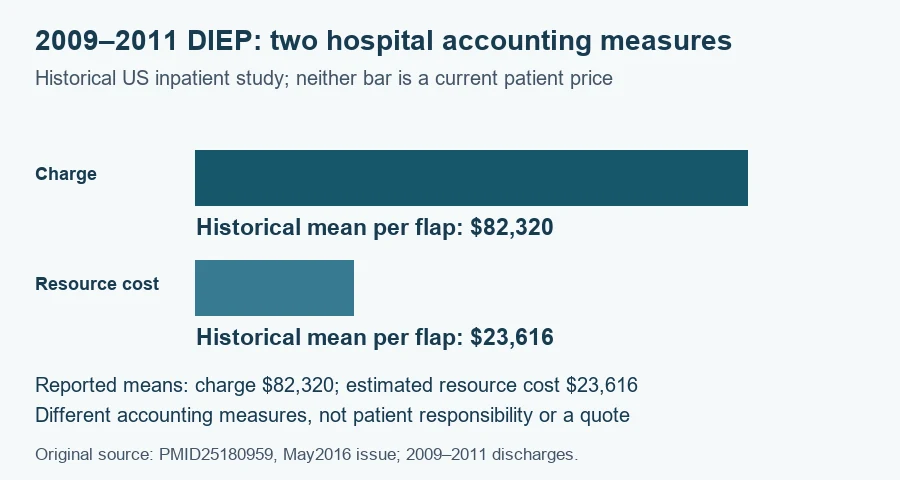
An original study published in the May 2016 issue of Annals of Plastic Surgery examined 19,182 hospital discharges across four autologous flap types using 2009–2011 US inpatient data. Its abstract reported a DIEP mean charge of $82,320 per flap and mean estimated resource cost of $23,616 per flap. The overall discharge count covers the study’s flap groups; it is not a DIEP-only denominator. These are historical accounting measures, not current patient prices.
The original graphic keeps those two measures separate. The difference between them does not establish an insurer discount, a patient’s saving or a negotiated cash rate. The analysis does not supply your allowed amount or reconstructive course. Its practical lesson is to identify what a cost figure measures before using it in a decision. Neither bar should be imported into the personal worksheet as an observed contemporary quote.
| Historical evidence field | What the original abstract reports | Boundary for a price decision |
|---|---|---|
| Data period and setting | US inpatient discharges, 2009–2011 | Not today’s outpatient or complete-course quotation |
| Overall study population | 19,182 discharges across four flap types | Not a DIEP-only patient count |
| DIEP mean charge per flap | $82,320 | Submitted-charge measure, not patient responsibility |
| DIEP mean estimated resource cost per flap | $23,616 | Hospital resource measure, not an allowed amount |
| Publication | May 2016 issue | Does not make the underlying observations current |
Which DIEP flap reconstruction cost records should you request?
ASPS lists professional, hospital or facility, anesthesia, medication, garments and testing or imaging among reconstruction cost categories. That scope list identifies possible bill components, not a current national DIEP fee or a rule that everything must be charged separately. Ask each office what its own estimate covers and which organizations supply other estimates. Do not add a bundled service twice simply because it also appears in a general checklist.
Collect records by billing entity and stage. The hospital’s response may describe a different portion of care from the reconstructive surgeon’s response. A combined-looking summary may still exclude another professional claim. Ask what the estimate assumes about the assessed admission and what could change it. If an amount is contingent on authorization or a coding decision, preserve that condition alongside the number instead of removing it to make a neat total.
Keep proposed later work distinguishable from possible contingencies. An adjustment discussed as a future option is not automatically scheduled or necessary. Conversely, a known planned stage should not disappear because the initial operation has the largest quote. Write the uncertainty directly: proposed and estimated, possible but not estimated, or outside this reconstruction scope. This gives the reader a usable account without pretending that an unfinished plan is complete.
Original DIEP flap reconstruction cost worksheet: reconcile one claim
Consider an invented example in which the submitted charge for a specified covered clinical scope is $50,000. The hypothetical processed explanation of benefits shows an allowed amount of $30,000, insurer payment of $24,000 and patient responsibility of $6,000. We assume there is no additional payable charge outside that responsibility for this specified scope. The model does not tell you how an actual plan processes a claim or whether this assumed arrangement applies to you.
The allocation reconciles because $24,000 plus $6,000 equals $30,000. The $20,000 difference between the submitted and allowed figures is not inserted into the patient’s balance under the stated assumption. It is also not described as a saving the patient negotiated. Those distinctions prevent a charge, an adjustment and a responsibility from being added together as though they were three separate purchases.
Suppose the patient has already paid $2,000 that is confirmed as credited toward the same $6,000 responsibility. The remaining clinical balance is $4,000. Add a separate invented $1,200 for practical travel and assistance that is not part of the modeled claim. Future personal outlay is therefore $5,200. The complete modeled personal outlay remains $7,200: $2,000 paid earlier plus $4,000 clinical balance plus $1,200 practical expenses.
| Original hypothetical reconciliation | Amount | Treatment in the worksheet |
|---|---|---|
| Submitted charge | $50,000 | Recorded for comparison with the claim, not added to patient responsibility |
| Allowed amount | $30,000 | Equals the assumed insurer and patient allocations |
| Insurer payment | $24,000 | Part of the allowed amount, not personal outlay |
| Patient responsibility | $6,000 | Clinical personal amount under these explicit assumptions |
| Confirmed prior payment | $2,000 | Credited once against that responsibility |
| Remaining clinical balance | $4,000 | $6,000 minus the confirmed $2,000 credit |
| Separate practical expenses | $1,200 | Outside the modeled clinical claim |
| Future personal outlay | $5,200 | $4,000 clinical balance plus $1,200 practical expenses |
| Complete personal outlay | $7,200 | $2,000 paid plus $5,200 still to fund |
Why a deposit can distort DIEP flap reconstruction cost comparisons
A deposit is a payment event, not necessarily another expense. In the example, adding the $2,000 deposit to the full $6,000 responsibility and then adding practical expenses would produce $9,200. That would count the same credited payment twice. The correct whole-course amount is $7,200 under the model’s assumptions. Keep complete cost and remaining cash needs on separate lines so an earlier payment does not inflate one or disappear from the other.
Before applying a real credit, confirm where it sits. A receipt from one organization does not automatically prove a credit against another organization’s bill. Ask for a dated account statement identifying the payment, the account and its disposition. If the payment is refundable, transferred or awaiting reconciliation, record the status without assuming a final outcome. A worksheet becomes more useful when unresolved items remain visible rather than being silently converted into credits.
Do not substitute a pre-service collection request for final responsibility. An office may collect an estimate that later needs reconciliation after processing. Ask how differences are handled and where written account information can be obtained. Keep the original collection request, the payment receipt and the later explanation of benefits together. Their different dates and purposes help explain why a balance changed without assuming an error or promising a refund. For separating reconstruction-benefit questions from a personal coverage decision, see breast reconstruction insurance coverage.
What changes if another DIEP claim is added?
An estimate can become incomplete when the assessed course changes or an omitted billing entity supplies another claim. For a separate sensitivity example, assume another covered service has an allowed amount of $6,000 and assigned patient responsibility of $1,200. Also assume another $900 in practical expenses. These are invented additions, not a prescribed stage, a typical fee or a forecast that more surgery will be needed.
The expanded whole-course personal amount is $7,200 plus $1,200 plus $900, or $9,300. If the same $2,000 payment remains the only confirmed prior payment, future outlay is $7,300. The arithmetic changes because documented scope changed; it does not change because the old hospital study was multiplied by a new number of procedures. Keep the original estimate and the added scope dated so the reason for the difference is clear.
This sensitivity shows why DIEP flap reconstruction cost cannot be summarized by one unqualified figure. A source may measure a flap, while your account may describe several organizations or stages. Ask which description a total follows. If an additional service is still being considered, show it as an optional scenario with its own assumptions, rather than blending it into the confirmed plan and announcing a larger inevitable bill.
A practical DIEP flap reconstruction cost comparison table
Compare proposals only after the treating team has assessed their clinical suitability and described the work. Do not use a financial table to rank techniques for someone whose needs are unknown. The table’s purpose is to reveal missing information, different billing units and unsettled claim assumptions. A lower displayed figure may simply cover a smaller scope or omit another organization’s claim, so the task is first to establish what is being compared.
| Comparison field | Record from the actual proposal | Keep unresolved when |
|---|---|---|
| Clinical unit | Assessed site or sites and proposed reconstructive work | The label does not identify the scope |
| Billing entities | Each professional and facility organization included | Another participating organization’s estimate is missing |
| Financial measure | Cash agreement, estimated claim or processed responsibility | The number is an unspecified charge or research estimate |
| Payment credits | Account-specific confirmed payment and credit | A receipt has not been matched to the relevant balance |
| Known later work | Separate estimate for a proposed additional stage | Timing or scope remains under discussion |
| Practical budget | Actual travel and assistance arrangements | An assumed allowance has no supporting arrangement |
Preserve the answers in their original form. A copied number without its qualifying text can become misleading when it is shared with a family member or used to plan funds. Include the date, who supplied it, what was included and what remained subject to change. When offices give different answers, ask them to clarify the discrepancy using the same proposed scope rather than averaging incompatible numbers.
Questions about DIEP flap reconstruction cost to resolve before payment
Ask whether the estimate covers the proposed reconstruction and donor-site work, which organizations will bill separately, and what the hospital amount assumes. Ask the benefits administrator what financial measure its estimate uses and what remains contingent on processing. These questions seek records rather than guarantees. Keep any authorization question separate from the final account calculation so approval for a described service is not mistaken for a promise of zero personal liability.
Also ask how payments are recorded, which account receives a deposit and what written reconciliation will follow. If the assessed plan changes, request an updated scope and estimate rather than editing an old total yourself. Record the practical arrangements separately, including whether they are confirmed or merely provisional. Someone helping with your budget should be able to distinguish a payable amount from a contingency without having to guess what each row means.
The useful outcome is a traceable personal worksheet, not an internet bargain benchmark. Each figure should have a named measure, a source document and an explicit scope. Historical evidence can explain why the language of cost requires care; your actual proposal and account records determine what needs funding. For broader benefit-period calculations, use the separate breast reconstruction cost guide after the appropriate claim terms have been established.
Comparing DIEP flap reconstruction cost: cash and insured estimates
A cash agreement and an insured estimate may both be expressed in dollars while describing different obligations. For a DIEP flap reconstruction cost comparison, record the actual contractual scope of each before putting their totals side by side. Identify whether the cash agreement includes the same professionals, hospital services and assessed subsequent work. Identify whether the insured estimate concerns one claim or the complete proposed course. The difference between two displayed numbers cannot explain missing scope by itself.
Do not calculate a supposed cash advantage by subtracting an insurer payment from a submitted charge. In the hypothetical worksheet, the insurer’s $24,000 payment is an allocation within the $30,000 allowed amount. It is not the price of a separate service that disappears when a patient pays cash. A real cash comparison needs its own actual agreement and an independently documented personal insured amount for equivalent assessed care. Neither is established by the historical study’s accounting measures.
Similarly, a quotation for initial care should not be described as a complete lifetime expense. Your team may distinguish planned work from possibilities that cannot be predicted. Record what the agreement promises about included follow-up and what remains outside it, without assuming an open-ended entitlement or an inevitable future operation. Questions about unexpected care belong with the actual offices and plan; a simplified worksheet cannot establish the terms in advance.
Keep the purpose of the comparison visible. You are organizing documents for an assessed clinical decision, not choosing necessary care by the lowest unqualified number. A useful DIEP flap reconstruction cost worksheet shows matched scope, remaining uncertainties, complete personal outlay and future cash needs separately. If one proposal cannot yet answer those questions, preserve that gap and seek clarification rather than assigning a zero that makes it appear cheaper.
Sources and evidence boundaries
Sources were checked October 12, 2026. The ASPS educational endpoints did not supply an underlying fee year or a complete national DIEP price. The original study concerns 2009–2011 inpatient accounting and appeared in the May 2016 issue. All personal worksheet amounts are invented arithmetic inputs. No clinician or human review is represented.
ASPS abdominal flap and monitoring scope
ASPS reconstruction bill categories
Original 2009–2011 inpatient charge and resource-cost study
Sources and review scope
Plastic Surgery Editorial Team. Source records checked through October 12, 2026. Review scope: source and editorial checks for general education. No individual clinical assessment is represented.
- ASPS abdominal flap and monitoring scope. American Society of Plastic Surgeons. Publication/update date not stated. Checked 2026-10-12.
- ASPS reconstruction bill categories. American Society of Plastic Surgeons. Publication/update date not stated. Checked 2026-10-12.
- Original 2009–2011 inpatient charge and resource-cost study. Annals of Plastic Surgery / PubMed. Source date: 2016-05. Checked 2026-10-12.