
DIEP flap reconstruction uses skin, fat and associated blood vessels from the lower abdomen to rebuild a breast after mastectomy while leaving the abdominal muscle in place. It is a free-flap operation: the transferred tissue needs its blood vessels connected to vessels at the chest. It therefore involves both a reconstructed breast and an abdominal donor site, with different goals, risks and recovery questions.
Muscle-sparing does not mean that the abdomen has no operation or no possible complication. The National Cancer Institute defines DIEP as a muscle-preserving abdominal flap, and ASPS describes the microsurgical transfer and postoperative blood-flow monitoring. The useful decision is whether this particular donor source, reconstructive plan and recovery burden fit your clinical situation and preferences. NCI: DIEP flap definition ASPS: abdominal flap techniques
This guide concentrates on the DIEP-specific discussion rather than treating every type of reconstruction as interchangeable. It explains how to ask about the abdomen, interpret donor-site evidence and organize a plan that accounts for cancer treatment, practical support and later assessment. Choosing reconstruction, delaying it or choosing another approach remains an individual decision with the clinical team.
Understand the tissue and blood supply without choosing an operation yourself
The flap is living tissue, not an implant or a bag filled with fat. The word “perforator” refers to the blood vessels supplying the skin and fat through the abdominal tissues. The microsurgical connection at the chest is central to the operation. A breast-shape illustration that shows only tissue moving upward leaves out the reason monitoring and specialist expertise matter.
Ask the surgeon to explain the proposed donor source and the blood-supply assessment in plain language. What is known about your abdominal tissue and previous scars? Is further assessment needed? What alternative would be discussed if the planned flap is not suitable? You do not need to interpret a vessel image yourself, but you should understand why the proposal is appropriate and what remains to be confirmed.
Do not assume that having removable abdominal skin establishes candidacy. Tissue availability is one consideration within a broader assessment. The amount needed depends on the reconstructive goal and whether one or both breasts are being addressed. A photograph of someone else’s abdomen cannot establish that your own donor tissue can supply the same volume or support the same plan.
Assess the abdomen as a donor site and a functioning part of your body
Tell the clinician about abdominal operations, scars, hernias or previous tissue procedures. Bring available records rather than assuming every old incision is either irrelevant or automatically disqualifying. NCI identifies prior surgery, health and available tissue among factors affecting reconstruction choice. NCI: factors affecting reconstruction choice
Describe what you need your abdomen to do in everyday life. Your priorities may include lifting at work, caring for children, transferring out of bed comfortably or returning to a particular activity. These descriptions make the function discussion more useful than a general question about whether the operation is “easy to recover from.” The clinical team can address restrictions and rehabilitation in relation to actual tasks.
Ask how the abdomen will be closed, what scars are expected and how postoperative abdominal concerns will be assessed. Keep contour and function as separate questions. A flatter-looking donor area does not prove unchanged strength, and a well-healed scar does not independently measure comfort or physical well-being. Both appearance and function belong in follow-up if they matter to you.
If the proposal is described as providing a “tummy tuck benefit,” ask exactly what that means. A reconstructive donor-site closure should not be treated as an interchangeable cosmetic abdominoplasty package. Clarify which contour changes are expected, what is not included and what recovery requirements follow from the actual reconstructive operation. An incidental aesthetic change should not obscure the main purpose or the abdominal risks.
| Site and goal | Question for the clinical team | Keep this distinction visible |
|---|---|---|
| Breast shape | What mound size and shape are realistic with this tissue? | Rebuilding shape versus reproducing the original breast |
| Flap blood supply | How will the tissue be monitored after transfer? | Microsurgical viability versus later appearance |
| Abdominal function | How do my work and daily tasks affect planning? | Preserved muscle versus a promise of no functional burden |
| Abdominal contour | What closure and scars are expected? | Donor closure versus a complete cosmetic tummy tuck |
| Previous surgery | Which records or additional assessment are needed? | An old scar versus a confirmed suitability decision |
| One or two breasts | How does the proposed allocation of tissue change? | Bilateral reconstruction versus repeating a unilateral plan |
Compare alternatives by the tradeoffs relevant to you
DIEP is one abdominal reconstruction option. TRAM flaps include muscle, while SIEA flaps use a different blood supply. Implant reconstruction and tissue from other donor sites offer different choices for suitable patients. The names describe anatomical and technical differences; they are not a universal ranking of what every person should select.
Ask why DIEP is being proposed in preference to the alternatives available in your situation. The answer should connect your health, cancer-treatment plan, donor assessment and priorities to the choice. If another approach is recommended, ask which specific consideration changes the balance. A useful explanation is more precise than describing one method as “natural” and every other option as inferior.
Do not measure the entire choice by a single complication category. An option might preserve more abdominal tissue while introducing a different donor-site concern or recovery burden. Ask about both the likelihood and the consequences of the particular problems under discussion. Also ask how the team handles a change in plan if the first choice cannot be completed as intended.
Consider the option of not rebuilding a breast mound as part of an informed discussion rather than as an assumed failure to choose. NCI explains that some people prefer flat closure. If you are uncertain, ask what can be decided now and what may remain possible later. The purpose is to make the reconstructive choice consistent with your preferences, not to impose a breast shape as the only acceptable outcome.
Coordinate timing with the breast cancer treatment plan
Ask the reconstructive and cancer-treatment teams to explain timing together. Immediate reconstruction begins with the mastectomy, while delayed reconstruction occurs later. Radiation and other treatment considerations can influence the plan. The timing should be described in relation to your actual care rather than inferred from the schedule in a patient story.
Make a shared list of what is confirmed and what is still pending. For example, you may know the intended mastectomy but still need decisions that affect later treatment. Ask how those uncertainties influence the proposed reconstruction and which changes would prompt reassessment. A drawing of an eventual breast shape is not a reason to disregard an evolving treatment plan.
Discuss who communicates changes between teams. You should not have to act as the sole messenger for a clinically important timing decision. Obtain the responsible contact and the next decision point. If travel or work arrangements depend on the date, clarify which elements are provisional before making commitments that are difficult to change.
What the prospective donor-site study measured
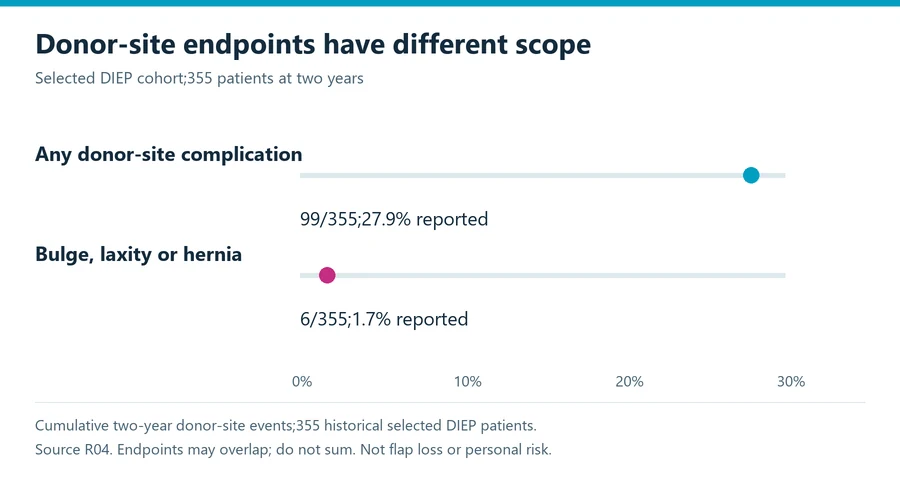
An original multicenter MROC study published in February 2018 compared abdominal flap outcomes. It had 720 participants with one-year follow-up and 587 with two-year follow-up. The two-year DIEP subgroup contained 355 patients. Its cumulative donor-site results included 99 of 355 with any donor-site complication, reported as 27.9%, and six of 355 with abdominal bulge, laxity or hernia, reported as 1.7%. Original MROC study: methods and two-year table
These are different endpoints in the same subgroup. The smaller figure cannot be labeled the total abdominal complication rate, and the larger figure cannot be labeled the chance of losing the breast flap. The study separately recorded donor-site problems, breast problems and patient-reported measures. Using the correct label matters at least as much as repeating the percentage accurately.
A narrow endpoint is not the whole donor-site story
“Any donor-site complication” includes a broader collection of recorded problems than the bulge, laxity or hernia category. The categories should not be added as if they were separate groups of people: one patient may contribute to more than one recorded concern. Nor should the two figures be plotted as a before-and-after improvement, because they concern different definitions at the same timepoint.
This guide’s supporting chart shows those two DIEP-specific endpoints with the same denominator and two-year context. It is an explanation of endpoint scope, not a forecast of your personal risk or a ranking of surgeons. The patient groups were not randomly assigned to flap types, and the care represents a historical multicenter cohort rather than every current practice.
The investigators also measured abdominal physical well-being using patient-reported surveys. That is distinct from whether an event appeared in the complication record. A person may want information about comfort and everyday function even if no narrowly defined complication was recorded. Conversely, a recorded wound concern does not by itself describe the person’s eventual view of the entire reconstruction.
| Evidence item | Verified result or definition | Avoid this interpretation |
|---|---|---|
| Two-year DIEP subgroup | 355 patients | Every enrolled reconstruction patient had a DIEP flap |
| Any donor-site complication | 99/355, reported 27.9% | This is the flap-loss rate |
| Bulge, laxity or hernia | 6/355, reported 1.7% | This is the total donor-site problem rate |
| Relationship between categories | Broader and narrower recorded endpoints | Add percentages as independent patients |
| Study design | Prospective multicenter observational cohort | Randomized proof of the best flap for every person |
| Follow-up | Cumulative two-year results | Lifetime observation or personal prediction |
Ask about blood-flow monitoring and response capacity
ASPS explains that free-flap blood flow is monitored in hospital and that reoperation may be needed when there is concern about the flap. Ask how that works in the facility where your operation would occur. Who monitors the flap, who assesses a concern and what arrangements allow the microsurgical team to respond? These are practical questions about the service, not requests for operative instructions. ASPS: free-flap monitoring
Distinguish an anticipated hospital stay from a guarantee about discharge. Ask what needs to be established before leaving and what could change the plan. Arrange support with some flexibility rather than treating an advertised minimum stay as a personal prediction. If you live far away, discuss whether the team wants you nearby for a period and how assessment would be obtained after travel home.
Do not interpret a successfully monitored flap as proof that every later aesthetic or donor-site goal has been achieved. Early viability is essential, but later healing, contour, comfort and preferences still need their own review. This separation helps explain why follow-up may continue even when the initial transfer is functioning as intended.
Consent should address both sites and the consequences of further treatment
ASPS identifies bleeding, infection, poor incision healing, anesthesia risks, partial or complete flap loss and sensation changes as relevant reconstruction concerns. Discuss how these apply to your proposed operation and health history. A list of general risks should lead to an individualized explanation, not end with a signature alone. ASPS: reconstruction consent considerations
Ask what would happen if transferred tissue were partly or completely lost, if the abdominal wound needed additional care or if the initial volume did not match the agreed goal. Clarify the difference between an urgent response to a complication and an elective later refinement. They may involve different clinical priorities, schedules and financial terms.
Sensation deserves its own conversation. A reconstructed shape does not establish restoration of the original sensation. Ask what is expected, what techniques are actually being proposed and how the team discusses the limits. Do not let an image of a natural-looking breast imply a sensory outcome that the photograph cannot show.
Keep cancer follow-up separate from cosmetic reassurance. If you notice a new concern, use the team’s assessment pathway rather than assuming it is merely part of reconstruction. Ask who evaluates breast changes and how information is shared with the cancer-treatment team. Reconstruction does not remove the need for an individualized follow-up plan.
Build recovery around real tasks, not a single date
Before surgery, walk through a normal day and identify activities that may need temporary help: getting up, reaching for supplies, cooking, commuting or caring for someone else. Discuss these with the team. A plan that says only “take time off” may leave the most important practical demands unexplained.
Obtain instructions for both the breast and abdomen, including dressings, drains if used, medicines, washing, movement, follow-up and warning signs. ASPS recommends individualized instructions and questions about resuming activities. Do not adopt another person’s drain-removal or exercise schedule as your own clearance. ASPS: individualized recovery planning
Ask whether rehabilitation support would be useful and how to access it. Explain the tasks or activities most important to you rather than requesting a generic exercise sheet. The aim is a coordinated return to function based on your recovery and the actual operation. This guide does not prescribe abdominal exercises, lifting limits or a deadline for returning to sport.
Keep the follow-up record useful. Note which site concerns you, when the concern started and which activity brings it out. A breast contour concern and abdominal discomfort should not be combined into a single statement that recovery is going badly. A precise description gives the team a better starting point for assessment and helps distinguish a healing issue from a later refinement preference.
Separate planned stages, refinements and complications
Ask what the initial operation is intended to complete. Later work may concern nipple or areola reconstruction, contour or symmetry, depending on the plan. Identify which steps are anticipated and which are possible rather than promised. A multistage plan should be clear enough that a later discussion is not automatically interpreted as failure of the first operation.
Record which goals will be assessed at each stage. The first operation may establish the breast mound, while later decisions address a different detail. Do not compare a finished photograph from a multistage reconstruction with an early image after the first operation without acknowledging the additional work and elapsed time.
Ask how elective refinement is priced and how care for a complication is handled. The terms should distinguish those situations before booking. A statement that revisions are “included” needs a definition: which procedures, under what conditions and with which associated charges? Understanding the terms is more useful than expecting an unlimited guarantee of symmetry or a particular appearance.
Clarify the full financial and practical commitment
No current, defensible national total price for your exact DIEP plan was verified for this guide. Request the actual scope and expected charges for the clinical team, hospital, anesthesia, follow-up and any planned additional stages. If seeking coverage, ask the insurer and practice about authorization, network participation and expected patient responsibility under your actual benefits.
Include practical costs in your planning record without pretending they are surgical fees. Travel, accommodation, time away from work and help at home can affect the decision even when clinical services are covered. Separate confirmed expenses from estimates and ask which changes in the clinical plan could affect them.
| Commitment | Confirm with the responsible party | Keep separate |
|---|---|---|
| Initial operation | Exact flap and one- or two-breast scope | Proposed technique versus a guaranteed final result |
| Hospital and anesthesia | Charges and authorization conditions | Professional fee versus complete medical bill |
| Follow-up | Location, routine reviews and concern assessment | Routine care versus additional intervention |
| Later stages | What is anticipated and what is optional | Planned completion versus treatment of a complication |
| Home support | Actual tasks needing help and flexible arrangements | Earliest discharge estimate versus full recovery |
| Travel and work | Provisional dates and possible changes | Nonmedical commitments versus clinical costs |
Decide with both the breast and abdomen in view
DIEP flap reconstruction offers a muscle-preserving way to use abdominal tissue, but the decision should account for the complete operation. Ask for an explanation of donor suitability, microsurgical monitoring, functional recovery and the alternatives relevant to you. Keep the evidence attached to its endpoint and timepoint rather than treating one favorable category as proof that every concern is absent.
Before deciding, summarize the plan: which breast or breasts are being reconstructed, why the abdomen is appropriate, how timing fits cancer care, what support you need and how later results will be assessed. A proposal that answers those questions gives you a stronger basis for choice than the phrase “muscle-sparing” alone or a photograph that cannot show blood supply, sensation or abdominal function.
For related planning, see questions to ask a plastic surgeon, recovery planning and understanding procedure costs.
Sources and review scope
Plastic Surgery Editorial Team. Source records checked through October 12, 2026. Review scope: source and editorial checks for general education. No individual clinical assessment is represented.
- NCI definition DIEP flap. cancer.gov. Publication/update date not stated. Checked 2026-10-12.
- NCI Breast Reconstruction After Mastectomy. cancer.gov. Source date: 2025-12-02. Checked 2026-10-12.
- ASPS abdominal free flap techniques. plasticsurgery.org. Publication/update date not stated. Checked 2026-10-12.
- Original Erdmann-Sager etal MROC abdominal-based outcomes. pmc.ncbi.nlm.nih.gov. Source date: 2018-02. Checked 2026-10-12.
- ASPS reconstruction risks. plasticsurgery.org. Publication/update date not stated. Checked 2026-10-12.
- ASPS individualized reconstruction recovery. plasticsurgery.org. Publication/update date not stated. Checked 2026-10-12.