
Upper vs lower blepharoplasty compares surgery directed at different eyelid regions. An upper-eyelid concern may involve excess skin and sometimes a functional question; a lower-eyelid concern may involve bags, skin or the contour near the lid-cheek junction. ASPS describes surgery on the upper lids, lower lids or both. The useful choice is the operation that addresses the assessed concern, rather than assuming the two procedures are interchangeable or that both are always needed. 1
Begin with the region, the problem and the desired endpoint. Appearance, measured visual field and comfort are different questions. This guide explains that distinction using original research, provides a region-specific planning table and helps separate a combined proposal into its components. It does not diagnose an eyelid condition, recommend an incision or determine insurance eligibility.
Identify the concern above and below the eye separately
Describe what you notice in plain language before selecting a surgery name. Is the concern above the eye, below it, on one side or across several areas? Does it concern appearance, a symptom or both? These observations are useful for a consultation but do not establish the cause or the appropriate treatment. Use the eyelid surgery procedure guide for the broader procedure context before separating upper and lower lid goals.
ASPS lists upper skin folds, eyelid puffiness, under-eye bags, lower-lid position and lower skin concerns among issues that eyelid surgery may address. That list does not mean one procedure corrects every issue or that a person with one concern needs treatment of both regions. Ask which findings are relevant to your actual assessment. 1
Keep each goal separate even if your initial description is simply tired eyes. Ask what the clinician believes creates that appearance and which part of the proposed plan responds to it. A broad aesthetic label can otherwise hide a difference between upper skin work, lower contour work and another component.
Also record what you want preserved. You may wish to retain a familiar feature while changing a particular concern. A consultation should not infer your preferred eye appearance from age, sex or a stock example. The proposed goal should be discussed before choosing a technique or interpreting a photograph as the desired result.
| Concern to describe | Assessment question | Endpoint to keep explicit |
|---|---|---|
| Skin above the eye | What finding explains the concern? | Appearance, function or separately defined goals |
| Bags below the eye | Which tissue and region are being assessed? | The specified lower-lid contour change |
| Lid-cheek transition | Is additional work proposed? | Actual component and appearance target |
| Difficulty seeing | What eye assessment is required? | Defined functional test, not a photograph alone |
| Familiar appearance | Which feature do you wish to retain? | Preference discussed without a universal beauty target |
Upper surgery needs an appearance and function distinction
The word upper identifies the region; it does not establish whether the goal is cosmetic, functional or both. Ask how the assessment separates those purposes and which outcome the proposed operation is expected to address. A functional explanation should describe the concern being evaluated rather than rely solely on an attractive example image.
If vision is part of the discussion, ask what testing is appropriate and what that test measures. A report of a larger visual field is not the same as a report of greater satisfaction with appearance. It also does not establish that every kind of visual problem will respond to eyelid surgery.
Do not turn a general description of hooding into your own diagnosis. Ask whether the concern is attributed to upper skin, lid position, the brow or another issue, and whether the proposed treatment includes a separate operation. The comparison here concerns upper and lower blepharoplasty; it does not make the other procedures synonyms.
Record the component list in writing. If a proposal includes more than upper skin treatment, ask what the additional work is intended to achieve. That makes it easier to interpret the expected result and to understand why another clinician might propose a different plan after assessing the same concern.
Lower surgery needs a skin and contour distinction
ASPS describes different lower-lid approaches, including an incision beneath the lash line and an internal transconjunctival approach. Its explanation distinguishes the skin-removal component from internal fat work. This is useful terminology for understanding a proposal, not an instruction to choose or perform either approach. 2
Ask what the recommendation is intended to change: the skin, a bag, a hollow, lid position or a combination. If several issues are present, ask which component addresses each one. Do not assume that a procedure described mainly by its incision automatically treats every concern below the eye.
Likewise, ask whether additional work near the cheek is included. A lower-blepharoplasty label may be used in a plan with another contour component. Separate that component’s purpose and evidence so that an attractive overall result is not attributed to a single step that was never performed alone.
This article does not rank incision choices or provide amounts of tissue to remove. The assessment should explain why the actual method fits the goal and what tradeoffs remain. A claim that one approach is always best, scarless or guaranteed to prevent every problem needs more support than the method’s name.
A small upper-eyelid study measured a visual-field endpoint
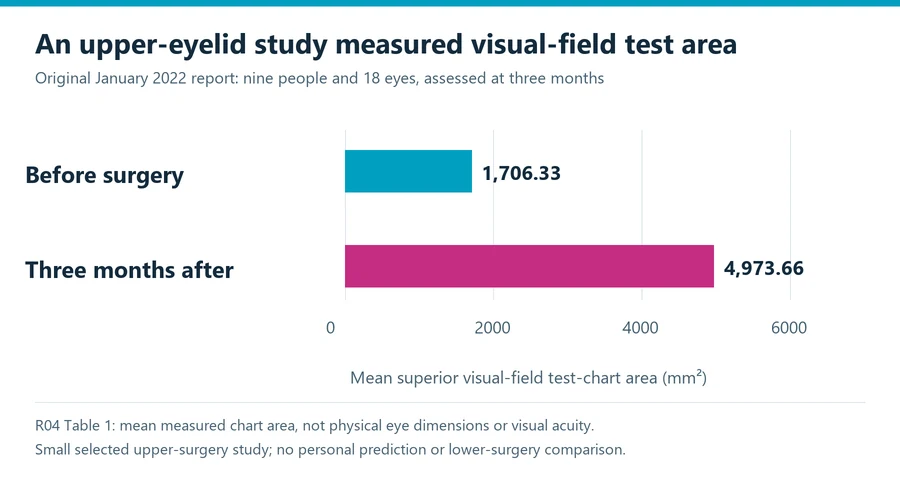
An original January 2022 paper prospectively evaluated nine patients, representing 18 eyes, after upper skin-excision blepharoplasty for the study’s specified condition. It used Goldmann kinetic perimetry before surgery and at three months. The superior visual-field area was quantified from the test-chart images. 4
Table 1 reported mean superior visual-field areas of 1,706.33 square millimeters before surgery and 4,973.66 afterward. The chart here plots those reported means. The units describe the study’s measured test-chart area, not the physical size of an eyelid or a recommended tissue-removal amount. 4
This was a small selected study, not a comparison against lower surgery or a personal prediction. The 18 eyes are not 18 independent people. The chart does not reconstruct individual test outlines, invent confidence intervals or promise that every reader will have the same change. 4
The evidence question is specific: a measured functional endpoint after an upper operation in a defined population. It should remain separate from lower-lid contour or satisfaction evidence rather than being borrowed as proof that any operation around the eyes improves every visual concern.
A lower-eyelid study measured tear-trough appearance instead
An original report first published online May 8, 2024 reviewed 98 patients who had lower blepharoplasty with a specified fat-grafting component. Its average follow-up was 7.2 months, ranging from six to 13. It assessed tear-trough appearance with a modified grading system as well as satisfaction and complications. 5
The reported mean appearance grade changed from 3.11 before treatment to 0.87 after treatment. Those grade values are not visual-field areas and should not be placed on the same efficacy scale as the upper-eyelid chart. The report was not a randomized upper-versus-lower trial or evidence isolating skin treatment from the added component. 5
The useful lesson is to match the endpoint to the goal. A lower-lid contour study may inform a discussion of that defined appearance concern. It does not demonstrate a functional effect it did not measure, and a favorable selected series does not establish a personal guarantee or absence of risk. 5
Patient satisfaction adds another type of information
An original FACE-Q development study published in the January 2017 issue described separate scales for eyes overall, upper eyelids, lower eyelids and eyelashes. It included 233 adult participants and evaluated the measurement tool. The existence of region-specific scales helps explain why a single overall impression may miss a particular concern. 6
This was a measurement-development study, not a randomized contest between upper and lower operations. Its findings should not be turned into a success rate for your proposed procedure. The source also discloses financial relationships related to the instrument; that context belongs beside its use, not hidden behind an impression of independence. 6
When reading a satisfaction study, ask what questions were used, when they were completed and how many people responded. Satisfaction with eyes overall, satisfaction with the upper region and satisfaction with a decision are not automatically the same endpoint. The label satisfaction does not eliminate the need to inspect the method.
Also distinguish a change within the same people from a comparison of different groups. A postoperative group scoring higher than a separate pretreatment group is not necessarily a paired treatment effect. The study design should be retained in the explanation rather than simplified into a promise about how much happier each patient becomes.
| Evidence endpoint | What it measures | What it cannot establish by itself |
|---|---|---|
| Visual-field test | A defined functional observation | Every aspect of appearance or every vision diagnosis |
| Tear-trough grade | A specified appearance assessment | Upper-lid function or a personal guarantee |
| Region-specific questionnaire | Responses to defined patient questions | A complete clinical diagnosis or risk probability |
| Photograph | A documented appearance example | Isolated effect of every component operation |
| Overall satisfaction | A specified response at a stated interval | Uniform benefit across every treated region |
Combined upper and lower surgery needs two sets of goals
If both regions are proposed, ask why each is included. The explanation should identify two assessed tasks rather than assume that a complete package is inherently better. You can have a strong preference about one region and remain uncertain about another; those preferences should be discussed separately.
Ask what outcome is expected from each component and how it will be evaluated. An overall photograph may show the combined appearance but cannot isolate each component’s contribution. A study of a combined plan should not silently become proof for an operation performed alone.
Separate added brow or cheek work
If the proposal includes work beyond the eyelids, give that component its own line in your record. Ask what goal it serves, whether it is optional and what remains untreated without it. This prevents a package title from obscuring the actual procedure list and helps you compare a second opinion on the same scope.
The same principle applies to staging. Ask whether both eyelid regions are part of one episode or whether later treatment depends on reassessment. A planned stage and an additional operation for an unexpected issue have different meanings. Keep that distinction in the written proposal and financial comparison.
Eye comfort and lid function should not be hidden by appearance goals
ASPS lists risks including difficulty closing the eyes, dryness, changes in lower-lid position, bleeding, infection, unfavorable scarring and changes in vision. These are categories to discuss with the treating team; they do not supply your personal probabilities. A desirable contour does not remove the need for that discussion. 3 Keep ocular-surface questions distinct with the eyelid surgery and dry-eye evidence.
Tell the team about your actual eye history and current symptoms rather than minimizing them to fit a cosmetic goal. Ask whether another eye assessment is needed and who coordinates it. This comparison cannot decide whether a symptom is caused by the eyelid or whether surgery is appropriate.
Ask how postoperative concerns are assessed and which team is responsible. Clarify the contact and escalation arrangement before booking. An appearance-focused package should still have a clear plan for evaluating function and unexpected problems; a reassuring photograph is not a substitute for that arrangement.
This article does not give a dryness-treatment regimen or diagnose a complication. Those are separate clinical questions requiring assessment. Nor does it assign a universal time to resume contact lenses, driving or other activities. Request instructions for your actual care rather than inferring clearance from a study’s follow-up date.
Read photographs by region and observation date
Use an example photograph to communicate a defined preference, not a promise of identical eyes. Identify which feature you are discussing and what the image does not show. A front view may help with one concern while leaving a side contour or a functional question unresolved.
Ask which procedures were included and when the postoperative photograph was taken. Upper surgery, lower surgery and added components should not be treated as the same treatment exposure. A photograph from an early assessment should not be described as a lifetime result or used to predict your own observation schedule.
Lighting, expression and camera position also deserve attention when appearance is the endpoint. Request consistent documentation where the image is being used for comparison. Consistency can make the visual task clearer, but it still does not convert a photograph into a functional test or a complication estimate.
Keep the personal preservation goal visible during that discussion. Ask whether the example shows the feature you wish to retain, as well as the feature you want changed. You do not have to adopt another person’s entire appearance to explain a single preference about your own eyelid region.
Match the quote to the actual component list
An upper-only quote, a lower-only quote and a combined quote describe different scopes. Before comparing prices, identify the included regions, added components, professional fees, facility arrangements and follow-up. A larger total does not explain the difference until the work being priced is clear. The eyelid surgery cost worksheet records the actual quoted lid regions and care scope, rather than assuming every proposal covers the same work.
This guide intentionally supplies no invented national upper-versus-lower cost ratio. The useful record is your actual written estimate and its exclusions. Ask how additional work is handled and whether a later proposed stage is part of the defined course or an optional decision after reassessment.
Functional assessment and financial coverage are separate questions. Do not infer insurance eligibility from an upper-lid label, a photograph or the small visual-field study. Ask the clinical team what assessment is appropriate and ask the insurer for the terms applicable to the actual plan. Neither answer should be substituted for the other.
| Proposal field | Upper component | Lower component |
|---|---|---|
| Assessed concern | Exact finding and goal | Exact finding and goal |
| Proposed work | Actual components | Actual components |
| Endpoint | Appearance, function or specified combination | Defined contour, position or other assessed goal |
| Added procedure | Reason and optional status | Reason and optional status |
| Quote and follow-up | Written inclusion and responsible team | Written inclusion and responsible team |
Explain the task you want to improve
A precise goal can describe a real situation rather than a general wish to look younger. You might want to discuss a particular upper fold seen in ordinary expression, or a lower contour that concerns you in consistent lighting. If the issue is functional, describe the actual activity and symptom instead of translating it into a cosmetic diagnosis yourself.
Ask how that task will be evaluated before and after treatment. A photograph, questionnaire and eye test can each supply useful information, but they answer different questions. A plan should say which evidence matches the task you care about and which outcome remains outside its promise.
Keep the two sides separate if the concerns differ. Symmetry should not be assumed from a package called bilateral surgery, nor should a small difference be interpreted online as a condition requiring treatment. Ask what the actual assessment finds and why the proposed plan addresses it.
Keep the unresolved region-specific question
Before deciding, ask what information could change the recommendation. You might understand the upper-skin proposal but still need clarification of a lower hollow, an eye symptom or the reason for added work. Name that gap rather than collecting unrelated outcome images until the uncertainty is obscured.
A second consultation is more useful when it addresses the same defined concern. Bring the component list and ask why a different plan is suggested. The disagreement may concern the assessment, expected benefit or extent of surgery, and those are different issues to resolve.
Explore the procedure guides for broader context. The consultation questions guide helps organize the actual assessment questions, and the cost comparison guide explains how to distinguish a package name from a complete written estimate.
Sources and review scope
Plastic Surgery Editorial Team. Source records checked through October 12, 2026. Review scope: source and editorial checks for general education. No individual clinical assessment is represented.
- ASPS eyelid surgery overview. plasticsurgery.org. Publication/update date not stated. Checked 2026-10-12.
- ASPS eyelid surgery procedure steps. plasticsurgery.org. Publication/update date not stated. Checked 2026-10-12.
- ASPS eyelid surgery risks and safety. plasticsurgery.org. Publication/update date not stated. Checked 2026-10-12.
- Objective quantification of the impact of blepharoplasty on the superior visual field. pmc.ncbi.nlm.nih.gov. Source date: 2022-01-15. Checked 2026-10-12.
- Correction of Tear Trough Deformity with Minced Orbital Fat Grafts During Transconjunctival Lower Blepharoplasty. pubmed.ncbi.nlm.nih.gov. Source date: 2024-05-08. Checked 2026-10-12.
- FACE-Q Eye Module for Measuring Patient-Reported Outcomes Following Cosmetic Eye Treatments. pubmed.ncbi.nlm.nih.gov. Source date: 2017-01-01. Checked 2026-10-12.