
Eyelid surgery dry eyes concerns need an eye assessment that distinguishes symptoms, tear findings and the actual operation. Dry-eye symptoms can occur after eyelid procedures, but a new eye complaint should not be diagnosed from this article or assumed to be harmless recovery. Tell the responsible team about burning, scratchiness, redness, light sensitivity, blur or another change and ask what assessment is appropriate. A severe or sudden visual concern should not wait for a routine appearance review or a recovery countdown.
This answer covers ocular-surface questions before and after an operation. It provides no eye-drop regimen, home test, surgical technique or personal clearance. The National Eye Institute explains that dry eye can involve insufficient tears, rapid evaporation or tears that do not function adequately, and that clinicians may examine tear measures and eyelid structure. A small prospective surgical study used several different endpoints and procedure groups. Its findings do not predict your personal risk or establish a universal date for resolution.
What does an eyelid surgery dry eyes question need to distinguish?
The term dry eye can describe a diagnosed condition, while a reader may be reporting a symptom without knowing its cause. State what you experience rather than assigning the diagnosis first. An uncomfortable eye, a change in vision or difficulty closing the eyelid needs the responsible clinician’s interpretation. Appearance, eye function and tear measurements are different questions. A reassuring cosmetic photograph does not answer all of them.
For eyelid surgery dry eyes, the actual operation matters as well. Upper or lower blepharoplasty and ptosis repair should not be treated as one interchangeable intervention. If more than one procedure occurred, obtain the documented scope. This page does not infer the operation from a scar location or a service title. The history and current assessment should identify which evidence and care questions apply rather than importing a number from an unrelated technique or population.
What does NEI dry-eye guidance explain?
The National Eye Institute describes burning or scratchiness, redness, light sensitivity and blurry vision among possible dry-eye symptoms. It explains that tear quantity, evaporation and function can be relevant and that an eye doctor may assess eyelid structure as well as tears. It also notes that severe untreated dry eye can sometimes damage the cornea. The page displays an August 6, 2025 update. It is general eye-health education, not a postoperative diagnosis. Read actual NEI dry-eye information.
An eyelid surgery dry eyes discussion should retain that scope. A list of possible symptoms does not rule out another explanation for a new complaint, and a common condition should not be used to dismiss a visual change. Ask which assessment is appropriate for your circumstances and what the clinician has actually found. This article does not identify a cause from a symptom checklist or decide which treatment category applies to you.
What should be discussed before an elective eyelid operation?
Tell the surgical and eye-care team about current or previous eye symptoms, actual diagnoses, prior procedures and the medicines or products they ask you to disclose. Ask whether the concern needs assessment before the proposed operation and who will provide it. Do not independently stop prescribed treatment or minimize a symptom to preserve a booking. If a history detail is uncertain, label it honestly and ask which records would help.
For eyelid surgery dry eyes, a baseline record helps distinguish a preexisting concern from a later observation. Ask how the team will document the relevant findings and how they affect the proposal. A statement that an operation is cosmetic does not remove the eye-health questions. Conversely, this article does not conclude that every person with dry-eye symptoms must avoid surgery. The responsible clinician must assess suitability and explain the actual benefits, limits and alternatives.
What did the original upper-eyelid study measure?
An original prospective study published February 23, 2022 assessed 32 eyes of 20 patients undergoing upper blepharoplasty, levator advancement for ptosis or both. It used tear tests, a symptom questionnaire, staining and other measures at several time points. Eyes and people are different denominators. The recruited group was small, included a wide age range and excluded certain prior or concomitant conditions. The answer inspected the abstract, methods, relevant results and limitations rather than claiming a new analysis. Read the original ocular-surface study.
For eyelid surgery dry eyes, the study shows why a reported outcome needs its actual endpoint and procedure group. Some measured changes persisted at the six-month observation, but that is not a prediction that your symptom will last six months or a guarantee it resolves then. The investigators identified sample-size and follow-up limitations. Recruitment in 2014 is distinct from publication in 2022 and present retrieval; it is not a new 2026 assessment of current practice.
Why are tear tests and symptoms different endpoints?
A study can measure the quantity of tears, their stability, staining or a person’s symptom report. A change in one measure may not answer every functional or subjective concern. Ask the clinician what each actual test is intended to establish and how its result relates to the examination. This article does not recommend a test or threshold and does not interpret a single remembered result as proof that the eye is healthy or that a complaint lacks significance.
An eyelid surgery dry eyes record should therefore identify the actual finding, not simply state that the test was normal. If you have a report, share it with the clinician assessing the current concern and ask which parts matter. If the symptom persists despite an earlier assessment, describe the current situation rather than treating the old result as a permanent answer. The clinical team should explain what remains uncertain and what would change the plan.
What should be reported after an operation?
Describe the symptom, which eye is affected, when it began, whether it is changing and how it affects daily tasks. Include the operation date and any actual instructions or treatments received. Tell the clinician about other symptoms separately rather than forcing them all into a dry-eye explanation. If photographs are requested, provide accurate dated images, while understanding that an examination may still be needed.
For eyelid surgery dry eyes, a record of appearance alone may omit the concern that matters. A patient can describe function or discomfort without knowing the cause. Ask the team which professional is responsible for the eye assessment and how a referral will be arranged if needed. A message about a cosmetic review is not necessarily a complete response to a medical complaint. This page does not decide that a particular symptom is expected or safe to ignore.
Which concerns should not wait for a routine review?
A new severe or sudden vision concern should not be managed solely through this guide or a future appearance appointment. Contact appropriate medical care and describe the actual change. This page supplies no checklist that rules out an eye emergency. The NEI’s general discussion of blur as a possible dry-eye symptom is not permission to assign every visual problem to dryness, and the absence of one symptom does not establish that nothing serious is occurring.
An eyelid surgery dry eyes conversation should separate the immediate response from the eventual explanation. The team may need to assess the eye before determining the cause. Do not delay necessary care while obtaining the operative report or comparing your photograph with an online recovery image. Share the known history, identify unknowns and follow the actual professional response instructions. Administrative information can be supplied alongside care rather than becoming a prerequisite for it. For a separate discussion of recovery tasks and questions after that procedure, see blepharoplasty recovery.
How should a proposed treatment be understood?
NEI describes treatment as dependent on the cause and discusses several broad options. Those categories do not create an individualized regimen for someone after surgery. Ask the assessing clinician what the actual proposal addresses, how to follow it and how response will be reviewed. This article does not select drops, prescribe a frequency or recommend an additional procedure. If another team has already given instructions, share them rather than combining incompatible advice yourself.
For eyelid surgery dry eyes, retain the actual prescription or care instructions and the professional responsible for them. Ask how to report a problem using the treatment or a change in symptoms. Do not borrow eye medication, substitute a product because it appears in a general article or independently discontinue prescribed care. A familiar over-the-counter category can still require a specific clinical discussion when the eye has been operated on and the concern has not yet been assessed.
Does a common recovery timeline predict resolution?
A timeline about bruising, return to work or appearance is not a sensory or ocular-surface endpoint. The original study’s follow-up visits were observations, not personal clearance dates. Ask the clinician what course is expected for the actual assessed problem and what uncertainty remains. This answer gives no countdown that permits waiting through a worsening symptom. A change should be reported according to the clinical plan, even if an appointment is already scheduled.
An eyelid surgery dry eyes plan can include observation only as an actual clinician’s recommendation with a clear reason and response route. Ask what is being monitored and what would prompt earlier review. If the plan simply says that symptoms are common, request clarification of how your concern was assessed. General context may be helpful, but it should not replace the current finding, instructions and follow-up responsibility.
How can the eye-health questions be organized?
| Question | Useful information | Boundary |
|---|---|---|
| What existed before surgery? | Actual history and baseline assessment | No eligibility from a form |
| What operation occurred? | Documented procedure and added scope | No all-eyelid-procedure rate |
| What is happening now? | Symptoms,function and actual finding | No diagnosis from a photograph |
| What does follow-up assess? | Actual endpoint and response owner | No fixed resolution guarantee |
Keep function visible alongside appearance
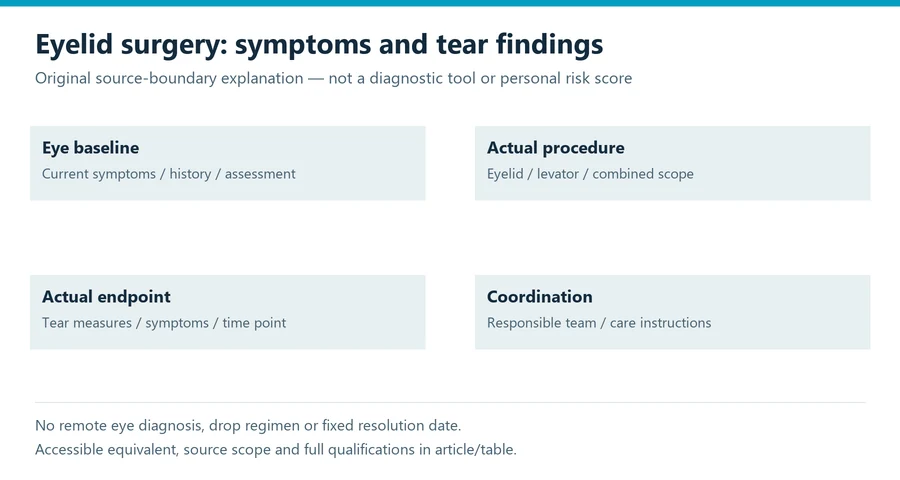
The original organizer makes an eyelid surgery dry eyes discussion specific without acting as a home screening tool. Use it to separate the history, exposure, current concern and next action. If the clinical team recommends referral, clarify who arranges it and how the finding reaches the team managing follow-up. A completed worksheet does not establish that the eye is safe or that a procedure is appropriate; it helps communicate the actual question.
How should daily activities be discussed?
Tell the assessing clinician if the concern affects reading, screen work, contact-lens use or another task, and request advice for the actual assessed situation. This article does not clear driving or prescribe task limits. A return-to-work date from a general guide may not answer a visual-function question. Explain the real task rather than only the job title so the clinical team understands why the symptom matters in daily life.
For eyelid surgery dry eyes, record any actual activity instruction and how it will be reassessed. If advice changes, keep the current plan visible and ask which earlier instruction it replaces. A practical adaptation should not become a substitute for obtaining the eye assessment that is needed. Likewise, the need to work should not be used as a reason to minimize a visual concern or reinterpret uncertainty as permission to proceed.
What if different clinicians use different terms?
Ask whether they are describing a symptom, a test finding, an eyelid problem or a diagnosed condition. Different terms may reflect different questions rather than an actual contradiction. Share the same accurate operative record and symptom history so that missing information does not account for the difference. If uncertainty remains, ask which further assessment would help and who is responsible for coordinating it. For keeping botulinum-toxin eyelid-droop questions distinct from other eyelid concerns, see botulinum toxin eyelid droop.
An eyelid surgery dry eyes second opinion should include the prior findings and actual treatments, not only a claim that the first clinician dismissed the concern. Explain your unresolved question clearly. This page does not rank specialists or settle a clinical disagreement. The purpose is a more precise assessment of the same concern, with transparent evidence and limits rather than a preferred diagnosis selected from an online account.
How should the consent discussion distinguish dryness from other eye findings?
ASPS lists ocular dryness, difficulty closing the eyes, ectropion and visual changes as separate possible eyelid-surgery risks. That list does not rank their frequency or imply that they are interchangeable. For eyelid surgery dry eyes questions, ask which finding the team is discussing and how it relates to the actual proposal. If you are concerned about more than one issue, name each one. A general statement about expected swelling does not answer a separate question about eye closure or visual function.
Read ASPS’s eyelid-surgery consent-risk categories.
The ASPS page is undated general education, not a personal probability or assessment of your eye. Its usefulness here is the distinction between categories and the instruction to discuss questions directly before consent. Keep that role separate from the NEI explanation of dry-eye assessment and the small surgical study’s particular test findings. Together, the sources support more precise questions without creating a universal diagnostic algorithm or guaranteeing a particular recovery.
How can different eye-care and surgical teams coordinate a review?
If another eye clinician has assessed you, bring the actual report or ask how it can reach the surgical team. Tell each team which symptoms concern you and which instructions you have received. Avoid summarizing a report as everything was normal when it addressed only one test or time point. Ask what the assessment established and what it did not examine. The next clinician can determine which details matter to the current question.
For eyelid surgery dry eyes coordination, clarify which team owns the current symptom assessment, any prescribed care and the next review. A cosmetic appointment and an ocular-surface assessment may have different purposes; knowing the purpose helps you communicate a concern to the appropriate clinician. This article does not decide which service is sufficient or whether a visual change is safe to wait on. Use the actual contact and escalation instructions, and seek prompt assessment for a serious concern rather than relying on a generic recovery date.
What should be retained for future procedure discussions?
Keep the actual findings, instructions, treatment history and any remaining uncertainty. Before considering another elective eyelid intervention, disclose the concern and previous assessments. Ask how they affect the new proposal and whether further eye evaluation is needed. A prior procedure’s apparent appearance result does not establish the ocular-surface outcome of another operation. This guide supplies no personal permission or universal waiting interval.
Eyelid surgery dry eyes evidence is useful when baseline, operation, symptoms and measured endpoints remain distinct. NEI guidance and a small original prospective study support clinical assessment without a personal incidence or resolution claim. Use the procedure guide for broader operation context. This resource contributes practical eye-health questions, without a home test, eye-drop prescription, fabricated patient outcome or guarantee of recovery.
Sources and review scope
Plastic Surgery Editorial Team. Source records checked through October 12, 2026. Review scope: source and editorial checks for general education. No individual clinical assessment is represented.
- NEI dry eye education. nei.nih.gov. Source date: 2025-08-06. Checked 2026-10-12.
- Original upper eyelid surgery ocular-surface prospective study. pmc.ncbi.nlm.nih.gov. Source date: 2022-02-23. Checked 2026-10-12.
- ASPS eyelid surgery consent-risk education. plasticsurgery.org. Publication/update date not stated. Checked 2026-10-12.