
Blepharoplasty recovery has at least two practical clocks: when your eyes can comfortably and safely support a task, and when bruising or swelling is less noticeable. NHS guidance says many people take about two weeks away from work, depending on the job, while redness and bruising can take several weeks to fade. A less noticeable bruise does not establish safe vision for driving. Your own eye-care instructions and postoperative assessment must guide the return to each activity.
This guide helps you organize visual tasks, transport, work, eye care and follow-up after eyelid surgery. It does not supply a home eye-treatment protocol or a personal clearance date. Upper eyelid, lower eyelid and additional lid-support work can be different plans. Start with the operation proposed and use the team’s written directions. The aim is a workable schedule that protects access to assessment, rather than a race to look ready for a photograph.
Identify the eyelid work and the tasks it affects
Begin the blepharoplasty recovery record with which eyelids will be treated and whether the plan includes another procedure. Ask the clinician to name any component whose recovery instructions differ from the basic eyelid plan. Keep the answer with the discharge paperwork. A general blepharoplasty recovery estimate cannot settle a question about combined surgery simply because all of the procedures involve the same part of the face.
Make a separate list of things you need your vision to do. Reading a phone, driving, operating equipment, studying detailed drawings and caring for another person create different demands. Tell the team about any task that is essential to your household or employment. Do not assume you can safely do a demanding task because you can briefly read a message. Ask which signs and conditions should govern its return.
The NHS describes several days away from driving and a potentially longer period of visible bruising or redness. It advises prompt clinic contact for severe pain or unexpected symptoms. These are broad patient-guidance statements, not an assessment of your eyes or a promise about appearance on a chosen date. NHS eyelid surgery recovery guidance
Ask about pre-existing eye problems and how your ordinary eye treatments fit the postoperative plan. Bring an accurate list rather than stopping a product yourself. If another clinician manages an eye condition, ask how information will be coordinated. The practical issue is knowing which instruction applies to which treatment, especially when two products or schedules sound similar but have different purposes.
Read blepharoplasty recovery by visual and social readiness
A work meeting can involve both prolonged viewing and concern about appearance. Separate those questions. Ask what the team recommends for the visual demands, then consider how comfortable you feel attending while a bruise is visible. A personal appearance preference can affect your schedule without being presented as a medical restriction. Conversely, a medical limitation should not disappear because makeup or a camera angle makes it less obvious.
| Planning question | Source context | Individual decision |
|---|---|---|
| Time away from work | NHS describes about two weeks, job-dependent | Which visual and physical duties can I resume? |
| Driving | NHS describes several days away | Is my vision adequate and am I otherwise cleared? |
| Visible bruising or redness | NHS describes several weeks | How will I arrange social or camera-facing duties? |
| Care and follow-up | ASPS emphasizes individual instructions | What applies to my eyelids and care products? |
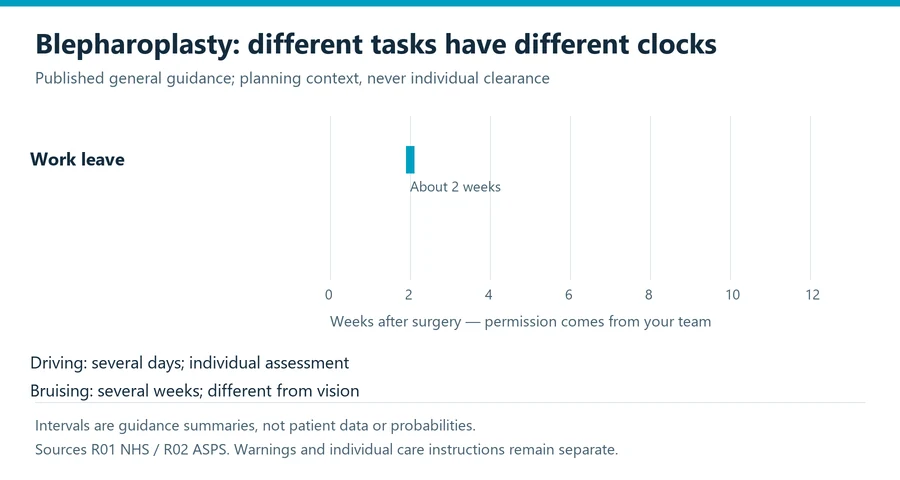
The planning graphic keeps the work estimate separate from driving and appearance. Its timeline summarizes general guidance, not measured recovery times from a clinical cohort. It cannot tell you how many days your bruising will last or when you will be safe to drive. Read it as a reminder to ask different questions, with the text table providing the same context when the image is not available.
An institutional instruction may differ from a general webpage because its scope and care plan differ. Do not average several schedules to produce a personal deadline. Ask the operating team which instruction it wants you to use. Blepharoplasty recovery is easier to plan when uncertainty stays visible and there is a specific appointment or contact route for resolving it, rather than a confident calendar based on unrelated operations.
Arrange transport before the operation
Before blepharoplasty recovery begins, ask what the facility requires for your trip home and the period after discharge. Name the person responsible and confirm that they understand the arrangement. Plan the route to follow-up as well, including who will accompany you if needed. A booking that gets you from the hospital to the front door does not necessarily cover the rest of the discharge plan; check that the complete arrangement meets the team’s requirements.
Memorial Sloan Kettering’s blepharoplasty instructions connect driving to clear vision and medication status, as well as safe ability to drive. Its guidance also gives a specific contact-lens restriction for its patients. Those are examples of why permission requires more than a date, not a substitute for the operating team’s own directions. MSK blepharoplasty aftercare guidance
Describe any public-transport journey you expect to make. Include reading signs, navigating stairs, travelling alone and reaching the destination from the stop. Ask whether another arrangement is advisable for a particular visit. The team can consider the medical demands, while you can arrange practical alternatives. Avoid finding yourself responsible for an unfamiliar journey because the only plan was that someone else would drive you home on surgery day.
If you ordinarily provide transport for others, arrange coverage for those journeys too. School pickups, another person’s appointment or a work obligation can create pressure to resume driving early. Make that obligation visible before surgery and choose a backup. Having a practical alternative is more useful than making a promise you hope your postoperative assessment will support. A recovery estimate should never become the only transport plan.
Get one clear eye-care plan
ASPS describes individualized instructions for eye care, medicines, concerns and follow-up after eyelid surgery. Initial healing can involve swelling, bruising, irritation and dry-eye discomfort. Ask the team to identify the care items you actually need and demonstrate the relevant instructions. This guide does not reproduce a cold-compress schedule, a drop dose or a method for handling your eyelids. ASPS eyelid postoperative guidance
For the eye-care part of blepharoplasty recovery, keep each product with its own written directions. Similar packaging or a shared word such as ointment does not make products interchangeable. Ask what to do if you are uncertain, miss an application or experience an unexpected symptom. Do not add a cosmetic product to a wound or change an eye medication because a general checklist recommends it. The clinician must explain what belongs in your care plan.
Ask a helper to listen to the explanation if they will assist you. Then describe the instructions back to the team and invite correction. This is especially useful if the plan contains several items or appointments. A helper can organize supplies and transport without being expected to judge a new eye symptom or improvise treatment. Keep the appropriate contact number beside the instructions so that questions have a clear route to an answer.
If instructions change, mark the older version as superseded and retain the new date. Do not leave two contradictory schedules in the same organizer. Contact the team if you are unsure whether a new instruction replaces an old one or applies only to one product. Your recovery paperwork should make the current plan easier to carry out, rather than requiring you to decide which of several remembered conversations was more authoritative.
Plan blepharoplasty recovery work by visual demand
Describe your visual work to the clinician. How long are the viewing sessions? Is small text unavoidable? Do you need to watch several screens or respond rapidly? Can tasks be paused or handed to someone else? These details can make a more useful discussion than a job title. Ask how to organize a return to those demands without assuming that every screen-based task has the same requirements.
A camera meeting is not a vision assessment
Being comfortable appearing on camera answers a social question. Being able to carry out work safely answers a functional question. Keep them separate when arranging leave or modified duties. If you would prefer not to appear on video, ask whether audio participation or another temporary arrangement is possible. That can be an ordinary workplace choice without being described as medical evidence that you are unable to work.
Ask the employer about reduced duties, shorter viewing periods or coverage for tasks the team has not cleared. Then take the actual proposed arrangement back to the clinician. A vague promise to take it easy can fail when the job expects uninterrupted attention. Agree when the arrangement will be reviewed and who needs the updated information. Avoid allowing a general two-week estimate to silently authorize every visual and physical part of your role.
For study or unpaid responsibilities, use the same task description. An examination, a long session of close reading or responsibility for supervising someone else may need planning even when there is no employer. Explain the deadline and ask what alternatives are available. You do not need to make recovery into a productivity test. The purpose is to identify an arrangement that respects the current instructions and leaves room for assessment if the plan changes.
Ask about contact lenses, makeup and ordinary routines
For blepharoplasty recovery, check the instruction for your own contact lenses and arrange an appropriate alternative in advance. Do not use a different institution’s minimum interval as permission to resume lenses. The team must consider the operation and how the eyes are doing. If you ordinarily depend on lenses for a specific task, say so at the consultation rather than assuming that this practical need changes the restriction.
Ask when cosmetics may be used near the operated area, how ordinary washing should be handled and which routine products should wait. Keep these as distinct questions. Permission to wash one area does not automatically allow rubbing the eyelids or using a cosmetic around an incision. Do not remove a dressing or manipulate stitches to make a routine easier. If an instruction is impractical for your circumstances, describe the problem and request guidance.
Consider hair appointments, exercise classes and social events as activities with actual demands. A hair wash, a swim and a quiet meal are not equivalent just because all are ordinary parts of your routine. Ask the clinician about the activities you intend to schedule. Avoid reserving an event that depends on a particular appearance result before you understand the range and have a backup if your comfort or instructions differ from the estimate.
Your support plan should also cover tasks that are difficult when you cannot rely on your usual visual routine. Label important contact information clearly and ask someone to help organize appointments if needed. This is an accessibility arrangement, not a treatment. The aim is to preserve independence where practical without making you responsible for a task that the care team has told you to postpone.
Know when blepharoplasty recovery symptoms need assessment
Guy’s and St Thomas’ advises immediate eye-department or emergency-department assessment if eye pain increases, vision worsens, redness increases or excess eye discharge appears after blepharoplasty. For a US reader, use your team’s urgent eye-care route or the nearest emergency department when those symptoms occur. Do not wait for the next planned appointment. Hospital guidance on urgent postoperative eye symptoms
Worsening vision is not a bruise to watch until the calendar catches up. Some institutions explain that ointment can cause temporary blur, but that explanation should not be used to dismiss a new or worsening visual problem. The responsible service needs to assess the situation. A selfie, a friend’s reassurance or a comparison with another person’s eyelid photographs cannot establish that your vision is safe.
Ask the team before discharge how to reach urgent eye care outside office hours. Keep the number and the physical destination together where your helper can find them. If symptoms require emergency assessment, arrange help promptly rather than sending repeated routine messages. A contact plan should specify what to do when the usual office is closed, not merely provide a daytime number that may be unanswered when you need it.
For general emergency symptoms, CDC clot guidance identifies new breathing difficulty, chest pain or fainting as reasons for immediate emergency help. CDC emergency clot symptom guidance Call 911 for an emergency in the United States. This is general response information, not a prediction of your personal risk or a reason to start a treatment yourself.
Keep help available for appointments and paperwork
Check how you will receive appointment information and read the instructions. If printed material is difficult to use, ask for an accessible format or for the team to explain it with your helper present. Set up practical assistance before surgery rather than assuming you can read every detail immediately afterwards. A reminder on a phone can organize a visit, but it cannot supply the missing clinical explanation of what that visit is for.
Keep the location of the follow-up clinic distinct from the urgent eye-care destination. They may be different services. Your helper should know which address belongs to a booked visit and which route applies if an urgent symptom appears. Include the appointment time, transport arrangement and contact route for rescheduling. This small record can reduce logistical confusion without suggesting that any organizer or device changes the medical recovery itself.
Use blepharoplasty recovery follow-up for specific decisions
Bring a short list of unanswered tasks to the visit: driving, work demands, contact lenses, cosmetics, exercise and any care question that has arisen. Ask which instruction changes and which stays in place. A reassuring visit should not be interpreted as permission for every activity unless that is what the team actually says. Record the decision in plain language, with the next review if one is needed.
Keep appearance questions precise and separate from symptoms. If a change concerns you, explain when you noticed it and whether it affects how the eye feels or functions. Ask when a later appearance assessment is useful, without deciding from one photograph that healing is complete or that a particular result has failed. The clinician can distinguish the questions using the operation, history and examination.
Before surgery, assemble a one-page plan containing transport, visual-work coverage, actual eye-care instructions, appointments and urgent contacts. After discharge, revise it to reflect the procedure performed. That is the practical value of a blepharoplasty recovery calendar: it organizes the next decision while preserving the difference between visible healing, safe vision and the activities the team has permitted.
For related context, see the blepharoplasty procedure guide and the recovery planning hub.
Sources and review scope
Plastic Surgery Editorial Team. Source records checked through October 12, 2026. Review scope: source and editorial checks for general education. No individual clinical assessment is represented.
- NHS eyelid surgery recovery guidance. nhs.uk. Source date: 2023-09-15. Checked 2026-10-12.
- ASPS eyelid surgery recovery guidance. plasticsurgery.org. Publication/update date not stated. Checked 2026-10-12.
- CDC about venous thromboembolism. cdc.gov. Publication/update date not stated. Checked 2026-10-12.
- Guy's and St Thomas' blepharoplasty aftercare. guysandstthomas.nhs.uk. Source date: 2023-12. Checked 2026-10-12.
- MSK caring for yourself after blepharoplasty. mskcc.org. Source date: 2024-08-02. Checked 2026-10-12.