
Lower body lift vs tummy tuck is primarily a comparison of treatment coverage and the proposed surgical plan. A tummy tuck addresses the abdomen. A lower body lift may extend the work around the lower trunk and address additional regions, such as the buttocks and outer thighs. The exact plan matters more than assuming that a larger-sounding operation is better. ASPS describes both the abdominal purpose of tummy tuck and the broader regional scope possible with body lifting. 1, 2, 3
Begin by asking which regions actually concern you and which the surgeon proposes to treat. Then compare the scar plan, additional procedures, follow-up and evidence for those specific changes. This guide helps you evaluate that scope without recommending an operation, drawing a personal incision plan or converting a published series into your own complication probability.
Map the concern from front, side and back
An abdominal photograph may not explain a concern that extends around the sides or back. List the regions separately before choosing a procedure name. Record what bothers you in each region and what change you hope for, rather than using whole body as a substitute for a precise goal.
ASPS says a body lift may involve the abdominal region extending toward the sides and lower back, the buttocks, and specified thigh areas. That list does not mean every body-lift proposal includes all of them. Ask the surgeon to identify the actual coverage and any areas left outside it. 1
This makes a limited plan easier to understand. If your concern is mainly anterior, ask why work elsewhere is proposed. If it extends posteriorly, ask what the abdominal operation is expected to do there and what it is not intended to change. These questions test the match between problem and treatment; they do not determine eligibility by themselves.
Use a simple written region record rather than trying to design an incision from an online diagram. A general illustration cannot establish the amount or distribution of tissue in your case. It can explain a concept, but the proposed operation should be described after an actual assessment, with a clear explanation of its boundaries.
| Region or issue | What to clarify in the actual proposal |
|---|---|
| Front of abdomen | Skin and contour work, and whether abdominal-wall work is included |
| Side of waist | Whether addressed directly, indirectly or left outside the operation |
| Lower back | Actual posterior coverage and proposed scar arrangement |
| Buttocks | Skin lifting, volume change or another separately named component |
| Outer versus inner thighs | Which area is included and which requires separate treatment |
What the tummy-tuck label tells you and what it does not
ASPS describes abdominoplasty as removing excess abdominal skin and fat and, in many cases, addressing weakened or separated muscles. That description does not establish that every tummy tuck includes the same internal work, incision extent or additional procedure. The operative proposal should specify those components. 2 Use the tummy tuck procedure guide when clarifying the proposed front-abdominal work.
Ask whether the recommendation is limited to skin and contour or also includes abdominal-wall work. If another concern, such as a suspected hernia, is discussed, ask how it will be assessed and which clinician manages it. Do not treat a cosmetic procedure label as a diagnosis or a guarantee that every abdominal problem is being addressed.
The term extended also needs explanation. Ask where the proposed treatment extends and why. An extension described in one consultation may not match what another practice means by the same word. Compare the actual regions and plan rather than assuming identical scope from matching terminology.
Likewise, a proposal that includes liposuction is not the same as one that does not. If both skin removal and fat contouring are planned, record which goal belongs to each component. This helps you understand a price difference or a different expected result without attributing everything to the tummy-tuck label.
What the lower-body-lift label needs to explain
ASPS describes one common complete lower-body-lift approach using an incision around the body to remove excess skin and fat and reposition tissues. It also says the incision pattern depends on the distribution of excess skin and surgical judgment. This is a general explanation, not a personal scar template. 3 The lower body lift guide provides a separate place to record the wider regional scope.
Ask whether the proposed operation is circumferential, near-circumferential or another described configuration. The distinction should be explained in ordinary language: where the work begins and ends, which regions it aims to change and where scars are expected. A term such as 360 should not replace that explanation.
Also separate lifting from adding volume. A proposal involving buttock skin work may include another component with a different purpose. Ask whether an additional procedure is being proposed, what it is intended to achieve and whether it is optional. A name that combines several goals can otherwise make it difficult to identify what you are actually agreeing to.
The same applies to the thighs. Do not assume that work affecting an outer-thigh contour addresses the inner thighs or the entire leg. Ask for the boundary of the expected change. If another thigh procedure is suggested, keep its scar, purpose and course of care in a separate line of the comparison.
Skin, fat and abdominal-wall questions belong in separate columns
Body lifting is not simply another term for fat removal. ASPS distinguishes excess fat with suitable skin elasticity from situations in which lifting and liposuction may be combined. A plan should therefore explain what issue each component addresses instead of promising one procedure for every kind of contour concern. 1
Describe the concern as you experience it, then ask what the assessment identifies. You might be focused on a fold, a change in clothing fit or a particular outline. Those observations are useful, but they do not establish which tissue or structure should be treated. Keep your description and the clinician’s assessment distinct.
If two proposals differ, compare their explanations before comparing their titles. One may describe an anterior skin issue while another identifies a broader distribution. Ask why the assessment differs and whether the disagreement concerns diagnosis, expected benefit or the extent of surgery. A second opinion is more useful when it addresses that exact difference.
You can prioritize one region while accepting that another remains untreated. The choice does not have to maximize the number of procedures. Write down which change matters most and which additional intervention you would not choose merely for a larger package. That gives the consultation a clear decision boundary.
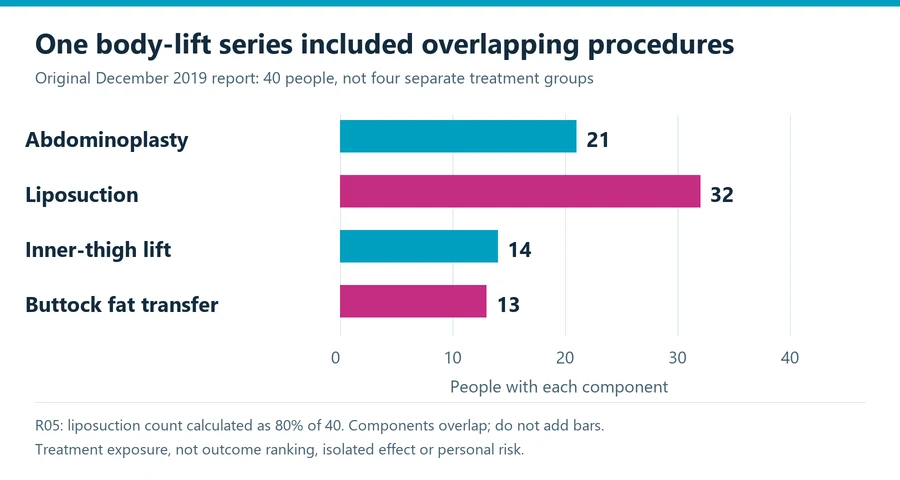
A published lower-body series included overlapping procedures
An original December 30, 2019 report described 40 consecutive women and men undergoing near-circumferential outer-thigh and buttock work. Twenty-one also had abdominoplasty. The report stated that 80% had liposuction, 14 had simultaneous inner-thigh lifts and 13 had buttock fat transfer. These categories overlap; they are not separate treatment arms. 5
The supporting chart plots those actual components. The liposuction count of 32 is calculated from 80% of 40. The figure describes what was done in that selected series, not which component caused a result or which operation is best. The abstract does not provide one uniform cohort-wide follow-up interval, so none is invented here. 5
This design helps explain why a body-lift outcome cannot automatically be attributed to skin lifting alone. The cohort had multiple interventions, and there was no randomized tummy-tuck-only comparison. A shared procedure label does not make all participants’ treatment exposures identical. 5
The same caution applies when you compare photographs. If a person had several components, an image cannot isolate each component’s contribution. Ask what treatment was included before treating a photograph or headline as evidence for the exact operation you are considering.
Outpatient reports are not personal setting recommendations
Another original report, published in June 2017, reviewed 42 consecutive outpatient circumferential body lifts performed from 2010 through 2016. Average follow-up was 10.4 months, and the operations included a variety of additional procedures. The report described complications and revisions within that selected experience. 6
Its existence does not mean that any reader can safely select outpatient care. Nor does a comparison with other published series establish that the setting alone caused a difference. Patient selection, operative scope and care arrangements need to remain visible when interpreting such a report.
Ask the treating team why the proposed setting is appropriate for the actual plan and how an unexpected problem is handled. Clarify who provides immediate assessment, which arrangements exist for escalation and who takes responsibility after discharge. A reassuring study title cannot replace those practical answers.
Also distinguish average follow-up from lifelong observation. A reported average does not mean that every participant was observed for exactly that interval. It does not establish that later events never occurred. When a recommendation relies on long-term results, ask whether the cited evidence actually observed the relevant endpoint over that period.
Scar coverage is a tradeoff to describe before booking
An operation’s treatment coverage and its scar coverage should be discussed together. ASPS notes that body-lift incision patterns vary with the excess tissue and surgical judgment. Do not infer your exact scar from a stock illustration or assume a clothing description guarantees concealment in everything you wear. 3
Bring clothing examples if visibility is important to your decision. Ask where the proposed scars are expected relative to those garments and what uncertainty remains. This communicates your preference without asking a photograph to act as a precise surgical plan. Record the explanation rather than relying on a general word such as hidden.
Ask how the proposed scar arrangement differs between your actual alternatives. A shorter-looking diagram does not by itself establish a better result, and a longer one does not prove more useful coverage. The relevant question is what goal justifies the difference and what appearance tradeoff you are willing to accept.
Do not treat scar length as a personal-risk calculator. It is one feature of a plan, not a substitute for evaluation of the procedure, your circumstances and the care setting. Ask about the proposed course and the uncertainties separately rather than using a single visible measurement to decide safety.
| Planning field | Tummy-tuck proposal | Lower-body-lift proposal |
|---|---|---|
| Regions directly treated | Actual named areas | Actual named areas |
| Abdominal-wall component | Included, excluded or not yet assessed | Included, excluded or not yet assessed |
| Added contour procedures | Each component and its purpose | Each component and its purpose |
| Scar arrangement | Proposed location and uncertainty | Proposed location and uncertainty |
| What remains untreated | Explicit limits | Explicit limits |
Combined and staged plans need a complete-course explanation
If several regions matter, ask whether the proposal involves one episode or a staged course. Do not assume that combining procedures is automatically better because it appears to reduce the number of bookings. Nor should several stages be assumed unnecessary solely because another person had a combined operation.
For each stage, record the region, purpose and reason for the sequence. Ask what will be reassessed before the next intervention and whether the later step is a definite part of the plan or an option contingent on that assessment. This distinction keeps an initial proposal from silently becoming an obligation to complete every possible procedure.
Separate a planned stage from an unplanned revision
A planned later operation and an additional procedure to address an unexpected or unsatisfactory issue are different categories. Ask how the written plan uses those terms. A complete-course comparison should not count a planned stage as evidence that the first operation failed, nor assume that every additional intervention was planned from the outset.
Keep the reason beside the procedure in your notes. If the plan changes, request an updated explanation of the goal and scope. This is especially useful when a package title remains the same even though the component operations change. The name alone cannot tell you what is now included.
Follow-up responsibilities matter as much as package wording
ASPS lists body-lift risks including bleeding, infection, fluid accumulation, healing problems, unfavorable scarring, recurrent looseness and serious cardiopulmonary complications. These are categories for discussion, not personal probabilities supplied by this article. The actual risks of your proposal need individualized explanation. 4
Ask who handles questions about each treated region and how to contact the responsible team. A combined operation should not leave you uncertain whether an abdominal concern and a posterior concern are managed by different arrangements. Clarify the follow-up plan before assuming that the same package covers every later appointment.
Discuss practical responsibilities in the context of the actual plan: travel, help at home, work demands and access to assessment. This guide deliberately does not assign a universal return-to-work or driving date. Those activities need instructions from the treating team; a comparison of operation names cannot grant clearance.
If a proposal relies on travel, ask how local assessment and communication will work after you leave. Identify the actual responsible clinicians and arrangements instead of assuming that an online message guarantees immediate care. The purpose is to understand the plan, not to declare any location or setting universally appropriate.
Compare quotes by regions and episodes, not a national shortcut
A quote for abdominal surgery cannot be fairly compared with a quote including multiple additional regions without identifying the extra work. First match the component list. Then ask which fees cover the surgeon, facility, anesthesia and the specified follow-up, and which services are outside the written estimate. The body lift cost worksheet helps compare the quoted regions and care episodes.
For a staged plan, compare the defined complete course as well as each episode. A lower first payment may describe only the first stage. Conversely, a combined quote may include an optional component you do not prioritize. Do not let the payment structure decide the treatment purpose before the scope is clear.
This article provides no invented national price difference or promise that one package is cheaper. The meaningful comparison is the actual written proposal, its time horizon and its exclusions. Ask for clarification of possible future expenses without automatically treating every theoretical event as a certain bill.
| Quote question | Useful written answer |
|---|---|
| Which regions and components are included? | Exact treatment list, not only package name |
| One episode or a staged course? | Defined stages and conditions for reassessment |
| Which professional and facility fees are included? | Named fee categories in the actual estimate |
| What follow-up is included? | Responsible team and covered arrangements |
| How are additional procedures handled? | Distinction between planned stages and other future work |
Compare documentation of each region
If you use photographs to discuss a proposal, request views that show the actual regions of interest. An abdominal view and a posterior view answer different appearance questions. Ask when the photographs were taken, what component operations were included and whether later procedures changed the result. The image should remain an illustration of a documented case, not a promise about your own body.
Write the unresolved question beside each view. For example, you may understand the proposed anterior change but still need an explanation of the side or posterior boundary. This prevents a persuasive photograph of one region from standing in for an unanswered question about another.
Choose the scope that answers your actual goal
The useful comparison is not small operation versus complete transformation. It is whether the proposed treatment covers the regions that matter, whether its tradeoffs are explained and whether the evidence matches its actual components. A broader name does not establish a better personal result.
Keep the region map, component list and unresolved questions together. If an important concern is left outside the plan, ask why. If another region is added, ask what benefit justifies it. Those explanations help you decide whether to proceed, seek another assessment or leave a cosmetic question open.
Explore the procedure guides for related operations. The consultation questions guide helps organize competing proposals, and the cost comparison guide explains the difference between an episode’s quote and a complete course of care.
Sources and review scope
Plastic Surgery Editorial Team. Source records checked through October 12, 2026. Review scope: source and editorial checks for general education. No individual clinical assessment is represented.
- ASPS body lift overview. plasticsurgery.org. Publication/update date not stated. Checked 2026-10-12.
- ASPS tummy tuck overview. plasticsurgery.org. Publication/update date not stated. Checked 2026-10-12.
- ASPS body lift procedure steps. plasticsurgery.org. Publication/update date not stated. Checked 2026-10-12.
- ASPS body lift risks and safety. plasticsurgery.org. Publication/update date not stated. Checked 2026-10-12.
- Near-circumferential Lower Body Lift: A Review of 40 Outpatient Procedures. pubmed.ncbi.nlm.nih.gov. Source date: 2019-12-30. Checked 2026-10-12.
- Safety of Outpatient Circumferential Body Lift: Evidence from 42 Consecutive Cases. pubmed.ncbi.nlm.nih.gov. Source date: 2017-06. Checked 2026-10-12.