
Body lift cost should describe the assessed regions and distinguish payable charges from descriptive allocations inside a package. A document can list abdomen, buttock and thigh work without charging each amount on top of the package total. Ask which rows are already included and which are additional obligations. Marketing labels such as “full body” do not establish either surgical scope or a complete financial inclusion boundary.
This guide offers an original hypothetical region-and-charge worksheet. It shows how adding internal professional allocations to an already inclusive professional package can double count the same amount. Every example dollar is invented arithmetic, not an actual clinic price, national total or price per anatomical region. The model does not recommend combining operations or select the extent of surgery. Clinical assessment determines the task; the worksheet clarifies how the written estimate represents it.
What does the published body lift cost average measure?
The ASPS body-lift cost page, checked October 12, 2026, displays $11,397 specifically for a lower body lift. It identifies a partial average excluding anesthesia, operating-room facilities and other related expenses. Its underlying fee year is not verified here. That figure is not a complete current national price for every operation described broadly as a body lift.
Preserve the lower-body denominator when discussing the source. Do not present it as the cost of all possible upper- and lower-body skin-removal procedures, breast work or an unlimited set of regions. Nor does it establish a tariff for individual regions inside a circumferential plan. Obtain an actual assessed quote that identifies the intended tasks and their related charges rather than extending the average to a different scope.
An advertised package near the partial average may still omit facility, anesthesia, specified care or practical outlays. A more inclusive package may naturally have a larger headline. Neither comparison establishes that an office is overcharging or that one proposal offers better clinical value. Match the actual financial components and clinical scope before interpreting the difference between two complete-looking numbers.
Why body lift cost requires a region map
The ASPS procedure overview describes possible abdominal, buttock and thigh regions and distinguishes body lifting from a task intended solely to remove fat. Those descriptions illustrate why the label is broad. They do not mean every listed area is included in every operation or that a single intervention can accomplish every desired contour change.
Ask the surgeon to describe the assessed regions in ordinary language and identify any separately proposed task. A circumferential description can cross named regions, so the same clinical work should not be inferred twice merely because two labels mention adjacent anatomy. At the same time, similar labels can conceal different plans. The clinician must explain the actual task; a billing worksheet cannot decide whether two anatomical descriptions are medically equivalent.
Keep an explicit included-region list and a separate excluded or not-proposed list. “Not proposed” does not imply that work is necessary later; it simply prevents a package from being interpreted as an unlimited promise. If you are considering additional work, ask whether it is appropriate and obtain its own assessment. Do not expand the operation to make a price-per-region ratio look more favorable.
How can body lift cost distinguish allocations from bills?
An allocation describes how a total is divided for explanation or accounting. A payable charge creates an obligation under the actual estimate. A row can show a dollar amount without being an additional bill if it is explicitly part of a package. Ask the office which interpretation applies before adding rows. Do not assume that all numerical lines are payable, or that all region lines are merely descriptive.
The ASPS consultation guidance describes reviewing goals, health, options and a recommended treatment course. That assessment supports a specific region map. It does not establish how an office allocates its professional charges. Clinical scope and financial inclusion should be clarified together, but the source is not evidence that every practice uses the hypothetical allocation method below.
| Body lift cost field | Clarification to obtain | Ledger treatment |
|---|---|---|
| Professional package | Does this amount include all named assessed tasks? | Payable once if confirmed |
| Region allocation | Is this a share of the package or an added charge? | Descriptive unless separately payable |
| Additional task | Is it proposed and outside the package? | Separate assessed obligation |
| Facility or anesthesia | Is it already included in the headline? | Add only if separately payable |
| Specified care | What care and supplies does inclusion cover? | Actual inclusion boundary |
| Personal arrangements | What will you purchase independently? | Separate verified outlay |
Ask for a written subtotal showing how the payable professional amount is derived. If the office supplies both package and allocation rows, their relationship should be explicit. If it cannot yet confirm that relationship, do not force a total by choosing the cheaper interpretation. Record the ambiguity and obtain clarification before treating the estimate as a comparable complete obligation.
Original body lift cost worksheet: count the package once
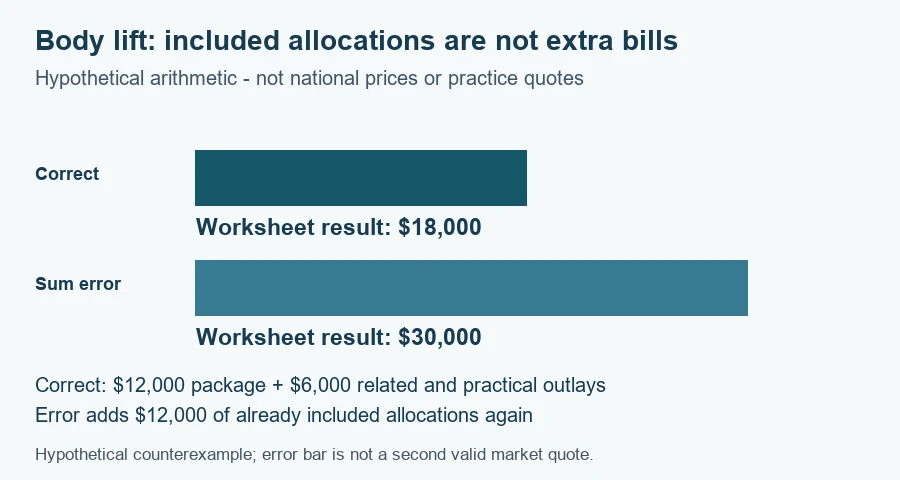
Assume a hypothetical assessed lower-body plan with one $12,000 professional package. The document expressly states that three region allocations—$5,000 abdomen, $4,000 buttock and $3,000 outer-thigh task—are descriptive shares already inside that package. They sum to $12,000. These invented allocations are not standalone clinic prices, anatomical recommendations or a standard body-lift billing structure.
Assume separately payable facility of $3,200, anesthesia of $1,800, specified care of $400 and personal logistics of $600. Those related lines total $6,000. The correct known planning outlay is therefore $12,000 plus $6,000, or $18,000. The package already accounts for the region allocations; they are not added again.
| Hypothetical document row | Amount | Payable in addition to package? |
|---|---|---|
| Professional package | $12,000 | Count once |
| Abdomen allocation inside package | $5,000 | No, expressly included |
| Buttock allocation inside package | $4,000 | No, expressly included |
| Outer-thigh allocation inside package | $3,000 | No, expressly included |
| Facility | $3,200 | Yes, under stated model |
| Anesthesia | $1,800 | Yes, under stated model |
| Specified care | $400 | Yes, under stated model |
| Personal logistics | $600 | Yes, separate model outlay |
| Correct known planning outlay | $18,000 | Package plus related lines |
Adding the three descriptive allocations again would produce an incorrect $30,000: $12,000 package plus $12,000 allocations plus $6,000 related lines. That is a double-counting error in this model, not a second valid market quote. The chart labels the erroneous sum explicitly. Its difference of $12,000 identifies the amount duplicated; it does not establish a discount, negotiation target or actual saving available from a practice.
The same caution works in the other direction. If an actual document lists three separately payable professional charges and does not state an inclusive package, counting only a headline called “starting price” may omit obligations. The hypothetical rule applies because inclusion is explicit. Ask for the actual relationship between subtotal and rows rather than copying the example’s favorable result into a document with different terms.
Can a body lift cost allocation become a standalone price?
An internal $5,000 abdomen allocation does not automatically mean the office offers that work alone for $5,000. The clinical task, setting and related charges may change when a proposal changes. A descriptive division of a bundle is not evidence of a separate quote. Ask for an assessment and an actual new financial proposal if you are discussing a different scope.
Likewise, deleting the $3,000 outer-thigh allocation does not necessarily reduce the package from $12,000 to $9,000. The actual agreement may price the combined task differently. The surgeon must determine what a changed plan means clinically, and the office must explain the resulting financial terms. Do not use allocation arithmetic to choose the operation’s extent or claim that a region can be removed without affecting the overall task.
Keep the original plan and revised plan side by side, with their actual scope and payable subtotals. Only then can you identify the complete financial difference. Some related charges might change while others remain the same, but none should be presumed fixed simply because you retained one region. The original model illustrates document reconciliation, not a method for reconstructing a changed surgery’s price from fragments.
How should body lift cost treat a separately proposed additional task?
Suppose an actual hypothetical revision of the plan adds an independently assessed task outside the original package. Assume its newly payable professional component is $2,500, additional facility $400, anesthesia $300, care $100 and logistics $200. Under those fictional inputs, the complete increment is $3,500 and the new known planning outlay is $21,500. No particular additional operation is recommended or priced by this example.
The complete increment is not the $2,500 professional amount alone. Equally, it does not include the original $12,000 allocations again. Keep the added task on a separate line with its actual related obligations, and retain the earlier package’s inclusion rule. This prevents two different errors: undercounting the new related expenses and duplicating the old region allocation rows while revising the total.
| Hypothetical reconciliation | Professional payable amount | Related and practical outlays | Correct total |
|---|---|---|---|
| Original assessed package | $12,000 | $6,000 | $18,000 |
| Separate added task | $2,500 additional | $1,000 additional | $3,500 increment |
| Revised complete plan | $14,500 | $7,000 | $21,500 |
| Merely adding descriptive allocations | No new task | No new obligation | Not a valid price change |
If the additional task has not been clinically proposed or its related charges are unconfirmed, the revised total remains conditional. Do not expand a body lift to obtain an advertised package saving. The clinical implications and realistic goals must be discussed first. A financial worksheet can describe a confirmed proposal without recommending that more work be combined or claiming a safety advantage from shared fees.
Does body lift cost represent one operation or several stages?
Ask whether the actual proposal concerns one assessed operation, multiple independently assessed stages or only a first stage. A broad region list does not establish that all work will occur at once. Each stage needs its own clinical plan and relevant financial documents. This guide does not determine which staging approach is safe or appropriate, and it does not estimate a universal saving from combining tasks.
If a quote describes only the first stage, label its total accordingly. Do not call it the complete price for every desired region unless later obligations are actually included and confirmed. Conversely, a planning document listing future possibilities is not automatically a commitment to buy all of them. Keep accepted tasks, conditional discussions and unassessed goals in separate fields so the financial record matches the actual decision.
Payment timing should be recorded independently of the package allocation. A professional advance credited against the $12,000 package reduces its remaining balance, not the complete $18,000 obligation. A payment to one entity does not settle another entity’s charge unless the actual arrangement confirms that relationship. Keep receipts attached to the payable bill rather than to an arbitrary region allocation.
Which care and practical expenses belong beside body lift cost?
Ask which routine visits, medicines and supplies the actual estimate includes and which are separately payable. A region allocation does not show how follow-up is billed. The word “aftercare” also does not establish an unlimited duration or every possible future service. Record the named inclusion boundary and ask how a further concern would be assessed if it becomes relevant, without inventing a future complication expense or individual probability.
Your personal arrangements should use actual inputs informed by the clinician’s advice. Transport, assistance, accommodation or missed income depend on your circumstances and the assessed plan. The model’s $600 logistics figure is not a universal allowance or a standard recovery expense. An additional task can affect those arrangements, but the financial worksheet cannot determine activity restrictions or a return-to-work date.
Do not remove necessary care from an estimate to make one package appear cheaper. Keep optional retail purchases separate where appropriate, while confirming the actual requirements with the treatment team. The purpose of reconciliation is to compare real obligations consistently. It should not turn a question about an inclusion into an instruction to substitute a product, skip follow-up or shorten an advised recovery period.
How should insurance and financing affect body lift cost comparisons?
The ASPS cost source notes that most health plans do not cover body-lift surgery or its complications. That general context does not establish an individual’s benefit or rule out every separately assessed medically relevant service. Ask the actual insurer about the particular proposed task and applicable requirements. Do not infer coverage from prior weight loss, a package label or a professional allocation assigned to one region.
If coverage is being investigated, retain its status and exact scope separately from a self-pay package. An approval or denial concerning one service does not automatically settle all tasks in a broad region list. This guide does not supply diagnosis codes, declare medical necessity or guarantee reimbursement. Use actual plan documents and responses before treating a hoped-for benefit as a credit against a payable bill.
Financing also has its own total-payment evidence. A monthly payment cannot be compared directly with the package’s full professional amount or an internal region allocation. Inspect actual disclosed terms if you are considering borrowing, and keep any applicable charges separate from the clinical estimate. No lender, interest rate or eligibility prediction is supplied here. A finance arrangement does not establish that the proposed operation is suitable.
How can you audit a body lift cost document before payment?
Mark every dollar row as payable, included descriptive allocation, prior payment, confirmed credit or pending amount. Then recompute only the payable obligations, crediting prior payments once when calculating the remaining balance. A descriptive allocation should retain its context but not inflate the total. If the document does not identify which category a row belongs to, ask the issuing office rather than silently choosing a classification.
Keep a region map alongside that charge map. A financially correct total can still describe a different clinical task from another proposal. Record the surgeon’s explanation of assessed regions, exclusions and any additional work, then compare matched financial fields. A label such as “complete contouring” cannot resolve either map by itself. The actual written description and clinical discussion supply the relevant evidence.
Preserve earlier documents when the quote changes. Identify whether the change concerns new scope, an adjusted payable amount, an altered inclusion or merely a clearer allocation description. The latter should not automatically change the total. After actual bills and payments arrive, reconcile their issuing entities and credits with the agreed terms. This record provides stronger evidence than a price-per-region figure derived from a bundle’s descriptive shares.
Body lift cost questions before committing
Should I add every region amount to the package? Only amounts expressly payable outside it. In the original model, $5,000, $4,000 and $3,000 are already inside the $12,000 professional package. Adding them again produces an incorrect $30,000 total instead of $18,000. The example diagnoses an arithmetic error under explicit assumptions; it does not establish how your office bills.
Does the lower-body average cover every desired skin-removal task? No. The ASPS figure retains its lower-body partial-fee scope. Other regions or independently assessed tasks require their own financial description. Do not turn a broad desired outcome into an unlimited inclusion promise or divide the average into supposed standalone region prices.
For clinical context, see the body lift guide. For the financial decision, retain the assessed region map, payable package, descriptive allocations, related bills, actual credits and pending amounts. That record makes body lift cost comparisons more understandable while preserving the difference between clinical scope, a professional allocation and a complete obligation.
Sources and review scope
Plastic Surgery Editorial Team. Source records checked through October 12, 2026. Review scope: source and editorial checks for general education. No individual clinical assessment is represented.
- ASPS lower-body partial fee boundary. American Society of Plastic Surgeons. Publication/update date not stated. Checked 2026-10-12.
- ASPS assessed region and skin-task scope. American Society of Plastic Surgeons. Publication/update date not stated. Checked 2026-10-12.
- ASPS body-lift assessment and options. American Society of Plastic Surgeons. Publication/update date not stated. Checked 2026-10-12.