
Fractional CO2 vs erbium laser is a comparison of specific resurfacing treatments, not a reliable shortcut to choosing a winner. First confirm which erbium device is proposed, what skin concern is being treated and what the complete course includes. Original acne-scar trials have reported different comparative findings under different protocols. Those results cannot establish the best treatment for every person, every scar or every resurfacing goal. 3, 4
The useful comparison is device identity, target, treatment course and endpoint. A laser name without those details leaves too much unspecified. This guide uses two original split-face studies to explain what the evidence actually measures, then provides a practical way to compare proposals without turning published settings into instructions or selected participants into personal risk estimates.
Start with a defined skin concern
ASPS describes laser skin resurfacing as an approach to facial wrinkles, scars and blemishes. That broad description is a starting point, rather than evidence that each laser protocol has the same effect on every concern. Its general explanation of resurfacing includes removing surface skin and heating underlying tissue. 1
Write down one main concern in ordinary language. A particular depressed acne scar, a broader texture concern and a line around the mouth are different requests. Ask the clinician to describe the assessed target in the treatment proposal. If a plan addresses several concerns, request a separate explanation of what each component is intended to do.
This matters when reading comparative research. An acne-scar trial does not automatically answer a wrinkle question. A result for a defined scar population cannot simply become a promise for an unspecified patch of facial skin. Before comparing percentages, check whether the research question resembles the question you are trying to answer.
Also identify what you would consider a meaningful change. You might care about the appearance of one region, the overall visibility of scars or how the area appears under ordinary lighting. These are preferences to discuss, not scoring systems you need to invent. Ask which assessment will document the goal and when that assessment will occur.
The existing laser skin resurfacing guide provides the broader procedure context. This comparison focuses on distinguishing two actual proposals and interpreting their evidence, rather than replacing an examination or prescribing a device.
Confirm the erbium device before comparing names
In the April 2023 original trial discussed below, the comparator was a fractional 2,940-nanometer Er:YAG device; the CO2 device used a 10,600-nanometer wavelength. These identify the studied equipment, not settings to request or reproduce. 4
Do not assume an advertisement using the word erbium describes precisely that trial’s equipment or treatment. Ask for the device name, the type of treatment it delivers and whether the proposed application matches the research being cited. If the clinician cites an Er:YAG study, the proposal should explain why that evidence is relevant to the actual device offered.
Device identity is only the first field. Ask whether the proposal covers the whole planned region, a smaller area or an additional visit for a separate concern. A comparison can change when one quote describes a limited application and the other describes a larger treatment area. Neither the label nor the advertised session price resolves that difference.
The erbium laser resurfacing guide can help organize that identity discussion. Keep the actual product and application in your notes rather than substituting a generic family name. An unanswered identity question should remain unanswered until the treating clinician clarifies it.
| Field | What to record | What a missing field prevents |
|---|---|---|
| Device | Actual device and treatment type | Matching the cited protocol |
| Target | Assessed concern and region | Knowing what outcome is being purchased |
| Course | Proposed visits and added treatments | Comparing complete episodes |
| Assessment | Outcome method and follow-up point | Interpreting an improvement claim |
What a split-face study can and cannot show
A split-face comparison gives two facial sides different treatments within the same participant. The two studies here used that general structure. It can be useful for examining a paired comparison, but it does not turn the sides into separate people or remove every source of uncertainty. 3, 4
When reading such a study, keep the person count separate from the treated-side count. A claim based on thirty participants should not be retold as evidence from sixty independent patients. The treatment relationship between the sides is part of the design, so a chart should preserve that relationship in its caption.
Side assignment also matters. A report that randomly assigns treatments and a report that consistently uses a particular treatment on one side do not describe identical designs. Ask whether a promotional summary retained this distinction or flattened both into the same evidence category.
Finally, compare the tested course with the proposed course. If the study included an additional intervention, the result describes that combined context. Calling the result the effect of a laser alone removes an important part of the experiment. A careful comparison states what was done, what was measured and what remains unseparated.
One randomized study followed acne scars for six months
An original study first published online on December 3, 2012, and issued in January 2013 enrolled twenty-four subjects with acne scars. It randomly assigned fractional Er:YAG and CO2 treatment to opposite sides, used two treatments two months apart and assessed outcomes at one, three and six months after the final treatment. The abstract reported no significant clinical difference at those assessments and greater treatment discomfort with CO2. 3
That is a defined finding under a defined course. It does not prove the two treatments are universally equivalent, establish a preferred choice for every skin presentation or show that discomfort will have the same pattern for you. The complete abstract was checked; unverified full-text details are not supplied here.
Notice the distinction between treatment dates and assessment dates. An outcome measured six months after the last treatment is not a claim that a person requires six months away from work. It also does not establish how long the benefit will persist beyond that observation window.
If someone uses this study to justify a proposal, ask which parts match: the target, the treatment identity, the course and the assessment. A citation alone is less useful than an explanation of that match. Where details differ, the discussion should make the difference visible instead of implying the study tested the exact plan offered to you.
A later trial reported different rating distributions
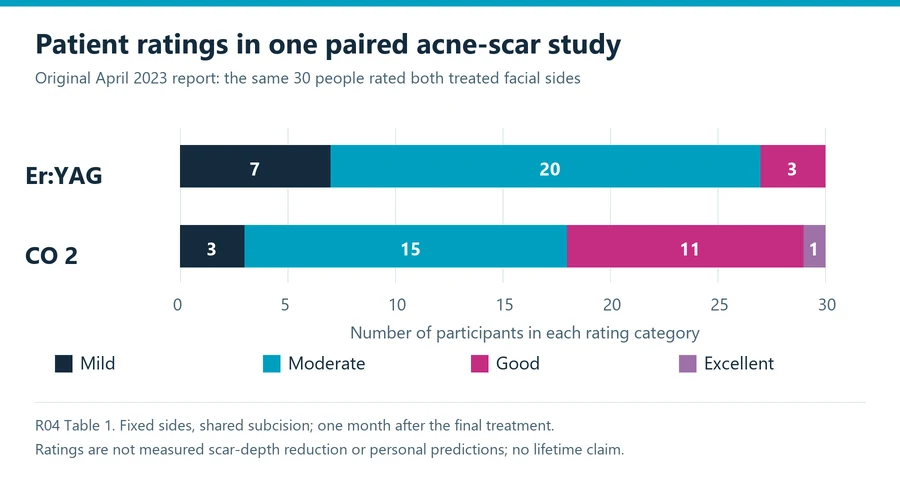
The original April 25, 2023 report evaluated thirty people, using CO2 on the right and Er:YAG on the left after subcision on both sides. It used three laser sessions and a one-month final assessment. Table 1 reports patient ratings as mild, moderate, good and excellent: Er:YAG counts were 7, 20, 3 and 0; CO2 counts were 3, 15, 11 and 1. The chart preserves those reported categories. 4
The paper also contains conflicting statistical wording between its table and narrative, and its side assignment and shared additional intervention limit interpretation. The raw table is shown without claiming a universal winner, reconstructing individual paired outcomes or extracting a personal complication rate. This is a useful example of why a striking chart still needs design information. 4
The difference from the earlier report should prompt closer reading. It should not be resolved by selecting whichever study supports an existing preference. Different courses, observations and assessments can produce different findings. Neither study’s existence supplies the missing explanation of whether its treatment context matches your assessed concern.
Read the chart as a distribution of ratings in this particular report. A bar in the good category does not mean every part of that participant’s skin improved by the same amount. The chart does not show every person’s paired movement between categories, nor does it show lifetime durability. Those missing details should stay missing rather than being invented from the totals.
Distinguish the person doing the rating
An evaluation by a participant and an evaluation by an investigator answer related but different questions. Before relying on an improvement figure, find out who assigned the score and what they were asked to evaluate. A percentage can appear precise while its meaning remains unclear.
For example, a category describing rated improvement is not automatically a percentage reduction in measured scar depth. A person reporting satisfaction is not necessarily reporting the same thing as an investigator assessing photographs. Keep the original label next to the number whenever a proposal or advertisement cites it.
The chart on this page deliberately uses one rating perspective from one table. It does not combine patient ratings with investigator ratings to create a larger sample. It does not merge categories from separate studies into an unofficial success rate. Those shortcuts can make a graphic look more decisive while weakening its interpretation.
Ask how your own goal will be documented. If you care about a particular region, an overall satisfaction question may not capture everything you want to discuss. If the proposal promises a measured change, request the measurement method. The useful connection is between your concern, the assessment and the evidence supporting the proposed approach.
| Claim format | Clarify | Avoid assuming |
|---|---|---|
| Improvement category | Rater, definition and observation date | Measured depth reduction |
| Photographic assessment | Conditions and scoring method | A personal outcome preview |
| No significant difference | Comparison, sample and endpoint | Universal equivalence |
| Combined treatment result | All included components | Effect of the laser alone |
Recovery needs a treatment-specific plan
ASPS explains that reactions and recovery vary with the treatment. Its recovery guidance discusses redness, swelling, pigment changes, infection, cold-sore reactivation and scarring. These are issues to discuss with the treating clinician, rather than reasons to infer that fractional treatment has no risks. 2
Ask what the actual proposed course means for your activities and follow-up. Separate the practical questions: when you will be reviewed, how concerns will be assessed, what instructions you will receive and who you should contact. A general recovery estimate should not replace the clinician’s plan for the actual procedure.
The laser resurfacing recovery guide addresses those planning questions in more depth. Treat the research observation dates on this page as research dates. They are not permission to resume exercise, restart skin products or schedule another treatment.
Separate appearance at a visit from permission for an activity
A study photograph at a particular month tells you when an assessment occurred. It cannot authorize an activity for an individual reader. If you need to plan work, travel or an important event, describe those activities to the clinician and ask how the proposed course affects them. Keep the answers attached to that proposal, not to a generic laser label.
Likewise, do not use the settings printed in a research paper as a treatment request. The purpose of recording protocol identity here is to interpret evidence. Your assessment and care instructions require the treating clinician’s judgment, including whether treatment should be offered at all.
Disclose relevant history before choosing a course
A comparison should leave space for information that could change the plan. Tell the treating clinician about previous treatments and your relevant medical and skin history, rather than trying to decide eligibility from a study’s inclusion criteria. Research selection rules describe who was studied; they do not provide a self-screening clearance tool.
ASPS specifically advises discussing a cold-sore history in its resurfacing recovery guidance. The laser resurfacing and herpes-risk discussion provides context for that disclosure. It does not supply an antiviral prescription, dose or permission to proceed. 2
Record the answer if the clinician says a cited study does not adequately represent your situation. That answer is useful. It identifies an evidence limitation rather than forcing a false match between the research population and your circumstances. Ask what evidence or clinical reasoning supports the proposed alternative.
Avoid treating a very small study as proof that uncommon problems cannot happen. The absence of a particular event in a selected series does not establish a zero personal risk. A sound discussion explains uncertainty and the plan for managing concerns without translating limited observations into certainty.
Compare complete proposals rather than session prices
Use the laser skin resurfacing cost guide to separate a session price from a complete quoted course. This comparison does not invent a national fee range or assign a price to a research protocol. The first task is to establish what each actual written quote includes.
Record the proposed region, number of visits, additional procedures, follow-up and separately charged items. Ask which parts are committed at the outset and which are conditional. A quote for one visit and a quote for a planned series are different units, even when both advertisements display a price beside the word laser.
If an additional procedure is part of the plan, keep it visible in both the evidence and cost discussion. A combined-treatment study should not be used to sell a laser-only benefit while a combined-treatment quote hides the extra component. The scope described in the evidence and the scope described in the proposal should be understandable together.
Do not estimate a complete course by silently multiplying a headline price by a research session count. The research course is not your treatment plan, and the quote may include or exclude items that change the comparison. Use the actual proposal, then identify any missing information before calculating a total.
| Question | Proposal A | Proposal B |
|---|---|---|
| Exact device and region? | Record written scope | Record written scope |
| Single visit or planned course? | Record proposed visits | Record proposed visits |
| Added procedures? | List separately | List separately |
| Follow-up and assessment? | Record method and timing | Record method and timing |
| Missing or conditional charges? | Request clarification | Request clarification |
Make the comparison useful without forcing a winner
Fractional CO2 vs erbium laser becomes useful when the comparison names a target, identifies the devices and explains the tested or proposed course. A broad preference for one laser family is less informative than an answer about the actual assessed concern and the evidence relevant to it.
Before choosing, check whether you can explain the proposal in plain language. You should be able to identify the region, the main goal, the included components and the planned assessment. If one of those is unclear, the next step is clarification. More decimal places in a promotional statistic will not fill that gap.
Keep the strongest finding and its limitation together. A reported difference belongs beside the sample, the course and the observation point. A nonsignificant finding belongs beside the actual comparison, rather than being expanded into a universal equivalence claim. A combined-treatment result belongs beside the additional treatment.
The aim is an informed discussion with the treating clinician. This page provides a method for reading two proposals and two original studies. It does not diagnose scars, prescribe settings, estimate your individual complication risk or promise the appearance of your skin after treatment.
Sources and review scope
Plastic Surgery Editorial Team. Source records checked through October 12, 2026. Review scope: source and editorial checks for general education. No individual clinical assessment is represented.
- ASPS laser skin resurfacing overview. plasticsurgery.org. Publication/update date not stated. Checked 2026-10-12.
- ASPS laser skin resurfacing recovery. plasticsurgery.org. Publication/update date not stated. Checked 2026-10-12.
- Comparison of fractional erbium-doped yttrium aluminum garnet and carbon dioxide lasers in resurfacing of atrophic acne scars in Asians. pubmed.ncbi.nlm.nih.gov. Source date: 2012-12-03. Checked 2026-10-12.
- A Comparative Study on the Usefulness of Fractional CO2 and Fractional Er:YAG in Acne Scars: A Split-Face Trial. pmc.ncbi.nlm.nih.gov. Source date: 2023-04-25. Checked 2026-10-12.
- ASPS laser skin resurfacing procedure steps. plasticsurgery.org. Publication/update date not stated. Checked 2026-10-12.