
Laser resurfacing herpes risk should be discussed with the responsible clinician before treatment, including your actual cold-sore history and any current symptoms. AAD laser education advises disclosing cold sores, medicines and relevant medical conditions. Historical original research studied clinician-directed antiviral prevention in selected facial resurfacing groups. That evidence does not supply your personal risk, prove that outbreaks are impossible with prevention or authorize a medicine regimen chosen from an article. Ask how the clinical team will assess the proposal, plan prevention if appropriate and respond to a concern.
This resource explains the history, evidence and care-coordination questions. It provides no drug choice, dose, start date or duration. A new lesion or other concern after resurfacing needs assessment rather than an online diagnosis. AAD cold-sore guidance recommends medical care for concerns such as a lesion near an eye, several sores or substantial pain. Tell the team what is occurring and seek the appropriate evaluation; do not treat every new skin change as ordinary healing or assume it must be HSV.
Why discuss laser resurfacing herpes risk before an appointment?
The actual history may affect the clinician’s assessment and plan. Tell the team about known cold sores, previous diagnoses and prior concerns around procedures, while labeling uncertain memories honestly. A general skin-treatment questionnaire should not replace a specific discussion if you do not understand what was asked. The clinician needs to know what is documented and what is uncertain rather than receiving an assumed negative history simply because you do not recall a test.
For laser resurfacing herpes risk, ask which actual laser procedure is proposed, the area and purpose, and whether another intervention is included. A service called resurfacing may not identify those details. Evidence from a historical CO2 facial study should not automatically be transferred to every current device, area or combined treatment. This page does not choose the technology or decide whether the proposal is appropriate for you.
What does AAD laser education advise disclosing?
AAD’s laser-scar education emphasizes consultation and asks patients to disclose cold sores, medical conditions, medicines and supplements. It discusses clinician planning for people prone to cold sores and the importance of actual aftercare. Its scope is general laser-scar education, and the displayed references do not establish a new revision date. This answer does not copy its broad medication-stop instructions as personal directions. Read AAD laser consultation information. For comparing acne-scar treatment questions by scar type, see acne scar treatment by scar type.
A laser resurfacing herpes risk conversation should use that disclosure guidance without converting it into a self-selected prescription. Ask the responsible clinician whether prevention is appropriate for the actual intervention and what information supports that decision. If a medicine is prescribed, obtain the exact instructions from the prescriber. Do not use a remembered regimen from another procedure or stop an existing prescription because a general laser page mentions medicines that may affect care.
What did the original prevention study examine?
A study published in April 2002 evaluated two clinician-directed preventive regimens in 120 participants undergoing facial CO2 laser resurfacing. No HSV events were observed in either studied group. That is a bounded result in a selected historical population, not evidence that the risk is zero for everyone or that a particular regimen is universally suitable. This answer inspected the indexed original PubMed abstract; a direct opening was empty and the full paper was not accessed. Read the original laser prevention study record.
For laser resurfacing herpes risk, the study supports asking about a professional prevention plan while preserving the evidence limits. It does not provide a current universal medication protocol. The actual drug, health history, procedure and clinical assessment need to be considered by the prescriber. This article intentionally omits the study’s doses and schedules. An absence of observed events in a limited trial should not be rewritten as a personal guarantee or a reason to disregard a later symptom.
Why does the type of resurfacing matter to the evidence?
A study’s device, area, population and follow-up define what it evaluated. A result about a particular facial CO2 intervention does not establish an identical outcome for every laser or an unrelated procedure. Ask which evidence the clinician considers applicable to the actual proposal and what differences limit the comparison. A technology’s familiar name should not make those differences disappear. This page does not rank devices by HSV risk or choose settings.
A laser resurfacing herpes risk record can identify the proposed intervention and the source of the plan without becoming a technical operating guide. Ask whether the proposal changed after consultation or includes a combined treatment that needs its own discussion. If the area or clinical circumstances change, tell the team and ask whether the prevention or follow-up advice needs review. An earlier booking date or leaflet does not automatically cover a different intervention.
What if you have never had a recognized cold sore?
Tell the clinician that you do not recall a recognized episode rather than interpreting the statement as a laboratory conclusion or a zero-risk guarantee. This article does not recommend testing or establish that an unrecognized history rules HSV in or out. The clinical team can explain which history and assessment are relevant to the proposal. Avoid guessing an answer to a medical question simply because you believe a particular response preserves the appointment.
For laser resurfacing herpes risk, the record should distinguish a known diagnosis, an uncertain earlier lesion and no recalled history. Ask how each is considered without choosing a category yourself. A prevention study’s selected participants may not match your situation. The point of accurate disclosure is to support the clinician’s decision, not to certify safety through a negative checkbox or assign a personal probability from memory.
What if a lesion or symptom is present before treatment?
Report the actual concern to the clinical team before proceeding with the elective appointment and ask what assessment is appropriate. Describe where it is, when it began and what has changed. Do not diagnose it as HSV from an internet image or conceal it because the booking is difficult to change. This article does not decide whether to cancel, treat or reschedule; the responsible clinician must assess the current situation and explain the plan.
A laser resurfacing herpes risk discussion should identify who makes that decision and how you will receive the answer. Administrative confirmation that the appointment remains booked is not necessarily clinical permission to proceed with a new concern. If the original clinician is unavailable, ask how an appropriate assessment will occur. Keep the actual advice and its date rather than relying on a general instruction from the first consultation.
How should a prescribed prevention plan be understood?
Ask the prescriber to explain the purpose of the actual medicine, how to follow the instructions, and whom to contact with a problem or a change in health. Provide the requested medication and relevant medical history. Keep the prescription distinct from information in a research abstract. This guide does not select an antiviral, interpret interactions, prescribe a schedule or decide that the regimen used in an old study is suitable for you.
For laser resurfacing herpes risk, prevention and treatment of an actual concern are different tasks. If symptoms develop despite a prescribed plan, contact the responsible team rather than changing the regimen yourself or assuming the symptom cannot be HSV. Conversely, the presence of a lesion does not establish the diagnosis through this article. Ask what assessment is needed and how the prevention instructions relate to the current clinical finding.
Does prevention eliminate the need for symptom assessment?
No outcome observed in a selected study establishes that every future patient will remain free of a complication. A person receiving clinician-directed prevention should still follow the actual response instructions and report a concern. The study’s lack of observed events is not an instruction to disregard symptoms. Ask the team how to distinguish routine communication from a concern requiring prompt assessment and where care should be obtained if the original practice is closed.
A laser resurfacing herpes risk plan should state the clinical response owner, not only the medicine instructions. A clinic may provide routine skincare aftercare, but a suspected infection or another medical concern needs the appropriate assessment. Do not apply another product, alter the treated surface or borrow medicine to preserve the expected appearance timeline. This resource supplies no troubleshooting procedure or home diagnosis. For a separate discussion of recovery tasks and questions after that procedure, see laser skin resurfacing recovery.
Which cold-sore concerns does AAD identify for medical care?
AAD’s cold-sore patient guidance recommends medical care for situations including lesions near an eye, several sores, substantial pain and certain immune-related circumstances. It describes clinician assessment and, when appropriate, testing to help identify HSV. The page displays a February 1, 2024 update. This is general cold-sore education, not a laser-specific diagnosis or regimen. Read AAD cold-sore assessment guidance.
For laser resurfacing herpes risk, that source supports seeking care for a concerning lesion rather than assuming all changes are ordinary healing. Tell the assessing clinician about the actual procedure and any medicine taken. This page does not rule out an eye or other serious problem, and its examples are not a checklist requiring every item before contact. Ask for an appropriate response based on what is happening now.
How can the planning questions be organized?
| Question | Useful information | Boundary |
|---|---|---|
| What is the actual history? | Documented or recalled cold sores and concerns | No zero risk from memory |
| What is proposed? | Actual laser,area and added procedures | No all-device study transfer |
| What is the clinician’s plan? | Assessment and actual prescribing decision | No self-selected regimen |
| How is a concern handled? | Clinical owner and response instructions | No prevention guarantee |
Keep the evidence separate from the prescription
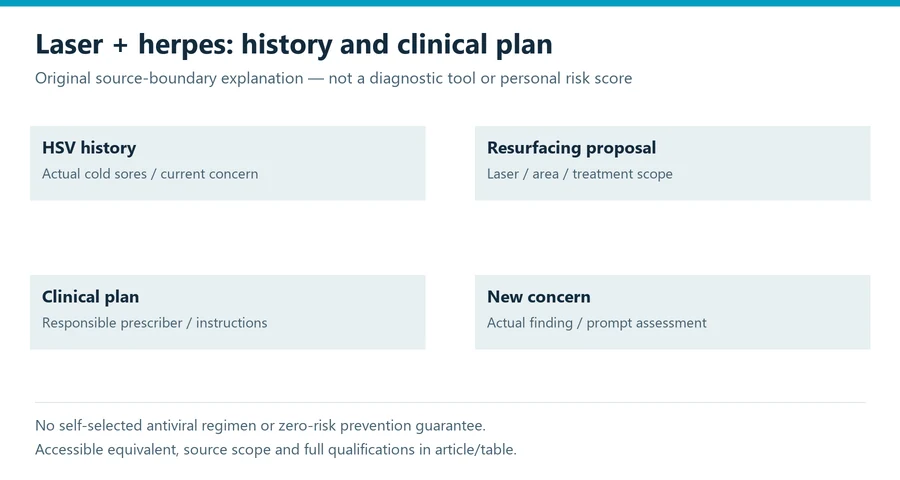
The original organizer helps a laser resurfacing herpes risk conversation identify the information, decision and response responsibility. It is not an eligibility screen or a medication protocol. If a study is cited, ask which procedure and participants it describes and how it informs the actual proposal. A complete planning record does not prove that prevention will succeed; it helps you understand what has been assessed and what instructions belong to your clinician.
What if the appointment or proposed procedure changes?
Tell the clinical team about a changed date, area, procedure or health concern and ask whether the actual instructions need review. Do not independently move a medication schedule to match a new booking. A prescription is an actual clinical instruction, not a generic calendar formula. If different staff members provide different answers, request clarification from the professional responsible for the prescribing or assessment decision.
For laser resurfacing herpes risk, retain the current plan and identify any earlier instruction it replaces. If an elective procedure is postponed, ask what needs to be established before reconsidering it and how a current concern should be assessed in the meantime. This article does not assign a universal waiting period after a lesion or declare that a particular number of symptom-free days supplies clearance.
How should evidence and marketing claims be compared?
Ask whether a claim is based on an actual original study, general education, a clinician’s judgment or the current assessment. A statement that a limited trial had no observed outbreaks is narrower than a statement that the procedure never causes one. Keep the publication date and procedure context attached. A study from 2002 should not be presented as new 2026 trial data or used to promise an identical result with every technology.
Laser resurfacing herpes risk evidence can support a meaningful discussion without a headline personal percentage. Ask what uncertainty remains and how the team responds if the expected course changes. This page does not publish a device or practitioner ranking. A confident marketing statement should not replace a product-specific proposal, actual clinical assessment and transparent response arrangement.
What should be retained for follow-up or another opinion?
Keep the actual procedure record, relevant history, prescriptions, assessment findings and instructions. If you seek another opinion, explain which question remains unresolved: diagnosis, prevention, a new symptom or a future elective proposal. Share prior treatments accurately rather than omitting them to obtain a preferred answer. The second clinician can explain which information is needed and what can be determined from the available record.
For laser resurfacing herpes risk, the record should label a tentative explanation as tentative. If a diagnosis is established, retain the actual professional finding rather than only a description copied from an online account. Ask who communicates test results and how follow-up is arranged. Administrative record requests should support medical care, not delay assessment of a current concern while you assemble a perfect history.
How should a change of clinic or procedure affect an existing prevention plan?
If the proposed resurfacing changes, tell the new responsible clinician about the previous assessment and any prescription already issued. A plan attached to one procedure should not silently become instructions for another device, area or date. Ask the clinician who prescribed the medicine to explain whether the instructions still apply. If different teams give different directions, request clarification from the responsible professionals rather than combining portions of the plans into your own schedule.
In laser resurfacing herpes risk planning, keep a brief record of the actual proposal, the clinician’s instructions and the question that remains unresolved. You may need to communicate the exact prescription label or obtain a prior note, but the clinical team determines the current plan. A historical study regimen is not a substitute for that discussion. This resource does not select a preventive drug or tell you to begin, stop or change a prescription because an appointment moved.
The same distinction helps when an unexpected concern occurs after treatment. Report the actual symptoms and the prevention instructions you followed without assuming that prevention makes infection impossible or that every new lesion is herpes. A clinician can assess the finding and its relationship to the procedure. For laser resurfacing herpes risk, the useful handoff is the accurate history, current concern and responsible contact; a confident remote diagnosis adds certainty that the evidence and an examination have not supplied.
What belongs in the elective decision?
Understand the actual proposal, relevant history assessment, clinician-directed prevention if appropriate, and the plan for a new concern. Ask for clarification if you cannot explain the instructions in your own words. The decision should use the actual clinical information and your goals without treating an old trial as an individual guarantee. This guide does not decide whether you should proceed or prescribe how to prevent a complication.
Laser resurfacing herpes risk planning is most useful when history, procedure, evidence and response responsibilities remain distinct. AAD education and the bounded original study support a clinical conversation, not a home medicine schedule. Use the procedure guide for broader treatment selection. This answer supplies practical questions without a fabricated outcome, universal probability, antiviral regimen or personal clearance.
Sources and review scope
Plastic Surgery Editorial Team. Source records checked through October 12, 2026. Review scope: source and editorial checks for general education. No individual clinical assessment is represented.
- AAD laser scar consultation education. aad.org. Publication/update date not stated. Checked 2026-10-12.
- Original valacyclovir laser resurfacing prevention trial. pubmed.ncbi.nlm.nih.gov. Source date: 2002-04. Checked 2026-10-12.
- AAD cold sore diagnosis and treatment education. aad.org. Source date: 2024-02-01. Checked 2026-10-12.