
Cheek implants vs cheek fillers compares a surgically placed solid device with an injected material used to change facial volume or contour. The choice cannot be reduced to “permanent versus temporary” or “surgery versus no risk.” You need a clearly defined cheek goal, the exact proposed implant or filler, an explanation of why it suits the examined area and a plan for future care. A study comparing two fillers does not establish whether either is better than a cheek implant.
The most useful starting point is a description of the change you want: more prominence in a particular cheek area, restoration of fullness, correction of an asymmetry or another specific concern. Ask the clinician to identify which part of the proposal addresses that goal and which limitations remain. This educational comparison does not choose a device, injection product, amount or technique for you. It helps distinguish the offers and read their supporting evidence without assuming that unlike treatments are interchangeable.
A solid implant and an injectable filler are different materials
ASPS identifies cheek implants as a surgical augmentation option and injectable fillers as a nonsurgical option. 1 FDA also uses the term “injectable implants” for dermal fillers. 2 That terminology does not make a gel injection the same as a solid cheek device. Clarify what the clinician means whenever the word “implant” appears in a consent form or treatment description. The dermal fillers guide explains that procedure and its consultation questions separately.
Ask for the exact solid implant material and design, or the filler product and material. “Cheek enhancement” is a goal, not a product identification. “Filler” is a category, not a guarantee that every product behaves the same way. The written plan should identify the actual proposal and the area being treated. Keep the distinction visible when comparing risks, expected duration, a possible correction and cost.
FDA’s approved-filler page directs readers to specific product information and approval records. 3 Ask to review the current patient information for the proposed product and intended use. An approval for one filler or one location does not automatically describe another. This does not require you to become a device regulator; it requires the team to make the treatment identity and scope understandable before you decide.
| Identification question | Solid cheek implant | Injectable filler |
|---|---|---|
| What is proposed? | Exact material and device design | Exact product and filler material |
| Where is it intended? | Clinician-defined augmentation area | Clinician-defined injection area |
| How will it be documented? | Operative and device records | Product and treatment records |
| What if the result needs reassessment? | Ask about the surgical assessment process | Ask about assessment of the actual material |
Retain the records the treating team recommends. If you later discuss another procedure, provide the existing treatment history rather than assume the new clinician can identify every material from appearance. A clear record is more useful than remembering only the amount paid or the broad name of the treatment. It also helps you ask product-specific questions if guidance changes.
Define the cheek goal before selecting a method
Describe the location and character of the desired change rather than request a general increase in “cheekbones.” Point out the concern in a neutral, unfiltered photograph and explain whether it is visible from the front, in profile, during expression or in another setting. This is a communication aid, not a way to diagnose the underlying anatomy. Ask the clinician to explain what the assessment shows and how it connects to the proposed change.
Distinguish a request for added projection from a request for more fullness across a broader area. Also distinguish either from a concern about skin, a line or a position you would like lifted. Those descriptions may lead to different discussions. Adding volume should not be assumed to solve every concern around the cheek. A good recommendation explains which part of your stated goal it addresses and which part may remain.
If the two sides differ, ask whether the proposals are the same on both sides and why. “Balanced” does not mean that identical amounts or identical devices are automatically appropriate. You do not need to select the quantities yourself. You need to understand whether the plan is based on an assessed difference and what residual asymmetry is realistic. Avoid treating a digitally mirrored face as a required surgical target.
Before committing to a method, decide what would count as too much change for you. Bring that preference into the conversation as clearly as the change you want. A photograph that looks appealing on someone else may not fit your own sense of proportion or identity. Ask how the team will evaluate the proposed contour and which appearance cannot be promised. The answer should address your goal rather than simply recommend a larger package.
Understand the surgical proposal without choosing operative details yourself
ASPS describes different approaches for solid cheek implants, including an incision inside the mouth or beneath the eyelid, depending on the surgeon’s approach. 4 Ask which is proposed and what that means for your aftercare and visible scar discussion. This is not a reason to select an incision from an online description; it is a reason to identify the actual operation in the plan you are comparing.
Ask whether the implant proposal is isolated or accompanies another facial operation. If a result photograph includes a facelift or another procedure, it cannot isolate the contribution of the cheek implant. Record every planned component and its purpose. This keeps a narrower implant offer from being compared with a photograph of a more extensive treatment as though both showed the same intervention.
Clarify the distinction between a planned addition and a possible later correction. What is intended in the initial operation? Which additional procedure is conditional, and what would prompt reconsideration? A complete explanation does not require a promise that no future surgery will ever be needed. It requires the team to explain what is planned now and how a concern would be assessed afterward.
A long-lasting device also raises a preference question: do you understand and accept the ongoing relationship with that device? Ask how to obtain help if your preference changes or a new concern develops. Do not assume removal is equivalent to never having had surgery. The appropriate discussion is individualized and should not be replaced by a promotional statement that a solid device is automatically the most economical or most natural option.
Filler duration and correction depend on the actual product
FDA explains that some fillers are absorbed over time and that duration depends on the material and treated area. It also warns that reducing or removing filler may require interventions with their own risks, and may be difficult or impossible, particularly for permanent or non-hyaluronic-acid materials. 2 “Reversible” should therefore prompt a product-specific discussion rather than act as a blanket assurance.
Ask what evidence supports the expected duration for the product, location and treatment course actually proposed. Does the estimate refer to a visible improvement, a rating-scale response or measured retained volume? Those endpoints need not describe the same experience. Also ask whether the estimate includes a touch-up or further treatment. A study involving optional additional injection does not automatically describe one treatment followed by no further care.
If you want a modest change and an opportunity to reassess it, explain that preference. Do not assume it proves you should receive filler, or that a successful filler result guarantees a later implant result. The materials and procedures differ. If a clinician proposes a sequence, ask for its purpose and the conditions that would determine the next step rather than treating the first treatment as a compulsory trial.
Keep follow-up assessment separate from an automatic refill date. A plan should explain when the result will be reviewed and how a decision about further treatment will be made. Record the original goal and previous treatment details so the discussion concerns the overall course. Do not choose additional volume merely because a package expires or because a discounted appointment is available.
What a filler trial can and cannot answer
A randomized 2021 study compared two hyaluronic-acid fillers, with 142 participants assigned to one product and 68 to the control. Optional touch-up was allowed at four weeks. The primary comparison was a midface fullness scale at 12 weeks after the last injection; follow-up continued through 48 weeks. Reported mean scale changes were −1.4 and −1.3. Neither group received solid cheek implants. 5
| Evidence detail | What the trial describes | What it does not establish |
|---|---|---|
| Comparison | Two specified hyaluronic-acid products | Implant versus filler superiority |
| Treatment course | Injection with an optional touch-up | Every one-session result |
| Primary endpoint | Fullness rating at 12 weeks after last injection | A personal volume target |
| Follow-up | Study assessments through 48 weeks | Lifelong persistence or absence of rare harm |
A rating-scale change is not a percentage of retained injected volume or a percentage of people who prefer the result to surgery. Keep the name of the measure attached to the finding. The fact that a study is randomized is valuable for the comparison it actually makes; it does not expand its scope to an untested operation. Ask which part of your decision the evidence informs and which remains a clinical or personal judgment.
Be similarly careful with a split-face filler study. Treating the two cheeks differently can help compare specific injection approaches or products, but it is not necessarily a comparison between filler and a surgically implanted device. When a headline says “cheek augmentation study,” read the methods before borrowing its conclusion. The broad goal can be shared while the actual interventions are quite different.
Why a historical implant report uses two denominators
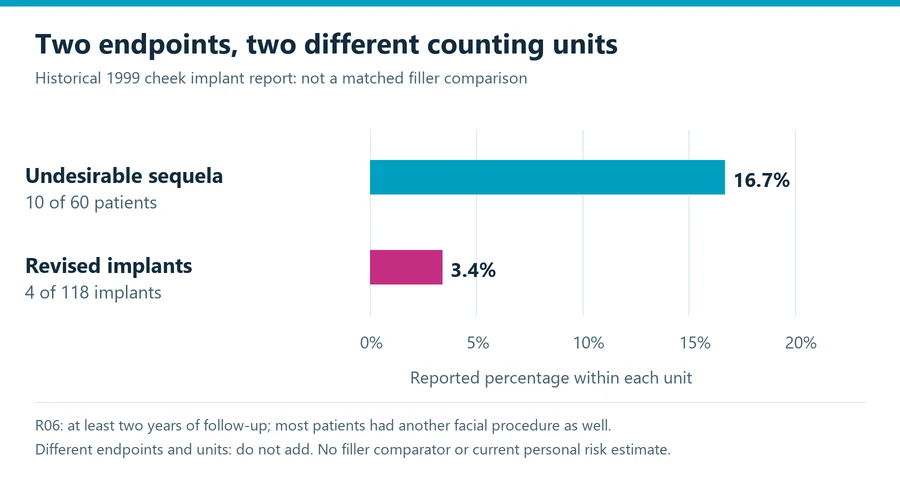
A 1999 retrospective report followed 60 implant patients for at least two years. Most also had another facial procedure. Ten patients had an undesirable sequela, reported as 16.7%; four of 118 implants were revised, reported as 3.4%. These are different endpoints with different units. The study did not include a filler comparison. 6
The companion chart preserves the patient denominator for the first observation and the device denominator for the second. It is an explanation of how the report counted events, not a current personalized risk estimate. The two percentages should not be added or interpreted as competing rates of the same event. Historical material, selection and combined procedures also limit how directly the figures describe a new offer. 6
One person can contribute more than one device
When a paper counts implants rather than patients, ask what that unit means before interpreting the percentage. A revision to one device is not automatically a revision to one distinct person, and a person-level complication count cannot be converted to a device count without the underlying records. The denominator is part of the finding, not an optional footnote that can be dropped to simplify a sales claim.
The same caution applies to satisfaction. An overall result from combined facial surgery does not reveal how much satisfaction came from the cheek implant alone. A favorable report can be informative while still leaving your specific question unanswered. Ask whether the studied population, material, accompanying surgery and assessment period resemble the proposal you are considering. If they do not, the clinician should explain the limits rather than present the study as a guarantee. The facial fat transfer guide explains that procedure and its consultation questions separately.
Compare the relevant risks instead of counting incisions
ASPS identifies possible cheek-implant displacement, scar tissue around the device, infection, asymmetry, sensation changes, healing concerns and revision among augmentation risks. 7 FDA warns that filler injected unintentionally into a blood vessel can cause serious harm, including tissue death, blindness or stroke. 2 These concerns differ; neither category becomes risk-free because it avoids the other’s procedure.
Ask the team to explain the risks for the specific material, location and operation proposed, and its plan for assessment if a concern develops. A claim that one approach is safer needs a defined endpoint and relevant evidence. A small study reporting no serious adverse events cannot establish that a rare event is impossible. Likewise, a report describing a complication does not establish its frequency in every current practice.
Know the written contact and urgent-care instructions before treatment. FDA advises immediate medical attention for unusual pain, vision changes, concerning skin color changes near an injection or stroke symptoms during or shortly after filler treatment. 2 Do not wait for a routine cosmetic follow-up to discuss those symptoms. Request the responsible clinician’s plan, and do not attempt to inject, dissolve or reposition a material yourself.
Plan recovery around the actual procedure and your responsibilities
ASPS describes individualized postoperative care for cheek augmentation. An inside-mouth implant approach may involve specific diet or mouth-rinse instructions; other care can involve dressings, medicines, warning concerns and follow-up. 8 Ask for the instructions for your actual proposal. Do not adopt a mouth-care regimen or recovery calendar from another person’s account simply because both treatments were called cheek augmentation.
List the activities you must plan for: work, caregiving, exercise, driving, eating, travel and an upcoming event. Ask which restrictions apply and how readiness is assessed. Visible swelling and medical clearance are different planning questions. A person may be concerned about appearing at an event even after being cleared for a task, or may feel ready before being medically cleared. The team’s instructions should govern the medical decision.
If you are traveling for treatment, ask how follow-up and a new concern will be assessed after you leave. Make arrangements before the procedure rather than assume a photograph sent later can answer every question. Keep the exact treatment record accessible to clinicians involved in subsequent care. This is useful whether the proposal is surgery or injection and should be part of comparing the complete offer.
Compare costs over a stated course, not a lifetime promise
Request written estimates naming the material, one or both sides, planned amount or device, treatment components and follow-up. For surgery, clarify facility and anesthesia charges. For filler, clarify whether the quotation is per syringe, per visit or for a defined course, and whether a touch-up is included. A price without those units cannot be compared reliably with another offer.
| Cost item | Information needed | Comparison error to avoid |
|---|---|---|
| Initial treatment | Named product or device and scope | Treating all cheek enhancement as equivalent |
| Additional treatment | Included, optional or separately quoted | Assuming every future visit is free or required |
| Follow-up | What assessment is included | Comparing only the initial appointment |
| Longer course | Your stated time horizon and uncertainties | Claiming a lifetime saving from an invented refill schedule |
Do not multiply an assumed annual filler cost across decades or declare surgery a one-time lifetime expense. Neither assumption follows from the studies above. You can compare the initial offers and discuss plausible future commitments while leaving uncertain frequency and cost uncertain. A budget worksheet is most useful when it records what is known and names the person who can clarify an unresolved item.
Choose a clearly identified plan for your own contour goal
Summarize the intended cheek change, the material proposed, the reason it fits the examination and the limitation you most need explained. Ask the team to correct that summary. If you are comparing two recommendations, compare those elements before comparing slogans about permanence, reversibility or naturalness. You may decide that a proposed change is too large, that future responsibilities do not fit your preferences or that more assessment is needed.
A sound choice connects a specific cheek goal to a named device or filler and an understood care plan, while keeping study endpoints and denominators intact. The evidence can inform that discussion without pretending there is one best material for every face or a head-to-head answer where none was actually studied.
Related planning guides
Explore the procedure guide library, questions to ask a plastic surgeon and full-course cost guide.
Sources
R01. ASPS: Cheek Augmentation.
R02. FDA: Dermal Fillers (Soft Tissue Fillers).
R03. FDA: FDA-Approved Dermal Fillers.
R04. ASPS: Cheek Augmentation Procedure Steps.
R06. Metzinger and colleagues: Five-year retrospective malar implant review, September 1999 issue.
R07. ASPS: Cheek Augmentation Risks and Safety.
R08. ASPS: Cheek Augmentation Recovery.
Sources and review scope
Plastic Surgery Editorial Team. Source records checked through October 12, 2026. Review scope: source and editorial checks for general education. No individual clinical assessment is represented.
- ASPS cheek augmentation option categories. plasticsurgery.org. Publication/update date not stated. Checked 2026-10-12.
- FDA filler scope, removal limits and urgent concerns. fda.gov. Publication/update date not stated. Checked 2026-10-12.
- FDA product-specific approved filler index. fda.gov. Publication/update date not stated. Checked 2026-10-12.
- ASPS cheek implant approach differences. plasticsurgery.org. Publication/update date not stated. Checked 2026-10-12.
- Original randomized HARC versus comparator filler trial. pubmed.ncbi.nlm.nih.gov. Source date: 2021-09-01. Checked 2026-10-12.
- Original historical Silastic malar implant cohort. pubmed.ncbi.nlm.nih.gov. Source date: 1999-09. Checked 2026-10-12.
- ASPS cheek implant risk categories. plasticsurgery.org. Publication/update date not stated. Checked 2026-10-12.
- ASPS individualized cheek operation aftercare. plasticsurgery.org. Publication/update date not stated. Checked 2026-10-12.