
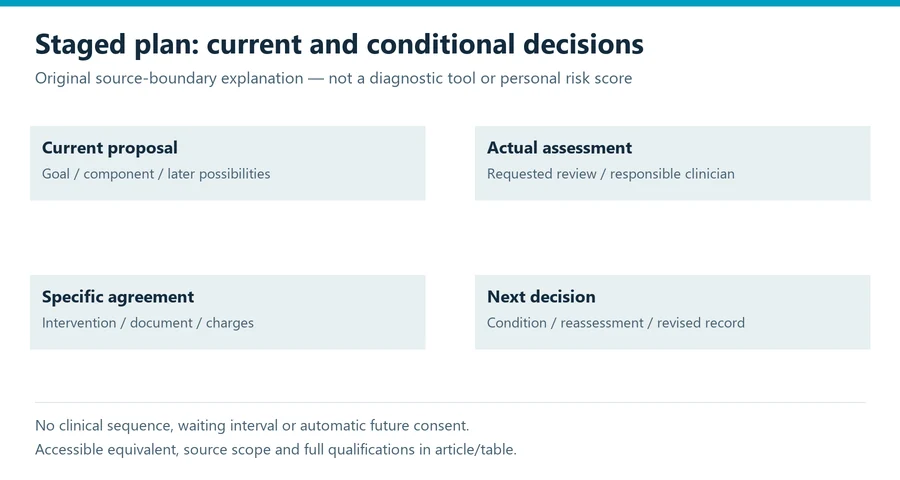
A staged plastic surgery plan should identify what is proposed now, what remains conditional and which decisions must be revisited later. A discussion of several operations is not automatic authorization for all of them. Ask the team to explain each actual proposal, its assessment process and the relevant financial agreement. This page organizes those questions; it provides no clinical stage interval, sequence recommendation or personal clearance to proceed.
Use the record to separate a goal, a possible stage, a current agreement and a completed decision. If a later stage depends on reassessment, keep that condition visible. A package price, calendar reservation or deposit does not decide whether a future operation is clinically appropriate. The responsible professionals should explain the actual plan and what happens when it changes.
What should a staged plastic surgery plan name first?
Begin with the actual goal and the proposed components. Ask the surgeon which part is being considered for the current operation and which parts are only possibilities for later discussion. Avoid describing every option mentioned at a consultation as a commissioned stage. An accurate record should show the difference between considering an option and deciding to undergo a specific intervention.
The American Medical Association’s Ethics Opinion 2.1.1 describes informed consent as communication leading to agreement about a specific medical intervention. Its guidance addresses relevant information, alternatives including forgoing treatment and documentation of the decision. We directly inspected the official opinion. It is ethics guidance, not a state-specific legal determination or proof that a form authorizes every future operation. AMA informed consent ethics opinion
For a staged plastic surgery plan, ask how the team distinguishes the current intervention from future proposals. If you do not understand the scope, request clarification before treating the record as settled. This article does not interpret the legal validity of a consent form. Keep any administrative revision question in the revision policy record, separate from current assessment or treatment. Its original organizer helps identify what was actually explained and agreed, with unresolved questions left unresolved. The informed consent discussion provides separate context for understanding a specific intervention; it is not a substitute for the actual professional conversation.
| Staged plastic surgery plan entry | Actual information to confirm | Boundary of this organizer |
|---|---|---|
| Proposal | Current component and later possibilities | No recommended sequence |
| Assessment | Required review and responsible clinician | No clinical waiting interval |
| Agreement | Specific consent and payment document | No automatic future authorization |
| Next decision | Actual condition, reassessment and updated record | No guaranteed later stage |
Mark conditional stages as conditional
A later operation may be discussed without a final decision. Record the condition the clinician actually describes and identify who will assess it. Do not replace that condition with an online recovery estimate or a date that suits your calendar. This planning record does not determine whether the condition has been met; it keeps the next question visible for the responsible professional.
How should goals be separated from components?
Write the goal in ordinary language and keep the proposed technique in a separate space. A person may have one goal with several possible approaches, or several goals that require separate discussions. This article does not select the appropriate operation. It helps prevent a list of procedure names from obscuring what each part is meant to address and what remains uncertain.
For a staged plastic surgery plan, ask whether a component is proposed, optional, conditional or declined. Use the team’s actual explanation rather than creating a status from your expectations. If a later possibility is removed from consideration, update the record. Keeping an old option visible as if it remains scheduled can create confusion about appointments and agreements.
Ask how alternatives relate to each goal. This includes the possibility of no operation when that is part of the clinical conversation. A stage should not be treated as inevitable simply because another stage has already occurred. The next proposal still needs its own explanation and decision process appropriate to the circumstances.
If the goal changes over time, tell the surgeon. Do not assume that the original technique remains the current recommendation. Preserve the earlier discussion as history while identifying the current question clearly. This is original document organization, not a clinical claim that a particular change in preference requires a specific operation or waiting period.
Which questions belong to each proposed operation?
The American College of Surgeons provides patient education encouraging discussion of the actual operation, alternatives, anesthesia, recovery and costs with the surgeon. We inspected the current page and summarize those broad factual topics without reproducing its questionnaire. The page is undated; its reference to a 2008 book does not establish the page’s update date. ACS questions before an operation
A staged plastic surgery plan should not assume that an answer about one operation applies unchanged to another. Ask the team which explanations concern the current proposal and which will need to be revisited. This page supplies no activity restriction, anesthesia choice or complication probability. Those answers depend on the actual intervention and clinical assessment.
Record the responsible clinician for each unanswered question. One item may need the surgeon’s explanation, while another may need anesthesia or an administrative billing contact. Do not assign a clinical decision to a booking representative because that person answered the telephone. The service should explain its roles and how the final answer will reach you.
Keep the discussion understandable. If two stages have similar names, ask the team to identify what differs in scope. A short label can be convenient for scheduling but inadequate for an informed conversation. The organizer should preserve the actual description rather than turn an ambiguous label into a detailed proposal this website invented.
How should stage-specific costs be documented?
Ask which document covers the current stage and whether any later stage has an estimate, a quote or only a preliminary discussion. Identify the billing entity, proposed service and date on each document. Do not treat a total mentioned verbally as proof that every provider and facility charge is included. Ask the appropriate service to explain inclusions and exclusions in writing.
CMS’s guidance for people who do not have or do not use insurance explains good faith estimates of expected charges. Its current page says estimates presently list a single provider or facility and advises requesting estimates from each involved party. It also distinguishes an estimate from a bill and notes that unanticipated care may not be included. These statements have the source’s uninsured or self-pay scope, not a universal rule for every insured arrangement. CMS self-pay good faith estimate guidance
For a staged plastic surgery plan, ask which actual stage and party an estimate describes. If a future service is not yet defined, retain that uncertainty. The CMS guidance does not supply a guaranteed complete package price or determine a reader’s individual legal rights. This article makes no estimate of what a later operation will cost.
Record payment commitments separately from clinical conditions. A deposit may have an actual contract purpose that the practice should explain, but it does not establish medical readiness or authorize an additional intervention through this website. Ask how a changed proposal affects the agreement and preserve the actual answer. The deposit and refund terms keeps the payment commitment separate from the clinician’s decision about the current proposal. Do not infer a refund promise from a general planning example.
What happens when a stage is postponed or removed?
Ask the clinical team what remains under consideration and what assessment is needed next. Keep the reason it actually provides separate from your own interpretation. A changed date may reflect an administrative arrangement or a clinical recommendation; the record should identify which. This page does not decide whether a delay is necessary or how long it should last.
For a staged plastic surgery plan, request updated booking and payment information from the relevant office. Identify whether an estimate, reservation or agreement needs revision and who will provide it. Do not assume that a payment associated with one service automatically transfers to another. The actual written terms and service’s explanation matter.
If you decline a later proposal, tell the team clearly and ask how the record and future appointments should be updated. A completed earlier operation does not make every later option obligatory. This organizer does not interpret a contract’s enforceability or provide legal advice; it identifies the clinical and administrative questions that should receive separate answers.
Preserve the earlier documents rather than silently rewriting the history. Mark which version is current and why it changed. That can help you explain a discrepancy later without suggesting that an old estimate or proposal was never issued. A factual revision record is an original organizational suggestion, not a guarantee that a dispute will be resolved in a particular way.
How can reassessment be recorded without inventing clinical intervals?
Use a space for the actual review the clinician requests, its purpose and the professional responsible. Leave the date or interval blank until the team provides an instruction. A general article about recovery cannot establish the appropriate interval for the next proposed operation. The organizer should not create a clinical deadline because the administrative plan needs a calendar entry.
A staged plastic surgery plan may involve several kinds of review, and the team should explain what applies to your proposal. Ask whether a future decision depends on a new consultation, updated information or another assessment. This page does not prescribe any particular test or declare that an appearance result is sufficient evidence to proceed.
Record the outcome of the actual reassessment once it happens. Distinguish an appointment attended from a decision reached. If further information is needed, identify the next step rather than marking the stage approved. The same principle applies to an estimate: receiving a document does not settle an unanswered clinical question.
If the proposed operation changes after review, ask for an updated explanation and the appropriate agreement process. Do not assume that the consent or instructions for an earlier proposal apply automatically. The responsible team should clarify what is current, which earlier information remains relevant and what must be discussed again.
Which logistical commitments should remain conditional?
Travel, leave, childcare and household arrangements may depend on the actual proposal. Identify those dependencies without using them to determine medical readiness. Ask when the team expects to communicate the next decision so that you can understand what is still provisional. This resource does not supply a return-to-work date, travel clearance or support requirement.
For a staged plastic surgery plan, keep a practical list of commitments that would need revision if a stage changes. Name the person or service responsible for each arrangement and the actual contract terms when available. Do not assume that an airline, employer or care provider will accommodate a change. This original record makes the questions visible without promising an administrative outcome.
Avoid buying a later stage’s supplies solely because the stage appears in a preliminary plan. Ask the clinical service what is actually needed and when it should be obtained. This page does not recommend equipment, medicines or preparation products. Its purpose is to separate an issued instruction from an anticipated purchase.
If a helper’s availability changes, tell the team when it affects the arrangement the service requested. Ask whether the plan requires review. Do not substitute an unassessed care arrangement or assume that a date already paid for must proceed. The clinical recommendation and the household booking consequences should be discussed with the people responsible for each.
How should the record handle several billing entities?
Give each entity its own entry and keep the documents tied to the stage they actually describe. A surgeon’s office, anesthesia service and facility may provide different information. Ask who will bill for which service and whether a combined document truly includes the other parties’ charges. This article does not assume a universal billing arrangement or prescribe how a practice should structure its package.
A staged plastic surgery plan should distinguish included, excluded and unknown items. Unknown is not the same as zero. If a charge is described as included, record who confirmed it and where the confirmation appears. If the proposal changes, ask whether that statement remains current. These are original contract-record questions, not estimates of actual prices.
Check dates and identifiers before comparing documents. Two estimates may refer to different proposals or periods, and a revised one may replace an earlier version. Keep the actual version history and ask about any discrepancy. This page does not determine which document legally controls an individual agreement.
After a bill arrives, compare it with the relevant actual document rather than a total for an unrelated stage. Ask the billing entity to explain an item you do not understand. The separate fee and dispute resources can provide their own scope; this article does not recommend withholding payment or promise that a difference will be removed.
How should a preliminary calendar be labeled?
A preliminary calendar can organize questions without promising future operations. Mark each entry as a discussion, assessment, provisional booking or confirmed administrative appointment according to what actually occurred. Keep that status separate from a clinician’s decision about an intervention. This page does not determine that a calendar date is medically appropriate or that a reservation authorizes a stage.
For a staged plastic surgery plan, place the actual condition for the next decision beside the provisional entry. If the team has not supplied a condition or time, leave the space unresolved rather than importing an interval from another procedure’s recovery guide. Ask who will update the calendar after the relevant conversation and how you will receive the current instructions.
When an entry changes, record the source and date of the update. Tell the people managing dependent arrangements which commitment actually changed, without inventing a new clinical plan for them. A factual version history helps separate scheduling work from professional assessment. This original calendar method is not a surgical protocol, consent document or contract and does not guarantee that a later operation will occur.
What should a complete stage record show?
A useful record names the goal, the current proposal, the assessment status, the relevant agreement and the next decision. It can also show that a stage was declined or remains conditional. It cannot show that a future intervention is safe, that a result is guaranteed or that a specific sequence is clinically preferred. Those are not administrative conclusions that an organizer can make.
For a staged plastic surgery plan, review the record at each actual decision point. Ask the team to explain anything that changed and update the current version without deleting the historical documents. Keep pending questions visible and identify their owners. This creates a more accurate conversation than treating a preliminary list as a permanently fixed surgical itinerary.
The primary sources were checked October 12, 2026. This article has not received qualified clinical review. Its original stage organizer is not a validated clinical protocol, consent form or contract. Use it to preserve separate proposals and actual decisions, while obtaining assessment, timing and treatment instructions from the responsible professionals.
For operation-specific information, see the procedure guides and discuss the actual proposed stage with your clinical team.
Sources and review scope
Plastic Surgery Editorial Team. Source records checked through October 12, 2026. Review scope: source and editorial checks for general education. No individual clinical assessment is represented.
- AMA Ethics Opinion2.1.1 informed consent. code-medical-ethics.ama-assn.org. Publication/update date not stated. Checked 2026-10-12.
- ACS questions before actual operation. facs.org. Publication/update date not stated. Checked 2026-10-12.
- CMS self-pay good faith estimate guidance. cms.gov. Publication/update date not stated. Checked 2026-10-12.