
Plastic surgery travel planning needs more than a procedure booking and a return ticket. Record who will assess you before departure, where actual follow-up will occur, how records will reach the next clinician and what happens if the original itinerary changes. Obtain individualized instructions and travel assessment from the treating team. This guide provides an original continuity and contingency worksheet; it does not clear anyone to travel, recommend a destination or supply a universal number of nights to stay after surgery.
Download the travel planning worksheet (printable PDF). Complete it privately and bring unresolved care questions to your treating team.
What should plastic surgery travel planning compare?
Compare the care arrangements behind an itinerary before comparing its convenience. A nearby operation, an operation in another state and an operation abroad can all involve a handoff between teams. The international setting adds questions about language, legal systems, medicine rules and coverage. The relevant question is not whether a trip looks organized on a brochure. It is whether the actual people responsible for assessment, follow-up and unexpected care have confirmed their roles and whether you understand what remains unresolved.
Begin with the clinical proposal rather than a destination package. A traveler may change the planned intervention after an examination, and that can change the support, records and reassessment questions. Do not treat a booked room or a paid deposit as evidence that the operation is appropriate or that the original return date remains suitable. Keep provisional arrangements visibly provisional until the team supplies the relevant individualized assessment. A planning worksheet cannot make an uncertain medical decision certain by attaching a calendar to it.
CDC’s medical-tourism chapter in the 2026 Yellow Book is dated April 23, 2025. It advises discussing complications and coverage, obtaining overseas records in English and sharing treatment and travel history with later clinicians. These are international-care considerations, not a comparative rating of countries or a rule that domestic care has no risks. Use the chapter’s continuity principles within their scope. Do not interpret a destination’s marketing or accreditation as a guarantee of a favorable result. 1
Build the plastic surgery travel planning continuity ledger
Write each proposed handoff as a separate row. Name the responsible role, the actual contact method and the evidence that the arrangement has been accepted. “My usual doctor is nearby” does not establish that this doctor has agreed to manage a particular postoperative need. “The surgery office has a telephone number” does not establish who responds after hours or where an in-person assessment takes place. An honest blank is more useful than a guessed arrangement that only looks complete.
| Continuity item | What to document before relying on it | What the entry cannot establish |
|---|---|---|
| Treating-team contact | Confirmed routine and after-hours routes and instructions | A response guarantee or substitute for urgent local care |
| Planned follow-up | Actual location, responsible clinician and appointment status | That every question can be handled remotely |
| Records handoff | What records are available, language, recipient and transfer method | That an incomplete summary is enough for every clinical decision |
| Itinerary review | Who assesses departure plans and what changes require review | A universal return date or airline medical clearance |
| Contingency arrangement | Local assessment route and unresolved payment or coverage questions | A guaranteed admission, clinical outcome or insurance benefit |
Use precise status language. “Requested” means you have asked. “Arranged” means the relevant party has accepted the arrangement. “Received” means the document or confirmation is actually available. “Needs clinical review” means a clinician still has to interpret the information. Those distinctions keep the worksheet from presenting an unfinished handoff as completed care. Date important confirmations so that a later reader can tell whether an entry reflects the current plan or an earlier proposal that has since changed.
Keep a short summary of the proposed care and the treating team’s contact details available through a secure method you can access if a phone fails or a connection is unavailable. Ask which documents should accompany that summary and how another clinician can obtain more detail. Do not publish an operative report, passport image or medicine list on an open planning page. The aim of plastic surgery travel planning is useful continuity with appropriate privacy, not maximum public sharing of sensitive records.
Distinguish a room from an agreed care arrangement
A hotel reservation confirms accommodation under its terms. It does not confirm that the room meets your individualized needs, that another guest can provide assistance or that the staff will perform health-care tasks. Ask about actual access and practical arrangements using the treating team’s instructions. Describe the task you need help with rather than assuming that the phrase “recovery friendly” has a standard meaning. Record what the accommodation has confirmed, what your helper has agreed to do and what remains a clinical question. The caregiver planning worksheet records who has actually agreed to the practical care tasks.
Transport is another separate arrangement. A booked ride does not establish suitability to sit, move, lift luggage or travel alone. Ask the team what constraints apply to your proposed journey and what assessment is required if circumstances change. Keep the driver’s role distinct from a clinician’s role. A person who can carry a bag may not be the person who can assist with another task. The worksheet should expose those gaps instead of hiding them within a general statement that transport is included.
Avoid turning a recovery stay into an ordinary holiday schedule. The activities advertised near a destination are not part of your individualized care plan. If you have questions about a pool, excursion, prolonged outing or other activity, ask the team and record the actual answer. This guide does not set a postoperative activity timetable. In plastic surgery travel planning, a flexible itinerary is useful because it leaves room for an actual reassessment; flexibility itself does not establish that a planned activity is clinically appropriate.
An original plastic surgery travel planning example
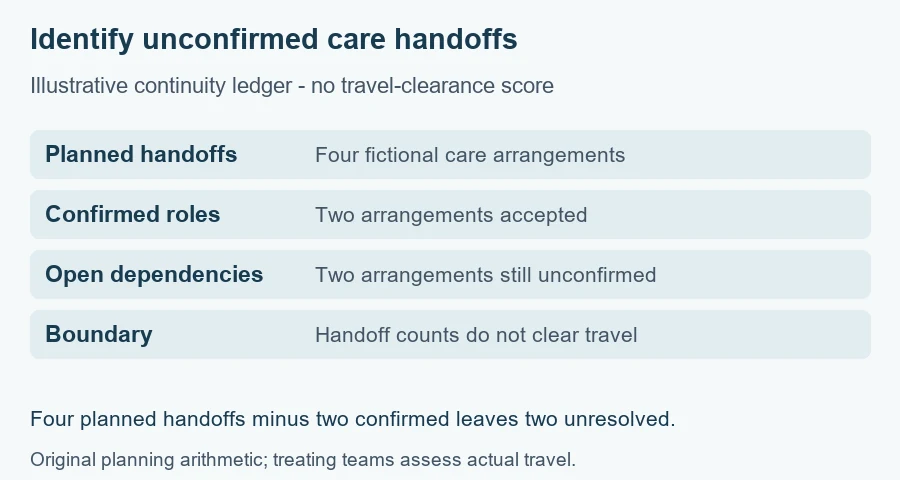
Consider a fictional itinerary with four planned handoffs: discharge to the traveler and helper, a local follow-up visit, records transfer to the home clinician and a review of the return journey. Suppose the first two arrangements are confirmed while the records recipient and itinerary-review role remain unconfirmed. Four planned handoffs minus two confirmed handoffs equals two unresolved arrangements. This is invented planning arithmetic. It is not a safety score, a required number of appointments or proof that the trip may proceed.
The two unresolved items have different next actions. Records transfer needs an actual recipient, permission or secure process where applicable and confirmation of what can be provided. Itinerary review needs the relevant team to explain who will assess the proposed journey and what happens if the plan changes. Neither issue is solved by the other one being confirmed. A file arriving at home does not clear the traveler to depart, and an administrative return booking does not mean another clinician has accepted a follow-up role.
Do not divide the confirmed handoffs by the planned handoffs and advertise the result as readiness. The number of rows is an editorial choice, and one missing arrangement may be consequential even when many other entries are complete. Use your plastic surgery travel planning worksheet to identify dependencies, not to calculate clinical permission. The fictional example demonstrates how to make open responsibilities visible. The treating professionals must assess the actual patient, procedure, condition and proposed travel arrangements.
Separate travel insurance from coverage for planned treatment
A policy’s title is not enough to determine whether it covers an event associated with elective treatment. Obtain the actual contract and ask about the proposed purpose of the trip, planned procedure, complications, follow-up and evacuation. Keep the insurer’s answer and the relevant wording with your worksheet. Record whether preauthorization or another step is required, without assuming that a general emergency benefit includes every complication after deliberately traveling for care. A seller’s summary cannot replace the actual applicable terms. Use the separate flying after plastic surgery consultation questions for an individualized clinical discussion; insurance wording is not flight clearance.
CDC’s separate April 23, 2025 Yellow Book chapter distinguishes travel disruption, travel health and medical evacuation insurance. It explains that benefits vary and that credit-card protections require careful review rather than serving as a substitute for the relevant policies. This classification helps organize questions. It does not establish that any policy covers your proposed surgery or an associated complication. This guide gives no premium average or recommendation of an insurer. 2
| Coverage or payment question | Evidence to request | Distinction to preserve |
|---|---|---|
| Planned procedure | Actual policy wording and written response about the trip purpose | Buying insurance does not imply treatment coverage |
| Unexpected assessment | Applicable benefit, exclusions and payment process | Emergency treatment and elective follow-up can have different terms |
| Evacuation | Conditions, authorization route and destination rules | A benefit name does not promise transport to a hospital of your choice |
| Changed itinerary | Applicable cancellation or interruption terms | A flexible booking and an insurance claim are different arrangements |
| Records and claims | Required documents and submission method | A receipt does not by itself establish reimbursement eligibility |
Keep payment responsibility separate from clinical urgency. A question about reimbursement should not become a reason to postpone necessary assessment. If you are concerned about a possible complication, obtain appropriate medical help according to the actual instructions and local circumstances rather than waiting for an administrative answer. The worksheet can identify a payment process in advance, but it cannot diagnose a problem or decide how urgent a symptom is. Do not use an unanswered insurance email as a self-triage tool.
International documents and medicine rules
For a trip outside the United States, check current official destination information rather than relying on another traveler’s experience. The Department of State’s Medicine and Health page was updated August 11, 2025. It explains that the U.S. government does not pay medical bills abroad and advises checking destination rules for prescription medicines. These facts support planning questions, not a determination that a specific product can cross every border or that consular assistance supplies clinical care. 3
If a medicine is part of your actual plan, ask the appropriate professionals and authorities what documentation and permissions are needed for each destination and transit country. Record the generic product name and the official rule source when useful. Do not change a prescription to fit an itinerary based on this guide. The team must address medical changes, and the relevant authorities determine legal entry requirements. A medicine that is lawful at home can still require additional verification abroad; a travel worksheet cannot waive that requirement.
Ask how you will obtain complete care records in a language the next clinician can use. A brief invoice may identify a purchase without describing the operation, devices, medicines or relevant findings. Ask the treating team what documentation will be provided and how additional detail can be requested. If interpretation or translation is needed, organize that process rather than guessing at clinical terminology. Plastic surgery travel planning should make a usable handoff possible while preserving the source and limits of every document.
What changes should reopen the planning record?
Revisit the worksheet when the proposed intervention, actual health circumstances, departure plan, helper arrangement or follow-up recipient changes. A revised plan can affect several rows at once. For example, changing the location of a follow-up visit may alter transport, records delivery and payment questions. Note the change and contact the relevant responsible roles. Do not assume that all the old confirmations automatically apply because the procedure’s general name remains the same. What matters is the actual current arrangement.
Maintain a change record with the date, the item changed, the person or role providing the update and the dependent questions to revisit. This is an original planning method, not an official clinical protocol. It makes contradictory messages easier to reconcile. If two instructions appear inconsistent, ask the team to clarify which applies rather than choosing the one that best fits a ticket or room reservation. Keep the older version for context, but clearly mark which information is awaiting clarification or has been superseded.
Make contact instructions usable across locations
A contact plan should work from the place where you will actually be staying. Confirm which number or channel to use, what happens outside routine hours and whether your device can reach it from the destination. Note the relevant time zone when an appointment or callback time could otherwise be misunderstood. These are practical communication checks, not guarantees of an immediate response. The actual team should explain what to do if the usual route cannot be reached or an in-person assessment is needed. The discharge instruction record preserves the actual contacts and individualized instructions across locations.
Keep routine questions distinct from a concern that needs medical assessment. Do not invent symptom categories or urgency thresholds from a scheduling worksheet. Instead, retain the treating team’s actual instructions and ask for clarification if the language is unclear. A secure message sent to a routine administrative inbox may not be the route the team intends for a new concern. Plastic surgery travel planning should record the agreed process, including its limitations, without presenting every communication method as equally appropriate for every circumstance.
If a helper will participate, confirm what information they may receive and what tasks they have accepted. A person listed as an emergency contact has not necessarily agreed to translate, arrange transport, manage bookings or interpret clinical advice. Define those roles separately and avoid assigning a task simply because someone is traveling with you. This protects the accuracy of the record and makes disagreements easier to identify before a plan depends on them. Clinical instructions still come from the responsible professionals.
When returning home, make the handoff explicit rather than assuming the overseas or distant office and local clinician communicate automatically. Ask whether an appointment is needed, what documents should be supplied and how the receiving team acknowledges receipt. Keep questions about ongoing assessment separate from requests for a particular procedure or medicine. The receiving clinician needs the relevant history and must make their own assessment. A plastic surgery travel planning record supports that conversation; it cannot require another professional to accept a predetermined clinical conclusion.
A printable plastic surgery travel planning worksheet
The printable version provides space for the handoff, responsible role, confirmation evidence, contact method and unresolved dependency. Add a separate contingency section and a change record. It is a private planning aid, not a travel certificate or consent document. Use it to prepare questions before booking and to keep actual confirmations accessible afterward. Do not add private records to a public website merely because the worksheet discusses record sharing. Transfer clinical information through an appropriate secure process agreed with the recipients.
| Worksheet stage | Practical use | Boundary |
|---|---|---|
| Proposal | Record current procedure and destination questions | No suitability or destination endorsement |
| Confirmation | Obtain actual accepted roles and usable documents | No inferred clinician agreement |
| Reassessment | Ask who reviews a changed plan and how | No fixed travel timetable or self-clearance |
| Handoff | Share necessary records through an agreed method | No public personal-information collection |
| Update | Preserve changes and revisit dependent arrangements | No readiness percentage or clinical score |
Common questions about the continuity plan
Does plastic surgery travel planning tell me when I can fly?
No. This record addresses who will assess the journey and how the arrangements depend on that assessment. It supplies no universal clearance date, prevention regimen or airline rule. Discuss your actual procedure, health circumstances and itinerary with the relevant team, and confirm the carrier’s applicable requirements separately. A return booking, a symptom-free interval or a completed worksheet does not establish fitness to travel. If the plan changes, revisit the assessment rather than extending an old assumption.
Is care near home always the same as agreed follow-up?
No. Availability in a general sense is different from a confirmed role in your care. Ask the proposed recipient what information they need, what assessment they can provide and how to arrange it. Do not assume that another clinician will adopt the original surgeon’s plan or that a remote photograph can answer every question. The aim is to establish an actual route to appropriate assessment, while leaving the clinical judgment to the professional who examines the situation.
Can an all-inclusive package answer every contingency question?
Read what is actually included and what happens if the original plan changes. The term does not establish an agreed complication assessment, insurance benefit, suitable accommodation or return-travel clearance. Use plastic surgery travel planning to separate clinical roles, booking terms and payment obligations. Ask for unresolved arrangements in writing where appropriate. A useful record identifies a gap early; it does not convert a commercial promise into an individualized medical guarantee.
Sources and review scope
Plastic Surgery Editorial Team. Source records checked through October 12, 2026. Review scope: source and editorial checks for general education. No individual clinical assessment is represented.
- CDC Yellow Book 2026: Medical Tourism. cdc.gov. Source date: 2025-04-23. Checked 2026-10-12.
- CDC Yellow Book 2026: Travel Insurance, Travel Health Insurance, and Medical Evacuation Insurance. cdc.gov. Source date: 2025-04-23. Checked 2026-10-12.
- U.S. Department of State: Medicine and Health. travel.state.gov. Source date: 2025-08-11. Checked 2026-10-12.