
Planning plastic surgery recovery and manual work starts with the tasks your job actually requires, the treating team’s individualized restrictions and the arrangements the employer has genuinely accepted. A job title or one lifting weight does not describe the whole shift. This original task-demand worksheet helps you record movement, repetition, tools, work setting and unanswered questions for the relevant discussions. It does not establish a safe load, work capacity, required leave period or permission to return after a particular number of days.
Download the manual work task record (printable PDF). Complete it privately and bring unresolved care questions to your treating team.
Why does plastic surgery recovery and manual work need a task record?
“Manual work” can include very different activities. Receiving a delivery, stocking a high shelf, cleaning, moving a cart, assisting another person and operating a tool do not involve identical demands. Even within one job, the same object can be handled from different positions or at different frequencies. Describe the actual task rather than assuming that everyone with your job title has the same duties. The useful record provides context for a clinician and employer to discuss; it does not substitute for either party’s assessment.
Start with a representative description of the job as normally performed. Identify routine tasks, occasional tasks and tasks that arise unexpectedly. Ask the appropriate workplace role to help confirm the description when needed. Do not leave out an infrequent task simply because it takes little time if it is still a required part of the role. Conversely, do not label every ordinary task an essential legal function yourself. That distinction involves the actual job and applicable process, not a label added by this website.
The EEOC’s May 1, 2002 ADA questions-and-answers document discusses essential duties and explains that a written job description can be evidence without being conclusive. Its current page carries a notice about the 2008 ADA amendments. This guide uses the limited point that a job description needs context; it does not adopt older disability-definition examples, decide legal eligibility or promise a change in duties because someone has had plastic surgery. 1
Build an original record for plastic surgery recovery and manual work
Use the discharge instruction record to retain the actual individualized instructions separately from this job-demand description.
Use one row for each materially different task. Describe the action in ordinary words, what is handled, where it starts and ends and whether it repeats. Record measurements only when they come from the actual workplace or another reliable source. If the weight or frequency is unknown, label it unknown and identify who can verify it. Do not estimate an allowable weight from how a task feels or use this worksheet to test your postoperative capacity.
| Job-demand field | Information to record | Question it helps prepare |
|---|---|---|
| Task and object | Actual action, object or person-related duty | Is this task included in the proposed work arrangement? |
| Start and end position | Where handling begins and ends, reach and route | What context does the clinician need to understand? |
| Repetition and duration | Actual frequency, uninterrupted periods and variability | Does the explanation address the repeated task rather than one occurrence? |
| Tools and conditions | Equipment, grip, clothing and work environment | Has the proposed arrangement accounted for the real setting? |
| Accepted arrangement | What the employer actually confirmed and its limits | Which duties or responsibilities remain unresolved? |
Keep the demand record separate from the restriction record. The first describes the work. The second captures what the actual treating team says about your situation, including questions that require review. A third field records what the employer has accepted. Those three records answer different questions. A description of a cart being available does not establish medical suitability to push it. A clinician’s instruction does not automatically establish that the employer has agreed to a specific alternative assignment.
OSHA’s warehousing guidance distinguishes lifting, lowering, bending, overhead reaching, pushing, pulling, posture and repetition as work features. The source is specific occupational hazard information, not a postoperative instruction. Those categories help you notice what a description such as “light warehouse duty” leaves unexplained. No numerical load limits or proposed equipment changes from that guidance are converted here into a plastic surgery recovery rule. 3
Why a single weight can leave the task unexplained
A weight is one characteristic of handling an object. The task may also involve where the object is picked up, the position of the hands, how far it is moved, whether the worker turns, how it is held and how often the action occurs. Give the relevant professionals the actual context instead of sending only the heaviest number you remember. Do not assume that two tasks with the same object weight receive the same individualized answer. This guide does not calculate the medical meaning of those differences.
NIOSH’s Revised Lifting Equation page describes an occupational tool for assessing single or multiple two-handed lifting tasks and its relative-stress outputs. The page records an expert review on February 21, 2024, and publication on May 15, 2024. That workplace tool does not provide postoperative lifting clearance. This guide adopts no recommended weight output, index threshold or universal safe load. The practical lesson is to describe the actual lifting task rather than treating a number as a complete recovery instruction. 2
Some duties do not fit a lifting description at all. Pushing equipment, carrying an object along a route, restraining or assisting a person, prolonged tool use and an unexpected response can involve different questions. Do not apply a lifting calculator to all of them merely because the work is physical. Your plastic surgery recovery and manual work record should identify the task category and uncertainty so that the relevant team can decide what assessment or information is needed. It is a preparation document, not an ergonomic certification.
An original plastic surgery recovery and manual work example
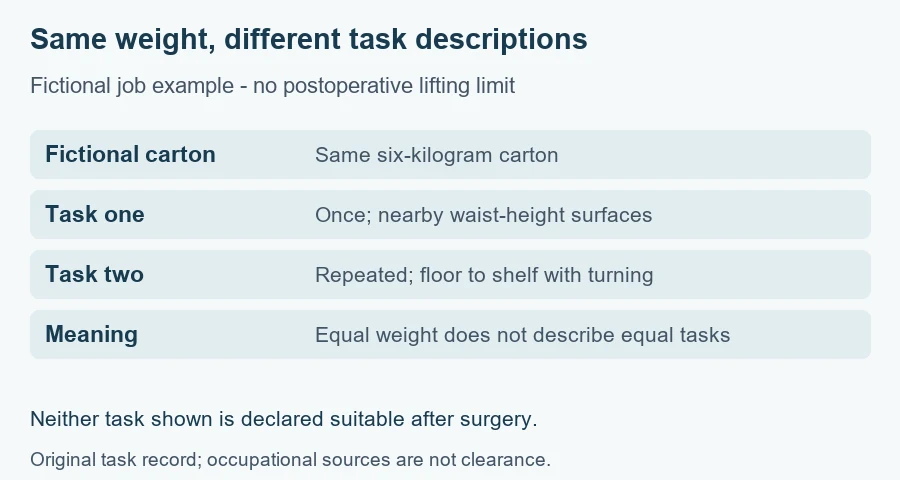
Consider a fictional job using the same six-kilogram carton in two different tasks. One entry describes handling the carton once between two nearby waist-height surfaces. The other describes repeatedly moving it from a floor position to a shelf while turning. The object weight is identical, but the actions and repetition are not. These are invented task descriptions, not load recommendations, clinical comparisons or a claim that either task is suitable after surgery. They show why a weight-only note can omit important context.
The worksheet would keep the tasks in separate rows and ask the actual team to address the relevant description. It would not mark the first task safe because it sounds simpler or calculate a return date for the second. The employer would also need to confirm what duties an actual proposed arrangement contains. A statement that a worker will perform “lighter duties” does not tell you which of the two tasks remains, whether the carton changes or who handles an unexpected delivery.
If a proposed assignment substitutes a different task, describe that task independently. Do not simply subtract the carton weight and declare the job light. The new assignment may still involve reaching, repetitive movements, equipment operation, prolonged standing or another demand that needs discussion. Plastic surgery recovery and manual work planning is more useful when it replaces vague adjectives with an accurate task description. The fictional example supplies no clinical threshold; it identifies the information that a real discussion would otherwise lack.
Describe the whole duty cycle, including unusual tasks
The leave from work documentation guide addresses the separate leave question; a task description does not establish eligibility.
Ask how the task fits into the actual shift. A movement that occurs once during a quiet period is different in its description from the same movement repeated throughout a busy period. Record the usual pattern and how it can vary, without inventing a frequency to fill the table. Include a source such as a confirmed duty description or workplace observation from your normal role. Do not undertake a postoperative work simulation to generate data for this worksheet. Any capacity assessment belongs with the appropriate professionals.
Note demands that appear outside the main task list: opening doors, moving supplies, carrying personal equipment, responding to interruptions and reaching a work location. A proposed change to one duty may leave those ordinary demands untouched. The point is not to classify every movement as dangerous. It is to avoid a plan based on a partial description of the work. Ask the clinician and employer which parts need clarification and which arrangements are actually relevant to your circumstances.
Keep unexpected or safety-sensitive responsibilities visible. A worker may spend much of a shift on a modest task but still be required to operate machinery, respond rapidly or assist someone in an unusual situation. State what the actual role requires rather than deciding that an infrequent duty can be ignored. This record gives no instruction to operate equipment, perform a task or judge your own response capacity. It helps the relevant people discuss a description that includes the responsibilities the job really carries.
Separate proposed duties from accepted arrangements
Use clear status words. “Proposed” means someone has suggested an arrangement. “Under review” means an actual decision remains open. “Accepted” means the relevant employer role has confirmed the stated arrangement, subject to its documented terms. These words do not establish clinical permission. Keep the clinician’s actual instructions and any required review separate. A helpful conversation with a supervisor may begin a process without completing every practical, medical or policy question that the proposed return involves.
| Arrangement record | What needs confirmation | What not to assume |
|---|---|---|
| Task removed or reassigned | Which task, by whom and under what accepted arrangement | That all physical duties have disappeared |
| Different equipment proposed | Actual equipment, task and responsible review | That equipment automatically makes the task suitable |
| Changed hours proposed | Actual hours, duties and workplace process | That fewer hours establishes work capacity |
| Temporary assignment | Actual duties, duration of arrangement and review process | A guarantee of a legal entitlement or permanent change |
| Review after a change | Who receives updated information and confirms the plan | That the original arrangement automatically covers new duties |
Discuss what happens when a shift is busy or another worker is absent. An arrangement that depends on a colleague doing a particular task needs an accepted responsibility, not merely a hope that the colleague will be available. Do not turn that planning question into a guarantee that the employer must offer your preferred solution. Actual policies, duties and applicable requirements matter. The worksheet identifies an unresolved dependency and the role that can answer it; it does not decide an employment dispute.
If you are self-employed, identify who makes the practical arrangements when a task cannot be performed as originally planned. A customer deadline, supplier delivery or booking obligation can remain even when you control your hours. The record can help organize those dependencies without implying that self-employment eliminates the need for individualized clinical advice. Planning plastic surgery recovery and manual work includes the actual business tasks and support arrangements, not only an employee’s request to a supervisor.
Prepare useful documentation without oversharing
Ask the employer’s appropriate contact what process applies and what information is requested. Provide the actual job-demand description to the clinician when discussing relevant restrictions or documentation. Do not ask the clinician to certify a vaguely described job if the real tasks differ materially. Equally, do not send complete private records to a broad workplace mailing list merely because a planning question exists. Use the appropriate confidential route and obtain advice about a disputed request or legal concern from a qualified source.
Separate leave eligibility, pay, attendance policy and actual work-task arrangements. Those topics can interact, but one answer does not settle the others. A policy allowing time away does not establish work capacity on a chosen date. A proposed task change does not automatically establish paid leave or a statutory benefit. This guide focuses on describing demands and documenting actual arrangements; it does not repeat a full leave-rights or insurance guide or determine what protection applies to your individual situation.
When information changes, preserve the date and source of the update. A revised task, new equipment, different work location or changed instruction may alter the question previously discussed. Ask the relevant professionals to review the actual change rather than relying on a note that described another arrangement. Keep an earlier version for context but identify what has been superseded or remains uncertain. The record should help reconcile the plan, not create a reason to ignore an individualized restriction.
Who maintains the plastic surgery recovery and manual work record?
Where an access request is relevant, use the disability access planning record to keep the request and the actual response distinct.
Agree who keeps the current practical version and how updates reach the relevant people. The worker can describe the actual task, a workplace contact can clarify duties and accepted arrangements, and the clinician can explain individualized restrictions. Those contributions should remain identifiable. Do not let a summary prepared by one role silently become a decision attributed to another. A plastic surgery recovery and manual work record is most useful when its source fields show who supplied each part of the plan.
Keep uncertainty when summarizing a discussion. “Needs the actual equipment description” should stay open until that description exists and the relevant review occurs. An estimated review date is a communication arrangement, not a predicted recovery milestone. If someone receives a different version, reconcile it through the appropriate route. Plastic surgery recovery and manual work planning depends on a shared accurate description, while the decisions about clinical capacity, actual duties and applicable workplace process remain with the responsible professionals and parties.
A printable plastic surgery recovery and manual work worksheet
The printable version contains fields for the actual task, physical context, frequency or uncertainty, clinical question and proposed employer arrangement. Its separate change record identifies dependent tasks to revisit. It is an original private planning aid, not a medical certificate or agency form. Leave clinical judgments and unknown measurements unfilled until the responsible role supplies the information. The worksheet does not include a preset return week, allowed weight or work-readiness score.
Use it to prepare a focused description before the relevant appointment or workplace discussion. After an explanation or decision, record what was actually stated and its source. Check whether the resulting arrangement matches the task described. If it does not, ask for clarification rather than interpreting a general phrase such as “light duty” as an answer to every physical demand. A useful unfinished record shows the outstanding question and responsible role; a complete-looking record with guessed limits does not provide the same clarity.
| Review stage | What the original tool helps organize | Limit |
|---|---|---|
| Describe | Actual tasks, setting, tools and repetition | No diagnosis or task-risk calculation |
| Discuss | Individualized clinical questions and workplace process | No universal clearance or legal eligibility ruling |
| Confirm | Accepted practical arrangements and their stated scope | No assumption that a proposed change is approved |
| Update | New information, changed duties and dependent questions | No automatic extension of an earlier explanation |
Questions about the task-demand record
Can a lifting limit alone resolve plastic surgery recovery and manual work?
It may be part of an actual instruction, but it does not describe every job demand. Ask how the instruction relates to your specific tasks, including repetition, position, equipment and duties that are not lifting. Do not calculate your own allowable load from an occupational formula or translate another person’s recovery note into yours. The treating team supplies the individualized medical explanation; the employer confirms the actual proposed duties and arrangements through the applicable process.
Does a lighter assignment automatically mean I can return?
No readiness conclusion is given here. First describe what the proposed assignment actually contains and ask the relevant professionals about your circumstances. A different task may remove one demand while retaining another. Keep the medical question and accepted workplace arrangement distinguishable. The purpose of the worksheet is to expose those details so the discussion is specific, not to classify any job with a favorable label as suitable after surgery.
What if my job description does not match my normal shift?
Record the actual differences and ask the appropriate workplace role to clarify them. A title or written description can be useful context without capturing every duty or variation. Keep both the source document and the confirmed explanation when preparing questions for the clinician. Your plastic surgery recovery and manual work record should reflect the job being discussed, including unknowns, rather than a simplified version that makes an arrangement easier to describe but less accurate.
Sources and review scope
Plastic Surgery Editorial Team. Source records checked through October 12, 2026. Review scope: source and editorial checks for general education. No individual clinical assessment is represented.
- EEOC: The ADA, Questions and Answers. eeoc.gov. Source date: 2002-05-01. Checked 2026-10-12.
- CDC NIOSH: Revised NIOSH Lifting Equation. cdc.gov. Source date: 2024-02-21. Checked 2026-10-12.
- OSHA: Warehousing, Hazards and Solutions. osha.gov. Publication/update date not stated. Checked 2026-10-12.