
How long does facial fat transfer last? There is no single reliable duration for every facial region or person. Some transferred volume may persist, but early fullness, measured surface volume and satisfaction are different endpoints. Small original studies following patients for one and five years show why the word permanent is insufficient: results varied by region, and weight changes complicated long-term volume interpretation. Use the actual treated area, follow-up record and clinical assessment to discuss the result rather than treating a percentage as a personal forecast.
How long does facial fat transfer last in the area being treated?
Facial fat transfer uses tissue obtained from your own body and transferred to the face. ASPS explains that the result can be less predictable and that more than one procedure may be needed to achieve the desired change. That is different from a fixed schedule for repeating treatment. The clinician should explain which regions are proposed, what change is intended and how the result will be assessed. ASPS facial fat-injection guidance
Do not treat the face as one interchangeable recipient site. A statement about cheek volume may not describe the lip region or another facial concern. Ask what evidence applies to the actual area in your proposal and whether the surgeon is discussing a regional measurement or the overall appearance. A broad claim about lasting facial volume leaves that important distinction unanswered.
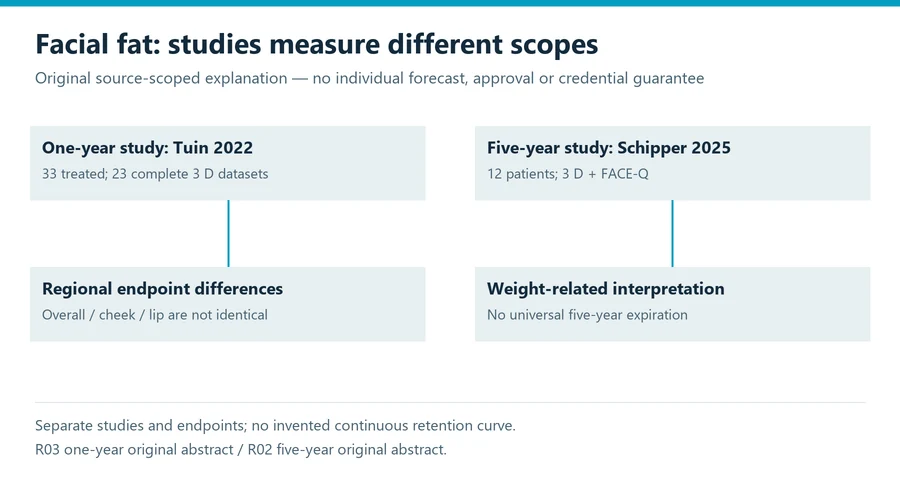
A one-year original study illustrates the issue. Tuin and colleagues evaluated three-dimensional surface changes and FACE-Q satisfaction after facial fat grafting without additional surgical procedures. Thirty-three women underwent treatment, while twenty-three had complete three-dimensional data for analysis. At one year, overall and cheek-region volume gains remained, while the lip-area effect was no longer present in that sample. This does not predict what any individual region will do. Original one-year facial fat study
The practical question is therefore more specific than whether fat lasts. Ask what the intended regional change is and how the clinician will distinguish an early appearance from a later assessed result. If the recommendation includes several areas, request a separate explanation of each goal. This organization helps you understand the plan without prescribing an amount, technique or expected retained percentage.
What does lasting mean: visible volume, graft retention or satisfaction?
Visible fullness describes appearance. A measured change in the facial surface describes an imaging endpoint. Satisfaction describes the person’s response to the result. Those measures can inform one another, but they are not the same thing. A pleasing photograph does not measure surviving graft cells, and a numerical surface-volume change does not establish that a particular person is satisfied.
Ask which endpoint is behind any claim you are given. Was the finding assessed by examination, photographs, three-dimensional imaging or a questionnaire? What baseline and follow-up were compared? If a percentage is mentioned, ask what it is a percentage of. The injected amount, measured facial change and biological survival of every transferred cell are not automatically interchangeable quantities.
The question “How long does facial fat transfer last?” can otherwise produce a confident answer that addresses the wrong outcome. You may be asking how long a particular appearance will remain, while the cited study measured a regional surface change at one visit. A useful explanation should name the endpoint before supplying a time or a number.
Keep the goal and measure together
Write the intended change beside the proposed way to evaluate it. For example, a consultation may concern a specific contour rather than an overall volume increase. Ask what observation would count as meaningful progress and what limits the measurement has. This is an original conversation aid, not a clinical scoring system, and it supplies no target measurement that you should try to achieve yourself.
How long does facial fat transfer last in the five-year evidence?
Schipper and colleagues reported a five-year assessment of twelve patients using three-dimensional surface imaging and FACE-Q satisfaction measures. In that small sample, the observed volume increase was associated with weight gain rather than the injected amount, and satisfaction returned to its preoperative level. The authors identified weight change as a difficulty in interpreting long-term retention. The abstract was inspected; this resource does not claim a full-text review. Original five-year facial fat study
That finding is not a universal five-year expiration date. It does not establish that every person’s transferred tissue disappears, that everyone needs another procedure at five years, or that gaining weight is a way to improve satisfaction. The sample and measurements cannot provide those conclusions. They do show why longer follow-up may change the interpretation of an apparently straightforward permanence claim.
The one-year and five-year reports should also not be treated as interchangeable replications. They involve different follow-up information, and the abstracts alone do not establish that combining their figures would create an independent lifetime forecast. Keep each report’s population, analysis denominator, measurement and duration together. A chart should make those limits visible rather than draw a smooth invented retention curve between visits.
For a personal consultation, ask whether the evidence being discussed has a similar treated region and assessment method. The useful task is to understand the relevance and uncertainty, not to find one percentage that can be applied indefinitely. This page provides selected original evidence and a planning framework; it is not an exhaustive systematic review or a prediction of your future appearance.
How can early photographs mislead a duration comparison?
An early postoperative image and a later result can describe different stages. Ask the clinician when they intend to assess the outcome and what changes they expect to evaluate over time. A date chosen for your actual procedure should come from the clinical follow-up plan, not from converting a study visit into a universal permission to judge or repeat treatment.
When comparing images, record the treatment date, follow-up interval and any other procedures performed. Lighting, pose and the way an image is selected can also affect an informal visual comparison. A photograph with no date or context cannot answer how long a result lasted. If images are used in a consultation, ask what they demonstrate and what they cannot establish about a different person.
Do not convert dissatisfaction with an early appearance into an automatic recommendation for more volume. The clinician needs to assess the actual finding and explain appropriate next steps. Ask what is known, what remains uncertain and whether more observation or another evaluation is proposed. This resource does not supply a waiting period, injection plan or method for correcting a concern at home.
When asking “How long does facial fat transfer last?”, distinguish the first follow-up from the visit used to assess a later result. The difference matters to expectations and to planning the complete course of care. It can also prevent a dramatic early picture from being mistaken for a documented long-term outcome, without dismissing a concern that deserves clinical attention.
How long does facial fat transfer last when body weight changes?
The five-year study’s association with weight change means that observed facial volume cannot automatically be attributed only to the injected amount. A measurement that looks larger later may reflect several influences rather than a direct count of retained graft. Discuss your actual history and goals with the clinician instead of assuming that any later change proves a technique’s success or failure.
Do not use this association as a prescription to gain or lose weight. The study does not supply a personal weight target, a method to enlarge the graft or a promise of satisfaction. Any weight-related medical plan belongs with the appropriate treating clinician. The role of the information here is to explain uncertainty in interpreting long-term volume, not to direct a body-weight intervention.
If your circumstances are likely to change, ask how that uncertainty affects the timing and goals of the proposed procedure. Record what the clinician says about assessing the result and what future changes would prompt a review. A clear plan can acknowledge that appearance is not frozen forever without claiming that every possible change can be predicted in advance.
Keep the assessment about the actual concern. A change in appearance does not necessarily mean a specific retained fraction has been lost, and a stable-looking photograph does not prove biological permanence. The question “How long does facial fat transfer last?” is most useful when linked to the intended regional outcome and the evidence available to assess it.
Does a combined facial procedure answer the fat-transfer duration question?
If fat transfer is proposed alongside another operation, ask what each component is intended to accomplish. A combined result may not reveal how much of the visible change is attributable to fat alone. The one-year study described above examined facial fat grafting without additional surgical procedures, so its scope should not be silently transferred to every combined treatment proposal.
Request an explanation of the complete operative plan, including the specific recipient areas and the role of any other procedure. Ask which evidence supports each discussion of duration. A general before-and-after image of combined care cannot establish the longevity of an isolated fat-transfer component. The clinician should explain the plan’s goals and limits without requiring you to make that inference.
If alternatives are discussed, compare the actual task and evidence rather than only a promise that one option is permanent. Different procedures may address different features and involve different risks or follow-up. This page does not rank them or recommend a particular operation. Its purpose is to help you ask whether the proposed method answers your specific concern and how its outcome will be evaluated.
For financial planning, identify whether the estimate covers one session or a discussed course of care. The possibility of later treatment is not evidence that it will be needed or that it is included in the first fee. Keep duration uncertainty and billing terms separate. A realistic comparison states the actual scope and leaves unknown future treatment marked unknown.
How long does facial fat transfer last before another session is considered?
There is no repeat-treatment date that this article can assign. ASPS notes that multiple procedures may be needed to achieve a desired facial result, but that does not mean every person should book another session or repeat care on a fixed anniversary. The actual assessment, goals, risks and clinical recommendation determine what should be discussed next.
Ask why another procedure is being proposed. Is the discussion about the original goal not being achieved, a new appearance preference, a concern requiring evaluation, or a change that occurred later? Those explanations are different. A clear recommendation should connect the observed finding to the intended task instead of treating the word touch-up as a complete description of care.
For cheek augmentation, ASPS explains that fat-transfer results depend on injected and retained fat and that another operation may be necessary in some situations. This is a regional counseling statement, not a probability of repeat treatment or a promise that additional surgery will deliver a particular result. Keep that limit when applying the information to a different facial area. ASPS cheek-result limitations
Ask about the benefits, risks, alternatives and follow-up of the proposed additional care. You can request clarification or another assessment before committing. An uncertain duration is not, by itself, an instruction to undergo more treatment. A second-session discussion should have its own informed explanation and financial scope rather than be assumed as an inevitable part of the original procedure.
Which records help answer the longevity question at follow-up?
Bring the original proposal, treatment date, recipient regions, operative record if available and previous follow-up assessments. Note any other facial procedures performed and any later changes that concern you. These records do not allow you to calculate a retained fraction at home, but they help the clinician understand what was actually done and what comparison is being requested.
Ask how a proposed result measurement will be interpreted. If imaging is used, identify the baseline and the region measured. If satisfaction is discussed, clarify the goal being assessed rather than assuming a single overall rating captures every concern. The method should match the question, and its limitations should be explained before its result is used to recommend another procedure.
For new or troubling symptoms, obtain clinical advice instead of waiting to settle the durability debate. This page cannot determine the cause or urgency from a photograph or a retention claim. Ask the treating team how to contact them with concerns and who will interpret new findings. A research endpoint should not distract from the actual care issue in front of you.
Use a short question list: what changed, what evidence explains it, what remains unknown, and what will the next assessment accomplish? This original organizer is deliberately not a diagnostic checklist. It gives the conversation a clear purpose while leaving examination, interpretation and individual recommendations with the clinician.
What should a regional follow-up comparison record?
Before comparing two visits, label the same facial area, the date relative to treatment and the question being assessed. Ask whether an overall image is being used to discuss a localized goal, and whether another procedure or later treatment changed the comparison. Keep an explanation of uncertainty beside the result instead of removing it when saving a number.
When the question is “How long does facial fat transfer last?”, this record prevents one region or endpoint from silently replacing another. It is an original planning aid, not a new measurement method or a reason to order imaging. The clinician chooses the appropriate assessment and explains what the available evidence supports.
How long does facial fat transfer last: which evidence answers which question?
The table keeps the evidence scopes separate. It contains no invented pooled retention estimate or projected lifetime curve. The studies report measurements at their stated follow-up periods; the society guidance provides counseling context. Neither category supplies personal clearance or a guarantee that one treatment will permanently match a preferred appearance.
| How long does facial fat transfer last: source | Actual observation | Limit |
|---|---|---|
| Tuin et al, 2022 | One-year 3D and satisfaction follow-up; 23 complete 3D datasets | Regional differences; not lifetime or cell-survival measurement |
| Schipper et al, 2025 | Five-year 3D and FACE-Q assessment; 12 patients | Weight-associated volume and small sample |
| ASPS facial and cheek guidance | Predictability and possible additional care discussed | No personal repeat schedule or survival percentage |
The answer to “How long does facial fat transfer last?” should name the region, endpoint and follow-up before making a duration claim. For the underlying procedure and consultation context, read the facial fat-transfer guide. Sources were checked October 12, 2026, with original journal and online publication dates retained separately. No patient outcome, clinician review, biological permanence or individual retention forecast is invented here.
Sources and review scope
Plastic Surgery Editorial Team. Source records checked through October 12, 2026. Review scope: source and editorial checks for general education. No individual clinical assessment is represented.
- ASPS facial fat injections. plasticsurgery.org. Publication/update date not stated. Checked 2026-10-12.
- Schipper et al five-year facial fat graft study. pubmed.ncbi.nlm.nih.gov. Source date: 2025-03. Checked 2026-10-12.
- Tuin et al one-year facial fat study. pubmed.ncbi.nlm.nih.gov. Source date: 2022-08-01. Checked 2026-10-12.
- ASPS cheek augmentation results. plasticsurgery.org. Publication/update date not stated. Checked 2026-10-12.