
Breast implant infection needs medical assessment; it cannot be confirmed or excluded from a photograph, a calendar or this article. The FDA explains that infection is possible at any time after implant surgery and that an implant may need removal if infection does not respond to antibiotics. Those statements are not instructions to select an antibiotic or decide on removal yourself. Contact the responsible surgical team about a suspected infection, describe the current concern and obtain the assessment the situation requires.
Sepsis is a life-threatening emergency caused by the body’s response to infection. Confusion, shortness of breath, clammy skin, extreme pain or discomfort, fever, shivering or feeling very cold can accompany it. Seek immediate medical care when sepsis is suspected rather than waiting for a routine cosmetic appointment or every possible sign. The CDC’s general warning does not diagnose an implant infection, but it explains why a worsening infection concern must not be treated only as a question about the appearance of the breast.
What does breast implant infection mean in the FDA guidance?
The FDA describes contamination of wounds by microorganisms and distinguishes infection from other implant complications. Most infections resulting from surgery appear early, but a later date does not rule infection out. The complication list is alphabetical, not a ranking of how often each problem occurs or how severe it is. A new concern should be assessed on its current findings and actual history, not dismissed because the usual recovery period seems to have passed. Read actual FDA implant complication information.
For breast implant infection, the practical question is what the clinical team needs to assess now. Tell them when the surgery occurred, what device or procedure is known and what has changed. Do not assign an organism or cause from an online account. A breast that feels different may have several possible explanations, and the clinician must decide which examination or testing is appropriate. This guide supplies no home test or decision rule that declares infection present or absent.
What should you report to the surgical team?
Describe the actual concern, where it is, when it began and whether it is changing. Include pain, swelling, redness, drainage, wound changes or systemic symptoms if present, without deciding that one alone proves infection. Explain any care you have already sought and any actual instructions or prescriptions received. The team needs a current description rather than a summary such as normal healing or infected implant selected before an examination.
A breast implant infection conversation should distinguish your observations from the clinician’s findings. If you have photographs requested by the team, keep them accurate and dated, but understand that an examination may still be necessary. Do not manipulate a wound, drain fluid or attempt another intervention to make a home diagnosis. If the original team cannot provide appropriate assessment, ask where care should be obtained rather than interpreting the absence of a callback as a medical conclusion.
When should a systemic concern take priority over records?
The CDC explains that suspected sepsis requires immediate clinical evaluation and treatment. Its listed symptoms are possible signs, not a checklist requiring every item. A person should not wait for fever merely because another concerning change is already present. This page cannot determine the level of urgency remotely; describe the situation to an appropriate medical service and seek immediate care for a suspected emergency. Read CDC sepsis warning and response information.
For breast implant infection planning, records support care but should not delay it. Tell the assessing team about the implant and actual surgical history if known, while identifying missing details honestly. A device card, antibiotic list or operative record can be supplied when available. An emergency response should not depend on recovering an invoice or persuading an unavailable practice to send a complete file first. Medical assessment and administrative record requests are separate tasks.
Which operation and device details matter to the conversation?
Request the operative record, actual device identity and relevant follow-up information. A permanent implant and a tissue expander are not the same device or treatment stage. Cosmetic augmentation and reconstruction also have different clinical contexts. Include the sequence of procedures, not only the most recent receipt. If the clinical team requests other relevant treatment history, supply it accurately rather than guessing what a service name usually includes.
A breast implant infection record should distinguish confirmed device details from memory. State whether a device was replaced or another intervention occurred, if documented. If the preparation or operation scope is unknown, keep that limitation visible. The assessing clinician can explain how it affects the current question. This article does not infer device type from breast appearance, identify the manufacturer from a photograph or certify a particular product or practice.
Why is the date of onset useful without being diagnostic?
Timing helps the clinical team understand the sequence, but it does not by itself determine the cause. The FDA’s statement that infection is possible at any time prevents the shortcut that an older implant cannot be involved. Conversely, a concern soon after surgery is not automatically infection. Report when the change was first noticed, subsequent changes and any assessments rather than fitting the history into a preferred explanation.
For breast implant infection, ask what the clinician considers established and what remains uncertain after reviewing that sequence. If a test or examination is recommended, ask which question it is intended to answer. A result should be interpreted in the actual clinical context. This page does not recommend a culture technique, imaging study or laboratory threshold, and it does not rule out a concern because one remembered result was described as normal.
Does the FDA statement mean every infection requires removal?
The FDA says an implant may need removal if an infection does not respond to antibiotics. May does not mean that this article can select removal or declare that every infection can be treated while retaining the device. The medical and surgical decisions depend on the actual assessment. Ask the clinical team to explain the objective, evidence, risks and uncertainties of the proposed approach, including which findings would change it.
A breast implant infection treatment discussion should identify whether the proposal concerns treating infection, addressing the device or pocket, investigating an uncertain finding or planning later reconstruction. Those objectives are related but distinct. This page does not prescribe medicine or surgical technique and does not promise that an implant can be saved. The responsible team must determine what is appropriate, while explaining the implications for the current medical concern and any future elective plan.
What can an original salvage study establish?
An original 2018 report reviewed infections in a cohort undergoing two-stage breast reconstruction. It distinguished proven infections, attempts at pocket salvage and the fate of expanders or permanent devices. Patient selection affected which people were considered for salvage and which underwent removal. That design cannot supply a randomized comparison or a personal cosmetic-augmentation probability. This answer inspected the indexed primary PubMed abstract; the direct opening was empty and the full paper was not accessed. Read the original reconstruction infection study record. The breast augmentation guide explains that procedure and its consultation questions separately.
For breast implant infection, the study is useful as a warning against a headline salvage percentage detached from its denominator and population. A selected attempt group is not every person with a suspected infection, and pocket salvage does not necessarily mean that the original device remained in place. Ask what an outcome actually measures and whether the evidence applies to the proposed clinical situation. This page intentionally supplies no success probability or treatment algorithm from that cohort.
Why should a selected study not become a personal guarantee?
Different treatment groups may contain people selected for different reasons, which can affect observed outcomes. A study about reconstruction, expanders and documented infections does not automatically answer a question about an unrelated implant, uncertain symptoms or another operation. Ask the clinician which features of the evidence match your situation and which do not. The limitation should remain visible even when an approach is described as possible. For understanding the specific BIA-ALCL evidence and its limits, see BIA-ALCL.
A breast implant infection discussion should also distinguish control of infection from a later appearance or reconstruction result. Improvement in one endpoint may not establish all the others. Request a clear explanation of what the proposed intervention aims to achieve now and which decisions would follow. An operation report, an infection outcome and a patient’s satisfaction are different records. This page does not invent any of them or describe a hypothetical example as an observed case.
How should an actual medicine plan be understood?
If treatment is prescribed, ask the responsible professional to explain the actual instructions, who will monitor response and whom to contact about a problem. Keep a list of the prescriptions and any actual reactions or difficulty following the instructions. Do not use leftover medicine, borrow a prescription or change treatment based on this article. Tell the assessing team what you have taken so that its decisions use an accurate history.
For breast implant infection, a medication list is not proof that the infection has resolved or that surgery will be unnecessary. Ask how response will be assessed and what should prompt earlier contact. If another clinician is involved, share the actual prescription and findings rather than a generic statement that antibiotics were given. This resource does not interpret the regimen, select a duration or diagnose treatment failure from one photograph or a promised countdown.
How can the assessment questions be organized?
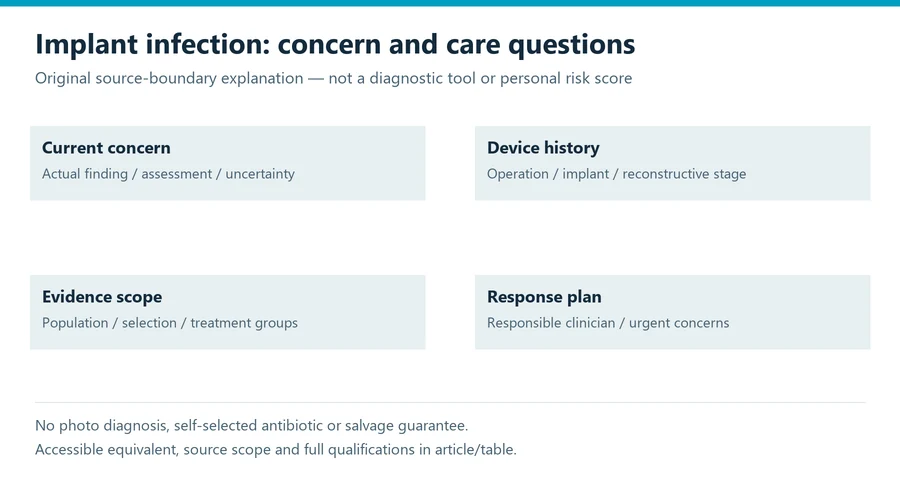
| Question | Useful information | Boundary |
|---|---|---|
| What is happening now? | Symptoms,onset and change | No remote infection diagnosis |
| What surgery and device occurred? | Actual operation,implant or expander record | No guessed product |
| What has assessment established? | Finding,tests and uncertainty | Calendar does not exclude infection |
| What does treatment aim to achieve? | Clinical objective and response plan | No automatic removal or salvage promise |
Keep urgent care separate from later planning
This original organizer helps a breast implant infection conversation identify the current task. It is not a severity scale, clinical protocol or clearance form. If an urgent medical concern exists, address it before trying to resolve future appearance, scheduling or financial questions. Those later decisions can be discussed using the actual findings. A completed worksheet should not be used to claim that infection has been prevented, treated or ruled out.
How should different care teams communicate?
Ask which team is responsible for the current assessment, the actual treatment decision and follow-up. If emergency care, the surgical practice and another clinician are involved, clarify how records and instructions will pass between them. Request the actual discharge or follow-up information and ask about any apparent conflict. This guide does not decide that one team’s advice replaces another without an actual clinical handoff.
For breast implant infection, a clear contact route matters when symptoms or the plan change. Ask whom to reach outside routine hours and where further assessment should occur if the original practice is unavailable. Administrative staff may help arrange contact, but a booking response is not necessarily a clinical decision. Keep the names of responsible roles in your private record without treating that list as verification of credentials or quality. For keeping breast-implant-associated SCC questions distinct from other implant complications, see breast implant associated squamous cell carcinoma.
What should you ask about a proposed surgical step?
Ask the surgeon to name the actual objective and scope, explain why it is being considered and describe relevant alternatives and uncertainty. A phrase such as washout, replacement or salvage may not tell a patient what is included. This page supplies no procedural technique. Request the actual clinical explanation, including how findings during assessment or treatment could change the plan and who would discuss that change with you.
A breast implant infection proposal may also affect later reconstruction or another elective choice. Keep immediate medical care and future appearance planning distinct. Ask which decisions need to be made now and which depend on recovery or further findings. Do not infer a guarantee of reimbursement, replacement-device benefit or a future operation from the fact that a complication occurred. Those administrative questions require their own exact documents and should not postpone the medical response.
How can an urgent-care handoff preserve the actual device information?
If you are being assessed outside the original surgical practice, tell the receiving team which operation and device information you actually have. A device card, operative note or medication list may be useful when available, but obtaining a complete file should not delay emergency assessment. State when the operation occurred and which team has the original record. If you cannot identify the implant or reconstructive stage, say so rather than guessing from the appearance of the breast or a remembered marketing description.
A breast implant infection handoff should preserve the distinction between your concern and an established diagnosis. You can report that you were told to seek assessment for a suspected infection without claiming that a particular organism or treatment response has been confirmed. If you have already been assessed, bring the resulting instructions when practical. The receiving clinician can determine what needs clarification and whether the previous plan remains appropriate. This resource does not decide which tests, medicines or operation should follow.
What practical questions follow an actual assessment?
Once an assessment has occurred, ask what the team concluded, what remains uncertain and what the next planned review is intended to check. If a medicine is prescribed, obtain the actual instructions and ask the responsible clinician or pharmacist about any uncertainty. If a surgical step is proposed, ask what problem it is intended to address and which device or stage is involved. Those are different decisions, even when they appear together in one discussion.
For breast implant infection coordination, identify who will receive results and who should answer a new concern. A scheduled review and an earlier contact instruction can coexist; they should not be merged into a promise that waiting until the review is always safe. Ask how the responsible team wants you to communicate an unexpected change and what to do if that contact is unavailable. Keep the actual instructions accessible to the person helping you. This is organization of clinician-directed care, not a substitute antibiotic or salvage protocol.
What should be retained after assessment or treatment?
Keep the actual diagnosis or tentative finding, treatment record, instructions, follow-up plan and contact route. If a device is removed or changed, request the documented details rather than assuming its identity from a general procedure name. If uncertainty remains, record it honestly. Ask which new symptoms or changes should prompt reassessment and how the clinical team expects to communicate test results or further recommendations.
Breast implant infection evidence supports timely medical assessment, accurate disclosure and a specific explanation of treatment objectives. FDA information, CDC emergency guidance and the bounded reconstruction study do not provide a home regimen, personal success rate or guaranteed device outcome. Use the procedure guide for broader operation context. This answer helps organize the current care question while leaving diagnosis, medicine and surgery decisions with the responsible clinical team.
Sources and review scope
Plastic Surgery Editorial Team. Source records checked through October 12, 2026. Review scope: source and editorial checks for general education. No individual clinical assessment is represented.
- FDA implant complications. fda.gov. Source date: 2023-12-14. Checked 2026-10-12.
- CDC sepsis education. cdc.gov. Source date: 2026-08-17. Checked 2026-10-12.
- Original Franchelli breast reconstruction infection management cohort. pubmed.ncbi.nlm.nih.gov. Source date: 2018-04-13. Checked 2026-10-12.