
Breast implant associated squamous cell carcinoma refers to reported SCC in the capsule around an implant. It is different from BIA-ALCL and from ordinary breast cancer. The FDA states that its cause, incidence and risk factors remain unknown; new swelling, pain, a lump or other breast changes need clinical assessment rather than a diagnosis from an online description. The FDA does not recommend removing implants from people without symptoms solely because of concern about these reports.
What is breast implant associated squamous cell carcinoma?
The FDA’s safety communication concerns squamous cell carcinoma reported in the capsule, the scar tissue that forms around a breast implant. A capsule is not itself cancer. The communication also addresses other reported lymphomas distinct from the better-known implant-associated anaplastic large cell lymphoma. These are different pathological findings, not interchangeable names for a single implant complication. The precise diagnosis determines the relevant treatment discussion.
The existence of reports does not establish that an implant caused an individual’s cancer or that every capsule change is malignant. Likewise, uncertainty about cause is not a reason to ignore a new symptom. The useful approach is to preserve both facts: reported serious disease merits attention, and the evidence does not supply a personal incidence figure or a diagnosis based on appearance. A person with implants may have many possible explanations for breast change. Clinical examination and appropriate investigation are needed to determine which, if any, applies. This page helps organize that conversation; it does not identify cancer from a photograph or replace pathology.
Read the FDA capsule SCC safety communication.
Which symptoms belong in the assessment discussion?
The FDA communication describes swelling or pain as common reported symptoms and also discusses lumps or changes in the skin over the breast. These are reasons to explain the actual change to an appropriate clinician. They are not a specific combination that a patient must match before requesting care. Nor does any one of them prove capsule cancer. A clinical assessment can consider other implant complications and unrelated breast problems as well as the reported malignancies.
For breast implant associated squamous cell carcinoma concerns, describe when a change began, whether it persists or progresses and what evaluations have already occurred. Keep known facts separate from a feared diagnosis. If the situation is a medical emergency, seek emergency care rather than waiting to assemble records or receive a cosmetic-office message. For other new changes, ask how promptly the clinician wants to assess you and who will handle follow-up. A general website cannot decide urgency from a few words, and it cannot declare a change harmless because it resembles someone else’s healing photograph.
What does the FDA communication actually report?
The communication was issued March 8, 2023 and updated March 22, 2023 with reporting information. It discusses a literature review through January 2023 and medical-device reports with a January 15, 2023 cutoff. Those are historical evidence windows. Reading the page in 2026 does not turn its counts into an up-to-date registry of every case. Publication, update, reporting cutoff and retrieval are different dates with different meanings.
Breast implant associated squamous cell carcinoma reports also cannot simply be added across the literature and reporting system. The same case may appear in more than one source, and reporting completeness varies. This resource does not turn those counts into a combined unique-case total, a personal probability or a comparison between manufacturers. A dramatic headline that adds every figure may appear precise while counting the same experience twice. Ask what an asserted number measures and whether the underlying information supports the conclusion being drawn. The FDA’s important message includes the uncertainty, not only the existence of reports.
Why are cause and incidence still uncertain?
The FDA states that the cause, incidence and risk factors are unknown. A report identifies a possible safety signal or an observed clinical case; it does not by itself supply the full number of implant users at risk, their duration of exposure or consistently collected comparisons. Those missing elements matter when someone tries to calculate a rate. Without appropriate denominators and a suitable study design, an exact-looking percentage can misrepresent how much is actually known.
For breast implant associated squamous cell carcinoma, uncertainty should be explained rather than filled with a reassuring or alarming estimate. This page does not classify a particular brand as safest, infer causation from a sequence of events or estimate the chance that a symptom represents cancer. It also does not use reported deaths as a personal prognosis for someone who has not been diagnosed. If disease is confirmed, the treating specialists can explain the relevant findings and treatment questions. If it is not confirmed, the first task is appropriate assessment, not applying outcome statistics from a different population to an unresolved concern.
Does fill or surface type determine your risk?
The FDA communication describes reports involving different implant characteristics, including saline and silicone fill and different surface types. That does not establish equal comparative risk across those categories. Reporting a case after a type of device is not the same as a controlled comparison that measures how often disease occurs among all users of that device. Device history is still useful, but it cannot be converted into a simple home rule saying one characteristic proves or excludes this diagnosis.
Breast implant associated squamous cell carcinoma needs its own evidence discussion. Do not automatically import the better-established texture association discussed for BIA-ALCL into SCC as though the diseases were identical. Obtain the actual device records and explain any replacements or previous expanders. If details are unknown, label them unknown. An implant card can help identify a device, but it cannot tell you whether a new symptom is malignant. The clinician must interpret the current findings and history, and may need imaging, tissue evaluation or specialist input rather than a conclusion from surface or fill alone.
What does the assessment and evidence map show?
| Issue | Supported distinction | Evidence limit |
|---|---|---|
| Disease identity | Capsule SCC differs from lymphoma and breast tissue cancer | Symptoms do not identify cell type |
| New breast change | Clinical evaluation and indicated testing | No diagnosis from a photograph |
| Reported cases | Historical signal with overlapping sources | No summed total or incidence |
| No symptoms | Routine care and individual discussion | No universal preventive removal instruction |
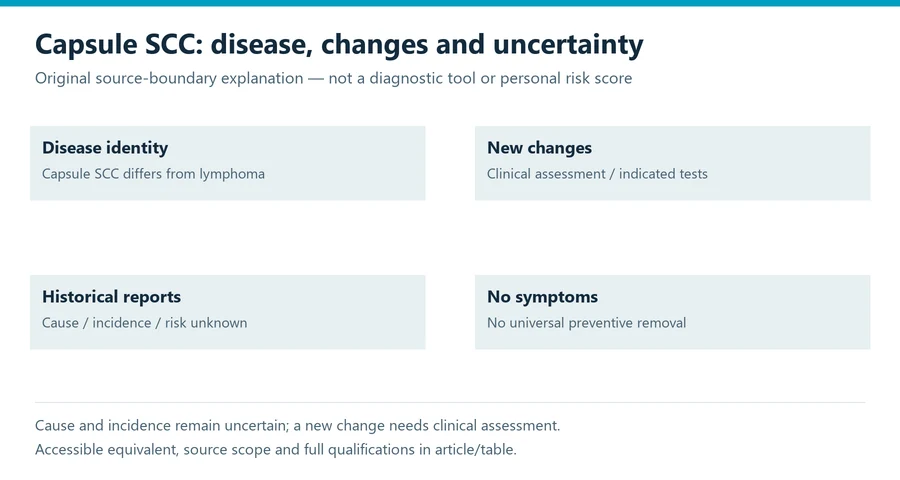
The map keeps breast implant associated squamous cell carcinoma separate from neighboring questions. A normal-looking breast is not a pathology report. A passive reporting count is not an individual’s risk. A routine device check has its own purpose and may not answer a new symptom question. A confirmed malignancy changes the situation and requires diagnosis-specific care rather than an ordinary cosmetic replacement conversation. These distinctions help a reader understand why the clinician may recommend a different assessment than a website’s general implant timeline.
The table and original diagram are explanations, not a validated clinical pathway or scoring system. They contain no observed patient outcomes and cannot certify that someone is cancer free. Use them to identify which question you are actually asking and which evidence would answer it. If several questions apply, discuss them separately so that an answer about device integrity does not inadvertently stand in for an answer about the cause of a persistent change.
How is suspected capsule disease investigated?
The FDA discusses examination of capsule tissue and appropriate evaluation when a concerning finding is suspected. The clinician decides what investigation fits the findings. A patient should not attempt to select pathology tests from a web article or assume that any removal procedure automatically supplies the correct diagnostic evaluation. Ask what is being investigated, what specimens or imaging may be needed and who will explain the results.
Breast implant associated squamous cell carcinoma, if confirmed, calls for a multidisciplinary treatment discussion. The FDA communication refers to relevant specialists including surgical oncology, plastic surgery, breast surgery, radiology, oncology and pathology. That does not mean every symptomatic patient needs all of those services before any initial assessment. It means a confirmed diagnosis is more specific than a generic implant concern and may require coordinated expertise. Ask who is responsible for bringing the findings together and whether referral is appropriate. Keep actual pathology and imaging reports for continuity rather than relying only on a verbal summary of a previous visit.
Does implant age provide a safe waiting period?
The communication describes a wide range of time since implantation among reported cases. That historical range is not a recommended waiting interval, an automatic replacement date or assurance that a newer implant cannot be involved in an important clinical problem. It should not be used to tell a person with new symptoms to wait until a particular anniversary. Equally, reaching an age mentioned in a report does not establish that cancer is present or that immediate removal is required.
For breast implant associated squamous cell carcinoma questions, document placement and replacement dates because they help establish the history. Then focus on the current findings and the appropriate assessment. Silicone rupture surveillance and other routine care have their own schedules and purposes; they are not a universal cancer-detection calendar. Ask the clinician what each follow-up is intended to monitor, how new changes should be reported and what would lead to an earlier visit. The important distinction is between a historical description of diagnosed cases and an individualized plan for someone who needs care now.
Should an asymptomatic person arrange preventive removal?
The FDA does not recommend removing implants from people without symptoms solely because of concern about these reports. Its advice also states that the reports do not require a change to routine medical care or follow-up. That is not the same as saying no one ever needs removal for another indication. Pain, contracture, rupture, personal preferences or a confirmed disease may lead to a different decision after appropriate assessment.
Breast implant associated squamous cell carcinoma concerns should therefore be discussed without turning fear into a universal surgical instruction. Ask what is known, what remains uncertain and what alternatives apply to your actual situation. If a clinician proposes removal, clarify the reason and the planned scope, including how any concerning tissue would be evaluated. Do not assume that a marketing phrase about complete or en bloc removal identifies the right operation for every patient. Surgical choices carry their own risks and consequences. The source does not establish that one generic operation eliminates every possible future symptom or malignancy concern.
How does this differ from other implant questions?
BIA-ALCL is a lymphoma, while SCC is a different cell type. Breast implant illness describes reported systemic symptoms and evidence questions, not a synonym for either malignancy. Capsular contracture refers to tightening and firmness of scar tissue; the presence of a capsule or contracture does not itself establish cancer. These distinctions matter because an explanation about one condition cannot automatically answer a question about another.
Breast implant associated squamous cell carcinoma also differs from ordinary breast-cancer screening and implant rupture monitoring. A person may need more than one of those services depending on history and findings. Ask what a proposed test addresses and what it leaves unresolved. A previous result described as normal should be interpreted within its actual purpose, timing and report, not treated as lifelong clearance from every breast or implant concern. The FDA’s broader complication page and lymphoma questions provide context, but they do not replace a diagnosis-specific assessment of an actual new change.
Read the FDA’s wider complication discussion.
Read the separate lymphoma explanation.
Which records help a consultation?
Keep the current concern separate from the device timeline
Prepare a concise description of the change, placement and replacement history, device card if available, and prior imaging or pathology reports. Label gaps honestly. Request original records from previous facilities where feasible, but do not delay seeking assessment until every document is found. Ask which information would be most useful and how to transfer it securely to the care team. An operative report may clarify details that a broad billing description or old advertisement cannot establish.
For breast implant associated squamous cell carcinoma, the practical questions include what the clinician is considering, what testing is proposed, when results are expected and who will respond if findings change. Keep the named follow-up contact with your records. These are original organization suggestions, not a diagnostic tool or personal treatment plan. The FDA’s device-decision information explains the importance of understanding the actual label and ongoing responsibilities. Broader operation context is available in the site’s procedure guides; the assessment of a current concern belongs with qualified clinicians who can examine you and interpret the findings.
Read the FDA’s device decision information.
What if a previous test was described only as an implant check?
Consider someone who has a new breast change and remembers being told that a scan last year was normal. Obtain the actual report and explain the current change. The earlier examination may have had a specific purpose, and the informal phrase implant check does not identify everything it assessed. This hypothetical scenario does not say the previous care was deficient or that cancer is present. It illustrates why a documented result and its timing matter.
For breast implant associated squamous cell carcinoma concerns, ask the clinician how that earlier assessment relates to the findings now and whether another investigation is appropriate. Do not assume the report rules out every future capsule problem, and do not dismiss it as useless because it did not have an all-purpose label. Keep the actual result available for comparison. The useful decision comes from clinical interpretation of current and previous findings, with uncertainty acknowledged, rather than from either reassurance or alarm based on a vague remembered summary.
How should you use this resource as evidence evolves?
The official sources were inspected on October 12, 2026. This page preserves the March 2023 issue and update dates and the historical evidence windows rather than claiming a new FDA incidence estimate. An inspection date does not establish qualified clinical review of this article. Nor does it prove that every subsequent case, study or local clinical guideline has been captured in an exhaustive review. Updated evidence should be interpreted with its design and limitations intact.
When discussing breast implant associated squamous cell carcinoma, keep uncertainty and action together. Unknown incidence does not make a new symptom irrelevant, and a frightening report does not diagnose the symptom or require every asymptomatic person to have surgery. Preserve accurate device and clinical records, request appropriate assessment for changes, and clarify who owns follow-up. A useful decision is based on the actual findings and available options, with source limits stated clearly, rather than on summed reports, guessed device history or promises that a generic test or operation answers every implant-associated concern.
Sources and review scope
Plastic Surgery Editorial Team. Source records checked through October 12, 2026. Review scope: source and editorial checks for general education. No individual clinical assessment is represented.
- FDA capsule SCC safety communication. fda.gov. Source date: 2023-03-22. Checked 2026-10-12.
- FDA implant risks and complications. fda.gov. Source date: 2023-12-14. Checked 2026-10-12.
- FDA BIA-ALCL questions and answers. fda.gov. Publication/update date not stated. Checked 2026-10-12.
- FDA things to consider before implants. fda.gov. Publication/update date not stated. Checked 2026-10-12.