
Chin liposuction removes localized fat; a neck-lift plan can also address underlying tissues, the platysma and excess skin. The right comparison depends on what the clinician identifies beneath the appearance you want changed. A fuller profile, loose skin and visible neck bands are not automatically the same treatment problem. 12
For chin liposuction versus neck lift, ask for the proposed components before comparing price, scars or recovery. Liposuction can be included within a neck-lift operation, so the names do not always describe mutually exclusive choices. A useful proposal explains what each part changes and which concern would remain outside the scope.
Name the concern without diagnosing it from a profile
Describe the area that concerns you at rest and during ordinary movement. You might dislike fullness below the chin, the appearance of loose neck skin or a band visible in certain expressions. Those observations are useful starting points, but they do not establish which tissue is responsible or how it should be treated.
ASPS lists the chin and neck among areas where liposuction can reduce localized fat. It also explains that skin quality affects how the area conforms and that liposuction is not treatment for obesity. 1 Removing fat should not be described as a guaranteed correction of every feature visible beneath the jaw.
ASPS describes neck-lift concerns including excess fat and skin, loose skin and muscle banding. 2 A procedure discussion should identify which of these is actually being addressed in your case. The word lift alone does not explain whether the plan contains fat treatment, muscle work, skin excision or a broader facial component.
| Concern | What the assessment should explain | Avoid assuming |
|---|---|---|
| Localized fullness under the chin | Is removable fat the relevant target? | Less fat answers every profile concern |
| Loose or folded skin | Is skin redraping or excision proposed? | A small-access procedure removes excess skin |
| Neck bands | What tissue and movement are involved? | Fat removal corrects every band |
| Combined jawline and neck concern | Which regions and components are included? | The operation name describes the entire plan |
Use photographs to communicate rather than diagnose. Head position, lighting and expression can change the visible profile. An assessment should interpret the actual anatomy and your goals without asking you to choose a procedure based on a comparison between an extended-neck pose and a neutral one.
Ask what standalone liposuction would leave unchanged
If chin liposuction is proposed, ask why the clinician believes that scope matches the concern. The explanation should identify the fat target and discuss the skin response. A statement that the incisions are small is relevant to access, but it does not establish that every desired contour change will follow.
Also request a clear description of the features outside the scope. You may accept a limited improvement in one area while leaving another feature unchanged. That can be an informed preference when the boundary is explicit, rather than a disappointing discovery after an operation was presented as a complete neck transformation.
Do not choose an extraction amount from a photograph, a desired angle or another patient’s report. Treatment planning must account for the actual region and surrounding tissues. A volume removed in a study does not provide a personal formula, and more removal is not automatically a better aesthetic endpoint.
If the remaining concern would involve skin or muscle, clarify whether a separate operation is being proposed now, considered later or simply discussed as an alternative. A possible later treatment should not silently turn a limited procedure into a guaranteed staged transformation whose full course and cost have never been explained.
Translate neck lift into its actual components
ASPS describes a traditional neck-lift incision around the ear and posterior hairline, with tissue repositioning, commonly platysma tightening and removal of excess skin. A separate incision under the chin may be used for liposuction and muscle repair. A limited-incision approach can offer a more limited result. 3
This means a quote called neck lift may contain several distinct actions. Ask the surgeon to identify those actions and their purposes. If liposuction is included, the decision is partly about whether the additional skin or tissue work is justified by the assessed goal, not a simple contest between suction and lifting.
Do not rank plans solely by incision length. A shorter incision may have a different scope, while a longer one carries a scar tradeoff that needs consideration. The proposed scar should be explained in relation to the actual procedure and your preferences rather than dismissed as always invisible.
If lower-face treatment is also included, record that explicitly. A neck-only goal and a combined face-and-neck goal are different courses. Their photographs, care requirements and fees should not be presented as equivalent without identifying the additional regions and procedures responsible for the change.
Read an anterior-neck series by the operation performed
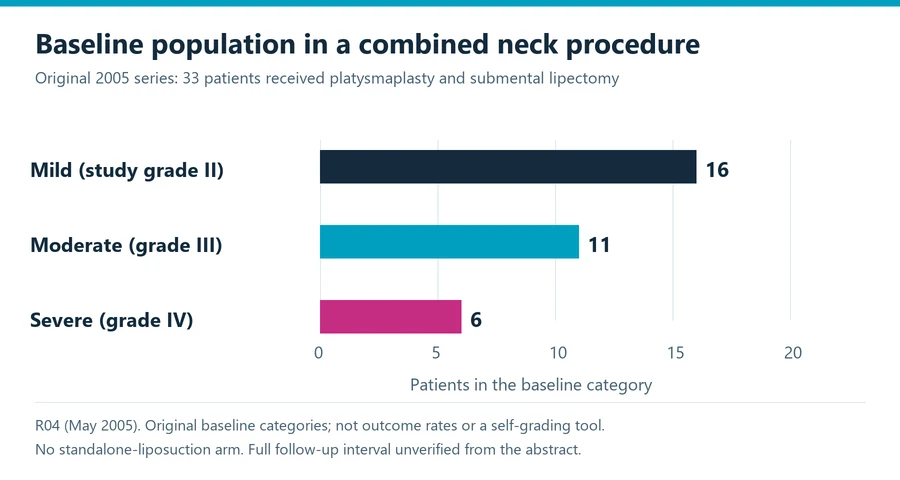
An original May 2005 series reported thirty-three consecutive patients treated with anterior platysmaplasty and submental lipectomy. At baseline, sixteen were classified as having mild, eleven moderate and six severe cervicomental-angle deformity under the authors’ grading system. These were selected patients, not a matched trial of liposuction against a full neck lift. 4
The procedure combined muscle and fat work. Its results therefore cannot establish what standalone chin liposuction would have achieved in the same patients. The authors also limited the goal to profile change rather than desired mid-face change. Scope is essential when a limited approach is compared with a larger operation. 4
| Original 2005 baseline category | Patients |
|---|---|
| Mild, study grade II | 16 |
| Moderate, study grade III | 11 |
| Severe, study grade IV | 6 |
| Total treated with the combined anterior procedure | 33 |
The original abstract does not establish a verified follow-up duration for every patient in this evidence check. We do not add one, reconstruct individual outcomes or assign yourself a study grade from a selfie. The supporting chart shows the baseline mix only; it is not a treatment-selection algorithm. 4
Why the baseline chart matters
The plotted counts show who was described in a small original series. Most participants were not in its most severe category, and every participant received the same named combined approach. Neither the counts nor the label anterior-only proves that the operation is suitable for someone with a different goal.
These grades belong to the study’s assessment framework. They do not define an ideal neck or a standard every reader should meet. A visual can clarify the population while leaving clinical suitability to examination, rather than giving you an apparent scientific reason to select a procedure without assessment.
Separate energy-assisted liposuction from a neck-lift comparison
An original randomized study enrolled thirty-six adult women to compare a specified diode-laser-assisted treatment with traditional submental liposuction. Ultrasound assessments occurred at two weeks and two months. Both groups showed reduced fat thickness. This was a comparison of fat-treatment methods, not a comparison with skin-excision neck lifting. 5
Its short-term measurements do not establish the lifetime effect of an energy device or whether the method can replace surgery for excess skin. The actual device, setting, population and outcome matter. A claim about an assisted technique should not be transferred to every product described as laser or radiofrequency treatment.
The abstract also describes different satisfaction categories for the two groups. Those categories are not treated here as matched success rates. A percentage of very satisfied participants and a percentage described as dissatisfied or neutral answer different questions; subtracting one from another would create an unsupported comparison.
Ask whether the evidence offered for a device matches the one actually proposed and the feature you want assessed. Approval or availability of a technology does not turn every combined marketing claim into a verified clinical endpoint. A comparison should retain the uncertainty rather than imply that an energy label removes the skin-versus-fat distinction.
Interpret a photograph as a documented treatment course
When reviewing examples, seek the treatment identity, accompanying procedures and assessment timepoint. A photo after liposuction plus muscle repair or skin treatment cannot isolate the contribution of fat removal. The same applies when a full facial operation changes the surrounding jawline as well as the neck.
Ask whether head posture and camera conditions are comparable. A different angle can alter the apparent relationship between the chin and neck. This is a reason to seek consistent documentation, not to accuse every pleasing photograph of manipulation or assume that a standardized image guarantees a particular personal result.
Also distinguish an early image from a later assessment. A result described at one postoperative visit is not a promise that all later changes will be identical. If the example contains additional treatment between images, that treatment belongs in the interpretation rather than being omitted from the original procedure’s claimed effect.
Your own preferred endpoint should remain explicit. You may want a change in profile while being comfortable with another feature, or prefer to avoid a scar even if a more extensive operation could address additional concerns. Examples are useful for discussion when they clarify those tradeoffs rather than replace the assessment.
Compare risks in the scope actually proposed
ASPS neck-lift guidance lists possible bleeding or hematoma, infection, wound-healing problems, prolonged swelling, sensory changes, nerve-related lower-lip weakness, skin loss and unfavorable scarring, among other risks. 6 These possibilities need explanation for the actual operation; they are not individual likelihoods or a frequency ranking against liposuction.
For liposuction, ASPS lists possible fluid accumulation, infection, contour irregularity, sensory changes, deeper-structure damage and anesthesia-related risks, among others. 7 A smaller access incision should not be interpreted as no complications. Ask how the treatment extent and any accompanying procedure affect the consent discussion.
Counting the entries in two risk lists does not tell you which plan is safer for you. The techniques and populations differ, and a clinical assessment needs your history and the intended scope. A meaningful comparison explains the relevant risks and available response without pretending that a general page can calculate your personal odds.
Clarify who evaluates a new symptom or unexpected appearance and where that evaluation occurs. Routine result review, urgent medical assessment and a later revision discussion are different pathways. You should receive actual contact and escalation instructions rather than assume that every concern can wait for the next scheduled aesthetic appointment.
Keep neck-lift instructions separate from generic swelling advice
ASPS neck-lift recovery guidance describes possible bandaging and drainage, individualized care and precautions about head position. It specifically warns against applying ice to the neck because of potential blood-flow compromise. 8 Generic advice copied from another operation should not replace the treating team’s actual instructions.
Ask how sleeping arrangements, driving and work duties fit the proposed course. Tasks involving turning or bending the neck need clarification from the team rather than a universal return-to-work day. This comparison organizes those questions; it does not authorize a movement, select a garment or prescribe a postoperative routine.
ASPS liposuction recovery guidance likewise describes support garments and individualized instructions. 9 Standalone chin liposuction still requires care and assessment. Confirm the specific arrangements for the face or neck rather than adopting a massage or compression practice from someone’s abdominal procedure.
For a combined neck-lift and liposuction plan, obtain coherent instructions for the full operation. Averaging two advertised recovery estimates would not tell you when you can resume a particular activity. The actual surgeon must assess the course, including any change caused by an unexpected finding or additional procedure.
Budget by components and confirmed services
Request a dated quote identifying the liposuction region, muscle or skin work and any broader face treatment. Separate surgeon, facility and anesthesia charges where applicable. A fee labeled chin lipo and a total labeled neck lift may describe entirely different services until the components and exclusions are made explicit. Use the neck lift cost worksheet to organize that procedure’s quoted services and financial assumptions separately.
| Quote item | What should be named |
|---|---|
| Fat treatment | Region, standalone or part of a combination |
| Muscle and skin work | Actual planned components, not a package implication |
| Treatment setting | Applicable anesthesia and facility charges |
| Follow-up | Included assessment and practical return arrangements |
| Additional intervention | Planned stage or policy for an unexpected course |
Do not assume that a combination produces a particular discount or that all possible follow-up treatment is included. A routine appointment, assessment of a concern and another operation are different services. Ask what the policy covers and what remains a possible separate charge.
The cheaper quote is not automatically the better comparison if it leaves the intended skin or muscle concern outside the scope. Conversely, a more extensive operation should not be treated as necessary merely because it can change additional features. Compare proposals that identify the same desired goal and acknowledge different tradeoffs.
No verified lifetime-cost calculation follows from the checked studies. Use confirmed current services and clearly labeled alternatives. If a later stage is uncertain, leave its necessity and cost uncertain instead of inventing a precise total that makes one procedure appear financially superior for every reader.
Clarify durability without promising unchanged aging
ASPS states that a neck lift cannot stop aging. 2 A surgical plan can change tissues without guaranteeing that the appearance remains identical forever. Ask how the team describes the intended result and future uncertainty, particularly if photographs or a promotional description suggest a permanent state.
For liposuction, do not equate removal of fat with a guarantee that the entire neck contour never changes. The visible profile involves more than one feature, and the procedure’s scope needs to remain distinct from a prediction about your future appearance. A universal number of lasting years is not established here.
If you anticipate weight change or another facial procedure, disclose that plan during assessment. Ask what it means for timing and interpretation of the current proposal. A treatment decision is clearer when future possibilities are acknowledged than when every later change is treated as a failure of the first operation.
Document which result you would consider worthwhile even if another concern remains. That preference can help explain why a limited scope may or may not be acceptable to you. It should inform discussion without becoming a promise that a particular feature will change by a predetermined amount.
Finish with a component-level decision record
Record the concern, the tissue identified by the clinician, the proposed components and the tradeoffs you would accept. Include the expected limits, care commitments and unresolved questions. You can organize a proposal in plain language without assigning yourself a clinical grade or deciding suitability from an online comparison.
If two clinicians recommend different plans, compare the feature each is addressing. One may be proposing isolated fat treatment while another includes skin or muscle. A useful second opinion explains why the scopes differ and what each would leave unchanged rather than asking you to choose by procedure name alone.
For chin liposuction versus neck lift, the central question is whether the proposed operation addresses the actual fat, skin and tissue concerns you want assessed. A small incision, a bigger package or an unmatched study endpoint cannot answer that question by itself. Keep the target and full course visible throughout the decision.
Related planning guides
Explore procedure guides, questions to ask a plastic surgeon and plastic surgery cost structure.
Sources
1 ASPS: Liposuction scope and skin limits. 2 ASPS: Neck lift scope and aging limits. 3 ASPS: Neck lift components and incisions. 4 Original anterior-only combined neck-procedure series. 5 Original laser-assisted and traditional submental liposuction trial. 6 ASPS: Neck lift risks. 7 ASPS: Liposuction risks. 8 ASPS: Neck lift recovery and ice warning. 9 ASPS: Liposuction recovery.
Sources and review scope
Plastic Surgery Editorial Team. Source records checked through October 12, 2026. Review scope: source and editorial checks for general education. No individual clinical assessment is represented.
- ASPS liposuction scope and skin limits. plasticsurgery.org. Publication/update date not stated. Checked 2026-10-12.
- ASPS neck lift scope and aging limits. plasticsurgery.org. Publication/update date not stated. Checked 2026-10-12.
- ASPS neck lift components and incisions. plasticsurgery.org. Publication/update date not stated. Checked 2026-10-12.
- Original anterior-only combined neck-procedure series. pubmed.ncbi.nlm.nih.gov. Source date: 2005-05. Checked 2026-10-12.
- Original assisted and traditional submental liposuction trial. pubmed.ncbi.nlm.nih.gov. Source date: 2016. Checked 2026-10-12.
- ASPS neck lift risks. plasticsurgery.org. Publication/update date not stated. Checked 2026-10-12.
- ASPS liposuction risks. plasticsurgery.org. Publication/update date not stated. Checked 2026-10-12.
- ASPS neck lift recovery and ice warning. plasticsurgery.org. Publication/update date not stated. Checked 2026-10-12.
- ASPS liposuction recovery. plasticsurgery.org. Publication/update date not stated. Checked 2026-10-12.