
Plastic surgery interpreter access means arranging communication that lets you understand the assessment and proposed care, ask your own questions and communicate your preferences. Tell the practice the language or communication method you use and identify the appointments for which assistance is needed. A successful scheduling call does not confirm an arrangement for a complex consultation, consent discussion or later follow-up. Ask who coordinates the service and how it will work at the actual visit.
Spoken-language assistance and disability-related effective communication have different legal contexts and may require different services. This guide separates those needs and provides an original conversation-stage worksheet. It does not determine a practice’s funding status, decide an individual legal dispute or certify an interpreter. Its practical purpose is to make the communication task, agreed method and unresolved question clear before an appointment relies on assumptions.
What does plastic surgery interpreter access need to solve?
Describe the language and method you normally use, not just a broad label. If you use sign language, identify that need; if you prefer spoken-language interpretation, explain the language and any relevant dialect. If another communication aid works better for you, say so. A practice cannot reliably infer the appropriate arrangement from nationality, a companion’s speech or a note saying that you need help.
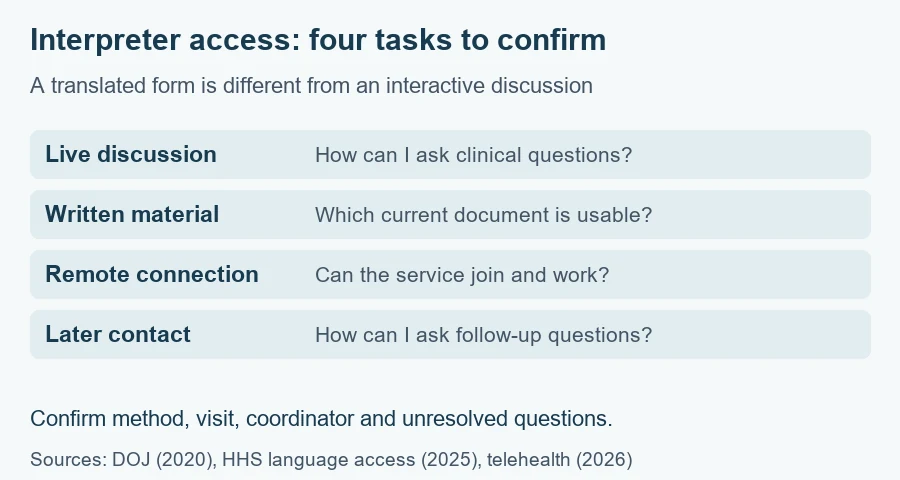
Separate conversation from documents. Interpreting a spoken or signed exchange and translating a written form are different tasks. You may need both, and a translated consent form does not by itself enable questions during the clinician’s explanation. Ask how the discussion and the documents will be made usable together. Record each arrangement rather than assuming that one service automatically includes the other.
Plastic surgery interpreter access should support your own participation. The interpreter communicates the exchange; the clinician remains responsible for explaining the assessment and options. You remain the person making decisions about your care, except where an authorized representative has a separate appropriate role. Ask the team to address you directly and allow time for questions rather than directing the entire conversation to the interpreter or companion. For preparing the questions and records for another opinion, see plastic surgery second opinion.
Disability-related communication and spoken-language access differ
DOJ effective-communication guidance addresses ADA-covered entities and people with communication disabilities. It considers the context and the person’s usual method, and describes qualified interpreters and other aids. It does not say that one modality works for everyone. A person who uses sign language and someone who does not use sign language may need different arrangements even if both have hearing loss. [1]
HHS language-access guidance concerns programs within the civil-rights authorities it enforces, including federally assisted health programs and covered entities. It describes free language assistance in that scope. Do not turn that statement into an unsupported claim that every private cosmetic practice has identical funding or obligations. Ask the practice to explain the service available and consult the relevant agency resource if its response leaves a rights question unresolved. [2]
For plastic surgery interpreter access, keep the need separate from the name of the legal framework. You can make a concrete request for an understandable consultation without first resolving every regulatory issue yourself. Record what the practice confirms and which question remains open. If an explanation about coverage or payment is unclear, seek clarification rather than accepting a general statement that all communication help is optional or universally chargeable.
A communication-task worksheet
The following table is an original planning aid, not a compliance score. Different stages can have different demands. A short exchange about the arrival time is not the same as discussing risk, alternatives or an unexpected finding. Use the record to confirm the actual service and who will coordinate it, then update it when the appointment or location changes.
| Plastic surgery interpreter access task | Confirm with the practice | Keep separate |
|---|---|---|
| Scheduling | Language or communication method and usable contact channel | A booking exchange versus clinical discussion |
| Assessment | How the history, findings and your questions will be interpreted | Interpreter role versus clinician explanation |
| Consent | Arrangement for options, risks and questions before deciding | Translated form versus an interactive discussion |
| Written information | Translation or accessible format for the needed documents | Document access versus live interpretation |
| Follow-up | Method for routine and urgent communication | A one-visit booking versus later care |
Mark a service as confirmed only when the practice has explained the arrangement for the relevant task. If staff say that someone will call you, the confirmation is still pending. Record the contact role, date and open question. This prevents a planning worksheet from looking complete while the consent conversation depends on a service that has not been arranged.
What does qualified interpretation mean here?
DOJ’s guidance describes a qualified interpreter through effective, accurate and impartial communication, including the specialized vocabulary needed for the exchange. Familiarity with two languages alone does not establish those skills. Ask how the practice arranges appropriate interpretation for a medical conversation. This is a service-confirmation question; you are not expected to evaluate an interpreter’s credentials from an online profile or conduct a professional examination yourself.
Explain if you have difficulty understanding a particular language variant or interpreting arrangement. A service can exist without being effective for your conversation. Ask who will address that problem and how the discussion can pause while it is resolved. Do not treat an uninterpreted explanation as understood merely because a form is available in another language. Understanding concerns should be raised with the clinician before you decide about the proposed treatment.
Plastic surgery interpreter access also requires a distinction between a neutral interpretation and advice about the operation. The interpreter should not become the person choosing the treatment or answering clinical questions independently. If you ask a medical question, direct it to the clinician through the agreed communication method. If an answer remains unclear, request another explanation rather than assuming the interpreter is responsible for filling the gap.
A companion is not automatically the interpreting plan
You may want a friend or family member present for support. Their role is different from qualified interpretation. Discuss which parts of the appointment you want them to attend and whether you prefer private time with the clinician. Bringing support does not automatically mean that the companion should handle medical language, confidential questions or the explanation of risks. Keep your preference and the arranged interpreting service separately documented.
DOJ guidance places effective-communication responsibility on covered entities and describes narrow circumstances for relying on an accompanying person. It does not permit a blanket instruction that a person needing sign-language interpretation must bring their own interpreter. Ask the practice to explain its arrangement rather than making a child or reluctant companion the default. Specific exceptions should not be expanded into an ordinary scheduling policy.
For plastic surgery interpreter access, tell the team if a companion’s involvement makes it difficult to ask certain questions. The reason may be privacy, independence or simply a preference about the conversation. You should not need to explain every personal detail to request a discussion with an appropriate interpreting arrangement. Clarify how the visit can support your participation while preserving the separate role of any authorized representative where one is relevant.
Remote interpretation must work for the actual interaction
A remote service can be useful, but the platform and setup must support the conversation. Ask how the interpreter will join, whether you can see or hear what you need, and what will happen if the connection fails. A device placed in the room is not proof that communication will be effective. The practice should explain the arrangement for the task and your usual method.
For sign-language video interpretation, the visual connection and positioning matter. DOJ guidance discusses circumstances in which remote interpretation may not be effective and an on-site service may be needed. Do not assume that either modality is always sufficient or always required. Explain any difficulty using the screen, and ask how the team will address it. This guide does not determine the appropriate modality for your particular appointment.
Plastic surgery interpreter access during telehealth needs its own confirmation. HHS and DOJ telehealth guidance describes barriers such as a platform that cannot include an interpreter and instructions that are not usable in the needed language. Its page was reviewed July 31, 2026. Ask whether the proposed system supports the agreed service and how you will obtain the connection instructions, rather than assuming an in-person arrangement transfers automatically to a video visit. [3]
Test the practical arrangement before a complex discussion
If the practice proposes a remote appointment, ask whether the connection and interpreting arrangement can be checked before the clinical conversation begins. Confirm which device and channel will be used and who can help if the service is not usable. A test is a practical preparation step, not evidence that every later medical explanation will be understood. You still need to be able to ask questions during the appointment.
Separate a platform problem from a misunderstanding of the clinician’s explanation. Both deserve attention, but they need different responses. A dropped connection requires restoring communication; an unclear treatment option requires another clinical explanation through the working service. Naming the problem can help prevent staff from treating every concern as a technical inconvenience or every technical failure as a patient’s lack of understanding.
For plastic surgery interpreter access, record the backup process as well as the main arrangement. Ask who decides whether the conversation should continue, pause or be rearranged when communication fails. Do not presume that a signed form resolves a failure in the discussion. You should be able to explain which question remains unanswered and ask the clinician how it will be addressed before making a decision.
Keep documents connected to the conversation
Ask which written materials you will receive and how they will be made usable. Consent forms, preparation instructions, aftercare information and billing documents answer different questions. A translated general brochure may not include the individualized instructions your treating team provides. Identify the document you need, its current version and the arrangement for asking about it. For organizing the actual discharge document and contact instructions, see plastic surgery discharge instructions.
If two versions appear inconsistent, ask the practice to resolve the difference. Do not choose whichever wording seems easier or assume that an older translation remains current. Record the document title or date so staff can identify the actual issue. The clinician should explain clinical instructions through the agreed communication method; the financial team can clarify the financial terms without letting those terms substitute for consent to treatment.
Plastic surgery interpreter access is particularly useful when a document requires action from you. Ask how you can confirm what is expected and which contact to use if a question arises later. A usable format alone does not prove that you understand every instruction, and a verbal explanation alone may not give you a reliable record to consult at home. Plan both the exchange and the material you will retain.
| Information item | Live communication question | Document question |
|---|---|---|
| Proposed care | Can I ask about goals and alternatives? | Which version describes the agreed scope? |
| Risks and consent | Can I clarify uncertainty before deciding? | Is the relevant form usable and current? |
| Individual instructions | Who explains what I should do? | How will I receive my actual instructions? |
| Routine contact | How can I ask later questions? | Which channel and details should I keep? |
| Financial information | Who explains charges or conditions? | Are the written terms usable and consistent? |
Ask how the arrangement protects a private discussion
Tell the practice if you want a confidential conversation without a companion present. Ask how the interpreting service participates and how documents or connection details will be handled. A privacy question is different from refusing assistance; you can need an interpreter while also wanting to discuss a sensitive concern directly with the clinician. Clarify those preferences before the conversation begins where possible.
If the appointment uses a shared device or remote link, ask who can hear or view the exchange and how the practice manages the session. Do not assume that everyone who helped you connect should remain for the assessment. Record the agreed participants and ask the team to explain any change. The practical goal is a conversation in which you can raise your own questions comfortably through the arranged service.
Confirm later locations and follow-up separately
The consultation office, operating facility and follow-up service may have different coordinating teams. Ask who will pass on the communication request and whether you need a new confirmation at each site. A service arranged for one discussion should not be silently extended to another without checking the details. Keep the actual location and date in your record.
Discuss contact after the visit, including how urgent instructions will be communicated. The treating team should explain its own contact process in a way you can use. This guide does not identify an urgent symptom list or provide medical clearance. Its question is whether the clinical advice and contact arrangement are accessible to you when they are needed, rather than only while an interpreter is physically present.
Plastic surgery interpreter access may also involve an appropriate companion who has a communication disability. DOJ guidance addresses companions in relevant circumstances. Tell the team who needs to receive information and what method they use, while keeping your own participation central. This is distinct from allowing a companion to make decisions or receive every private detail without clarification of their role.
Keep a clear record when an arrangement is unresolved
Write down the request, response, appointment and specific issue. “Interpreter needed” is less useful than a record of the language or method, the communication task and the practice’s proposed arrangement. If the response changes, preserve the earlier note and record the new answer. This can make a missed handoff visible without requiring you to decide its legal meaning during a scheduling call.
Ask who can resolve the outstanding question and how you will receive the answer. If the issue concerns funding or rights, use the relevant current agency guidance rather than assuming every practice is covered identically. An agency complaint resource can explain its process, but this guide does not guarantee a remedy or determine that a particular response is unlawful. Keep practical service coordination and an individual legal assessment separate.
| Plastic surgery interpreter access status | What is actually known | Useful next step |
|---|---|---|
| Requested | Need and task communicated | Identify the coordinator |
| Confirmed | Method and visit specified | Recheck if the location or date changes |
| Ineffective in use | A specific communication barrier occurred | Describe it and request a workable arrangement |
| Unresolved | A question still prevents planning | Obtain the responsible team’s answer |
When is the communication plan ready for a decision?
You should know how the clinical conversation, relevant documents and later contacts will work. You should also be able to ask your own questions and obtain an explanation from the clinician through the agreed method. A booking confirmation alone is not that plan. If a substantial question remains unanswered, identify it clearly rather than treating a signature as proof that communication has been effective.
Before attending, summarize the plastic surgery interpreter access arrangement and ask the practice to correct any misunderstanding. Keep the confirmation in a usable form. The goal is an understandable, interactive assessment and consent process with appropriate follow-up communication. It is not a promise that the treatment will achieve every appearance goal, a substitute for clinical judgment or a certification of a particular office’s compliance.
Sources and update record
Primary agency resources checked October 12, 2026. Page review dates below are not dates on which all underlying laws were enacted. Provider and funding scopes remain distinct. No legal, interpreter-qualification or clinical review is claimed.
| Source | Observed date | Scope |
|---|---|---|
| DOJ effective communication | Updated February 28, 2020 | Context-specific aids, qualified interpretation and companion boundaries |
| HHS limited-English-proficiency guidance | Reviewed July 18, 2025 | Language services in the relevant federally assisted or covered scope |
| HHS and DOJ telehealth nondiscrimination guidance | Reviewed July 31, 2026 | Remote-service barriers and access; provider scopes distinguished |
Sources and review scope
Plastic Surgery Editorial Team. Source records checked through October 12, 2026. Review scope: source and editorial checks for general education. No individual clinical assessment is represented.
- DOJ effective communication: context and qualified service. ada.gov. Source date: 2020-02-28. Checked 2026-10-12.
- HHS language access: provider and funding scope. hhs.gov. Source date: 2025-07-18. Checked 2026-10-12.
- HHS and DOJ telehealth access: actual remote-service barriers. hhs.gov. Source date: 2026-07-31. Checked 2026-10-12.