
Plastic surgery facility accreditation concerns a health-care organization’s standards and scope; it does not by itself establish that your operation is appropriate or free of risk. Verify the actual treatment location, accrediting body, program and current status, then discuss anesthesia, monitoring and emergency arrangements for the proposed procedure. A surgeon’s credential, a building’s appearance and a facility’s accreditation are different matters. This guide verifies no individual facility and supplies no provider ranking.
What does plastic surgery facility accreditation mean?
Accreditation involves an assessment against an accreditor’s standards. The Joint Commission describes an on-site standards-compliance survey and an ongoing improvement process. ASPS patient information discusses facility equipment, personnel, anesthesia and monitoring. These are meaningful organizational issues, but a favorable organizational status should not be translated into a guarantee that every procedure, clinician or patient has the same risk. The actual proposal still needs clinical assessment.
Begin with the precise claim made by the facility. Ask which body granted the accreditation, what program applies and which location it covers. A general statement that a company is accredited may not identify the operating site or service you are considering. Record the information before deciding what to verify. This is an original question organizer, not an official accreditor’s inspection protocol. It helps prevent a familiar seal from being accepted as an all-purpose approval without knowing what it represents or whether it applies to the care actually being offered.
Read the Joint Commission’s explanation of its accreditation process.
Why does the actual location matter?
The consultation office, operating facility and postoperative accommodation may have different addresses and responsibilities. Ask where each stage will occur. A clinic brand may describe several places, while an official search or certificate may identify a particular organization or site. Do not assume that seeing a seal in the consultation office resolves the status of a different operating room or recovery service. Obtain the actual names and locations relevant to the proposal.
For plastic surgery facility accreditation, keep a separate entry for each actual site that matters. Record the legal or operational name supplied, any doing-business-as name, the address and the role in care. Then ask what authority or credential applies to that site. If a location changes before surgery, revisit the relevant verification and clinical questions rather than assume the original answers automatically transfer. This page does not determine whether a particular company’s accreditation covers multiple sites. The accreditor and actual records can clarify that question. Your worksheet should identify what was checked rather than simply state that the brand is approved.
How can an official organization search help?
AAAHC provides a public search with organization name, doing-business-as name, location and program filters. It explicitly notes that accredited organizations may not appear because of factors including name changes, status changes or services offered, and that results are limited. A search can therefore help locate information, but absence of a result should not automatically become a definitive claim that a facility is unaccredited. Matching and source limitations still matter.
Plastic surgery facility accreditation checks should record the actual query, matched identity, displayed information and date. If the match is unclear, ask the facility for precise details and seek clarification from the accreditor. Do not select a similarly named organization because it produces a reassuring result. This article inspected the search method, not a particular facility record, and does not issue a verified badge. An official result also needs its program and scope understood; a name match alone does not establish every service you might associate with the organization or the suitability of your proposed operation.
Read the AAAHC organization-search instructions and limitations.
Why do older names appear in facility guidance?
The ASPS facility page still uses historical organization names, including AAAASF. QUAD A’s official history explains that AAAASF rebranded as QUAD A in 2022. That can help a reader understand older paperwork or guidance without treating the change as proof that an individual facility has any particular status. Organization history and a current site verification are different pieces of evidence.
For plastic surgery facility accreditation, record the exact name on an actual certificate or claim and ask how it corresponds to the current accreditor. Do not assume a historical name means a credential is invalid, and do not assume the rebrand validates any document bearing the older name. The relevant questions remain the source, location, program and current status. This page does not reproduce an accreditor logo or create a certificate. It uses the official history only to clarify terminology, not to infer a facility’s present authorization or compare one accreditor’s safety performance with another. For checking the exact specialty-board credential, see plastic surgeon board certification.
Read QUAD A’s organizational history.
What belongs in the facility worksheet?
| Entry | Useful information | Separate question |
|---|---|---|
| Actual site | Organization name, address and care role | Consultation office may differ |
| Credential | Accreditor, program, status and check date | No personal outcome guarantee |
| Proposed care | Operation and anesthesia plan | Clinical suitability still required |
| Continuity | Monitoring, response and transfer arrangements | Accommodation is not automatically medical care |
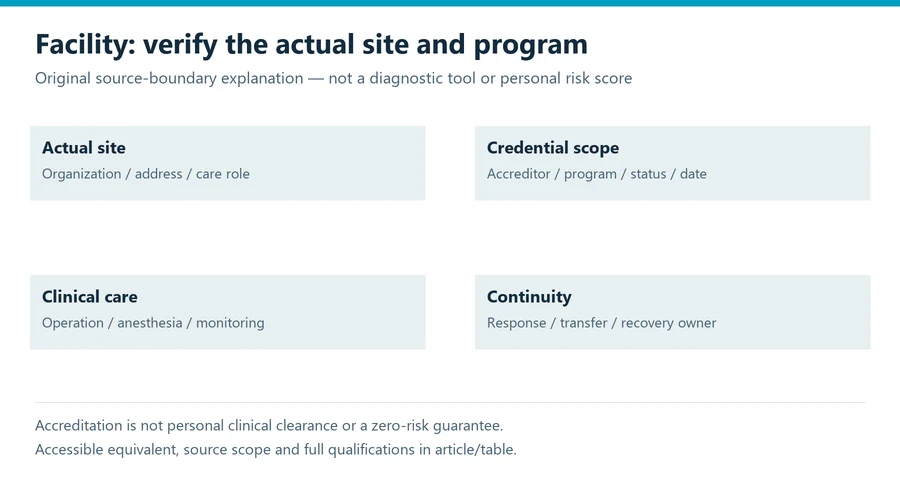
The worksheet keeps plastic surgery facility accreditation separate from individual clinical clearance. It can organize the facts and unresolved questions before an appointment. Keep the source and date beside the status, and label unknown entries honestly. Do not turn the table into a point total that approves a site because enough boxes were checked. One important unresolved question may need clarification regardless of how many other entries are complete.
The original diagram explains these categories and has an equivalent text table. It is not an inspection report, a validated risk tool or a claim that a particular facility was visited. It contains no observed patient outcomes or comparative complication rates. Use it to identify who can answer each question and which actual document or assessment is relevant. The completed record should show what is known and what remains a clinical or verification dependency rather than supply a decorative safety score.
Is accreditation the same as state licensure or Medicare participation?
The ASPS patient page describes several alternatives within its member-surgeon facility policy, with distinctions based on anesthesia scope. Its policy should not be rewritten as a single universal law requiring the same credential at every US site. Accreditation, state licensing and participation in a federal program are different descriptions. The applicable rules and actual site records determine what each claim means in context.
For plastic surgery facility accreditation, ask which status is being claimed rather than accept the broad word approved. Record an accreditation claim as accreditation and a licensing claim as licensing. If a clinical proposal depends on a particular authorization, seek the relevant official explanation instead of assuming one label proves all the others. This guide does not assess current licensing law in every jurisdiction or determine compliance for a named facility. It also does not use ASPS membership requirements as evidence that a nonmember site has violated the law. The distinction helps a reader ask accurate questions without inventing a regulatory conclusion.
Read the ASPS facility guidance and its stated scope.
How does anesthesia fit the facility discussion?
The proposed anesthesia and procedure need an actual clinical plan. Ask who will provide anesthesia care, how the responsibilities are arranged and what monitoring and recovery services are available. A facility’s credential is useful context, but it does not decide which anesthesia is appropriate for your medical history or procedure. An advertising term such as light sedation is not a substitute for the team’s explanation of the actual plan.
Plastic surgery facility accreditation questions should therefore be discussed alongside, not instead of, anesthesia assessment. If the scope changes from the original proposal, ask whether the setting, staffing or care arrangements also change. Record which answers refer to the actual operation rather than a typical service offered by the organization. This article supplies no anesthetic prescription or universal rule that one building type is safest for everyone. It does not independently verify the credentials of an anesthesia professional. The practical aim is to prevent an organizational seal from prematurely ending questions that require the clinical team to evaluate the person and the proposed care.
What should you ask about emergency response?
ASPS facility guidance discusses equipment, monitoring and emergency transfer arrangements. Ask how those arrangements apply to the actual site and operation, who is responsible and what happens if a complication requires another level of care. A general statement that a hospital is nearby does not explain the entire response pathway. Request an explanation in ordinary language rather than technical details you cannot independently evaluate.
For plastic surgery facility accreditation, preserve the difference between an official credential and the specific operational explanation you receive. Ask whether a transfer arrangement and relevant response capability are part of the proposal, and identify who can clarify uncertainty. Do not try to inspect equipment or test an emergency pathway yourself based on a website checklist. This organizer is not a clinical audit protocol. Its purpose is to reveal whether important responsibilities have been explained before you commit. A response plan reduces uncertainty about what will happen when help is needed; it is not proof that complications cannot occur or that any particular outcome is guaranteed.
How is postoperative accommodation different?
A hotel, home stay or advertised recovery residence may be part of the travel arrangement, but its name alone does not establish medical capability. The ASPS page advises asking about accreditation or licensing for a specialty postsurgical treatment facility as well. Do not assume the operating site’s credential automatically describes another place where you will sleep or receive assistance. Clarify the actual service and the people responsible. For preparing sleep-apnea questions for the anesthesia team, see sleep apnea and outpatient surgery.
Plastic surgery facility accreditation planning should include the distinction between ordinary accommodation, practical help and clinical monitoring. Ask what service is provided, what instructions apply and how a concern reaches an appropriate clinician. Record the location and contact separately from the surgical facility. This guide does not establish staffing requirements for every accommodation or classify an actual residence as licensed. It also does not imply that every patient requires a specialty recovery facility. Your needs depend on the operation and assessment. The useful task is to avoid treating a package description as evidence that a separate postoperative setting supplies the care you actually need.
Can published facility risk figures predict your outcome?
The ASPS facility page includes pooled complication and mortality statements without a clearly displayed current review date. This resource does not import those numbers as your probability or as current rates for every operation. A group-level figure requires its population, procedures, period and outcome definitions to be understood before it can support a meaningful comparison. Accreditation alone cannot make those different clinical circumstances identical.
For plastic surgery facility accreditation, ask what a numerical claim actually measures. A clinic’s marketing statistic may refer to a period or case mix different from your proposal. A record of no observed rare events is not proof that none can occur. This page supplies no comparative safety ranking among accreditors, office settings, surgery centers or hospitals. The decision about setting should consider the actual clinical needs and service capabilities rather than an unsupported promise attached to a seal. Keep the source and limitations visible when discussing evidence so that a precise-looking number does not replace an individualized assessment. For organizing options, unanswered questions and the consent discussion, see plastic surgery informed consent.
What does a hypothetical location change illustrate?
Recheck the site rather than only the brand
Imagine receiving a proposal naming one operating address and later being told the same company will use another address. The useful response is to clarify the new site, relevant program and clinical arrangements. A shared brand does not settle those details. This is a hypothetical planning example, not a claim that a real facility changed locations or operated without appropriate credentials.
For plastic surgery facility accreditation, update the worksheet with the actual change and identify which previous answers remain applicable. Ask whether the anesthesia, monitoring, recovery or emergency plan has changed too. Preserve the explanation and its source rather than rewrite the entire record as verified because the company name stayed the same. If an important question remains unresolved, request clarification before elective scheduling. The original exercise demonstrates accurate record ownership, not a rule that every location change is unsafe. It helps keep the specific site and services visible through a decision that may otherwise be presented as a simple administrative substitution.
How can you organize documents without creating an endorsement?
Keep each supplied document labeled by its source and purpose. A facility brochure, a certificate copy, an official organization-search result and a clinical explanation are different items. Record the address and program attached to the credential instead of letting the company name stand in for every location. If the document’s scope is unclear, identify the question for the facility or accreditor rather than assign a favorable interpretation yourself.
For plastic surgery facility accreditation, a practical organizer can distinguish observed information, the service’s explanation and remaining verification. This is original editorial organization, not an accreditor’s approved inspection form. It does not prove that every certificate is authentic or that a claimed service falls within a particular program. Ask the relevant authority what information establishes the actual current status. When a new document or location is supplied, preserve the date and explain which entry it clarifies. Do not erase the earlier uncertainty in a way that implies a check was completed when it was not. The useful outcome is a traceable factual record, not a published safety badge or a personal-risk conclusion unsupported by the clinical assessment.
How should you use the completed record?
The official pages were inspected on October 12, 2026. No named facility was searched, visited or certified through this article, and no qualified clinical review or individual legal assessment is claimed. Where an official page did not identify a clear revision date, copyright and retrieval are not used to invent one. Current status and scope require the actual accreditor’s record and the appropriate clinical discussion before publication of an individual verification claim.
Use plastic surgery facility accreditation as one part of understanding the actual care proposal. Verify identity, site, program and status, then clarify anesthesia, monitoring and continuity for your situation. Keep organizational credentials separate from surgeon credentials and personal suitability. Broader operation context is available through the site’s procedure guides, while the treating team must explain the actual setting and responsibilities. A useful record makes unresolved questions concrete. It does not promise that a credential guarantees an outcome, that one facility category is universally best or that every absent search result proves a regulatory failure.
Sources and review scope
Plastic Surgery Editorial Team. Source records checked through October 12, 2026. Review scope: source and editorial checks for general education. No individual clinical assessment is represented.
- ASPS facility guidance. plasticsurgery.org. Publication/update date not stated. Checked 2026-10-12.
- AAAHC current organization search. aaahc.org. Publication/update date not stated. Checked 2026-10-12.
- QUAD A organizational history. quada.org. Publication/update date not stated. Checked 2026-10-12.
- Joint Commission accreditation process. jointcommission.org. Publication/update date not stated. Checked 2026-10-12.