
Tummy tuck cost becomes useful only when you know what the quoted operation includes. The American Society of Plastic Surgeons cost page displayed an average surgeon’s fee of $8,174 when checked on October 12, 2026. It excludes anesthesia, operating-room facilities and related expenses, and the page does not identify the underlying fee-data year. Treat it as a dated observation of that page, not a current nationwide total or a price promised for your abdomen. Your decision needs an examined surgical plan and a complete written estimate. ASPS fee scope.
This guide helps you audit an abdominoplasty quote, separate abdominal-wall questions from cosmetic skin removal, and calculate the amount you would actually commit. The original worksheet below uses invented numbers solely to demonstrate arithmetic. It does not quote a practice, recommend a technique, predict an insurance decision or estimate your personal recovery. For procedure fundamentals, start with the tummy tuck guide, then bring this narrower budget checklist to your consultation.
Read tummy tuck cost evidence without changing its meaning
An average surgeon fee and a complete surgical bill answer different questions. The first describes a professional charge within a source’s reporting scope. The second depends on the services, people and setting in your particular plan. A headline saying a tummy tuck costs $8,174 would erase that distinction. Adding guessed anesthesia and facility percentages would replace one incomplete observation with another unsupported number. Neither approach tells you what a written quote from a practice actually covers.
The latest ASPS procedural report available when checked is the 2025 report. Its methodology describes national and regional procedure estimates, aggregated and extrapolated from member, partner and claims information. We inspected the report and did not find a surgeon-fee table. Its publication year therefore cannot establish that the dollar amount on the separate cost page is a 2025 fee average. Keeping these sources separate prevents an older, undated fee from being presented as newly measured simply because a newer procedural report exists. ASPS 2025 report, methodology page 40.
The practical role of the ASPS figure is limited: it helps explain why a surgeon-fee headline might look different from an all-inclusive offer. It cannot prove that a quote above it is excessive, that one below it is safe, or that a specific region should add a certain premium. When a practice cites a national average, ask which year, which operation category and which excluded charges it means. A source label should make comparison clearer, not function as a sales credential.
Define the operation before comparing tummy tuck cost
Write the exact proposed operation in ordinary language before recording its price. Does it address lower-abdominal skin only, a larger skin distribution, flank fullness, the abdominal wall, or more than one of these concerns? A short label such as mini, full or extended does not supply enough information by itself. Ask the clinician to describe the planned extent, intended scar distribution and components in the consent and quote. You should not have to infer them from promotional photographs or a booking code.
For tummy tuck cost comparisons, liposuction is a particularly important boundary. One proposal may include named abdominal or flank areas; another may price them separately; another may not recommend fat removal at all. This is a difference in scope before it is a difference in value. Do not multiply the advertised price by the number of body areas or assume every abdominal contour problem calls for both operations. The examination determines what is appropriate, and your worksheet records what was actually proposed. ASPS consultation context.
Abdominal-wall repair deserves its own written question. Ask whether the plan includes an assessed muscle or fascial component, how it is described, and whether anything remains undecided pending examination or additional evaluation. A concern about a hernia is a reason to seek the appropriate assessment, not a way to relabel elective contouring as automatically covered care. If different clinicians or services are involved, request separate scope and billing explanations. This guide supplies a financial comparison method, not a diagnosis or a surgical instruction.
The tummy tuck cost scope audit
Use the following fields before you place two prices side by side. Leave an unanswered field marked unknown rather than assigning it a zero. Ask each office to clarify its own language, then save the dated response with the original quote. A verbal promise can be hard to reconcile later when the surgeon, scheduling team and facility issue different documents.
| Scope field | What to record | Comparison problem it prevents |
|---|---|---|
| Abdominal procedure | Exact name, extent and assessed components | Comparing different operations as one product |
| Additional contouring | Named areas and included or separate charges | Assuming flank treatment is included |
| Abdominal-wall question | Proposed assessment and any separate service | Treating a suspected hernia as a coverage decision |
| Surgical setting | Actual facility and billing organization | Confusing surgeon fee with facility fee |
| Anesthesia | Planned service and quote basis | Missing a separately billed professional charge |
| Follow-up | Visits, duration and handling of extra needs | Assuming unlimited care from the word package |
Scope can change after a consultation. If the final plan differs from an online preliminary estimate, request a revised document that identifies the change rather than just a new total. Record whether a previous consultation fee or deposit transfers to the revised plan. Keep the clinical reason for a change distinct from its financial consequence: a smaller operation is not automatically a better choice because it fits a budget, and an added component is not automatically justified because financing is available.
Separate tummy tuck cost inclusions, exclusions and conditions
A useful tummy tuck cost worksheet has three categories. Included charges are explicitly contained in the quoted amount. Excluded charges are expected elsewhere and need a separate estimate. Conditional charges apply only under stated circumstances, such as a longer facility booking or an unplanned service. Ask for the condition and calculation basis. A blank line is unresolved information; a zero should mean the service is explicitly included without an additional charge or does not apply to your actual plan.
ASPS lists several potential cost categories, including professional fees, anesthesia, facility use, medical tests, garments and prescriptions. Do not assume every patient needs each item or that a practice must bill each separately. The purpose is to discover omissions and duplicate counting. If the facility amount already contains a named anesthesia service, adding a second anesthesia estimate would overstate the comparison. If a package excludes anesthesia, omitting it would understate the same comparison.
Ask how time-based charges work, including the estimated time, billing increment and whether a cap or included allowance exists. Do not choose or change an anesthesia plan yourself to achieve a lower line item. The financial task is to understand the clinician’s planned service and the billing responsibility that accompanies it. Confirm who will send each bill, when payment is due, and which changes require your agreement before you make a nonrefundable commitment.
Worked tummy tuck cost arithmetic with hypothetical numbers
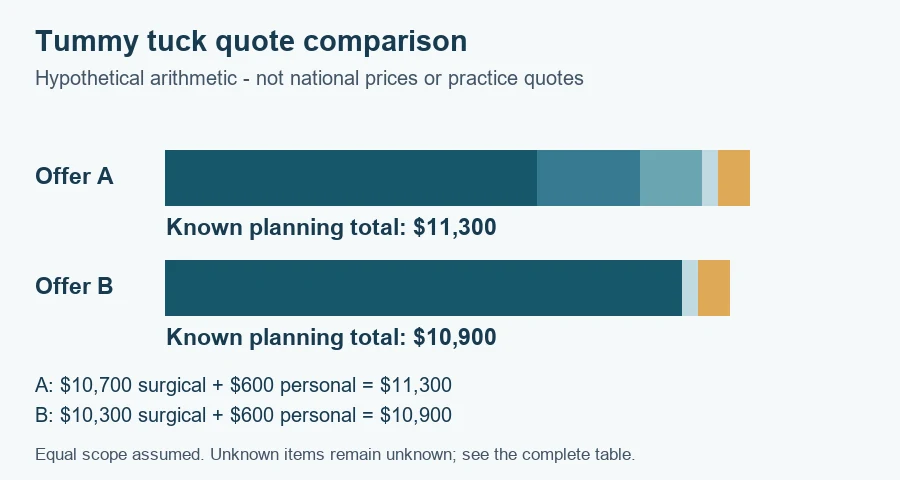
The example compares two hypothetical offers for an assumed identical abdominal plan. No practice supplied these prices, and they are not market averages. Offer A has a lower professional fee but separate facility and anesthesia charges. Offer B has a higher package price that explicitly contains those same categories. The worksheet shows why the smaller first number need not produce the smaller known subtotal.
| Hypothetical category | Offer A | Offer B |
|---|---|---|
| Professional or documented package charge | $7,200 | $10,000 |
| Facility charge outside that amount | $2,000 | Included |
| Anesthesia outside that amount | $1,200 | Included |
| Tests, garments and prescriptions outside it | $300 | $300 |
| Known surgical subtotal | $10,700 | $10,300 |
| Personal support and travel allowance | $600 | $600 |
| Known planning total | $11,300 | $10,900 |
Offer A’s known surgical subtotal is $7,200 + $2,000 + $1,200 + $300 = $10,700. Adding the hypothetical $600 personal allowance produces $11,300. Offer B’s $10,000 package plus $300 produces $10,300, or $10,900 with the same allowance. The professional headline difference is $2,800 in A’s favor, but the known planning-total difference is $400 in B’s favor. That reversal is arithmetic about the supplied assumptions, not evidence that packages are usually cheaper.
Replace every number with an actual documented amount before using the worksheet. If a charge is unknown, label the subtotal incomplete rather than entering zero. Do not combine personal allowances with an office quote and then call the result a surgeon’s price. Keep a separate contingency note for possible extra needs without claiming a universal percentage or complication probability. The chart reproduces this same example; it is not a second price dataset or a forecast of your likely bill.
A deposit changes timing, not the total price
Tummy tuck cost planning also needs a payment calendar. A deposit credited against the surgical charge is part of that charge, not another cost to add on top. For example, if the hypothetical $10,700 surgical subtotal requires a credited $1,000 deposit, the remaining surgical balance is $9,700. The committed total stays $10,700. A separately charged booking or consultation fee has a different treatment unless the office confirms that it is credited.
| Hypothetical payment timing | Amount | Treatment in the total |
|---|---|---|
| Credited deposit | $1,000 | Already part of the $10,700 subtotal |
| Remaining surgical balance | $9,700 | Subtotal minus credited deposit |
| Total surgical obligation | $10,700 | Deposit and balance added once |
Ask for cancellation, postponement and refund terms before paying. Record what happens if the clinician recommends waiting, if a required evaluation changes the plan, or if you decide not to proceed. Request the deadline, any retained amount, whether a credit expires, and whether facility or anesthesia cancellation rules differ from the surgeon’s rules. These are contract-specific details; an educational page cannot tell you that a deposit is always refundable or always forfeited.
Do not use a short promotional deadline as a substitute for a complete estimate. It is reasonable to take the documents home, resolve missing service categories and compare the same examined plan. If a quote expires, ask what must be rechecked and whether a new consultation is required. Keep the expiration date beside the price so an old offer does not become the basis for a later commitment after the scope or included care has changed.
Budget for the household task, not just the operation
The personal side of tummy tuck cost can be different for two people receiving the same surgical quote. Consider transport, nearby accommodation if relevant, an accompanying adult, help with children or dependents, and income you would forgo under your clinician’s restrictions. These amounts are yours to estimate. They should not be filled from a national price table or from somebody else’s recovery story.
Build the support plan around actual duties. A person whose work involves lifting or physical tasks should ask how the proposed operation could affect those duties and who will reassess return to them. Someone working remotely still needs to ask about comfort, stamina and follow-up attendance rather than assuming remote work eliminates recovery costs. Request individualized instructions; this guide does not set a universal number of leave days or promise that a particular allowance will be enough.
Separate unavoidable commitments from optional conveniences. Accommodation booked far in advance may have its own cancellation conditions. A support person may need transport and leave as well. If the plan changes, the clinic’s refund policy may not reimburse these personal expenses. Keeping their booking terms in the same folder as the surgery documents makes your financial exposure visible without turning every possible inconvenience into a fabricated medical risk estimate.
Insurance and financing need their own documents
ASPS states that most plans do not cover cosmetic tummy tuck surgery or its complications. Your policy and any separately assessed functional service still need direct verification. An office’s expectation is not the insurer’s written decision, and a diagnosis code is not a guarantee of payment. Ask which component is being submitted, what authorization is required, and which charges remain your responsibility if coverage is denied. Do not deduct an assumed reimbursement from your budget.
For financing, compare the total repayable amount and conditions rather than only the monthly number. The Consumer Financial Protection Bureau explains that deferred-interest offers can charge interest dating back through the promotional period if their payoff conditions are not met. Read the actual agreement, including its deadline, interest basis, fees and late-payment consequences. This is a reason to understand the terms; it is not a recommendation for a lender or a prediction about approval. CFPB deferred-interest explanation.
Your surgery decision, quote comparison and credit decision can be reviewed separately. Ask whether financing changes the clinic price or refund route and who receives a refund if you postpone. Never interpret an approved credit limit as clinical clearance or evidence that the procedure is affordable for your household. A clear document trail helps you distinguish what you owe the practice from what you may ultimately repay under a separate credit contract.
Which extra-care charges belong outside the tummy tuck cost quote?
A revision policy should explain more than whether the surgeon’s professional fee is waived. Ask who decides whether additional treatment is indicated, any applicable time window, and which facility, anesthesia, tests or travel costs remain. There is no universal rule that a dissatisfied patient gets a free repeat operation. An apparent guarantee may cover only one fee category, and a new procedure may have a different clinical scope from the original one.
Ask who handles an unexpected problem and how to obtain care outside scheduled visits. Record financial responsibility for additional assessment without delaying necessary treatment over a price question. Do not treat an included follow-up package as proof that complications cannot happen, or an optional protection product as comprehensive insurance. Have the office explain its exclusions and the separate role of your existing health coverage before you rely on either.
The budget worksheet cannot settle whether the proposed procedure is suitable, whether the scar tradeoff matches your goals, or whether a revision will be appropriate. Those questions belong in the clinical consultation. Its purpose is narrower: to prevent vague service descriptions and incomplete arithmetic from making one offer appear better than another. The written answer to a missing field often contributes more to a useful comparison than another advertised discount.
Bring this final comparison to the consultation
Before deciding, confirm that each quote names the same operation, contains a clear service subtotal, identifies separate bills, and explains conditional fees. Save the source date for any published benchmark and the date of your own estimate. Record credited deposits once, personal costs separately, and unknown items visibly. Then ask about the specific unanswered questions rather than requesting a generic lowest price.
Use the procedure guide to review the clinical scope and the consultation questions to organize your discussion. A useful tummy tuck cost comparison ends with a documented plan you understand, a realistic personal support arrangement and a clear payment obligation. It does not require inventing a national total, accepting a time-limited offer, or treating price as a prediction of your outcome.
Sources and review scope
Plastic Surgery Editorial Team. Source records checked through October 12, 2026. Review scope: source and editorial checks for general education. No individual clinical assessment is represented.
- ASPS tummy tuck fee scope. American Society of Plastic Surgeons. Publication/update date not stated. Checked 2026-10-12.
- ASPS 2025 procedural report and methodology. American Society of Plastic Surgeons. Publication/update date not stated. Checked 2026-10-12.
- ASPS tummy tuck consultation. American Society of Plastic Surgeons. Publication/update date not stated. Checked 2026-10-12.
- CFPB deferred-interest credit explanation. Consumer Financial Protection Bureau. Source date: 2024-01-22. Checked 2026-10-12.