
Tuberous breast correction addresses an assessed developmental breast shape, not simply a request for larger breasts. The plan may need to consider the breast base, lower-pole shape, areola and differences between sides as well as volume. Ask which features have been identified, which changes matter to you and how the proposed approach addresses them. An implant or fat-transfer label alone does not describe the whole correction.
Queen Victoria Hospital’s patient guidance describes tubular or tuberous breasts as a developmental pattern that can affect one or both sides, with a constricted base and changes in the skin envelope and areola. The term should follow clinical assessment rather than a comparison with an online photograph. A useful proposal identifies the features of your own anatomy without treating one shape, size or degree of symmetry as compulsory. QVH developmental breast shape guidance
Start with assessment and the reason for seeking change
Explain whether the appearance has been present since development or represents a newly noticed change. NCI advises medical follow-up for unusual breast changes, including a change in size or shape, a lump or nipple and skin changes. Most changes are not cancer, but a recent normal mammogram does not remove the need to discuss a new finding. Do not assume a developmental label explains a new symptom. NCI guidance on breast changes
After assessment, describe what you want to change in ordinary language. The concern might be the lower breast contour, areola prominence, size or the relationship between the two sides. Ask the clinician to connect your description to the assessed features. If the proposal mainly increases volume but your priority is shape, clarify how it addresses that priority before moving on to device or technique details.
Discuss whether you want a change in overall size at all. Correcting a shape concern and enlarging a breast are related but different aims. If both are desired, record both and ask which components of the plan address each. If enlargement is not a priority, say so explicitly rather than assuming that a correction consultation must lead to a larger volume.
The assessment should also establish whether each side needs the same approach. A bilateral developmental pattern can still involve different starting features. Ask for an explanation by side, including what will change and what variation may remain. Perfect identity should not be presented as the inevitable endpoint of two operations performed under the same label.
Separate the base, lower pole and areola questions
Ask what the surgeon means by constriction and where it is relevant in the assessed breast. Request a description of the intended shape change rather than a procedural demonstration or an instruction to manipulate tissue yourself. A conceptual diagram can distinguish the areas being discussed, but it cannot prescribe an incision, release, implant position or graft volume for your anatomy.
The lower-pole question concerns more than how much total volume will be added. Ask how the proposed plan relates to the portion of the breast below the areola and to the breast fold. A proposal that lists an implant size without explaining the assessed shape objective leaves part of the decision unanswered. The same applies to a fat-transfer volume that is presented as if quantity alone explains the planned contour.
Areola appearance should be discussed separately from breast size. Ask whether it is part of the planned correction, what change is intended and what scars or remaining differences are relevant. Do not assume that a change elsewhere will necessarily address this feature, or that every prominent areola requires the same operation. Your priority and the assessed anatomy should determine what is considered.
| Assessed feature | Question about the proposed change | Distinction to keep clear |
|---|---|---|
| Breast base | Which shape limitation does the plan address? | Base shape is not simply total volume |
| Lower pole | What contour is intended below the areola? | A device size does not explain the whole shape plan |
| Areola | Is it included and what is the stated objective? | Areola appearance is a separate endpoint |
| Breast fold | How is it considered in the assessment? | A diagram is not a personal operative target |
| Difference between sides | What is proposed for each side? | Bilateral treatment does not imply identical starting anatomy |
Use these questions to compare proposals that otherwise sound similar. Two plans may both involve implants but differ in the features they address. Two plans may both use fat transfer but differ in their objectives and anticipated sequence. Those differences should be visible in the explanation, not hidden behind a familiar technique name.
Compare approaches without declaring a universal winner
The original research includes implant-based correction and autologous fat grafting, also called lipofilling. These are approaches studied in selected patients, not interchangeable packages for everyone with a tuberous breast label. Ask why the proposed approach fits the features, desired change and commitments you have discussed, and which alternatives were considered. Your preferences about devices and additional procedures belong in that discussion.
A 2024 preliminary comparison included 24 patients and 36 breasts: 13 patients underwent lipofilling and 11 implant-based correction. It assessed patient-reported outcomes using BREAST-Q and reported improvement after both approaches. The lipofilling group had a mean 2.67 interventions and the implant group a mean of one. These are observed group averages, not a prescribed course or proof that the options are equivalent for every patient. Original preliminary tuberous breast comparison
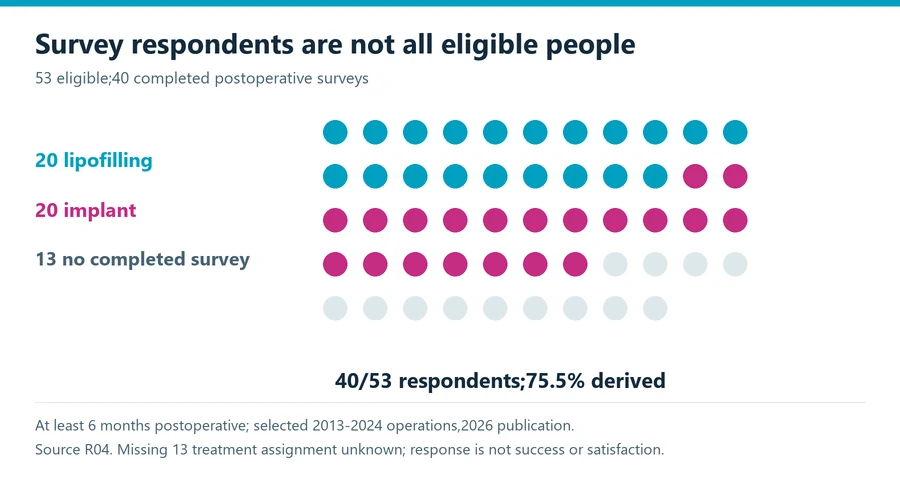
A more recent 2026 single-center retrospective study examined treatments from 2013 through 2024. Of 53 eligible patients, 40 completed postoperative surveys, with 20 in each treatment group. Some reported outcome domains favored lipofilling, while other domains did not differ significantly. The findings concern the surveyed groups and do not establish a universal causal advantage of one technique. Original 2026 patient-reported outcome study
The difference between these studies is useful: a procedure-count finding from one selected group should not be made into an automatic rule for every later proposal. Ask how the clinician’s anticipated sequence relates to your plan rather than adopting either study’s average as your expected number. Neither a small p-value nor a nonsignificant comparison can remove the need to understand selection, endpoints and follow-up.
Distinguish planned stages from later revision
A planned second stage is a different event from an unplanned operation after the initial correction is complete. Ask what the team considers the primary correction process, whether more than one procedure is anticipated and what criteria will determine the next step. A quotation for the first procedure alone may not describe the planned course. The explanation should identify both the clinical sequence and its practical implications.
A 2024 retrospective report followed 129 patients whose treatment began between 2010 and 2020, comparing implant and lipofilling pathways. It explicitly separated the primary correction process from further operations afterward. That distinction is more useful for interpreting a plan than adding all procedures together and calling every additional operation a complication. The research was observational, with treatment selection rather than random assignment. Original long-term correction pathway study
Ask how the expected stages will be described in your consent and estimate. What is intended in the first operation, what may be assessed before a later step and what remains uncertain? A staged plan should not be sold as a single visit if additional procedures are already anticipated. Conversely, the possibility of reassessment should not be treated as proof that the team expects a failure.
Count the course, not just the first visit
Compare the full anticipated pathway: operations, assessment appointments, recovery support and ongoing device care where applicable. Ask which elements are included in the current estimate and which will be discussed later. This does not require pretending that every future event can be predicted. It requires making the known sequence and uncertainty clear enough that you can decide whether its commitments fit your circumstances.
If the first result does not meet a particular goal, ask how that concern would be evaluated before another procedure is proposed. The cause of a residual shape concern, the person’s preferences and the clinical assessment matter. A general promise to finish the correction later does not explain the decision. Nor does an early photograph establish which further treatment, if any, is appropriate.
Interpret satisfaction studies with the survey denominator visible
The 2026 study’s 40 completed surveys came from 53 eligible people. The remaining 13 should not be labeled dissatisfied, satisfied or complication-free without their data. The response fraction is 40 divided by 53, approximately 75.5%; it is a source-derived description of survey completion, not a success rate. Keeping both numbers visible helps prevent a completed-response result from being attributed automatically to the whole eligible group.
The survey was collected at least six months after surgery and concerned several BREAST-Q domains. A satisfaction-with-outcome domain is not the same question as physical well-being, sexual well-being or satisfaction with breasts. Ask which endpoint supports a claim you encounter. Combining different domains into a single word such as best loses information and can imply an overall conclusion the study did not establish.
The study was retrospective and postoperative, and its authors called for prospective adjusted work with before-and-after BREAST-Q assessment. This limitation matters even when a comparison is statistically significant. Groups can differ in ways that affect results, and a later questionnaire does not create a randomized baseline comparison. Do not treat an association as a guaranteed effect for someone choosing between approaches today.
| Evidence detail | Question it answers | Claim it cannot establish by itself |
|---|---|---|
| 40 of 53 eligible survey responses | How much of the eligible group responded | A 75.5% surgical success rate |
| 20 surveyed people per treatment group | The reported survey group sizes | Equal risk or equal starting anatomy |
| At least six-month postoperative survey | The minimum collection timing | Lifelong satisfaction or device durability |
| Separate BREAST-Q domains | Different aspects of the reported experience | A single universal winner |
| Retrospective treatment groups | Observations after selected care | Randomized proof of the best operation |
When comparing a study with a proposed plan, also check whether the intervention includes other shape-related components. A broad technique category may conceal differences within it. Ask for evidence that matches the actual plan and starting pattern, with the outcome and timepoint stated. No chart on this page turns a study average or a survey response into your personal prognosis.
Account for implant commitments if a device is proposed
FDA states that breast implants are not lifetime devices and that complications can require additional surgery. Its guidance includes capsular contracture, rupture and breast or nipple sensation changes among risks. If an implant is part of correction, these continuing considerations belong in the decision alongside the intended shape change. FDA breast implant risks
Request the actual implant’s patient labeling and the applicable monitoring information. The broad word implant does not identify the model, labeling or all of its commitments. Ask how future care would be coordinated and who would evaluate a concern. This guide does not provide a device-selection rule, a fixed replacement date or a personal probability of an implant complication.
If avoiding implants is a priority, say so and ask how the alternatives fit the assessed shape and goals. Device avoidance is one preference among several; it does not by itself prove that a different operation is suitable or free of risk. If fat transfer is proposed, ask about the complete planned course and the additional region involved in obtaining tissue, with its own care and appearance considerations.
Discuss future pregnancy, breastfeeding and sensation goals where relevant. Ask for individualized advice about the exact plan rather than inferring function from a technique label. Neither a satisfaction study nor an attractive contour image predicts these outcomes for a particular reader. The discussion should state uncertainty honestly and explain which priorities may affect the decision or timing.
Define the comparison without inventing an outcome image
Ask how the assessed features and the intended goals will be documented before surgery. Photographs or a diagram may help explain a region, but they should have a clear purpose. A conceptual illustration is an educational aid, not a promised future appearance. Do not assume that changing a digital outline establishes what your tissue will look like after healing or how you will feel about it.
For a visual comparison, request consistent positioning, framing and purpose. An image that emphasizes volume may not answer a lower-pole or areola question. A clothing view may answer a practical preference different from an unclothed contour view. State which question matters so the evidence is relevant, rather than letting the most striking image define your goal for you.
Also clarify what will remain unchanged. A proposal may focus on a particular developmental feature without altering every difference you notice. Ask whether those remaining features are deliberate limits, uncertainties or topics for further assessment. A useful plan can explain all three without presenting untouched anatomy as a defect or promising that every aspect will become identical.
Price the actual correction pathway
The checked primary studies do not provide a contemporary national total price for tuberous breast correction. Obtain a dated estimate for the side-specific plan, including the anticipated sequence. An estimate for ordinary augmentation should not be assumed to include every shape-related component or a staged correction. Ask the team to identify what the figure covers in plain language.
| Financial component | Detail to obtain | Decision it clarifies |
|---|---|---|
| Each side’s planned work | Shape and volume components | Whether proposals address the same goals |
| Anticipated stages | Included procedures and reassessment | First-operation price versus planned course |
| Device or tissue transfer | Included materials and additional treatment region | Technique-specific scope |
| Anesthesia and facility | Arrangement and fees | Surgeon fee versus total estimate |
| Follow-up and further care | Responsibility and written charges | Continuing commitments and uncertainty |
Ask how a potential additional procedure would be priced and authorized. A known stage, treatment of a complication and an elective revision may have different arrangements. Do not assume that a reference to further care means it is included or that every additional charge represents the same event. The policies should be understandable before you commit to the course.
If coverage is being considered, use the actual payer’s policy and documentation requirements. A developmental diagnosis does not automatically establish a US coverage decision, and a UK hospital’s funding guidance is not a US insurance rule. Ask which service is being submitted and what authorization is required. Keep the clinical assessment and the financial determination separate so one does not stand in for the other.
Choose a shape goal and a course you understand
Tuberous breast correction is a feature-specific decision after assessment. A clear proposal explains the base, lower pole, areola and side differences; connects those features to your priorities; and describes the reason for its technique and sequence. It distinguishes stages from revision, keeps survey denominators visible and discusses the commitments of any device. It does not promise perfect symmetry or prescribe a procedure count from a study average.
Before deciding, check that your leading concern appears in the written objectives and that the estimate describes the same plan. If shape, staging or follow-up remains vague, ask for clarification rather than relying on a package name. Proceeding, postponing or choosing an alternative should follow an understood tradeoff, with the uncertainty and your preferences plainly recorded.
If two consultations recommend different sequences, compare the point at which each team expects to reassess the lower-pole and areola goals. Ask what information that reassessment adds and what would change the next step. A shorter initial sequence is not automatically a more complete correction, and a longer sequence is not automatically better tailored. The explanation should connect each proposed step to an assessed feature and a defined objective.
For related reading, see breast augmentation, breast lift and questions to ask a plastic surgeon.
Sources and review scope
Plastic Surgery Editorial Team. Source records checked through October 12, 2026. Review scope: source and editorial checks for general education. No individual clinical assessment is represented.
- QVH developmental breast shape guidance. qvh.nhs.uk. Source date: 2023-08. Checked 2026-10-12.
- NCI breast changes. cancer.gov. Source date: 2025-12-02. Checked 2026-10-12.
- Original preliminary tuberous correction comparison. pubmed.ncbi.nlm.nih.gov. Source date: 2024-05-17. Checked 2026-10-12.
- Original2026 tuberous correction patient-reported cohort. pubmed.ncbi.nlm.nih.gov. Source date: 2026-05-18. Checked 2026-10-12.
- Original long-term primary versus later correction pathway report. oulurepo.oulu.fi. Source date: 2024-05-14. Checked 2026-10-12.
- FDA implant risks. fda.gov. Publication/update date not stated. Checked 2026-10-12.