
Tip rhinoplasty focuses on an assessed concern about the nasal tip, but it is not a standard small operation with one technique or predictable result. The tip’s appearance needs to be considered with the bridge, nostrils, adjacent structures and breathing. A useful proposal explains the desired change, the actual work included and the limits of treating that concern alone. A tip-focused goal does not establish that the operation can or should be isolated.
Describe the feature you want assessed in ordinary language. Is the concern visible from the front, in profile, from below or when your expression changes? Do you also have breathing symptoms, a previous injury or earlier surgery? These details help define the task. A cropped photograph or a preferred angle cannot replace assessment of the nose as a whole.
This guide explains how to separate a tip goal from broader rhinoplasty and how to read studies reporting tip-related outcomes. It does not give a graft, suture or cartilage-removal recipe, prescribe an ideal angle or diagnose obstruction. Its purpose is to help you understand an assessed plan and recognize when a photograph or a statistic answers a different question.
A tip concern is one part of a wider nasal assessment
ASPS identifies the tip, bridge, nostrils, size, asymmetry and breathing among rhinoplasty considerations. It also emphasizes evaluation of nasal structures when breathing is impaired. Those separate categories explain why a request about the tip can lead to questions about other parts of the nose. They do not imply that every person needs every component treated. ASPS rhinoplasty scope
Ask the clinician to identify the feature that accounts for your concern. A word such as bulbous, drooping or prominent can be used differently by different people. The assessment should connect your description to the actual finding and explain which change is being considered. You do not need to decide the anatomical diagnosis before the consultation.
Record what you want preserved as well as what you want changed. You may prefer the bridge or another feature as it is. State that clearly so the clinician can explain whether the proposed tip change can be considered independently and what tradeoffs remain. An attractive simulation of the whole nose should not be treated as agreement to change areas you never asked to alter.
The intended result should be described across relevant views. A change that looks different in profile may also affect how the nose is discussed from the front or below. Ask which views demonstrate the proposed goal and which limitations the assessment reveals. A single idealized profile is too narrow a description of a three-dimensional feature.
| Goal to describe | Assessment question | Scope to record |
|---|---|---|
| Tip shape or definition | Which assessed feature explains the concern? | Tip work and any additional components separately |
| Tip position in profile | What change is proposed and what should remain? | Relationship to adjacent nasal features |
| Nostril or lower-nose appearance | Is this the same task as the tip concern? | Included and excluded regions |
| Breathing concern | What functional assessment is appropriate? | Functional endpoint separately from appearance |
Appearance and breathing need separate explanations
The NHS describes rhinoplasty as changing the shape or size of the nose and distinguishes cosmetic reasons from surgery intended to help breathing. That distinction is useful even when both goals are discussed together. An appearance change does not by itself prove that an obstruction has been assessed or treated. Local NHS coverage information should not be read as another country’s insurance rule. NHS rhinoplasty scope
Describe breathing symptoms directly rather than assuming they come from the visible tip. Tell the clinician what you experience, whether one or both sides are involved and what evaluation has already occurred. The clinician can explain which structures or other considerations need assessment. This guide does not provide a home valve test or identify the cause of blocked breathing from an image.
If functional work is proposed, ask what it is intended to address and how the outcome will be evaluated. Keep that explanation separate from the desired photographic change. A combined course can have two goals, and an overall satisfaction statement may not reveal whether each was met. You should know which measures answer the appearance question and which answer the function question.
If no functional treatment is planned, ask how breathing is considered in the assessment and consent discussion. A proposal should not ignore function merely because you initially asked about appearance. Nor should a breathing claim be added to a cosmetic description without a specific assessed rationale. Clear scope prevents the two topics from becoming interchangeable marketing benefits.
Keep an appearance baseline and a functional baseline as separate records. Ask which documentation the clinician considers useful for each and whether an existing test or questionnaire addresses the question being discussed. A symptom score should not be relabeled a measured percentage of airflow, and a photograph should not stand in for that score. If the follow-up uses a different measure, ask how comparison with the baseline will be interpreted. This prevents a broad statement of improvement from concealing which goal was actually evaluated and which question remains unanswered in your own proposed course.
Isolated tip work and combined rhinoplasty are different proposals
Ask whether the plan is limited to the tip or includes the bridge, nostrils, septum or other work. List each component in ordinary language. You should understand why additional treatment is suggested and what would happen if it were not included. This is a consent question rather than a request to select an operative method yourself.
A combined before-and-after image cannot establish what tip work alone accomplished. Several features may have changed, and the visible relationship between them is part of the result. Before using the example to compare a plan, ask which procedures were performed and which view illustrates the concern relevant to you. Otherwise, you may be comparing an isolated goal with a whole-nose course.
The same caution applies to a published tip technique. A paper may describe a maneuver used within broader cosmetic rhinoplasty rather than a standalone procedure. Its complication or revision results then belong to that reported course. Do not rename them the outcomes of isolated tip surgery without evidence that the study actually separated that component.
If the clinician recommends changing a feature you hoped to preserve, ask for the connection between that recommendation and your stated goal. You can consider the explanation without assuming that more work is automatically better. The assessment should leave you able to distinguish a necessary component in the proposed rationale from an optional additional preference.
Projection, rotation and definition are communication terms, not home targets
A consultation may use words such as projection, rotation or definition to discuss the intended appearance. Ask the clinician to explain each term on an appropriate view and relate it to your own goal. A technical term becomes useful when it clarifies the plan. It is less useful when it is presented as an ideal number that every nose should reach.
Do not apply a universal angle or ratio to decide that your nose requires surgery. A measurement used in one study or one photographic method needs its own context. It does not establish a personal aesthetic obligation. A preference can be discussed without treating facial identity, sex or background as a rule that determines a single acceptable shape.
Ask which changes are realistic for your assessed tissues and which tradeoffs remain. A digital image can illustrate a discussion, but it is not a clinical outcome or a guarantee. The explanation should identify uncertainty rather than imply that software can predict every surface detail. Preserve the distinction between a communication aid and documentation of an actual result.
When you describe a preference, use the view and feature that matter instead of requesting a copied nose. You may want a particular impression in profile while valuing how the front view already looks. State both priorities. The clinician can then explain how the proposed course relates to them, including limits and the option of not proceeding.
What a large tip-technique series actually reports
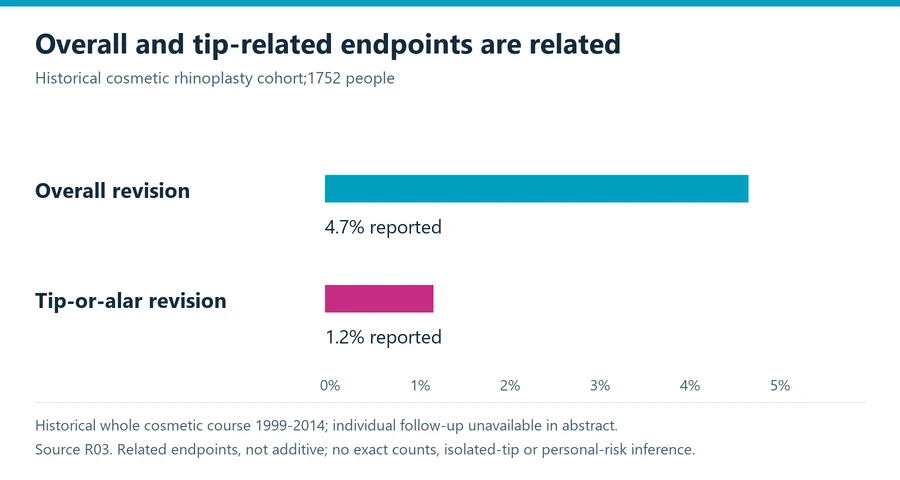
An original study published online on May 25, 2016 described 1,752 cosmetic rhinoplasty patients treated during 1999–2014 with a particular tip approach. It reported an overall revision rate of 4.7% and tip-or-alar revision of 1.2%. Those are different endpoints in the reported cosmetic course, not two rates to add together or a forecast for isolated tip surgery. Original tip-approach cohort
The abstract does not provide the individual follow-up detail or complete endpoint definitions needed for a personal-risk model. Its long operation period should not be described as fifteen years of observation for every participant. The study supplies selected historical clinical observations. It does not establish a current universal probability, prove that the named technique is best or isolate every contribution to the whole result.
Keep the overall and region-specific revision endpoints distinct
An overall revision rate and a tip-or-alar revision rate are not independent categories to sum. A clear chart can show the reported figures as separately labeled bars while noting their relationship and the missing follow-up detail. It should not turn the smaller number into a percentage of people guaranteed to avoid every complication or need for further care.
The denominator and unit should remain visible. Reported percentages are rounded observations, so this guide does not reverse-calculate exact patient counts that the inspected abstract did not supply. A graph should retain the reported values rather than produce apparently precise counts from arithmetic. Precision in presentation cannot recover information missing from the source.
Read a satisfaction statement with the same care. If the questionnaire, respondent denominator and timing are not available in the inspected material, do not turn an adjective into a measured satisfaction percentage. A photograph and a clinician’s assessment also differ from a patient-reported outcome. Each can provide information, but the label should tell you which is being reported.
| Evidence question | Information needed | Misleading shortcut |
|---|---|---|
| Was treatment isolated? | Actual included rhinoplasty components | Calling every whole-nose result tip-only |
| What is a revision? | Endpoint and region definition | Combining overall and regional rates |
| How long was observation? | Follow-up interval and completeness | Treating operation years as each person’s follow-up |
| Who answered satisfaction questions? | Instrument, respondents and timepoint | Turning a descriptive claim into a percentage |
| Was there a comparator? | Study design and selection | Declaring one technique universally superior |
Compare photographs without treating them as predictions
Ask for the operation’s included scope and the dates of the views being discussed. A picture taken early in a course documents that moment, not every later appearance. A selected final image does not show all intermediate concerns. The treating clinician should explain when and how the relevant result will be assessed for the actual proposed operation.
Compare front, profile and lower-nose views when they are relevant to the goal. Lighting, head position and expression affect what can be seen. A close-up may highlight one feature while hiding the relationship you want preserved. Ask what the image demonstrates rather than treating an attractive presentation as evidence for every claimed benefit.
Avoid relying on filtered or generated inspiration images as if they documented an achievable surgical outcome. Even an authentic photograph of another person cannot establish that you have the same tissues or options. Use an example to communicate a preference, then ask for an explanation of the differences that matter to your assessment.
If clinical photographs of you are taken, clarify storage and permissions. Documentation for care and optional public marketing use should be distinguished. You can agree to useful clinical records without agreeing to appear in a promotional before-and-after. That distinction is especially important when a close facial image is readily identifiable.
Risks and follow-up remain relevant to a tip-focused goal
ASPS lists rhinoplasty concerns including bleeding, infection, breathing difficulty, scarring, altered sensation, an unsatisfactory appearance and possible revision. A tip-focused label does not remove the need to discuss the actual proposal’s risks. Ask which categories are relevant to the assessed course and how the service handles concerns that require examination. ASPS rhinoplasty risks
Discuss any previous operation, injury or treatment before selecting a schedule. The assessment should account for that history rather than treat a familiar-looking goal as a first-operation case. If records are missing, ask whether obtaining them could change the proposal. A clear explanation of the gap is preferable to guessing which technique or material was previously used.
Ask for a written follow-up arrangement and contact instructions. Know who will assess breathing or appearance concerns and how access works if you travel. This guide does not prescribe taping, massage, medication, splint care or a calendar for return to activities. Those instructions belong to the team responsible for the actual course.
State the practical tasks you need to plan around, including work, travel and responsibilities. Ask how the prescribed restrictions relate to those tasks. Looking presentable, feeling comfortable and being ready for a particular activity are different questions. A generic advertisement calling tip treatment minor should not replace that discussion.
Compare an itemized plan and complete quotation
The quotation should identify tip work and additional components separately. Ask whether the stated amount is the surgeon’s fee or the complete payable cost, including setting and anesthesia charges when applicable. A whole-rhinoplasty fee from an unrelated source is not a verified price for your assessed tip-focused proposal.
Request written terms for follow-up, unexpected assessment and possible further treatment. A routine visit, an additional service and another operation may have different financial arrangements. Knowing the terms clarifies the commitment; it does not predict the result. Keep the quote with the anatomical plan so differences between proposals can be interpreted accurately.
| Quotation field | Clarification to obtain | Comparison error avoided |
|---|---|---|
| Anatomical work | Tip and other included regions | Comparing isolated and combined courses as identical |
| Functional component | Assessed task and separate endpoint | Assuming an appearance fee includes obstruction treatment |
| Fees and setting | Professional charge and total payable | Mistaking a fee for the complete cost |
| Follow-up | Included visits and assessment access | Assuming every later concern is covered |
| Further treatment | Written additional-care terms | Treating payment as a guarantee against revision |
No current comparable tip-specific total-cost dataset has been verified for this guide, so no price range is supplied. Obtain a dated quotation for the assessed plan. If two prices differ, first determine whether they include the same work and care. A difference in a single advertised figure cannot explain those distinctions.
Turn a preference into a clear assessment question
Before the consultation, write what you want changed, what you want preserved and any breathing concern. Include the views that best explain the preference and the relevant treatment history. Keep those items separate from a requested technique. The clinician can then define the task rather than start from an operation you selected online.
Afterward, summarize the assessed finding, proposed components, intended endpoints and limits. Note what is still uncertain and what information could change the recommendation. A useful plan leaves you able to explain why each component is proposed and how the relevant result will be reviewed. It should also allow an informed decision to defer or decline treatment.
Related planning guides
The rhinoplasty guide explains wider appearance and function questions. Use the consultation question guide, cost guide and recovery planning guide to organize a complete proposal.
Sources and review scope
Plastic Surgery Editorial Team. Source records checked through October 12, 2026. Review scope: source and editorial checks for general education. No individual clinical assessment is represented.
- ASPS rhinoplasty scope. plasticsurgery.org. Publication/update date not stated. Checked 2026-10-12.
- NHS rhinoplasty scope. nhs.uk. Source date: 2023-09-22. Checked 2026-10-12.
- Original tip-approach cosmetic rhinoplasty cohort. pubmed.ncbi.nlm.nih.gov. Source date: 2016-05-25. Checked 2026-10-12.
- ASPS rhinoplasty risk categories. plasticsurgery.org. Publication/update date not stated. Checked 2026-10-12.