
A TCA peel uses trichloroacetic acid to remove outer skin layers under professional supervision. It may be considered for selected texture, pigment or scar concerns, but the name does not specify one treatment depth or one recovery course. A full-face peel and focal TCA CROSS for individual acne scars are different procedures. The useful starting point is a diagnosis and an intended depth, rather than choosing the highest acid concentration. FDA warns against purchasing or using certain chemical peel products without appropriate professional supervision because serious burns and scarring can occur. ASPS chemical peel definition FDA chemical peel supervision warning ASPS medium depth and risks
Before comparing offers, establish what is being treated, whether the proposed treatment covers the whole face or particular scars, and how the clinician will assess response. Agent, intended depth and treatment area belong together in the description. A price or concentration printed on a bottle cannot replace that description. This guide explains those distinctions and how to read actual research without turning a clinical protocol into a home treatment recipe.
What a TCA peel treats—and what the label leaves out
ASPS describes chemical peeling as removal of damaged outer layers to improve skin texture. Its medium-depth guidance includes TCA among several agents and describes treatment extending through the epidermis into the upper dermis. That is a description of a professional treatment category, not a promise that every TCA product reaches the same layer. FDA specifically identifies concentration, repeated applications and contact duration as factors affecting penetration. ASPS chemical peel definition FDA chemical peel supervision warning ASPS medium depth and risks
For a reader, this means two offers bearing the same ingredient name may not be equivalent. One may be a superficial treatment repeated within a broader pigment-care plan. Another may be a medium-depth resurfacing procedure with more visible healing. A third may be a localized scar intervention. Ask the clinician to explain the intended tissue effect in ordinary language and to name the concern that effect is supposed to address. Do not translate that explanation into application times, extra layers or a stronger product at home.
The word “peel” also does not make all agents interchangeable. ASPS discusses phenol in its separate deep-peel guidance. Its phenol-specific concerns cannot simply be assigned to every TCA peel; conversely, the existence of a lighter peel does not make a deeper treatment trivial. ASPS phenol deep peel distinction A comparison that mixes these categories can exaggerate either benefits or recovery. Request the actual agent and depth before relying on a description of someone else’s experience.
| Proposed treatment | Clarification that matters | Evidence boundary |
|---|---|---|
| Full-face TCA peel | Diagnosis, intended depth, skin response and healing plan | A different agent or depth is not an equivalent comparator |
| TCA added to pigment medication | What both treatments contribute and how response is measured | Combined-treatment results do not establish peel-only results |
| Focal TCA CROSS | Which individual scar shapes are targeted | Ice-pick scar research is not full-face resurfacing evidence |
| TCA with microneedling | Why both interventions are proposed | Do not attribute a combined effect entirely to TCA |
Diagnose the problem before selecting an acid
“Uneven skin” is too broad a target for a meaningful treatment comparison. It could describe pigmentation, texture, depressed scars or several concerns at once. Write down what you want to change without initially choosing a procedure: for example, the visibility of particular scars or a diagnosed pigment condition. The clinician can then explain whether peeling addresses that target, whether another approach should be considered, and whether the skin first needs evaluation or stabilization.
For acne scars, ask whether the clinician is recommending a broad resurfacing treatment or treating particular depressions. An original 31-patient study examined TCA CROSS for ice-pick scars using two different strengths on opposite facial halves. The mean change in its scar score did not differ significantly between sides, while adverse events were more serious on the stronger-treated side. Its nonrandomized, self-controlled design and specific scar population limit wider conclusions. Original TCA CROSS ice-pick scar comparison That does not supply a consumer concentration recommendation. It challenges the assumption that a higher number automatically produces a better overall choice.
For pigmentation, request the actual diagnosis rather than accepting “dark spots” as sufficient. The melasma study discussed below evaluated a defined population using prescribed topical treatment on both sides of the face. Its findings do not automatically apply to every type of discoloration. If a lesion is changing, unexplained or has not been assessed, an elective peel should not become a substitute for diagnosis. A useful consultation should resolve uncertainty about the target before selling a course of procedures.
Keep separate goals separate in the written plan. If the main priority is pigment but scar texture is also important, ask which outcome the first treatment will evaluate. Otherwise, improvement in one feature can be presented as success for every concern. A clear starting record lets you decide whether a treatment helped the problem you actually brought to the appointment, rather than adjusting the goal afterward to fit a photograph.
What a controlled melasma study can tell you
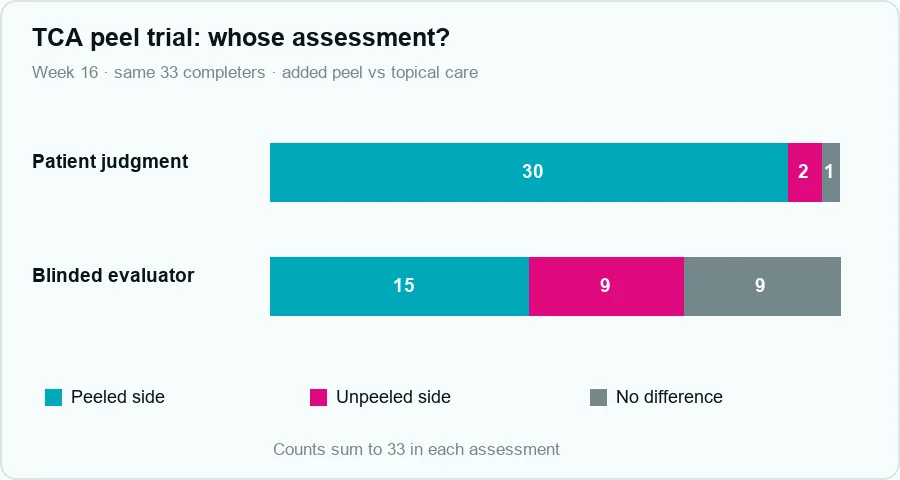
A September 2024 original trial analyzed 33 Latin American women with melasma who completed a split-face course. Both facial halves received hydroquinone and tretinoin; one randomly selected half also received four professional superficial TCA peels. Assessment was at Week 16. Patients favored the peeled half in 30 of 33 cases, whereas the blinded evaluator favored it in 15 of 33. The study was conducted at one center with one blinded evaluator. These are comparisons between sides, not numbers of people whose melasma disappeared. Original split-face melasma trial
That distinction is useful when a headline gives only the larger percentage. The patient perspective and the blinded assessment answer different questions. Neither should be discarded, but neither can silently replace the other. The same group of participants generated both sets of judgments; the counts are not two independent populations that can be added together. A chart should label whose judgment it shows and the assessment time, rather than display one large “success rate.”
Read the comparator before accepting a result
Because both sides received topical therapy, this trial asks about adding a peel within that regimen. It does not isolate what an otherwise untreated person would achieve from a TCA peel alone. The analyzed group was also smaller than the enrolled group. When comparing this evidence with your own situation, ask whether the diagnosis, accompanying care, skin characteristics and follow-up resemble the proposed plan. A difference between those conditions is a reason for a more careful discussion, not permission to invent an adjusted success percentage.
An additional randomized study of 40 women compared TCA with microneedling against TCA alone. It reported greater improvement in the combination group on measured melasma scores at its one- and three-month assessments. The abstract does not provide a verified numerical effect size for this guide. Original randomized TCA plus microneedling comparison Its value here is to show why a combined package needs its own explanation. It does not prove that every additional procedure is necessary or that this combination is best for every patient.
Skin color and pigmentation risk deserve specific attention
ASPS identifies unwanted darkening or lightening, infection and scarring among chemical-peel risks. Its medium-peel guidance notes that pigment changes can occur despite sunscreen use. ASPS medium depth and risks ASPS chemical peel safety That makes a discussion of your own history more informative than a general promise that a peel is suitable for “all skin types.” Ask how the clinician evaluates pigmentation risk and what features would lead them to change the treatment or advise against it.
Describe previous reactions to skin injury or cosmetic treatments in concrete terms: what happened, where it occurred, how long it lasted and whether you received treatment. Bring the names of products you use rather than describing all of them as skincare. ASPS consultation guidance includes medical history, medications, previous treatments and evaluation of the skin. ASPS medical history and skin assessment The purpose is to create a usable clinical history; do not stop a prescription or start a preparation product based on an online protocol.
Representation in research also matters. A small trial containing particular skin phototypes does not establish a universal risk estimate for all complexions or all depths. The right question is how closely its participants and treatment match the proposed procedure. A clinician should be able to explain both the relevant evidence and where individual judgment is needed. Marketing photographs alone cannot answer that question, especially when lighting, makeup or image processing obscure pigment differences.
Why an at-home TCA peel is not a substitute
FDA’s July 30, 2024 warning addresses chemical peel products containing acids, including TCA, in concentrations that can be unsafe without appropriate professional supervision. The agency describes serious injuries including burns, infection, skin-color changes and disfiguring scars. FDA chemical peel supervision warning These concerns are relevant even when a product is easy to buy or carries a familiar cosmetic label. Availability is not a clinical assessment of suitability.
Do not use a study’s concentration or application description as instructions. Research procedures involve participant selection, defined treatment conditions and professional monitoring that a bottle cannot provide. An internet comparison of “strong” and “weak” products omits those conditions. It also cannot determine whether a skin change needs medical evaluation, whether another active product changes the plan, or whether the intended depth is appropriate for the area being treated.
If you have already had a concerning reaction, seek medical assessment rather than treating the injury with another peel or trying to reproduce a neutralization method from a video. FDA notes that serious injuries may require emergency or specialty care. FDA chemical peel supervision warning Provide the product name and available label information to the treating professional. Keeping those details helps describe the exposure without requiring you to guess what happened beneath the skin.
Preparation and recovery: plan by depth, not by a countdown
ASPS differentiates recovery by peel depth. Its general recovery guidance describes redness and peeling after lighter treatments, with more involved healing after deeper ones. ASPS recovery by depth A single “back to work” number therefore cannot represent every TCA peel. Ask about the planned depth and separate physical comfort, visible appearance, permitted activities and continued skin care. Those questions affect scheduling in different ways.
For someone who works outdoors, the relevant issue may be practical protection during the workday. For someone with frequent public-facing meetings, visible redness or flaking may be the main scheduling concern. Neither circumstance determines medical clearance by itself. Describe the real work environment and ask how it fits the clinician’s instructions. A flexible calendar can be more valuable than choosing treatment around an unusually optimistic recovery story.
Request a written aftercare plan that identifies what to use, what to avoid, whom to contact and which changes require assessment. ASPS emphasizes following the treating professional’s skin-care and sun-protection instructions. ASPS recovery by depth Do not introduce an exfoliant, retinoid or second peel because the skin looks ready in a photograph. A visual milestone and permission to restart a product are different decisions.
Arrange follow-up as part of the course rather than as an optional extra. Ask whether the first review is intended to check healing or evaluate the final cosmetic response. If those are different visits, record both. This prevents an early reassuring check from being mistaken for a complete assessment of the treatment’s effectiveness. It also makes the cost and time commitment more transparent before you agree to proceed.
| Planning field | What to record | Why it cannot be merged with another field |
|---|---|---|
| Skin care | Written clinician instructions and product restart decisions | Appearance alone does not authorize a product change |
| Work environment | Outdoor exposure, physical demands and public-facing duties | Comfort and practical protection are different concerns |
| Healing review | Appointment and contact route for concerns | A healing check is not necessarily the final outcome assessment |
| Outcome assessment | Target concern, agreed measure and assessment point | A photo taken earlier cannot substitute for the agreed endpoint |
Compare the full course and its cost
A TCA peel quote should identify whether it covers one session or a planned course, the treatment area, and any accompanying interventions. ASPS notes that chemical-peel costs vary with treatment type and other factors. ASPS chemical peel cost scope This guide does not give a TCA-specific national price because a dated, appropriately scoped figure has not been verified. A broad chemical-peel average would not reliably describe the particular course you are considering.
Compare consultation, treatment, prescribed care, follow-up and any planned combination procedure separately. Ask whether a stated price assumes you will purchase several sessions, and what happens if the clinician recommends stopping or changing direction after reassessment. The aim is to understand the offer rather than demand the greatest number of procedures for the money. An unused prepaid session is not an outcome benefit.
Include practical expenses without calling them medical fees: time away from work, travel and any help you may need. Keep these amounts separate from the clinic’s quote so you can see why two people can face different total costs for a similar treatment. If financing is offered, compare the amount repayable and the terms independently of the claimed cosmetic result. Payment arrangements do not resolve questions about indication or safety.
| Comparison field | Offer A | Offer B |
|---|---|---|
| Diagnosis and intended depth | Request explicit description | Request explicit description |
| Area and number of sessions | Record included scope | Record included scope |
| Combination treatments | Name and price separately | Name and price separately |
| Care and follow-up | Identify inclusions and extra charges | Identify inclusions and extra charges |
| Reassessment or cancellation | Request written policy | Request written policy |
Evaluate results without relying on a dramatic photo
Agree on what will count as improvement before treatment: a defined scar concern, a pigment measure or another specific goal. Request photographs with comparable lighting, angle and presentation if images are part of the assessment. The purpose is a fair record, not creating a flattering picture. A photograph can illustrate change while still leaving questions about durability, symptoms and the contribution of other treatments unanswered.
When viewing published results, check whether the endpoint was patient preference, a clinician score or an instrument measurement. The melasma trial shows why these cannot be compressed into one number. Do not interpret a favorable side comparison as clearance, lifelong control or proof that no adverse effects are possible. Likewise, an early assessment does not establish durability beyond the reported follow-up.
Ask what would prompt a pause rather than another session. That might be a concern about healing, an unclear response or a mismatch between the original goal and what treatment can address; the clinician must determine the clinical response. A plan that includes reassessment is more informative than an automatic schedule with no explanation of what each visit is supposed to accomplish.
Questions that produce a usable treatment plan
Before agreeing to a TCA peel, ask the clinician to state the diagnosis, intended depth, treatment area and reason for choosing it. Ask how your history affects the plan, whether the evidence concerns the same indication, and what accompanying treatment is part of the expected result. Request written care instructions and a follow-up arrangement. These answers should make the proposed procedure identifiable, rather than merely repeat that peeling improves skin.
Finally, consider whether the expected change is valuable enough to justify the healing period, cost and uncertainty for you. Choosing to defer an elective treatment is a reasonable planning outcome when the target is unclear or the practical arrangements do not work. A good decision does not require committing to the strongest peel. It requires understanding the actual treatment and the evidence relevant to the skin concern you want to address.
For related planning, explore the procedure overview, facelift guide for a separate surgical facial-aging decision, and plastic surgery cost planning. These routes address different questions; a peel is not interchangeable with a facelift.
Sources and review scope
Plastic Surgery Editorial Team. Source records checked through October 12, 2026. Review scope: source and editorial checks for general education. No individual clinical assessment is represented.
- ASPS chemical peel definition. plasticsurgery.org. Publication/update date not stated. Checked 2026-10-12.
- FDA chemical peel supervision warning. fda.gov. Source date: 2024-07-30. Checked 2026-10-12.
- ASPS medium depth and risks. plasticsurgery.org. Publication/update date not stated. Checked 2026-10-12.
- ASPS phenol deep peel distinction. plasticsurgery.org. Publication/update date not stated. Checked 2026-10-12.
- Original TCA CROSS ice-pick scar comparison. pubmed.ncbi.nlm.nih.gov. Source date: 2024-05-09. Checked 2026-10-12.
- Original split-face melasma trial. pmc.ncbi.nlm.nih.gov. Source date: 2024-09. Checked 2026-10-12.
- Original randomized TCA plus microneedling comparison. pubmed.ncbi.nlm.nih.gov. Source date: 2022-12-06. Checked 2026-10-12.
- ASPS chemical peel safety. plasticsurgery.org. Publication/update date not stated. Checked 2026-10-12.
- ASPS medical history and skin assessment. plasticsurgery.org. Publication/update date not stated. Checked 2026-10-12.
- ASPS recovery by depth. plasticsurgery.org. Publication/update date not stated. Checked 2026-10-12.
- ASPS chemical peel cost scope. plasticsurgery.org. Publication/update date not stated. Checked 2026-10-12.