
Stomach liposuction removes selected fat beneath the abdominal skin to change contour. It is not a treatment for fat surrounding internal organs, a weight-loss operation or a substitute for removing substantial loose skin. The useful first question is what creates the shape you want to change: superficial fat, skin, the abdominal wall or a combination. Those concerns require different assessments and may lead to different treatment plans. ASPS procedure scope
Use this guide to organize an abdominal contour consultation, compare exactly what competing proposals include and interpret measurements without turning them into promises. A smaller measured waist, a lower weight and better metabolic health are separate outcomes. An attractive photograph cannot establish all three. Equally, being interested in cosmetic change does not mean you need surgery: observation, postponement and accepting the current contour remain reasonable options.
What does “stomach” mean in a treatment proposal?
In everyday language, stomach often means the entire belly. In an anatomical discussion, the stomach is an internal organ. A proposal for stomach liposuction should specify the external abdominal region rather than implying treatment of that organ. Ask the practice to distinguish the upper abdomen, lower abdomen, waist and flanks on a diagram. This prevents a broad marketing label from doing the work of an actual surgical plan.
The ASPS patient handbook describes the target as fat just beneath the skin. It also identifies skin elasticity as relevant to the eventual contour. That distinction explains why the same request for a flatter abdomen can produce different recommendations. Reducing a superficial layer and addressing a loose skin envelope are different tasks. ASPS liposuction handbook
For planning, divide your concerns into locations and features. Location might be a lower abdominal prominence, a waist transition or unevenness following an earlier procedure. Feature might be thickness, a hanging fold, a surface irregularity or a bulge you cannot explain. This is a description of what bothers you, not a diagnosis. Bring it to the examination without deciding in advance which instrument or operation must solve it.
Avoid using a home pinch test as a candidacy test. Feeling some superficial tissue does not establish how much can safely be treated, whether the remaining skin will meet your goals or whether another concern needs medical assessment. Similarly, a side-view photograph cannot identify every contribution to abdominal prominence. A useful consultation explains what the clinician has assessed and what remains uncertain, rather than simply confirming the operation you requested.
Separate fat, skin and abdominal wall goals
A contour goal needs a tissue-specific explanation. Consider a hypothetical request: “I want my lower belly to look smoother in fitted trousers.” That does not yet identify whether the important concern is localized fullness, redundant skin or the way the abdominal wall contributes to the profile. The next step is to translate the request into an examination and a realistic scope, not to assign the patient a procedure from the clothing complaint.
Liposuction and abdominoplasty have different roles. ASPS describes tummy tuck surgery as addressing excess skin and fat and weakened abdominal muscles. Panniculectomy addresses hanging lower abdominal skin and fat; abdominal muscles are typically not tightened during that operation. These are broad procedure distinctions, not a recommendation to combine everything or a guarantee that a particular bulge will be corrected. ASPS tummy tuck explanation ASPS panniculectomy scope
| Concern to describe | What needs clarification | What not to assume |
|---|---|---|
| Localized abdominal fullness | Which contribution is fat beneath the skin, and what change is feasible? | Any prominent abdomen is entirely removable superficial fat |
| Hanging skin or folds | How much of the concern is the skin envelope? | Fat removal substitutes for skin excision |
| Abdominal wall concern | What does the examination show, and is another assessment necessary? | Liposuction repairs muscles or diagnoses a hernia |
| Waist and flank transition | Which adjacent regions are included? | “Stomach” automatically includes the sides and back |
| Metabolic or weight concern | Which medical care addresses that goal? | Cosmetic contour establishes diabetes or cardiovascular benefit |
Use the table to compare the explanation behind a plan. If one proposal recommends only fat removal and another recommends skin excision, asking which finding led to the difference is more informative than comparing the procedure names alone. The disagreement might concern your preferred scar tradeoff, the expected remaining skin or the scope of your goal. It might also expose an unanswered question that deserves another assessment before a decision.
A person who prioritizes avoiding a longer scar might knowingly accept more residual skin than someone who prioritizes removing a fold. Neither preference establishes the medical suitability of the choice. Ask what tradeoff remains after each option, including doing nothing. A good plan should make the limitation visible before you commit, rather than treating an uncorrected concern as something discovered after surgery.
Abdominal contour is not the same as metabolic treatment
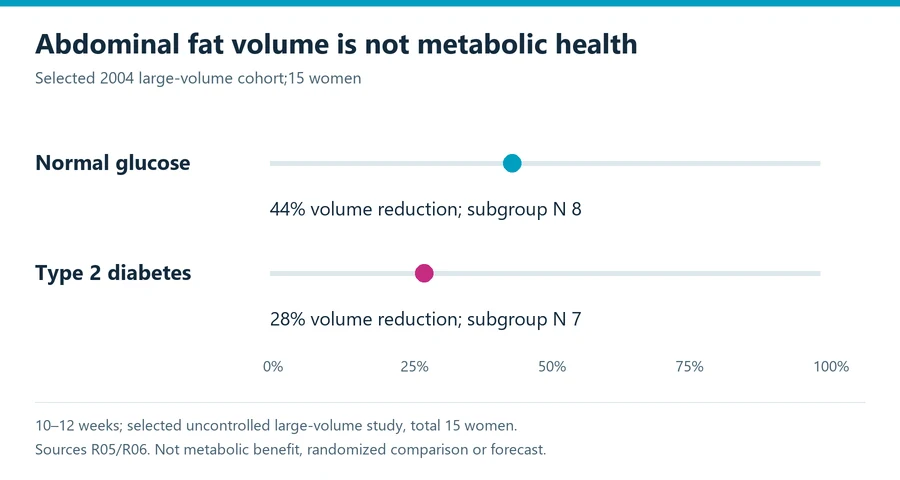
A small original study published June 17, 2004 evaluated 15 women with abdominal obesity before and 10–12 weeks after large-volume liposuction: eight had normal glucose tolerance and seven had type 2 diabetes. Abdominal subcutaneous fat volume fell by 44% and 28%, respectively. Investigators did not find significant improvements in measured insulin sensitivity or several cardiovascular risk markers. This was an uncontrolled, short-term study in a selected population, not a prediction for routine cosmetic patients. Original NEJM metabolic study
The distinction matters when you set your goal. A change in a superficial compartment cannot be used as proof that medical treatment for diabetes or obesity has succeeded. Nor does one small study settle every possible metabolic effect in every population or at every timepoint. “Not statistically significant” is not a demonstration that all effects are exactly zero. The decision here is to keep cosmetic assessment and medical disease management separate.
Read the compartment and endpoint before reading the percentage
| Original study item | What was reported | Interpretation limit |
|---|---|---|
| Normal glucose-tolerance subgroup | Eight women; 44% reduction in abdominal subcutaneous fat volume | Selected subgroup, not a promised percentage for a future patient |
| Type 2 diabetes subgroup | Seven women; 28% reduction in the same compartment | Not a randomized comparison of diabetes versus no diabetes |
| Reassessment | 10–12 weeks after large-volume treatment | Does not establish lifelong effects |
| Metabolic endpoints | No significant improvement in specified measured outcomes | Not proof of universal equivalence or a substitute for disease care |
When reviewing any contour study, write down the body region, measurement method, population and follow-up beside the result. “Fat reduction” can otherwise hide whether the endpoint is an ultrasound thickness, an imaging volume, a circumference, an aspirated material volume or a patient rating. Those measurements answer different questions. A percentage without its denominator and endpoint is too ambiguous to use as a personal planning target.
Map the treatment area before comparing techniques
Create a simple front-and-side outline and mark the areas you want discussed. Ask the clinician to distinguish planned treatment from regions that will be assessed but left untreated. This need not be an operative drawing for you to use yourself. It is a communication tool that can show whether two quotes describe the same coverage and whether your main concern has actually been addressed.
For example, an upper-and-lower abdominal proposal may differ from one that includes the flanks. A circumferential label may imply broader coverage, but you should still ask the practice to define it. Do not infer scope from a package name or a single flattering photograph. Record the boundaries in ordinary language so that the consent conversation, price explanation and follow-up assessment refer to the same plan.
Technique names should come after this scope discussion. If a proposal adds ultrasound, laser or radiofrequency assistance, ask what problem the addition is intended to solve and what evidence applies to your situation. The presence of an energy device is not itself an outcome. Compare the anticipated contour, remaining skin, recovery responsibilities and additional expense rather than assuming a technology label supplies a better result.
There is also a difference between a relatively smooth abdominal contour and deliberately emphasized muscle definition. If your goal involves visible definition, make it explicit. Ask what depends on your existing anatomy and what can realistically be changed. A sculpted marketing image may include a body type, pose, lighting or other procedures unlike yours. It should not silently become the standard against which your own result will be judged.
What to bring to the assessment
ASPS consultation guidance includes surgical goals, medical conditions, allergies, treatments, medications and supplements, substance use and previous surgery. Provide an accurate history rather than trying to present yourself as the ideal candidate. ASPS consultation guidance
For an abdominal concern, organize previous procedures by date, location and what was done, if you have those records. A prior abdominal operation, prior liposuction and an earlier skin-removal procedure are different entries. If an old record is unavailable, say so. Do not guess the extent of the operation from the scar alone. The purpose is to help the clinician understand the current situation, not to reconstruct a surgical history from internet diagrams.
Describe weight changes and future plans accurately as well. Separate a current stable preference from a goal that might change with planned weight loss or pregnancy. You do not need to choose a numerical target from a website to have a useful conversation. Ask how your individual history affects timing, expected contour and whether postponement would make more sense. Decisions about medicines or medical conditions belong with the clinicians managing them.
Prepare a short list of the result you would accept and the result you would consider disappointing. “Less fullness but some loose skin” and “removal of the fold even with a longer scar” are different preferences. This makes the tradeoff more concrete than asking whether you are a good candidate. A candidate discussion should end with an explanation of suitability, limitations and alternatives, rather than only a yes or no.
Risks belong in the abdominal plan
ASPS identifies risks including irregular contours, fluid accumulation, infection, persistent sensation changes, deeper injury, blood clots, anesthesia complications and possible revision. Loose skin or rippling may also remain a concern. No general list provides your personal probability or means all complications are equally likely. ASPS risks and safety
Ask how the proposed extent, any combined surgery and your medical history affect the safety discussion. A quotation that adds areas changes more than the price. It changes what is being proposed, so it should prompt a renewed explanation of the plan and recovery, rather than simply adding another discounted line item. If staging is suggested, ask what the separate stages are intended to accomplish and what remains between them.
Clarify where the procedure will take place, who provides anesthesia and what arrangements exist for unexpected care. These are practical facts to verify before paying, not claims that an attractive website can establish. Keep the responsible contact and after-hours instructions accessible to the person helping you recover. The written plan should identify how routine questions and urgent concerns are handled, including when immediate medical attention is needed.
Recovery: plan tasks rather than one return-to-work date
ASPS describes postoperative dressings, possible compression and individualized instructions about wound care, medicines, activity and follow-up. Recovery responsibilities vary with the operation. Follow your own team’s instructions rather than copying another person’s garment duration or exercise calendar. ASPS recovery guidance
Make a task list for your actual week. Sitting at a computer, commuting, lifting a child, carrying groceries and performing physical work are different activities. Ask which restrictions apply to each, when reassessment occurs and what help you should arrange. A return-to-work estimate is not permission for every task in that job. Likewise, feeling able to complete an activity does not replace clinical clearance when restrictions are still in place.
If the team recommends a garment, ask about fit, cleaning, how to wear it and whom to contact if it causes concern. Do not select greater compression as a way to force a flatter result. Record the prescribed plan and ask before changing it. If drainage care is part of your instructions, confirm how it is measured and reported rather than relying on a generic video intended for a different operation.
Early appearance should be interpreted in the context of healing. ASPS notes that swelling can take several months to dissipate and that outcomes are not guaranteed. Ask when your team intends to evaluate the contour and what changes should be assessed sooner. ASPS result expectations
Compare measurements without inventing a target
A before-and-after comparison is useful only when you know what is being compared. Ask for consistent views and an explanation of the timepoint. A front view, side view and oblique view can reveal different features, but none alone is a medical assessment. Lighting, posture and clothing should not become hidden substitutes for contour change. This is particularly relevant when you are judging an abdominal curve or a waist transition.
If circumference is recorded, ask where and how it is measured and whether the same method will be used later. If weight is recorded, keep it as a separate item. If a scan or ultrasound is used, identify its endpoint. There is no reason to combine these into a single success number. Your desired appearance and the clinician’s objective measurements can be discussed together without pretending they are interchangeable.
An aspirate amount also requires a definition. Ask what the number includes and why it is being reported. Do not convert a fluid-containing collection into pounds of pure fat or infer the final contour from it. A larger number is not automatically a better result or a sensible goal. The useful question is whether the proposed treatment addresses your assessed concern within an appropriate individualized plan.
Keep a simple measurement record with four columns: the measurement, the method, the date and the question it answers. A waist measurement might document a contour change; a patient questionnaire might document satisfaction; a laboratory result belongs to the medical question it was ordered to assess. If one proposal reports satisfaction and another reports tissue thickness, neither number can directly replace the other. Ask whether the practice follows the outcome that matters to your original concern and how a disappointing result would be evaluated. This is especially useful when your priority is clothing fit or an uneven transition rather than a particular circumference: the record can retain your actual goal instead of replacing it with whatever number is easiest to advertise.
What should an abdominal quote include?
ASPS distinguishes the surgeon’s fee from other costs such as anesthesia and facility expenses. Its general liposuction fee is not a verified total for stomach liposuction, and the current page does not identify a data year clearly enough to use it as a dated abdominal benchmark here. Request a written scope-specific total instead. ASPS fee versus total distinction
| Quote field | What to ask the practice to write down | Why it affects comparison |
|---|---|---|
| Treated regions | Upper/lower abdomen, flanks and any other included regions | Package names do not define equivalent coverage |
| Procedure components | Fat removal, any skin excision and any other proposed operation | Different tissue goals create different proposals |
| Professional charges | Surgeon and anesthesia charges, with inclusions | A surgeon fee alone is not the full cost |
| Facility and postoperative items | Facility, garments, tests, medicines and follow-up inclusions | Extra items may sit outside an advertised price |
| Additional care policy | What is covered if another assessment or procedure is needed | Revision terms differ from a guaranteed result |
Compare the written proposals after normalizing their scope. If one excludes the flanks or charges separately for anesthesia, mark that difference before ranking the prices. If financing is involved, separate the treatment charge from the borrowing terms and total repayment. A monthly payment is not the procedure price. Do not select a broader operation just because a bundle appears cheaper per area; each added component needs its own reason.
The most useful decision record contains your main concern, the assessment that explains it, the tissue and regions to be treated, the limitation you accept, the safety and recovery plan and the actual written cost. Keep any unresolved item visible. This turns stomach liposuction from a vague promise of a flat belly into a proposal you can understand, compare and decide whether to accept.
For related guidance, see the liposuction overview, tummy tuck versus liposuction and questions to ask a plastic surgeon.
Sources and review scope
Plastic Surgery Editorial Team. Source records checked through October 12, 2026. Review scope: source and editorial checks for general education. No individual clinical assessment is represented.
- ASPS liposuction scope. plasticsurgery.org. Publication/update date not stated. Checked 2026-10-12.
- ASPS patient liposuction handbook. plasticsurgery.org. Publication/update date not stated. Checked 2026-10-12.
- ASPS abdominoplasty scope. plasticsurgery.org. Publication/update date not stated. Checked 2026-10-12.
- ASPS panniculectomy scope. plasticsurgery.org. Publication/update date not stated. Checked 2026-10-12.
- Original abdominal liposuction metabolic study. nejm.org. Source date: 2004-06-17. Checked 2026-10-12.
- Original study bibliographic/abstract record. pubmed.ncbi.nlm.nih.gov. Source date: 2004-06-17. Checked 2026-10-12.
- ASPS liposuction assessment. plasticsurgery.org. Publication/update date not stated. Checked 2026-10-12.
- ASPS liposuction risks. plasticsurgery.org. Publication/update date not stated. Checked 2026-10-12.
- ASPS individualized recovery instructions. plasticsurgery.org. Publication/update date not stated. Checked 2026-10-12.
- ASPS contour result limits. plasticsurgery.org. Publication/update date not stated. Checked 2026-10-12.
- ASPS surgeon fee versus total. plasticsurgery.org. Publication/update date not stated. Checked 2026-10-12.