
Septoplasty is an operation on the nasal septum, the cartilage-and-bone partition between the two sides of the nose. Its main purpose in someone with symptomatic septal deviation is to improve the internal passage for breathing. It is not primarily an operation to create a different cosmetic nose shape. A useful decision starts with identifying why the nose feels blocked, how much that affects daily life and what the proposed operation is expected to address.
A bent septum, swollen nasal lining and an unwanted external shape are different questions. They can coexist, but they should not be collapsed into one promise to “fix the nose.” Current University Hospitals Sussex guidance distinguishes septal surgery from combined septorhinoplasty and explains that sprays may help swelling without straightening a bent septum. NHS septal surgery guidance, reviewed January 22, 2026
This guide helps you separate those goals, interpret the strongest original trial evidence and compare the proposed treatment with a defined medical-management plan. It does not diagnose the cause of your blockage from a photograph or provide instructions for manipulating your nose. The practical aim is a treatment discussion that names the problem, the intended benefit, the alternatives and the limits of what is known.
Describe the blockage before choosing an operation
Write down whether one side or both sides feel blocked, whether symptoms are constant or vary and what activities are affected. Include previous injuries, nose operations and treatments you have tried. Record how each treatment was used and what changed. Saying a spray “did not work” gives less information than describing the product, the prescribed course and the particular symptom that remained troublesome.
Explain the effect on your life in concrete terms. You might be concerned about breathing comfortably through your nose during routine activity, persistent stuffiness or symptoms that disturb sleep. Those descriptions help establish what you want to improve. They should not be treated as proof that the septum is responsible, or that one nasal operation will address every associated symptom.
Ask the examining clinician to connect the assessment to the proposed treatment. Which finding is thought to contribute to the blockage? Are there other nasal conditions to evaluate? What can the current assessment establish, and what remains uncertain? A diagnosis should do more than name an anatomical feature that happens to be present. It should explain why a particular intervention is being discussed for your symptoms.
The NAIROS trial investigators emphasize the importance of careful assessment because people reporting nasal blockage are a varied group. Their results concerned adults with obstruction associated with a deviated septum and at least moderately severe symptoms. They did not recruit everyone who occasionally felt congested. Original NAIROS report: interpretation and clinical scope
Keep internal function and external appearance on separate lists
If you also dislike the bridge, tip or overall direction of your nose, say so explicitly. Do not assume the cosmetic concern is included in a septoplasty proposal. Dorset County Hospital describes septoplasty as an operation not intended to change external appearance, while explaining that some patients need combined septorhinoplasty. NHS distinction between septoplasty and combined surgery
Create two goal lists: the breathing problem you want assessed and the visible features you want discussed. Ask which, if either, are included in the proposed operation. A combined plan should identify the functional and appearance-related components rather than suggesting that a cosmetic change proves better airflow. Equally, improved breathing does not demonstrate that a particular cosmetic preference has been met.
If the operation is being discussed only for function, ask what appearance changes are possible as a complication and how those concerns would be assessed. “Not intended to change appearance” is a statement about the objective, not an absolute guarantee about the result. Understanding that distinction makes the consent conversation more precise without turning a functional treatment into an appearance-driven one.
| Concern | Assessment question | What to keep separate |
|---|---|---|
| Persistent internal blockage | What findings connect the septum to my symptoms? | The presence of a bend versus its contribution to symptoms |
| Variable stuffiness | Is swelling or another nasal condition contributing? | Structural treatment versus treatment of lining symptoms |
| Visible crookedness or shape preference | Does the plan include external nasal work? | Septoplasty versus septorhinoplasty or cosmetic rhinoplasty |
| Sleep-related concerns | Which symptoms are being evaluated and how? | Easier nasal breathing versus promises about every sleep problem |
| Previous nasal surgery | What is different about the assessment and proposed revision? | Evidence from newly referred trial participants versus my history |
What the randomized trial compared
The original NAIROS study, published on October 18, 2023, enrolled 378 adults at 17 UK clinics. Participants had septal deviation with nasal obstruction and a NOSE symptom score above 30. They were assigned to septoplasty or a defined six-month regimen of nasal steroid and saline sprays. This was a comparison with a specified treatment course, not simply surgery versus doing nothing. Original randomized trial and verified publication date
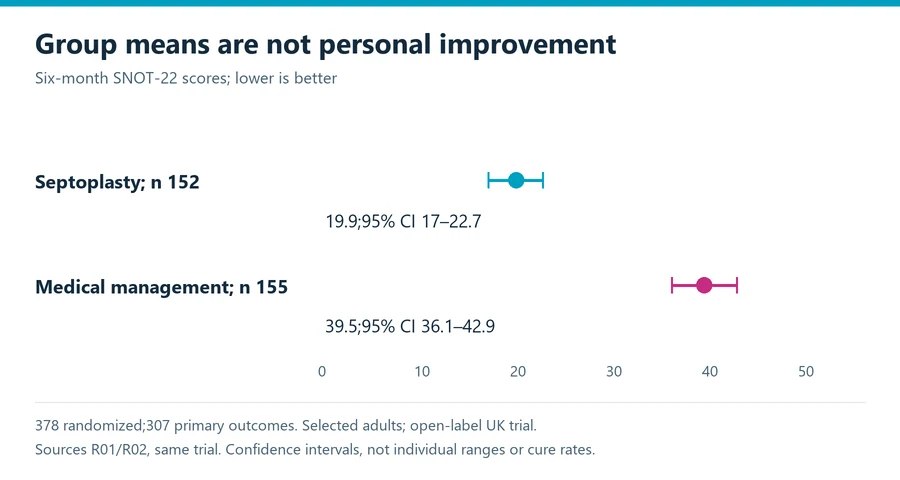
At six months, the reported mean SNOT-22 scores were 19.9 in the surgical arm and 39.5 in the medical-management arm, with lower scores indicating fewer problems on this measure. The adjusted between-group difference was 20.0 points in favor of surgery. Primary-outcome data were available from 152 surgical-arm and 155 medical-arm participants. These are group symptom scores, not percentages of people cured. Original NIHR trial report, March 2024
The trial offers a stronger comparison than a collection of postoperative testimonials because assignment was randomized and the alternative regimen was defined. Its open-label design matters too: participants knew which treatment they received. The useful interpretation is that the measured average symptom outcome favored surgery in the studied population. It does not establish that every participant improved by the group-average difference or that every blocked nose requires surgery.
Do not subtract two group means and call it an individual benefit
Subtracting the reported means gives 39.5 minus 19.9, or 19.6 points. The study’s adjusted estimate is 20.0 points because its analysis accounted for specified baseline and stratification factors. These numbers describe related but different calculations. Neither should be displayed as a promised improvement for someone who has not had an assessment or been shown to resemble the trial population.
The supporting figure for this guide plots the two actual six-month means with their reported confidence intervals. Its caption identifies the outcome samples and the eligible population. It does not use a “success” meter or a drawing of a fully opened airway, because the study’s principal comparison was a patient-reported symptom scale. Showing what was measured is more informative than giving the result an unrelated visual meaning.
Read trial denominators and timepoints correctly
The trial enrolled 378 people, but 307 provided the primary six-month outcome data. Those numbers answer different questions. Enrollment describes who entered the comparison; the outcome counts describe the available measurements at that assessment. A summary that puts the same enrollment number under every later result hides that distinction. Ask whether a quoted result comes from all enrolled participants, available respondents or people who actually received the operation.
The difference is particularly important for complication figures. A treatment-arm outcome analysis and a report among those who underwent surgery need not use the same denominator. Do not divide a complication count by the entire trial enrollment simply because it produces a smaller number. The responsible interpretation names the event, the population in which it was counted and the time context supplied by the report.
Six months also describes a research assessment, not a universal recovery deadline or a lifetime guarantee. The NIHR report discusses results over the trial period and cautions that economic conclusions at later horizons involved modeling. An observed symptom result, a future cost-effectiveness projection and a person’s out-of-pocket bill should never be substituted for one another. Original report: follow-up and economic interpretation
| Trial detail | Verified information | Interpretation limit |
|---|---|---|
| Enrollment | 378 adults at 17 UK clinics | Not a sample of all causes of nasal blockage |
| Eligibility | Septal deviation, obstruction and NOSE score above 30 | Not evidence for self-diagnosis from a score alone |
| Medical comparator | Defined nasal steroid and saline regimen for six months | Not every possible nonsurgical approach |
| Six-month outcome sample | 152 surgical-arm and 155 medical-arm participants | Not 378 measured results at that timepoint |
| Mean SNOT-22 scores | 19.9 surgery; 39.5 medical management | Group means, not cure percentages |
| Adjusted difference | 20.0 points favoring surgery | Not a promised personal change |
Medical treatment and structural surgery answer different parts of the problem
A clinician may propose treatment for swollen nasal lining even when a septal bend is present. The purpose is to understand or reduce a treatable contributor to symptoms; it is not to claim that a spray physically straightens cartilage. Keep the treatment goal and the reassessment plan explicit. Ask what should improve, how the response will be judged and what persistent symptoms would lead to another discussion.
Do not copy the trial regimen into your own medicine schedule. A research protocol is evidence about a comparison, not an individual prescription. Your clinician should account for the diagnosis, relevant medical history and products you already use. If a prescribed course was difficult to follow, explain the difficulty before concluding that the alternative has been adequately tested in your case.
Bring a practical record to reassessment: the instructions you received, what you actually used and which symptoms persisted. This allows the next discussion to be about the treatment response rather than competing impressions. It also helps distinguish a symptom that improved while another remained from an undifferentiated claim that nothing changed. The decision can then return to the contribution the proposed operation is expected to make.
Clarify additional procedures rather than accepting a bundled label
Some septoplasty plans include treatment of the turbinates, structures along the side of the nasal cavity. Other plans include external nasal work or another operation with a different purpose. Ask the surgeon to name each component, its intended benefit and its separate risks. A single package label can conceal more than one clinical decision.
The trial allowed septoplasty with or without turbinate reduction. That does not turn every additional procedure into a mandatory part of septoplasty, nor does it settle which technique is appropriate for an individual nose. The trial investigators discuss the limitations of interpreting additional turbinate treatment within their study. Original NAIROS discussion of treatment scope
Ask what the proposal would look like if the additional component were omitted. This is not a request to choose the operation yourself. It is a way to understand whether the extra treatment addresses a documented contributor to symptoms, an access requirement or a different goal. The explanation should be understandable without relying on a device brand or the assumption that more treatment necessarily gives a better result.
Balance the expected benefit with specific consent questions
Current NHS guidance identifies bleeding, infection, a septal hole and possible external shape changes as concerns to discuss. Dorset guidance also describes internal adhesions and changes in smell or sensation. These are categories for individualized consent, not a personalized rate table. Current NHS consent considerations NHS postoperative concerns
Ask which concerns are particularly relevant to the proposed operation and your history. Then ask what the response would be if a problem occurred. Knowing that bleeding is possible does not tell you which contact route to use or where to obtain assessment. Obtain the practice’s actual instructions rather than relying on a general online description of what is common.
Persistent blockage also deserves an explicit discussion. Ask when the team expects to reassess function, what would prompt investigation and how the possibility of further treatment is handled. An operation can have a justified purpose without guaranteeing complete relief of every symptom. Your consent should reflect the expected contribution, not an unlimited promise made from a positive group-average study result.
Separate immediate aftercare from later functional assessment
Ask whether you will have internal splints or packing, how those will be managed and who should remove them. Confirm which instructions apply if external nasal surgery is also performed. NHS leaflets describe postoperative blockage and individualized follow-up, but their schedules differ. A leaflet from another hospital should not override the plan given by the team responsible for your operation.
Before going home, obtain instructions about washing or nasal care, prescribed products, nose blowing, activity, travel and returning to work. Tell the team what your work involves: quiet desk duties and a job with physical exertion are different planning situations. Avoid turning the earliest date mentioned in someone else’s recovery story into permission for your own activities.
Early swelling or the presence of packing can make breathing feel different from the eventual result. Ask what is expected and which changes warrant contact. Increasing blockage with pain is identified in NHS guidance as a reason to seek medical assessment, rather than simply waiting for a routine review. Follow your treating team’s urgent-care instructions for bleeding or other concerning symptoms. NHS guidance on concerns after discharge
Keep the later assessment tied to the original goals. If your main concern was everyday nasal breathing, discuss that specifically rather than evaluating only the appearance of the nose. If a symptom persists, describe which side, which situations and what changed compared with before surgery. That record supports a more useful examination than deciding from a single unusually good or bad day that the operation wholly succeeded or failed.
Understand the bill and coverage as a separate evidence question
No dated, defensible national total septoplasty price was verified for this guide. A UK trial’s cost-effectiveness analysis does not establish a current US price or insurance benefit. Request a quote that identifies the procedure, any additional nasal work, facility charges, anesthesia, follow-up and the circumstances in which further costs might arise.
If seeking coverage, ask the insurer what documentation and authorization apply to the functional component. Do not assume that a combined operation makes every appearance-related component covered. Equally, do not assume that the word “nose surgery” makes every component cosmetic. The decision should use the actual plan documents and benefit terms, with any patient responsibility explained before booking.
| Planning field | Confirm before booking | Avoid assuming |
|---|---|---|
| Named operation | Septoplasty and each additional component | Every nasal procedure is included in one label |
| Functional objective | Symptoms and findings the treatment addresses | Cosmetic appearance proves improved breathing |
| Financial scope | Professional, facility, anesthesia and follow-up charges | A quoted surgeon fee is the total |
| Coverage | Actual authorization and benefit conditions | A clinical recommendation guarantees payment |
| Recovery support | Transport, care instructions and contact arrangements | Someone else’s timetable applies to you |
| Result assessment | Planned review of the original breathing concerns | An early postoperative day is the final outcome |
Make the decision with a defined goal and an honest comparison
Consider how the same evidence could be misread in a treatment discussion. A person asking for a straighter-looking bridge might be shown the trial’s improved symptom scores. Those scores do not answer that appearance preference. Someone asking whether to stop a prescribed spray might be shown the surgical group’s lower mean score. The trial does not supply a personal stop instruction. Someone worried about the first week after surgery might be shown the six-month result. That later assessment does not describe the first week’s care needs. Connecting each question to the right outcome prevents a persuasive number from doing work it cannot support.
You can use this approach with other evidence presented at consultation. Ask whether the result concerns anatomy, a symptom questionnaire, another clinical endpoint or patient satisfaction. Then ask when it was assessed and whether additional operations were included. This keeps the discussion relevant to your own goal while leaving clinical treatment decisions with the examining professional.
The strongest trial evidence supports septoplasty over its specified medical regimen for the studied adults with symptomatic septal deviation. It is valuable evidence, but its value comes from the details: who was eligible, what the alternative treatment was and which outcome was measured. Those details should inform your assessment rather than become a sales percentage detached from the research.
Before deciding, explain the proposal in your own words. What is contributing to the blockage? What will be treated? Which symptoms are expected to improve, and what may remain? What are the alternatives and the follow-up plan? If the answers are clear, you can weigh the expected benefit against the burdens, risks and financial commitment with a more realistic understanding of what septoplasty is intended to achieve.
For related planning, see rhinoplasty and appearance-related goals, questions to ask a plastic surgeon and understanding procedure costs.
Sources and review scope
Plastic Surgery Editorial Team. Source records checked through October 12, 2026. Review scope: source and editorial checks for general education. No individual clinical assessment is represented.
- Original NAIROS trial, author institutional repository. eprints.gla.ac.uk. Source date: 2023-10-18. Checked 2026-10-12.
- Original NIHR NAIROS report. pubmed.ncbi.nlm.nih.gov. Source date: 2024-03. Checked 2026-10-12.
- Original NIHR NAIROS report chapter7 Discussion. ncbi.nlm.nih.gov. Source date: 2024-03. Checked 2026-10-12.
- University Hospitals Sussex septal surgery guidance. uhsussex.nhs.uk. Source date: 2026-01-22. Checked 2026-10-12.
- Dorset NHS septoplasty patient guidance. dchft.nhs.uk. Source date: 2020-08. Checked 2026-10-12.