
Radiofrequency skin tightening uses electrical energy to produce tissue heating, with the aim of changing the appearance of treated skin. External RF applies a device at the skin surface; RF microneedling introduces small electrodes into the skin and is a different procedure. A useful result depends on the actual device, intended treatment area, assessed concern and measured endpoint. “Radiofrequency” alone does not identify one standardized treatment, and it does not promise the result of a surgical lift. FDA technology guidance
This guide focuses on external, nonsurgical RF and on how to evaluate a proposal accurately. It also explains the boundary with RF microneedling because offers sometimes use similar language for different interventions. The goal is to make device claims, safety information and cost comparisons understandable, not to select settings or recommend a device for use at home.
Start with the concern, then identify the technology
“Tighter skin” can describe a change in a wrinkle rating, a perceived improvement in firmness, a different jawline contour or a change in the circumference of a body area. Those are different outcomes. Before comparing treatments, identify the location and the visible change you want. A face wrinkle study does not automatically answer a question about loose abdominal skin. A circumference measurement does not establish that a facial contour has been lifted.
The FDA describes RF-induced heating in its noninvasive body-contouring guidance and notes that effects can include changes in cellulite appearance, circumference or perceived tightening. The same page emphasizes device-specific intended use. This is an important boundary: a broad explanation of the energy mechanism is not authorization for every device at every body site. Ask for the precise device name and the indication that relates to the proposed area.
Also clarify whether the offered procedure is entirely external, uses needles or involves an inserted instrument. A treatment name that combines several technologies needs an explanation of each component. If an offer includes RF and ultrasound, for example, the result cannot simply be attributed to RF without relevant comparative evidence. The written plan should describe what is actually being delivered rather than relying on a familiar umbrella term.
| Description in an offer | What to establish | What should not be assumed |
|---|---|---|
| External RF | Named surface device and intended site | The same risk profile as every RF product |
| RF microneedling | Needle electrodes and specific medical procedure | That external RF evidence applies directly |
| RF plus another energy | Each component and evidence for the combination | Which component produced an observed change |
| Nonsurgical lifting | Defined endpoint and realistic scale of change | Equivalence to a surgical facelift |
The table organizes questions rather than ranking treatments. An accurate description may reveal that two apparently competing offers are for different procedures, or that only one addresses the concern you actually have.
“Noninvasive” describes access, not an absence of risk
An external treatment does not require the same access as a surgical operation, but it still uses energy to affect tissue. The FDA lists RF body-contouring complications including discomfort, redness, swelling, burns, skin-color changes and scarring. The presence of these possibilities does not supply a personal risk percentage; it establishes that a safety discussion is part of the decision. FDA RF risks and device scope
Avoid interpreting “no incision” as “no injury can occur.” Ask how the actual device is used within its intended labeling, what assessment is needed and how concerns are managed after treatment. A reassuring description should identify the relevant risks and the response pathway, rather than dismissing the need for medical evaluation because the service is marketed as a facial or body treatment.
Your medical and treatment history matters to device selection. Tell the assessing professional about implanted devices, prior procedures, medicines and relevant skin concerns. Do not try to clear yourself using a generic online checklist. A history item may require a device-specific decision or advice from another clinician. A consultation is useful when it resolves that question; it is less useful when it merely repeats that a technology is widely used.
Keep RF microneedling safety information in its proper scope
On October 15, 2025, the FDA issued a safety communication concerning certain uses of RF microneedling. It describes serious reported complications including burns, scarring, fat loss, disfigurement and nerve damage. It also identifies RF microneedling as a medical procedure that should not be performed at home. This is current safety information to discuss if the proposed treatment uses needle electrodes. FDA RF microneedling safety communication
The notice should neither be ignored nor stretched into an invented incidence estimate for all external RF. Adverse-event reports establish a safety concern, but they do not provide the number of all treated people needed to calculate a personal probability. They also concern a defined procedure family. A claim that the notice proves every external device has the same risk would erase that distinction; a claim that RF devices are harmless would erase the safety issue.
Ask the person offering treatment to state whether needles are part of the procedure. If they are, request information relevant to that intervention and the named device. If they are not, ask for external-device evidence and labeling. You should not have to infer the procedure type from a before-and-after image, the appearance of the handpiece or a broad promise of collagen stimulation.
Evidence needs a device, a comparator and an endpoint
A controlled study provides more information when its comparison matches the decision being made. Comparing two active devices is different from comparing treatment with no treatment. A split-face design can compare two sides of the same person, whereas a parallel-group study compares different people. Both can be useful, but their denominators and interpretation differ. Counting treated facial sides as independent people would overstate the size of a split-face study.
A January 2019 trial included 20 people with mild to moderate laxity and compared monopolar RF on one facial side with microfocused ultrasound on the other, following participants for six months. It found improvements in its laxity scale but no statistically significant difference between the two sides on that scale. It did not compare RF with a surgical facelift or establish that every RF and ultrasound device is equivalent. Original split-face RF and ultrasound trial
The useful lesson is to ask what “effective” meant in the source. Was it an assessor’s rating, a measurement, a patient report or a mixture? Was the comparator another active treatment, an untreated side or a sham intervention? Was the result assessed immediately or after a specified follow-up? Without those details, a study citation may look impressive while answering a different question from your own.
A rating change is not a surgical distance
A change in a wrinkle or laxity grade describes that scale’s outcome. It should not be converted into centimeters of lifting unless the study actually measured that distance. Similarly, a statistically significant change does not by itself show that the difference would be noticeable or worthwhile to you. A clear explanation can show both the endpoint and its practical meaning without inventing a new measurement.
Ask how results will be evaluated in your own plan. If the answer is photography, discuss consistent views and lighting. If it is a rating scale, ask what the categories represent. If it is your own satisfaction, identify the particular change you hope to see. These questions make follow-up more informative than a generic declaration that the skin “responded.”
What a newer trial adds—and what it does not
A February 27, 2026, multicenter study compared two monopolar RF devices in a six-month, assessor-blinded, active-control noninferiority trial. The analysis included 212 participants, divided into groups of 107 and 105, with mild to moderate facial laxity. Its main endpoint concerned assessor-rated facial wrinkle improvement at 90 days. It was not a study of all body sites, surgery replacement or every skin type. Original 2026 monopolar RF study
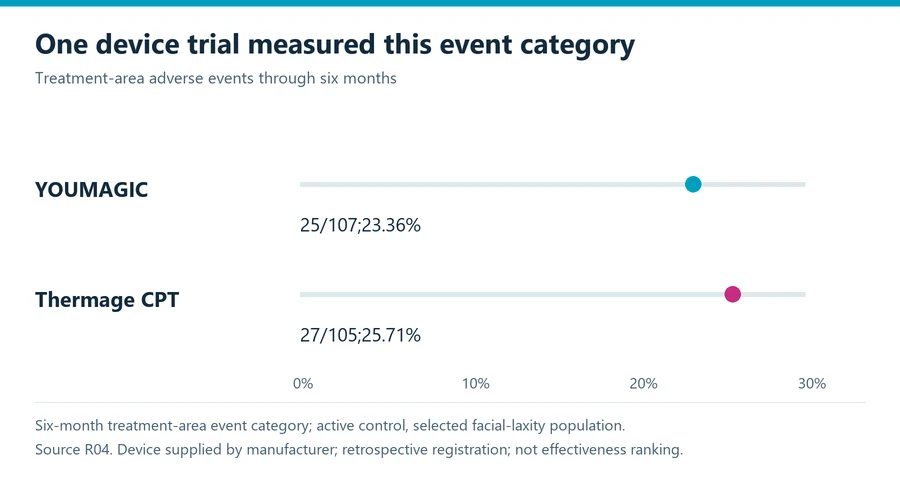
The full report recorded treatment-area adverse events in 25 of 107 participants in one arm and 27 of 105 in the other. Those are about 23.4% and 25.7%, respectively, using the published denominators. They describe this study’s event category, not a national complication rate or a prediction for you. The report’s safety definitions and selected population matter. It also disclosed device supply by the manufacturer and retrospective trial registration.
An original chart can show the two event proportions with the actual counts printed beside the bars. It should not add a “safer winner” badge or combine them with the efficacy outcome. Nor should it turn a lack of serious treatment-related events into proof that serious harms are impossible. A limited study can inform a discussion while remaining too small or selective to resolve every safety question.
| Question about a study | Why it matters | What to keep with the result |
|---|---|---|
| Who was analyzed? | Selected participants differ from all consumers | Actual group sizes and eligibility |
| What was the endpoint? | Improvement grades differ from lifting distance | Scale definition and assessment time |
| What counted as an adverse event? | Broad event categories differ from severe injury | Category, count and denominator |
| Was treatment compared with an active device? | Noninferiority is not a no-treatment comparison | Comparator and study design |
| How was the study supported? | Support and registration affect appraisal | Disclosures and registration timing |
Photographs should clarify, not exaggerate
Useful treatment photographs identify the actual procedure and the time between treatment and the image. Consistent posture, expression, lighting and camera position make changes easier to evaluate. A smiling after-image and a neutral before-image can answer a different visual question from a matched comparison. A cropped image might show texture well while obscuring the broader contour. Ask which feature the image is intended to demonstrate.
A relevant illustration can also explain the difference between an external applicator and needle electrodes without showing a patient outcome. It should show a skin surface, an external contact interface and a conceptual heating relationship, with a separate needle-based panel only if the distinction is necessary. It should not depict treatment temperatures, penetration depths or device settings as instructions. The purpose is to explain procedure categories, not to train an operator.
When a photograph is used as evidence, its caption should not imply that it represents the average outcome unless a source actually supports that claim. If it is an editorial portrait, label it as illustrative rather than presenting the person as a treated patient. Beauty and relevance can coexist with accurate representation; an attractive image does not need a fabricated medical story.
External RF and a facelift are different decisions
The American Society of Plastic Surgeons describes a facelift as surgery addressing visible facial and neck aging and states that minimally invasive rejuvenation cannot achieve the same results. This does not mean that everyone seeking an appearance change needs surgery. It means that the expected scale and type of change should be explained honestly. ASPS facelift scope
If you want a subtle change without choosing an operation, the decision may focus on whether the anticipated improvement is worth the cost and uncertainty. If you expect substantial correction of excess skin or a major contour change, ask whether the proposed external treatment addresses that expectation. A treatment should not be sold as a substitute merely because it contains the word “lift” in its name.
You can read the facelift guide to understand the separate surgical decision, without assuming that surgery is the next step. Declining both procedures is also an option. The relevant comparison is between assessed alternatives for your goal, including no intervention, rather than between marketing labels that promise different things without explaining the tradeoffs.
Compare the planned course and full cost
A price per session is not necessarily the total cost of a proposed course. Ask how many sessions are included, when the result will be assessed and whether further treatments are optional maintenance or part of the initial plan. An estimate should distinguish those categories. Otherwise, a seemingly lower price may cover a different service or a shorter course than another estimate.
Also identify the actual device, treatment area and included follow-up. A quotation for a small facial area cannot be compared directly with one for multiple body sites. A package that combines technologies should itemize them. If a promised result relies on an additional treatment that is not included, that should be visible before payment. No current national total-cost figure is provided here because the verified studies do not supply a comparable pricing dataset.
| Item to record | What makes offers comparable | What remains uncertain |
|---|---|---|
| Procedure identity | External RF versus needle-based or combined treatment | Whether the selected intervention suits you |
| Device and area | Exact model and intended treatment site | Response outside studied populations |
| Initial course | Sessions and included follow-up | Whether a desired change will occur |
| Further treatment | Optional maintenance versus planned continuation | Future preference and expense |
| Outcome assessment | Endpoint and review time | Magnitude and durability for you |
Use the cost planning guide to organize the written comparison. A clear estimate should still be considered alongside the evidence and assessment. Cost efficiency does not mean purchasing the largest package before knowing whether its procedure and expected endpoint match your goal.
Recovery information should be tied to the actual intervention
General promises about little downtime do not replace instructions for the selected treatment. Ask what temporary effects are expected, what changes need prompt assessment and how to reach the treating service. The answer should relate to your procedure, not to an external RF article if the plan actually involves microneedling. Keep written instructions so that a concern after treatment can be assessed without guessing from a promotional description.
Do not adjust medicines, repeat a treatment or attempt to manage a suspected burn using this guide. If something seems wrong after a procedure, seek medical assessment. An article can help identify the need for a clear care pathway, but it cannot examine an injury or decide whether a visible change is within the expected course.
Decide in advance how to judge whether the course was worthwhile
Before treatment, record the concern using consistent language. “The loose-looking area beneath my jaw” is a different target from “the fine lines on my cheeks.” If the plan addresses one but photographs emphasize the other, the assessment can become confusing. Agree on the feature to review and the expected review point. A record of your own priority helps distinguish a worthwhile subtle change from a result that is measurable yet unrelated to the reason you sought treatment.
Also discuss the decision after that review. Would an additional session be proposed only if there were a meaningful response, or is it already part of the initial course? What would lead the team to reconsider the approach? These are questions about the agreed plan, not instructions to set your own treatment interval. A clear stopping or reassessment discussion helps prevent the vague possibility of “more improvement” from becoming an unlimited purchasing commitment.
Finally, keep appearance, comfort and financial burden as separate parts of the evaluation. A favorable photograph cannot answer whether the experience and course were acceptable to you. You can decide that a modest change was worthwhile, that it did not justify continuation or that you prefer to stop. That decision need not be framed as a failure to maintain yourself or as a reason to purchase a different intervention immediately.
A worthwhile proposal makes its limits understandable
Before agreeing, you should be able to name the procedure, device, area and intended outcome in plain language. You should also understand what evidence relates to that plan and what remains uncertain. A statement such as “improve an assessed facial wrinkle endpoint using a named external device” is more informative than “reverse aging with RF,” because it describes a result that can actually be discussed and reviewed.
Device clearance, a favorable study and a beautiful photograph answer different questions. None alone establishes suitability or guarantees the outcome you want. Use them together with an assessment, a realistic goal and a clear follow-up plan. For broader preparation, see consultation questions and the procedure guide library.
Sources and review scope
Plastic Surgery Editorial Team. Source records checked through October 12, 2026. Review scope: source and editorial checks for general education. No individual clinical assessment is represented.
- FDA noninvasive contouring technologies. fda.gov. Publication/update date not stated. Checked 2026-10-12.
- FDA RF microneedling safety communication. fda.gov. Source date: 2025-10-15. Checked 2026-10-12.
- Original RF versus ultrasound randomized split-face trial. pubmed.ncbi.nlm.nih.gov. Source date: 2019-01. Checked 2026-10-12.
- Original2026monopolarRF active-control trial. link.springer.com. Source date: 2026-02-27. Checked 2026-10-12.
- ASPS surgical facelift scope. plasticsurgery.org. Publication/update date not stated. Checked 2026-10-12.