
Power-assisted liposuction, often shortened to PAL, uses powered movement of a liposuction cannula within a surgical fat-removal procedure. The device describes how an instrument moves; it does not by itself establish who should have liposuction, how much should be removed or what contour will result. The most useful comparison separates instrument efficiency, the patient’s goal and the safety of the complete operation. A claim that a tool works faster needs a different kind of evidence from a claim that patients recover faster or experience fewer complications.
This guide explains those distinctions and examines actual primary studies. It is intended for people comparing a proposed PAL plan with another liposuction approach, rather than selecting equipment or learning an operative technique. Start with the assessment and the planned outcome, then ask why the instrument was chosen. A device name is an incomplete answer to a body-contouring question.
Start with the contour question
The ASPS liposuction overview describes localized fat removal and states that liposuction is not an obesity treatment or an effective cellulite treatment. It also identifies skin quality as relevant to results and notes that additional skin surgery may be needed. Changing the instrument name does not answer a skin-assessment question. A proposal should distinguish the feature being addressed from the feature a patient hopes will change.
Describe the area and the concern without prescribing a solution. “The contour at my waist bothers me in fitted clothes” gives an assessor something to discuss. “I need the latest device because it must tighten everything” embeds an unsupported assumption. You can bring photographs that illustrate preferences, but they should not be treated as measurements of your tissue or proof that the same operation would produce the same result.
Ask whether the proposed plan is isolated liposuction or a combined operation. If skin removal, an energy-based treatment or fat transfer is included, keep it separately named. A result from a combined course does not isolate the contribution of PAL. The distinction matters when you read studies, compare prices and arrange recovery support. Our main liposuction guide addresses the broader assessment; this page owns the narrower instrument-and-evidence question.
Distinguish powered movement from other assisted methods
“Assisted liposuction” is an umbrella phrase, not one interchangeable technology. The ASPS assisted-liposuction page specifically describes laser and ultrasound approaches. It should not be cited as a PAL-specific comparative trial. Read the actual methods in a source rather than assuming that every assisted device uses heat, ultrasound or the same motion.
An original study published August 15, 2023 describes two different powered instruments, including one with oscillating reciprocal cannula movement. It also includes suction-assisted and ultrasound-assisted groups. The distinction between the two PAL instruments is useful: even within an acronym, equipment and study conditions can differ. A finding for one instrument should retain that identity when discussed, rather than becoming a verdict on all powered methods.
Your proposal can identify the instrument category without turning the consultation into a shopping exercise. Ask what problem its use is intended to solve in the assessed plan and what remains dependent on judgment. You do not need to choose a speed, cannula or operative setting. Those are clinical responsibilities. You do need an explanation that distinguishes the tool from any additional treatment and avoids presenting an acronym as a guarantee.
| Description in a proposal | Clarification to request | Inference to avoid |
|---|---|---|
| Power-assisted | Exact instrument category and intended role | Every powered device is interchangeable |
| Ultrasound- or laser-assisted | Whether an additional modality is included | All assisted methods have the same mechanism |
| Combined contouring | Which procedures are separately planned | Every observed result is caused by PAL |
| Fat harvesting | Whether transferred fat is part of the course | A laboratory cell endpoint proves a clinical graft result |
Interpret a one-minute output study accurately
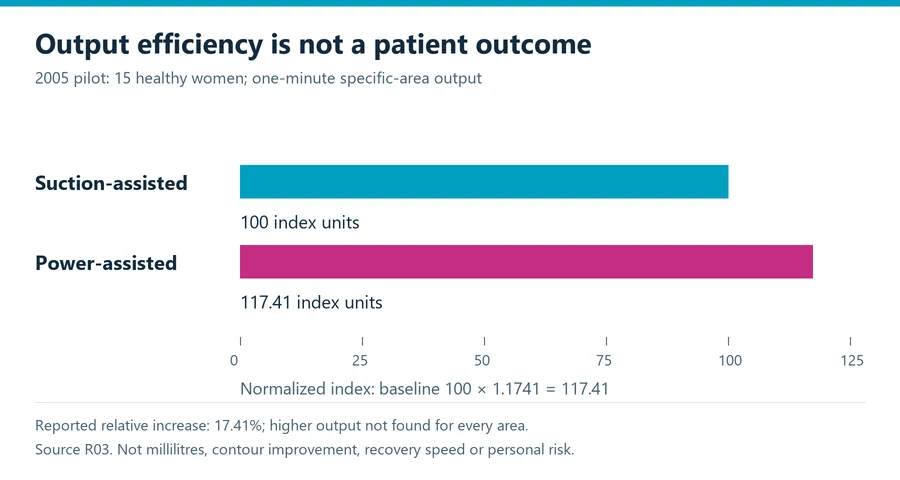
A 2005 original pilot study compared PAL with traditional suction-assisted lipoplasty in 15 healthy women. It examined general and area-specific output over one minute from symmetrical areas. The abstract reported a 17.41% increase in average specific-area output with PAL; the inner thigh did not show the same higher suction-capacity finding. PubMed records a January–February issue and March 10 electronic publication, which are different date fields.
That measurement addresses output under the study conditions. It is not a 17.41% improvement in appearance, a 17.41% reduction in complications or a promise to shorten the entire operation by that amount. A patient’s course contains more than the measured extraction interval. Nor does a higher output establish that more fat should be removed from a particular person. Those would be different claims requiring different evidence.
A normalized index is not a measured volume
The supporting chart expresses the reported relative difference using a comparison index: suction-assisted output is set to 100, and PAL becomes 117.41. The calculation is 100 multiplied by 1.1741. These are index units, not millilitres, percentages of body fat or success rates. The graph makes a relative result easier to see without inventing absolute volumes that the abstract did not supply.
Keep the small, selected population visible when reading the chart. The study does not establish the same difference for every body area, contemporary instrument, patient group or operator. It also does not resolve longer-term contour or recovery questions simply because the endpoint was measured quantitatively. The original observation can be useful for discussing efficiency while remaining insufficient for broader advertising claims.
| Study detail | Actual observation or scope | Unsupported extension |
|---|---|---|
| Population | 15 healthy female patients | Every patient or body area |
| Measurement | One-minute general and area-specific output | Whole-operation or recovery duration |
| Relative finding | 17.41% higher average specific-area output | 17.41% better appearance or lower risk |
| Graph calculation | SAL index 100; PAL index 117.41 | Absolute aspirate volumes or body-fat loss |
Read ergonomic findings as ergonomic findings
An earlier original paired comparison published in October 2001 used patients as their own controls. Its abstract reported reduced procedure time, intraoperative pain and surgeon fatigue, with increased aspirated fat per minute for powered cannulas. The accessible abstract does not provide the sample size or numerical effect magnitudes. We therefore do not create a numerical pain chart or calculate a personal benefit from it.
The paired design is relevant because it compares methods within people, but the design label alone does not answer every question. Ask which outcome was measured, how it was measured and at what time. Intraoperative pain is not the same endpoint as pain after discharge. Surgeon fatigue is not the same endpoint as patient satisfaction. A report can support discussion of one while leaving another unanswered.
This is also a useful test for promotional wording. “Less effort for the operator in a study” and “a safer operation for you” are distinct statements. Evidence must connect the second statement to actual patient outcomes rather than letting the first imply it. You need not disregard ergonomic research; you can recognize its purpose while asking for the separate evidence behind a safety or recovery claim.
Separate specimen research from patient outcomes
The 2023 original study assessed removed abdominal tissue and operator work measurements. Its methods list 328 specimens across suction-assisted, two powered, ultrasound-assisted and control groups. That is a specimen count, not 328 people followed for cosmetic outcomes. The work used tissue from women undergoing abdominal surgery in a selected population; its laboratory and ergonomic questions should retain that context.
The paper reports active energy expenditure, heart-rate measures and adipocyte testing. Those are different endpoints from the healed contour of a treated body area or long-term survival of transferred fat. A cell assay can investigate a biological question without proving that a person will retain a particular amount of grafted fat. The study also disclosed partial clinic funding. Its findings should be discussed with the actual methods and disclosure, rather than reduced to a device endorsement.
If your plan includes fat transfer, ask for evidence relevant to that clinical destination and outcome. Does a quoted number describe isolated cells, harvested tissue or the volume retained after treatment in patients? Are the timepoint and assessment method stated? Do not convert a laboratory percentage into a promised retained breast or facial volume. The units may look similar while referring to entirely different observations.
Research does not become irrelevant because it is experimental. It simply answers an experimental question. A reader who distinguishes specimens, body areas, procedures and people is less likely to be misled by a large-looking denominator. Keep those units next to every chart or quotation, and ask for clarification if a source description switches between them without explanation.
Compare the full plan rather than an equipment label
Instrument efficiency, clinical contour and recovery are separate outcome questions. Write your main concern first, then record the proposed areas, additional procedures and assessment assumptions. Only after that should a comparison include the tool’s intended role. This order keeps a technical feature from displacing the actual reason you sought advice.
If two proposals use different instruments, check whether the rest of the plans match. They might address different areas, include different additional treatments or anticipate different stages. A price or result comparison becomes difficult when those differences are hidden. Normalizing the descriptions is more helpful than asking which acronym appears most often online.
For an abdominal concern, distinguish a fat-removal proposal from a skin-removal proposal. Our tummy tuck versus liposuction comparison addresses that broader difference in intent. It does not prove a powered tool replaces a tummy tuck. Likewise, photographs of a combined operation cannot isolate the result of its cannula movement, even when PAL appears prominently in the caption.
A useful assessment summary can include what will be addressed, what may remain and what is outside the proposal. That is more informative than a single promise of “high definition” or “advanced contour.” Ask for those terms to be explained in relation to your actual goals. You can reject an unclear description without having to supply an alternative surgical plan yourself.
Treat safety as a property of the complete operation
The ASPS liposuction safety page identifies risks including anesthesia problems, infection, fluid accumulation, contour irregularities, sensation changes, deeper-structure injury and cardiac or pulmonary complications. The existence of powered assistance does not remove the need to discuss those categories. This general risk list does not provide a PAL-specific rate or determine your individual suitability.
Ask who is responsible for the operation, anesthesia and follow-up, what setting is proposed and how concerns will be handled. These practical questions belong beside the instrument explanation. A device comparison that omits the safety of the actual course is incomplete. The words “gentle” or “minimally invasive” should not replace a clear discussion of the planned surgical procedure and its risks.
Do not interpret a study reporting faster extraction as permission to increase the extent of treatment. An efficiency endpoint does not determine an acceptable removal amount or combination of procedures. This guide does not supply volume limits, anesthetic dosing, cannula instructions or a home procedure. Those decisions require accountable clinical assessment and a real operating plan.
Plan recovery by tasks and assessment
Request written instructions for the actual course rather than borrowing a timetable from a device advertisement. Record how follow-up will be arranged, who answers questions and which activities require reassessment. Desk work, driving, lifting and exercise are separate tasks. A short extraction measurement cannot establish a date for any of them.
When someone says a method has “less downtime,” ask which endpoint supports the phrase. Is it a pain score at a defined visit, a return-to-work measure, bruising or simply shorter instrument use? Those observations may matter, but they should not be substituted for one another. A recovery claim without a stated population or timepoint is difficult to evaluate and should remain an unanswered question in your notes.
Arrange transport and help according to the instructions supplied by the treating service. Do not use this article as a dressing, compression, exercise or medication prescription. If an instruction is unclear or a new concern develops, contact that service for advice appropriate to your course. Our recovery planning guide helps organize responsibilities without promising that a particular device makes support unnecessary.
Compare costs without inventing a PAL premium
A cost quote should identify the areas and the complete proposed course. Request separate information about surgeon, anesthesia and facility charges, additional treatments and included follow-up. Ask whether a quoted device-related charge changes the clinical scope or is simply part of the service’s pricing. We do not invent an average PAL premium or imply that paying more for equipment guarantees a better result.
| Quote component | Detail to compare | Common ambiguity |
|---|---|---|
| Treatment areas | Identical named areas and proposed stages | Different scopes presented as equal packages |
| Additional methods | Energy treatment, skin removal or fat transfer if proposed | A combined price described as PAL alone |
| Facility and anesthesia | Included charges and separate estimates | A surgeon fee presented as the total |
| Follow-up | Included visits and arrangements for concerns | Availability confused with included billing |
Financial clarity should follow clinical clarity. An itemized quote is not evidence of suitability, but it can show whether two descriptions are comparable. Use the cost component guide to structure questions. Keep any uncertain estimate labelled as such, and ask what would change it rather than treating an undated online price as a commitment.
Leave with a question the evidence can answer
One practical reading method is to underline the verb in a benefit claim. “Extracts,” “reduces,” “tightens” and “improves satisfaction” describe different tasks. Then circle the object: aspirate output, operator effort, skin appearance or a patient-reported score. Finally, locate the timepoint. If the supporting source measured something else, keep the claim unresolved instead of filling the gap with a favourable interpretation. This can be done with an advertisement, a consultation handout or a study summary without attempting to perform your own medical assessment.
Apply the same method to a photograph. Ask what the image documents, which procedures were performed and when it was taken. A before-and-after pair cannot identify the effect of PAL within a combined course unless the relevant comparison design supplies that evidence. Lighting, position and a pleasing result do not establish a device-specific causal explanation. Photographs may support a discussion of aesthetic goals, while the question of comparative effectiveness still requires research.
Keep your notes short enough to use: the exact claim, the supplied source and the remaining question. For example, an efficiency claim may be adequately described but still leave patient comfort or long-term contour unanswered. The purpose is to make the next conversation precise, not to accumulate an unranked folder of promotional material.
Power-assisted liposuction is best understood as a tool choice within an assessed surgical plan. The historical pilot’s output index concerns extraction efficiency. The paired study’s abstract concerns specific procedural and ergonomic outcomes. The specimen study concerns laboratory and operator measurements. None should silently become a universal ranking of patient safety, contour or recovery.
Before deciding, check that you can state the proposed goal, the areas involved, any additional procedures and the reason PAL was selected. Identify which benefits are supported by relevant patient evidence and which remain assumptions. For each quoted number, retain the unit, denominator and timepoint. A precisely framed uncertainty is more useful than a confident percentage answering the wrong question.
Use our consultation question guide for the remaining discussion and the procedure library for related topics. The aim is an understandable body-contouring proposal with clear responsibilities and evidence limits, rather than a decision made from a device name alone.
Sources and review scope
Plastic Surgery Editorial Team. Source records checked through October 12, 2026. Review scope: source and editorial checks for general education. No individual clinical assessment is represented.
- ASPS liposuction scope. plasticsurgery.org. Publication/update date not stated. Checked 2026-10-12.
- ASPS general liposuction safety. plasticsurgery.org. Publication/update date not stated. Checked 2026-10-12.
- Original PAL versus SAL output pilot. pubmed.ncbi.nlm.nih.gov. Source date: 2005-03-10. Checked 2026-10-12.
- Original powered versus manual paired comparison. pubmed.ncbi.nlm.nih.gov. Source date: 2001-10. Checked 2026-10-12.
- Original specimen viability and operator work study. pmc.ncbi.nlm.nih.gov. Source date: 2023-08-15. Checked 2026-10-12.
- ASPS laser and ultrasound assisted scope. plasticsurgery.org. Publication/update date not stated. Checked 2026-10-12.