
Platysmaplasty is surgery directed at the platysma muscle as part of a neck-contour plan. It is often discussed for visible neck bands, but a neck’s appearance can also involve loose skin, localized fat and the lower face. The important first step is to separate those targets. A muscle-directed procedure does not automatically remove every fat deposit, correct every skin concern or produce the same effect as a complete neck lift.
Band correction, skin contour and satisfaction are separate outcomes. A useful plan identifies which one matters most to you, which components address it, and how the result will be assessed over time. The term platysmaplasty does not describe one identical operation for every patient. Ask for the actual proposed scope, its boundaries and the evidence relevant to that plan. ASPS neck lift scope
Separate the visible concern into anatomical tasks
A neck may appear different at rest and during expression. Describe the bands or contour changes you notice without trying to diagnose them from a mirror or photograph. Explain whether your concern is a vertical band, fullness beneath the chin, loose skin or a combination. The examination determines the relevant structures and whether additional assessment is necessary.
Use separate descriptions for separate concerns. A wish to soften visible bands is different from a wish to remove a loose skin envelope or change a jawline contour. Combining them in one phrase such as tighter neck makes it difficult to assess a recommendation. Ask the clinician to link each finding to the proposed treatment component and to identify concerns that would remain unchanged.
The plan should also distinguish a neck-only goal from a broader lower-face goal. If another procedure is recommended, request its separate rationale. An additional component may address a relevant finding, but it should not enter the plan solely because the package name usually includes it. The benefit, recovery burden and financial scope of each component deserve their own explanation.
| Concern described | Assessment question | Avoid assuming |
|---|---|---|
| Visible vertical bands | How does the platysma contribute at rest and during expression? | A skin-only treatment and muscle treatment have identical endpoints |
| Fullness beneath the chin | Which tissue creates the fullness? | Every fullness concern is a muscle band |
| Loose neck skin | What envelope treatment is proposed? | Muscle work alone guarantees removal of all loose skin |
| Lower-face or jawline change | Is the concern inside the planned neck scope? | One named operation addresses the entire lower face |
A technique name needs a plain-language explanation
Clinical papers describe different approaches to managing the platysma and surrounding tissues. A name such as midline, lateral, suspension or transection does not establish a universal best operation. The treating clinician should explain why the proposed approach fits the assessment and how it relates to the other components of the plan. This guide does not provide operative instructions, cutting locations or a self-selected technique.
Ask which parts of the neck will be addressed and where incisions are expected. Request a scar map alongside the contour discussion. A limited incision does not by itself prove a limited risk, and a more extensive approach does not automatically mean a more durable result. The relevant comparison includes treatment scope, evidence, healing responsibilities and the features you want preserved.
If two recommendations differ, compare their tasks before judging their names. One may focus on a band concern while another includes skin and lower-face treatment. They may therefore be answering different questions. Ask each clinician to explain what the alternative would leave unresolved and what additional burdens the more extensive plan introduces. A coherent comparison is more useful than treating terminology as a ranking.
Botox Cosmetic has a specific temporary indication
The FDA label revised in October 2024 includes Botox Cosmetic for temporary improvement in the appearance of moderate to severe platysma bands associated with muscle activity in adults. That is a defined product and indication, not approval of every toxin for every neck concern. It does not establish that injection and surgery have interchangeable effects on loose skin, fat or a combined neck plan. FDA Botox Cosmetic label
If a nonsurgical option is discussed, ask what endpoint is intended and how its temporary effect will be assessed. Compare that endpoint with the goal of the proposed surgery rather than assuming that every treatment directed at the platysma solves the same problem. Ask how repeated treatment, follow-up and costs affect your decision. This article does not prescribe injection doses or locations.
The product label also includes a boxed warning about spread of toxin effects, including swallowing and breathing difficulties. A nonsurgical treatment requires its own assessment and consent discussion. Do not infer that the absence of an incision makes treatment risk-free. The choice should reflect the specific target, relevant evidence, clinical circumstances and your preferences.
What the follow-up study shows about different endpoints
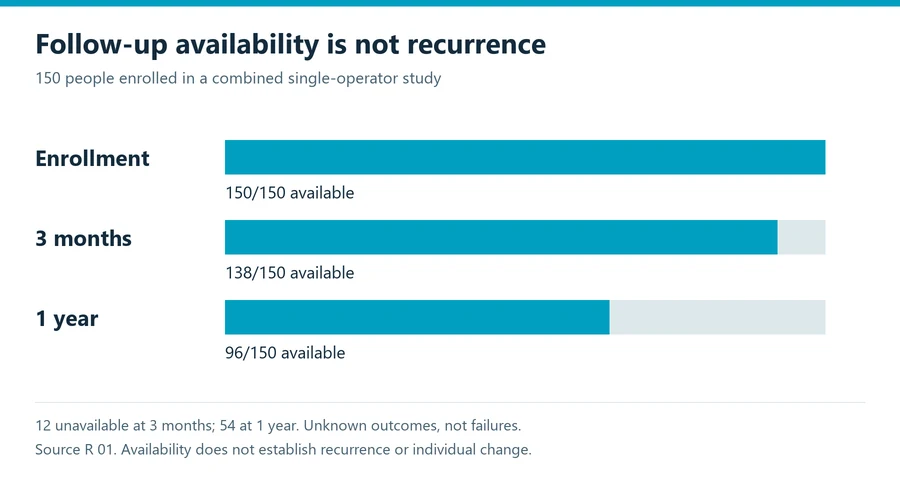
An original prospective study published in the October 2016 issue enrolled 150 consecutive neck-lift patients treated by one surgeon. Assessments were available for 138 at three months and 96 at one year. At one year, reported satisfaction was 76%, while 52% had no anterior skin excess and 55% had no band recurrence. The operation combined several components, so these observations are not results for every isolated platysmaplasty. Original prospective neck study
A follow-up percentage needs its assessment denominator
The study illustrates why satisfaction and anatomical findings should remain separate. Someone’s overall evaluation and a clinician’s assessment of one feature answer different questions. They should not be merged into a single success rate. Equally, the number assessed at a later visit should not disappear from a chart simply because the original enrollment number was larger.
A supporting chart can show enrollment and the two follow-up counts. It should make unavailable assessments visible rather than coloring them as failure or success. Changing denominators also limit how confidently a reader can interpret a change between visits. A difference between reported percentages is not automatically a paired change measured in the same complete group.
A 2017 study discussed another approach and compared results with an earlier technique. Its abstract reports comparative band and skin findings, but does not provide every endpoint denominator needed for a clean person-count plot. This guide does not turn an abstract comparison into a universal technique winner or an individualized prediction. Original comparative neck technique study
| Evidence question | Useful contribution | Limit to preserve |
|---|---|---|
| Do bands and satisfaction match? | Separate observed patient-reported and anatomical endpoints | They are not one success measure |
| How complete is follow-up? | Enrollment and assessed counts at each visit | Missing assessments are not known outcomes |
| Does a different technique prove superiority? | A defined observational comparison | Technique, selection and endpoint denominators require scrutiny |
Newer evidence does not erase study-design limits
A newer original study was published online in June 2025 and in the February 2026 issue. It followed 80 patients for one year after a combined primary facelift and muscle-directed approach that included intentional denervation. It reported recurrence, complications and satisfaction. Because it was a descriptive combined-treatment cohort, it does not isolate the effect of platysmaplasty or prove that this approach is preferable for everyone. Original newer combined neck cohort
The practical question is whether the evidence matches the recommendation being made to you. Does it involve a primary or revision operation? Which components were combined? Were outcomes assessed at rest, during expression or using another specified method? Was the endpoint band recurrence, skin contour or overall satisfaction? A paper concerning the neck can still answer a different question from your own.
Ask the clinician to explain the limitations as well as the favorable findings. No observed major complication in a small cohort is not proof that a risk cannot occur. A high satisfaction score is not a guarantee of a particular band appearance. These distinctions allow evidence to inform a decision without turning a study conclusion into a promise.
Plan the consultation around findings and priorities
ASPS recommends discussing goals, health history, medicines, prior surgery and anesthesia during a neck lift consultation. Bring accurate records of previous facial or neck treatment, including nonsurgical treatment. Explain any symptoms or concerns alongside your appearance preferences. The clinician’s assessment should determine what additional information is needed. ASPS neck consultation guidance
Write down the concern first, the findings second and the recommendation third. Keeping those steps separate helps prevent a technique name from becoming the presumed answer before examination. If the recommendation changes after the assessment, record why. A useful consultation leaves you able to explain the purpose and limits of the proposed treatment in ordinary language.
Discuss what you want preserved as well as what you want changed. A natural familiar neck and lower-face appearance can be a priority without requiring an idealized angle or contour. Ask how the proposed plan accounts for those boundaries. Choosing to investigate, wait or decline does not require you to prove that the feature is abnormal.
Risks belong to the complete plan
ASPS neck lift guidance lists concerns including bleeding, infection, altered sensation, poor healing, prolonged swelling, unfavorable scars and possible revision. It also discusses nerve injury that can affect lower-lip strength. These are broad risk categories, not personal frequencies for every muscle technique. Ask which apply to the actual components of your plan and how the team would recognize and manage a problem. ASPS neck surgery safety guidance
Distinguish general surgical risks from contour disappointment or recurrent bands. Both matter, but they need different explanations. Ask how the practice defines an additional procedure, a revision and ordinary follow-up care. Clarify who assesses a concern and which expenses may be billed separately. An offer of revision does not establish that every unwanted change can be reversed exactly.
If several procedures are combined, request a coordinated discussion of the overall plan rather than separate reassuring labels for each component. Ask what would lead the clinician to reduce the scope, stage treatment or advise against surgery. The goal is to understand the recommendation and uncertainty, not to collect a checklist of technique names.
Recovery advice for the neck is not an eyelid routine
ASPS neck lift recovery guidance specifically warns against applying ice to the neck because of concern about blood flow and skin injury. Do not copy a cold-compress routine from an eyelid procedure onto a neck operation. Follow the treating team’s instructions for the actual surgery, particularly when procedures in different regions are combined. ASPS neck recovery instructions
Request written directions for positioning, wound care, dressings, drains if used, medicines and follow-up. Confirm how those directions fit with instructions for any other procedure. Ask when driving, work, lifting and exercise may resume and what conditions would change that advice. One social-downtime estimate does not authorize every activity.
Make the support plan concrete. Who will provide transport, help with ordinary tasks and assist with attending follow-up? How will you contact the team outside routine hours? If you are traveling for treatment, arrange assessment and contingency care before booking the return journey. These responsibilities are part of the decision rather than details to improvise afterward.
Preparation requires coordinated instructions
ASPS describes preparation as potentially involving testing, medical evaluation and medication adjustments. Give the team a complete list of prescriptions, supplements and other relevant treatment. Do not stop a prescribed medicine independently after reading a general preparation page. Ask which clinician is responsible for coordinating any changes. ASPS neck preparation guidance
Confirm the surgical setting and the planned pathway after surgery. Ask whether the actual plan changes your need for home support or observation. A decision about muscle work should be considered alongside the anesthesia and other components, not as an isolated technical choice. Record unresolved requirements so they do not become assumptions when scheduling treatment.
Avoid purchasing an aftercare package solely because it is marketed for neck lifting. Ask which garments, supplies or treatments are actually recommended for your plan and who will provide instructions. Optional products should remain distinct from clinical requirements. A commercial bundle is not evidence that every patient needs the same routine.
Compare costs for the named components
The ASPS cost page provides a general neck lift surgeon fee and explains that anesthesia, facilities and related expenses are excluded from that average. It does not establish a dated national total for isolated platysmaplasty. This guide therefore does not convert the general fee into a muscle-procedure price or a complete bill. ASPS neck fee scope
| Quote component | Obtain a written explanation | Keep separate from |
|---|---|---|
| Muscle and other surgical components | What exact work and regions are included? | A generic neck-lift package label |
| Anesthesia and facility | Included amounts or separately billed estimates | Surgeon fee alone |
| Aftercare and follow-up | Supplies, medicines and visits included | Optional purchases |
| Additional treatment | Policy and possible expenses for problems or dissatisfaction | A guarantee of free revision or reversal |
Compare scope before comparing totals. Mark unanswered amounts as unknown rather than zero, and include your personal travel and support expenses separately. If an injection alternative is discussed, compare its actual treatment and follow-up obligations rather than assuming a temporary product cost and a surgical total cover the same endpoint.
Assess progress against the original task
ASPS notes that swelling can obscure a neck lift result and that outcomes are not guaranteed. Agree on the assessment schedule and how band appearance, skin contour and your experience will be recorded. Consistent posture, views and expression help make photographs useful without treating every early image as a verdict. ASPS neck result guidance
Keep the original task visible. Was the priority a band at rest, a contour concern during expression, loose skin or a combined goal? Which features were outside the treatment scope? Assessing those questions separately prevents a favorable overall impression from hiding an unresolved feature, and prevents an untreated region from being mistaken for failure of a different task.
A sound platysmaplasty decision connects the muscle target to an actual examination, a named complete plan, relevant evidence and practical follow-up. Use the facelift guide for broader face-and-neck context, the cost planning guide to organize quotes and the surgeon finder to begin qualification checks. A technique name alone cannot supply those answers.
Keep a band-assessment record separate from the overall photograph
For a band-focused goal, request documentation that makes the assessment condition clear. Is the finding being evaluated at rest or during a particular expression? A photograph taken in one condition should not be casually compared with a different condition at the next visit. The clinician should define how the feature will be assessed; you should not repeatedly strain or manipulate the neck to create your own testing protocol.
Keep the condition and date attached to each observation. Then record skin contour and your overall experience separately. This makes it possible to discuss a result precisely: satisfaction with the overall contour can coexist with a remaining band concern, while a favorable band assessment does not automatically resolve every skin goal. Treating the endpoints separately avoids both overstating success and dismissing a meaningful improvement.
When reviewing a study or treatment example, apply the same discipline. Identify the operation, the assessed feature, the observation time and how many people contributed data. If an example shows only an early static photograph, do not infer a one-year movement-related endpoint. If a report includes combined procedures, do not assign the visible change to muscle work alone. This record is a communication tool for understanding evidence and discussing the agreed target; it is not a home examination or a personal risk calculation.
Sources and review scope
Plastic Surgery Editorial Team. Source records checked through October 12, 2026. Review scope: source and editorial checks for general education. No individual clinical assessment is represented.
- Original prospective combined neck cohort. pubmed.ncbi.nlm.nih.gov. Source date: 2016-10. Checked 2026-10-12.
- Original lateral versus earlier full-section comparison. pubmed.ncbi.nlm.nih.gov. Source date: 2017-02. Checked 2026-10-12.
- Original newer combined rhytidectomy cohort. pubmed.ncbi.nlm.nih.gov. Source date: 2025-06-02. Checked 2026-10-12.
- FDA Botox Cosmetic label. accessdata.fda.gov. Source date: 2024-10. Checked 2026-10-12.
- ASPS neck scope. plasticsurgery.org. Publication/update date not stated. Checked 2026-10-12.
- ASPS neck recovery. plasticsurgery.org. Publication/update date not stated. Checked 2026-10-12.
- ASPS neck cost. plasticsurgery.org. Publication/update date not stated. Checked 2026-10-12.
- ASPS neck consultation. plasticsurgery.org. Publication/update date not stated. Checked 2026-10-12.
- ASPS preparation. plasticsurgery.org. Publication/update date not stated. Checked 2026-10-12.
- ASPS neck safety. plasticsurgery.org. Publication/update date not stated. Checked 2026-10-12.
- ASPS neck results. plasticsurgery.org. Publication/update date not stated. Checked 2026-10-12.