
Panniculectomy cost requires two separate questions: what the clinical plan includes and what your specific insurer will actually cover. A covered component can still leave deductibles, coinsurance and personal expenses. An additional noncovered service remains a separate financial commitment. Do not apply one coverage percentage to an entire mixed quote simply because the procedures might occur during the same visit.
This guide uses an original hypothetical allocation worksheet to keep those categories separate. It does not determine medical necessity, guarantee coverage or recommend adding cosmetic surgery. Its dollar amounts are invented inputs, not national prices or actual insurer benefits. Obtain the surgeon’s assessed plan, the insurer’s written benefit information and a reconciled estimate from every relevant billing entity before treating a number as your personal expected liability.
Is there an authoritative national panniculectomy cost average here?
The ASPS panniculectomy cost page, checked October 12, 2026, gives no numeric national average. It says fees vary and insurance may cover the procedure in some circumstances, with advance insurer consultation advised. This guide therefore does not manufacture a national range from unrelated abdominal operations or assign a fee year to an unpublished average.
ASPS lists possible professional, facility, anesthesia, medication, garment and testing expenses. Their relevance and inclusion depend on the actual plan. A surgeon’s fee alone is not necessarily the complete clinical price. Likewise, a hospital estimate may omit a separately billing professional. Ask which entities bill, what each estimate covers and whether an amount is a cash charge, billed charge, insurer-allowed amount or estimated patient responsibility.
An advertised tummy tuck price should not replace missing panniculectomy data. The ASPS procedure overview describes removal of hanging lower-abdominal skin and fat and distinguishes panniculectomy from a tummy tuck, in which abdominal muscle tightening may be part of the scope. These are different tasks. That distinction does not determine your eligibility or imply that every combined plan has the same billing arrangement.
Why panniculectomy cost can contain covered and noncovered components
A clinical plan can be discussed alongside an additional service without that addition acquiring the first service’s coverage status. Ask the surgeon to describe what is being proposed and the insurer to identify what it will consider under your policy. Do not assume a reconstructed label, shared incision or same-day setting makes every charge covered. Coverage information needs the actual service description and the actual plan, not a marketing package name.
If an additional cosmetic component is proposed, request its separate price and any associated changes to professional, anesthesia or facility charges. Do not assume those related charges are all covered because the main procedure may qualify. Equally, do not add an entire second facility bill if the office confirms a shared charge. The useful task is allocation: which actual services generate each expense, and who is expected to pay that line?
The surgeon’s assessment and the insurer’s benefit determination answer different questions. A procedure can be clinically appropriate while coverage remains denied or unresolved. An authorization may have conditions and should not be treated as a blanket guarantee of every final claim payment. Ask what the insurer’s particular document does and does not establish. Save its reference, date and scope rather than substituting general statements about what insurance usually does.
Which numbers belong in a panniculectomy cost worksheet?
The HealthCare.gov allowed-amount definition distinguishes the plan’s recognized amount for a covered service from a provider’s charge. Those numbers should not be used interchangeably. If the insurer supplies an estimated allowed amount, label it that way and identify the covered services it includes. A quoted cash package is a different pricing basis and cannot automatically be substituted into a coinsurance calculation.
| Amount type | What it describes | Question to resolve |
|---|---|---|
| Provider’s billed charge | What an entity submits or lists | Is this also the cash price? |
| Estimated allowed amount | Plan’s recognized amount for specified covered services | Which entities and services are included? |
| Remaining deductible | Applicable deductible still unpaid at the estimate date | Is this current for the planned service? |
| Coinsurance | Percentage under the applicable covered-benefit rules | What amount does it apply to? |
| Noncovered service charge | Separate excluded obligation if selected | Are all related additional charges included? |
| Personal logistics | Your own transport, support and other planning needs | Which actual costs can you identify? |
Do not use the provider’s headline charge to calculate patient responsibility if the insurer says a different allowed amount applies. Do not apply coinsurance to a separate excluded purchase without an actual benefit basis. Keep unknown entity charges in a visibly unresolved section. A worksheet with honest blanks can be more useful than a confident total made by assuming every missing item costs zero.
Original panniculectomy cost worksheet: a mixed-service allocation
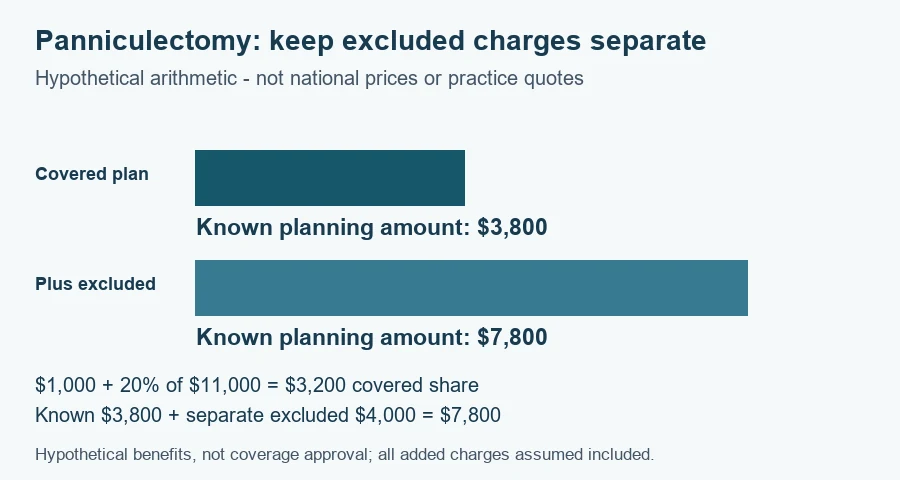
Assume, solely for the example, that specified covered services have a combined insurer-allowed amount of $12,000. Suppose the applicable remaining deductible is $1,000 and the patient then owes 20% coinsurance on the remaining allowed amount. Assume no other applicable cap or copayment changes the calculation and no additional covered entity is missing. These are hypothetical benefit rules, not a determination for any reader.
Under those inputs, the remaining amount after the deductible is $11,000. Twenty percent is $2,200. Add the $1,000 deductible to obtain $3,200 of modeled covered-service responsibility. Now add a hypothetical $600 of identified personal logistics to produce $3,800 of known planning spending. Keep that $600 outside the covered-service formula; the example does not assert that these personal costs are reimbursable or count toward insurance limits.
If a separately priced, noncovered additional service is selected for $4,000, the known planning amount becomes $7,800. That $4,000 is assumed to include all additional related charges for the fictional add-on; if a real quote does not include them, it remains incomplete. Selecting it does not change the example’s $3,200 covered-service calculation. It changes the separate noncovered commitment. No clinical benefit or suitability is inferred from either choice.
| Hypothetical input or result | Covered plan only | With separate noncovered service |
|---|---|---|
| Allowed amount for specified covered services | $12,000 | $12,000 |
| Remaining deductible | $1,000 | $1,000 |
| Coinsurance on remaining $11,000 | $2,200 | $2,200 |
| Modeled covered responsibility | $3,200 | $3,200 |
| Identified personal logistics | $600 | $600 |
| Separate noncovered additional service | $0 | $4,000 |
| Known planning amount | $3,800 | $7,800 |
The arithmetic is $1,000 plus 20% of $11,000, then $600 of external planning, then any selected noncovered charge. Applying 20% to the combined $16,000 would incorrectly treat the excluded $4,000 as though the same covered-benefit rule applied. That shortcut produces a different number without any source for the assumed coverage. The example’s central lesson is to preserve the covered and excluded bases before calculating a percentage.
How do deductible changes affect panniculectomy cost?
The HealthCare.gov coinsurance explanation describes a percentage paid for covered care after the deductible. The worksheet follows that limited structure. Your actual plan may have additional rules, and the applicable deductible balance can change between an estimate and the service. Ask the insurer to update the inputs rather than assuming the balance recorded months earlier is still correct.
In the same fictional $12,000 allowed-amount model, an already met deductible would leave 20% of $12,000, or $2,400, before external spending. With the original $1,000 remaining deductible, covered responsibility is $3,200. The difference is $800, not $1,000, because paying the deductible also reduces the amount to which the example’s coinsurance applies. This sensitivity calculation is separate from the base chart and assumes every other rule remains unchanged.
If a real remaining deductible exceeds the relevant allowed amount, do not use a formula that creates negative post-deductible spending. Obtain the insurer’s actual estimate and applicable rules. Likewise, do not presume a favorable out-of-pocket limit applies to every charge. A broad deductible figure alone cannot establish the final responsibility for multiple separately billing entities or a mix of covered and excluded services.
Does an out-of-pocket limit cap all panniculectomy cost?
The HealthCare.gov out-of-pocket-limit definition explains limits in relation to covered in-network care and identifies expenses that do not count, including services the plan does not cover. Therefore, an assumed covered-care limit should not be applied to the worksheet’s separate excluded service or personal logistics. Obtain the specific plan’s rules and current accumulator information for your circumstances.
The chart deliberately does not calculate a cap because no hypothetical cap is supplied. Adding one without defining its applicability would make the model look more complete while concealing uncertainty. If your insurer supplies a relevant remaining limit, apply it only to the expenses it says qualify. Ask separately about network status, entities involved and charges outside that protection. This guide does not determine legal balance-billing protections or network eligibility for you.
An estimate saying “insurance approved” is not an explanation of what counts toward your limit. Request an itemized benefit estimate and clarification of any excluded lines. If a cosmetic addition is payable separately, ask how the office keeps its contract and billing distinct from the covered component. Clear separation helps you see the actual discretionary commitment without implying that an insurer is responsible for it.
How should shared facility and anesthesia charges be allocated?
Ask each relevant billing office how its estimate handles a mixed plan. A shared setting does not automatically mean the entire facility and anesthesia charge is covered, nor does it mean a full additional bill is inevitable. Request the actual allocation method and resulting estimate. Do not invent a proportion from the procedures’ advertised prices or the time you guess each one will take.
For example, the fictional $4,000 additional-service charge is only complete because the model explicitly assumes all incremental related expenses are included. If a real estimate lists $4,000 for the professional component alone, additional facility or anesthesia obligations may remain unresolved. Mark that quote incomplete until clarified. Calling the professional component an all-in add-on would convert an unknown into a misleading budget number.
| Billing question | Evidence to request | Avoid this shortcut |
|---|---|---|
| Which services are covered? | Insurer’s specific written scope | Applying one approval to the whole package |
| Who bills separately? | Entity-specific estimates | Assuming one office quote covers everyone |
| How is an additional service allocated? | Written professional and related charges | Inventing a percentage of shared time |
| What is still unknown? | Clearly identified unresolved lines | Entering missing costs as zero |
| What changes if the plan changes? | Revised clinical scope and benefit estimate | Carrying forward an obsolete authorization |
If the surgeon changes the proposed scope after assessment, update the coverage request and financial estimate together. A previous document may describe a different task. Keep dated versions so you can trace the basis for each estimate. This is also useful when a final claim or invoice differs: you can identify whether the difference concerns scope, an allowed amount, an included entity or an excluded purchase.
What if insurance does not cover the proposed panniculectomy?
Request a complete cash estimate for the actual assessed procedure rather than reusing the covered-benefit formula. Clarify professional, facility, anesthesia, prescribed care and follow-up inclusions. Ask whether a deposit is credited, which services can change the amount and what cancellation or postponement terms apply. A cash price and an insurer-allowed amount are different figures; neither automatically proves the other is inflated or a bargain.
If financing is offered, obtain the actual payment schedule, fees and conditions. A monthly payment is not the complete procedure price. Compare the total contractual payment with the cash estimate for the same scope and retain any conditions that change repayment. This guide does not assume a loan rate or recommend borrowing. A suitable decision may be to wait or seek clarification rather than commit to an unaffordable or unresolved plan.
Avoid interpreting lack of coverage as evidence that the procedure is unnecessary, or possible coverage as evidence that it is suitable. Clinical assessment and benefit rules remain distinct. For broader context, see the panniculectomy guide. The cost worksheet is a financial organization tool; it does not establish a diagnosis, authorize surgery or replace the insurer’s current policy.
How do advance payments relate to the final panniculectomy cost bill?
An advance patient payment is not a second expense if it is credited against the same final obligation. Ask the billing office to identify which service and entity receive the payment, whether it is an estimate of covered responsibility or a separate excluded-service deposit, and how it will be reconciled. Keep the receipt with that entity’s estimate. Sending a payment to one office does not establish that a separately billing entity has also been paid.
For example, suppose you pay a hypothetical $1,500 advance against the worksheet’s $3,200 modeled covered responsibility. If the final obligation is exactly $3,200 and that entire advance is credited, the remaining balance is $1,700. Total paid toward that obligation remains $3,200. Adding the $1,500 advance to the full $3,200 again would double count the same payment. This arithmetic does not predict what an insurer will ultimately adjudicate or require an office to collect that amount.
If an advance instead belongs to the separate excluded service, retain it in that service’s own ledger. Do not deduct it from the covered responsibility merely because both procedures share an appointment. Record the covered and excluded contracts, payments and remaining balances independently, then combine actual cash obligations for household planning. This keeps a credited deposit from hiding a remaining bill elsewhere.
After claims are processed, compare the insurer’s explanation with the entity’s invoice and your payment receipts. Ask for reconciliation where descriptions or amounts differ. Identify the exact service, allowed amount, patient responsibility and payment already credited. An explanation of benefits is not automatically a request to pay a second time. Resolve uncertainties with the insurer and billing entity before assuming the original estimate was either a guaranteed final amount or an additional bill.
Frequently asked panniculectomy cost questions
Is a tummy tuck average a substitute for panniculectomy cost data?
No. ASPS distinguishes the procedures, and its checked panniculectomy cost page supplies no numeric average. Obtain an estimate for the actual assessed scope. Importing another operation’s fee creates an unsupported national price, even if both involve the abdomen. Keep any additional procedure separately named and priced instead of merging its fee into a supposedly representative average.
Does coverage mean I will pay nothing?
Not necessarily. Applicable deductible, coinsurance, entity charges and personal expenses need to be resolved. In the fictional worksheet, covered responsibility is $3,200, with another $600 of identified external planning. Those inputs demonstrate a method, not your benefits. Request the insurer’s actual current estimate for the specified services and confirm which entities it includes.
Why does the noncovered addition increase spending by the full $4,000?
Because the example explicitly treats that amount as a separately payable excluded charge, with all incremental related expenses assumed included. It has no supplied coverage benefit. Applying the covered component’s 20% rate to it would invent a benefit. A real additional service may have different scope and pricing, so confirm its complete amount before entering it.
What is the next step in clarifying panniculectomy cost?
Obtain three aligned descriptions: the assessed clinical plan, the insurer’s specific benefit scope and the billing entities’ estimates. Separate allowed amounts, covered responsibility, excluded services and personal logistics. Preserve unknowns and dated revisions. That produces a meaningful panniculectomy cost worksheet without manufacturing a national average or treating a mixed package as though one coverage rule applied to every line.
Sources and review scope
Plastic Surgery Editorial Team. Source records checked through October 12, 2026. Review scope: source and editorial checks for general education. No individual clinical assessment is represented.
- ASPS panniculectomy fee and coverage scope. American Society of Plastic Surgeons. Publication/update date not stated. Checked 2026-10-12.
- ASPS panniculectomy procedure distinction. American Society of Plastic Surgeons. Publication/update date not stated. Checked 2026-10-12.
- HealthCare.gov allowed amount definition. HealthCare.gov. Publication/update date not stated. Checked 2026-10-12.
- HealthCare.gov coinsurance definition. HealthCare.gov. Publication/update date not stated. Checked 2026-10-12.
- HealthCare.gov covered-care limit scope. HealthCare.gov. Publication/update date not stated. Checked 2026-10-12.