
Otoplasty cost should identify the assessed ear or ears, the intended correction and the related charges for that particular appointment. A one-ear quote is not necessarily half a two-ear quote because some charges may be shared. Equally, a two-ear proposal is not automatically better value or appropriate. Clinical assessment determines the task; an itemized estimate explains how the charges relate to it.
This guide offers an original hypothetical shared-charge worksheet. It separates an illustrative professional component from facility, anesthesia, assessment, care and personal logistics. All example amounts are invented arithmetic inputs, not actual clinic quotes or complete national averages. The model does not recommend treating a second ear, determine candidacy or promise symmetry. Its purpose is to reveal the financial denominator when two estimates name different scopes.
What does the published otoplasty cost average include?
The ASPS ear-surgery cost page, checked October 12, 2026, displays a $4,625 average for cosmetic otoplasty. It identifies a partial figure excluding anesthesia, operating-room facilities and other related expenses. The underlying fee year is not verified here. Treat that observation as partial fee context rather than a current complete national price or your likely bill.
The page does not establish a per-ear price or a formula for dividing its average by two. It does not specify the clinical mix behind the displayed amount in enough detail to reconstruct a one-ear estimate. Nor does it provide a tariff for adding a second ear to an existing operation. Ask for a written estimate based on your actual assessment instead of multiplying or dividing the published figure into a personalized forecast.
The ASPS page identifies professional, facility, anesthesia and other possible expenses. Which of those apply, how they are billed and what they include must be clarified for the actual plan. A quoted professional component may be lower than the displayed average while the complete known obligation is higher after related charges. Comparing one complete estimate with a partial average cannot establish that an office is expensive or unusually cheap.
Why otoplasty cost must identify one ear or both ears
The ASPS procedure overview discusses protruding ears occurring on one or both sides and describes ear surgery as individualized. That supports asking which side or sides are being assessed. It does not establish that both ears should always be treated, that an unaffected ear needs surgery or that a one-ear correction can deliver a guaranteed matched appearance.
Write down the proposed correction for each ear separately. A bilateral plan may involve different tasks on the two sides rather than the same task repeated. A revision proposal may also differ from an initial correction. Ask the surgeon to explain the intended changes and realistic limitations. Then ask the billing office which line items relate to professional work on each side and which relate to the shared appointment.
Do not use the model to select surgical scope. Its lower incremental amount for a second ear is an invented billing relationship, not an incentive to add an operation. If only one ear is clinically proposed, obtain that estimate. If two ears are proposed, ask why and request the complete plan. A calculation can clarify the quote but cannot evaluate the anatomical reason for changing it.
Which otoplasty cost charges may be shared?
Some charges can reflect an appointment or setting rather than a simple count of ears. Ask about the actual facility pricing rule, anesthesia estimate, assessment charge, specified follow-up and supplies. A fixed appointment charge may be shared in one estimate, while another setting uses time-based amounts or a different minimum. Do not assume that the shared amounts in the hypothetical worksheet remain constant in your plan.
The ASPS consultation page describes discussing health, goals and treatment options during assessment. Those discussions precede a useful financial comparison. Ask what information the office needs before confirming the proposed scope and related amounts. An advertised ear-pinning package may not yet address your particular anatomy, prior surgery or the difference between the two sides.
| Otoplasty cost component | Question for an actual estimate | Record |
|---|---|---|
| Professional work | Which ear and correction does this amount cover? | Assessed side and task |
| Facility | Is the amount fixed or dependent on time or scope? | Pricing basis and issuing entity |
| Anesthesia | What does the quoted amount include? | Estimate basis and adjustment rule |
| Assessment | Is it separate, included or credited once? | Actual payable amount or credit |
| Specified care | Which appointments or supplies are included? | Named inclusion boundary |
| Personal logistics | Do arrangements change with the assessed plan? | Your own verified inputs |
A shared charge is not necessarily an unavoidable fixed charge for every person. It is simply a charge treated as common to the two invented scenarios below. Ask whether your office’s actual estimate uses that relationship. If a longer proposed task changes facility or anesthesia obligations, enter the additional amount rather than treating it as free because the booking already exists.
Original otoplasty cost worksheet: shared charges and the increment
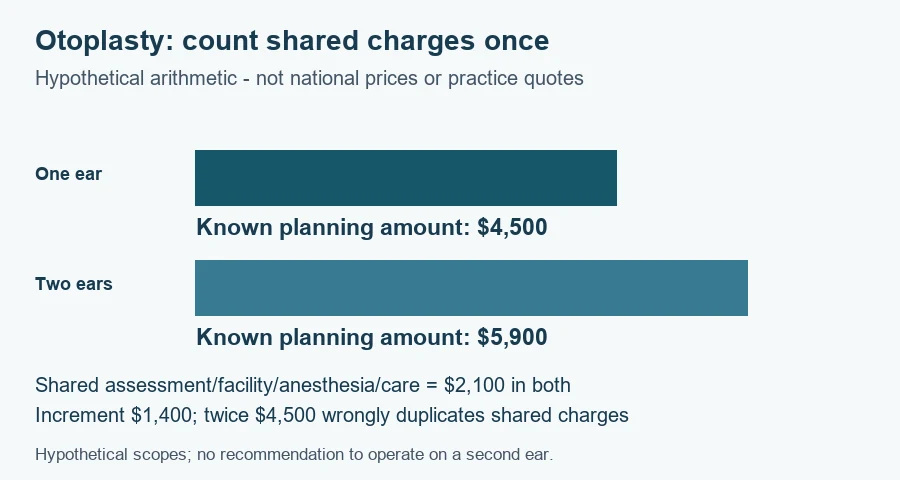
Assume a hypothetical one-ear professional component of $2,200 and a hypothetical two-ear professional component of $3,600. Both scenarios contain an assessment charge of $200, facility amount of $1,200, anesthesia amount of $600 and specified care of $100. Those four shared lines total $2,100. Both also contain $200 for personal logistics. No real office policy or usual clinical setting is implied.
The one-ear known planning total is $2,200 plus $2,100 plus $200, or $4,500. The two-ear known planning total is $3,600 plus $2,100 plus $200, or $5,900. Under the explicit assumptions, the added obligation is $1,400. It is the difference between the professional components because every other entered amount remains unchanged. If an actual related charge changes, this particular result no longer applies.
| Hypothetical component | One-ear assessed scope | Two-ear assessed scope |
|---|---|---|
| Professional | $2,200 | $3,600 |
| Assessment | $200 | $200 |
| Facility | $1,200 | $1,200 |
| Anesthesia | $600 | $600 |
| Specified care | $100 | $100 |
| Personal logistics | $200 | $200 |
| Known planning total | $4,500 | $5,900 |
Twice the one-ear total would be $9,000, which incorrectly duplicates every shared line under these assumptions. Half the two-ear total would be $2,950, which incorrectly removes half the appointment and logistics charges when estimating one ear. Neither shortcut represents the documented one-ear scenario. The correct total follows its actual components, not a division of a different scope’s headline.
The $1,400 increment is approximately 31.11% of the one-ear total. That percentage is not a national bilateral surcharge or a prediction of your office’s pricing. It merely describes this model. The most useful output is the list of lines that must stay unchanged for the increment to hold. When a real estimate differs, change the inputs and recompute rather than preserving the percentage as a rule.
How can an otoplasty cost sensitivity check expose hidden changes?
Suppose the actual two-ear proposal adds $300 of facility charges and $200 of anesthesia charges beyond the invented shared amounts. Its known planning total becomes $6,400. The increment over the original $4,500 one-ear scenario is now $1,900, not $1,400. This is another hypothetical sensitivity test, not a prediction that a bilateral operation takes a particular additional time or requires a particular anesthesia approach.
The $500 difference between those two increments identifies the added related charges. Reporting only the professional increase would understate the complete incremental obligation by that amount. Ask the office to explain whether the related charges are confirmed or provisional and which event could change them. A useful quote distinguishes a professional scope adjustment from the setting’s financial consequences instead of describing all of it as an “extra ear” fee.
| Increment test | Additional professional | Additional related charges | Total increment |
|---|---|---|---|
| Shared lines remain unchanged | $1,400 | $0 | $1,400 |
| Facility and anesthesia also change | $1,400 | $500 | $1,900 |
| A line is not yet confirmed | Actual amount needed | Pending | Complete increment unknown |
Do not fill a pending line with the worksheet’s assumption to produce a confident total. If the office cannot yet confirm anesthesia or facility scope, record the professional difference and keep the complete increment unresolved. You can still make progress by asking who issues the missing estimate and when it can be confirmed. An honest unknown is more useful than a precise number assembled from unrelated documents or invented practice norms.
How should a credited assessment fee affect otoplasty cost?
The worksheet counts the $200 assessment as a separately payable, uncredited amount in both scenarios. An actual office may use a different arrangement. If that payment is fully credited against a professional component already stated as an inclusive amount, adding it again would double count it. Ask for the exact inclusion and credit rule, not merely whether the consultation is described as “free” or “applied to surgery.”
For example, if the invented $2,200 professional amount already includes a credited $200 assessment payment, remove the separate $200 assessment line from the total. The complete one-ear obligation would be $4,300 under the remaining unchanged inputs, with $200 already paid and $4,100 remaining. If it is not credited, the original $4,500 total applies, with $200 paid and $4,300 remaining. These are mutually different assumptions; do not combine their favorable parts.
Keep the complete cost, prior payment and remaining balance in separate fields. A credited payment changes the balance and may change whether a line should be separately added, but it is not automatically a discount. The receipt should identify the entity receiving it and the bill to which it applies. A credit against a surgeon’s bill does not by itself pay a facility or anesthesia bill issued by another organization.
Can insurance be assumed in an otoplasty cost quote?
The ASPS cost page explains that most health plans do not cover elective cosmetic ear surgery and that some medically relevant procedures may have different coverage considerations. That general context does not decide a particular patient’s benefit, documentation requirements or reimbursement. Ask the actual insurer and relevant billing office about the specific assessed procedure rather than treating the word “ear surgery” as evidence of coverage.
Keep cosmetic reshaping separate from hearing-related or reconstructive tasks in the estimate. The ASPS overview specifically distinguishes protruding ears from hearing loss. A desired change in appearance does not, by itself, establish treatment of a hearing problem. If a clinical assessment identifies another concern, obtain the appropriate explanation and applicable financial documents. This guide does not supply diagnosis codes, authorize medical necessity or promise a successful claim.
If coverage is being investigated, maintain a separate self-pay estimate and any verified insured estimate with its own terms. Do not subtract an imagined reimbursement from the hypothetical total. An insurer’s general statement, a pending request and an actual written benefit determination are different evidence. Clarify the status, relevant entities and any patient obligations before using it in a comparison. For detailed policy questions, the controlling plan documents and insurer’s response matter.
Which practical expenses belong in otoplasty cost planning?
Personal arrangements can depend on the clinician’s actual instructions, the treatment setting and your circumstances. Transport, time away from paid work or caregiving arrangements should use inputs you can verify. The illustrative $200 logistics line is not a recommendation or an adequate universal allowance. Do not infer a standard return-to-work day, number of rides or need for accommodation from the financial model.
Ask what follow-up the actual clinical plan includes and which appointments would be separately billed. Check whether supplies named in the estimate are included, prescribed separately or merely optional. Necessary care should not be removed from the comparison because a lower headline looks attractive. The aim is to count the agreed obligations consistently, not reduce a spreadsheet total by omitting a part of the assessed plan.
If the two proposals require different personal arrangements, record those differences explicitly. A longer stay, a different location or a different visit plan can change practical spending even when professional prices match. Use the actual information available and identify pending assumptions. Do not allocate half a fixed transport bill to one ear merely because you are attempting a per-ear comparison; the relevant denominator is the arrangement that you must actually purchase.
How should revisions be kept separate in otoplasty cost comparisons?
Ask whether the estimate concerns an initial correction or a separately assessed revision. The ASPS overview includes adult dissatisfaction with previous ear surgery among the concerns discussed, but it does not assign a standard revision fee. Previous surgery can create a different clinical question. Do not assume that a historical one-ear bill establishes the price for further work on the same side, or that a current two-ear example predicts a revision obligation.
If an office describes a professional-fee waiver for some later work, obtain its actual scope and conditions. A waiver of professional charges does not automatically waive facility, anesthesia, assessment, supplies or personal arrangements. This guide does not estimate the likelihood of needing that work or add a speculative revision amount to your current bill. It asks you to identify what the written financial commitment does and does not cover.
Preserve separate dated estimates for separate assessments. A changed clinical task should have its own financial description rather than being hidden as a surcharge in the original comparison. If a concern arises after treatment, seek the appropriate clinical assessment; do not let the earlier worksheet determine what intervention you need. Financial recordkeeping supports understanding of the proposal, while the clinician addresses the actual medical and aesthetic concern.
Otoplasty cost questions before comparing offers
Is a one-ear operation half the bilateral price? Not necessarily. The model demonstrates why fixed appointment charges can make that shortcut wrong, while an actual estimate may use different rules. Ask for the specific professional and related amounts for the assessed one-ear scope. Dividing a bilateral headline cannot establish those amounts or whether the clinical plan is comparable.
Should I choose both ears because the increment looks small? A billing comparison does not justify extra surgery. The surgeon’s assessment and your informed goals determine the proposed task. The hypothetical $1,400 increment is useful only for understanding the model’s financial assumptions. It is not a recommendation to treat a second ear or a claim that doing so improves the outcome.
Can I compare the $4,625 published figure with the worksheet total? They have different denominators. The ASPS figure is a partial average with an unverified underlying fee year; the worksheet totals include invented related charges and logistics for explicitly labelled scopes. Neither is a complete current national estimate for you. Compare actual assessed proposals with matched inclusions instead.
For the clinical overview, see the otoplasty guide. For the financial decision, request a dated estimate naming each assessed side, the intended correction, all related charges, their pricing rules, actual credits and pending amounts. Recompute from those components. That approach preserves the distinction between a useful comparison of financial obligations and an unsupported per-ear price rule.
Sources and review scope
Plastic Surgery Editorial Team. Source records checked through October 12, 2026. Review scope: source and editorial checks for general education. No individual clinical assessment is represented.
- ASPS cosmetic otoplasty partial fee and coverage scope. American Society of Plastic Surgeons. Publication/update date not stated. Checked 2026-10-12.
- ASPS individualized ear and side assessment. American Society of Plastic Surgeons. Publication/update date not stated. Checked 2026-10-12.
- ASPS ear-surgery consultation scope. American Society of Plastic Surgeons. Publication/update date not stated. Checked 2026-10-12.