
Liquid rhinoplasty uses injectable filler to change the appearance of the nose by adding volume. It can camouflage selected contour irregularities, but it cannot remove a hump, make the nose physically smaller or repair an obstructed airway. In the United States, nasal filler injections are an unapproved use, and the FDA recommends against them. A short appointment or temporary material does not eliminate the possibility of serious harm. The useful decision begins with the exact change you want, the product and location being proposed, and the alternatives—including leaving the nose untreated.
This guide separates three questions that advertisements often combine: whether a profile can look different, whether someone feels more satisfied, and whether a treatment is appropriate despite its risks. Those answers require different evidence. A photograph can illustrate contour; a questionnaire records a person’s assessment; a regulator’s product indication describes a reviewed use. None replaces the others. A positive aesthetic study is not FDA approval for nasal injection. FDA filler indications and unapproved uses
Adding volume is different from reducing a nose
Think of the visible nasal profile as a line with elevations and depressions. Adding material beside a prominence may make that line look straighter while leaving the original prominence in place. That is camouflage through addition. Removing or restructuring tissue is a different intervention. The distinction matters when someone requests a smaller nose but is shown a smoother side view as the proposed answer.
ASPS describes liquid rhinoplasty as a treatment that works within existing anatomy, with possible changes to contour and definition. Its June 2026 explanation explicitly distinguishes the impression of a straighter profile from physical size reduction. A carefully framed goal therefore names the view and feature rather than promising an overall smaller nose. “Less noticeable irregularity in side profile” and “narrower nostrils from the front” are separate requests. ASPS explanation of additive nasal reshaping
Surgical rhinoplasty can address structural size, width, tip and nostril concerns. Breathing problems require examination of the structures involved in airflow; an attractive surface contour is not evidence that an airway obstruction has been corrected. The surgical option has its own risks and recovery, and it is not automatically the right choice. However, a treatment comparison should start from the same requested endpoint. Comparing filler camouflage with surgery intended to reduce size answers two different questions. ASPS rhinoplasty goals and airway evaluation
| Desired change | What must be distinguished | Evidence to request |
|---|---|---|
| A smoother side profile | Adding adjacent volume versus removing a prominence | Matched side views and an explanation of the actual contour task |
| A smaller or narrower nose | Physical reduction versus an optical change | Structural assessment and alternatives, not a filler simulation alone |
| Easier breathing | Airflow and internal structure versus external appearance | Functional evaluation independent of aesthetic satisfaction |
| Improvement after earlier surgery | Existing surgery and treatment history versus an untreated nose | Records and examination; evidence from untreated noses may not apply |
The table is a planning aid, not a selection algorithm. A person may have more than one goal. Keeping them separate makes it possible to recognize when a proposed treatment addresses only a secondary concern. It also makes choosing no procedure a concrete option rather than a failure to decide.
Read a profile comparison without changing the question
A useful photograph comparison keeps the head position, view, framing and lighting consistent. It identifies when each photograph was taken and whether other treatments were performed between them. A dramatic difference in shadow or camera angle can make an apparent contour change difficult to interpret. Request unedited images rather than assuming a dramatic social media transition isolates the effect of one intervention.
Then return to the original endpoint. If your concern is the front-view width, a side photograph cannot demonstrate that width changed. If the comparison shows a smoother bridge outline, it still does not document removal of the underlying prominence. A simulation can help name a desired contour, but it should be labeled as an illustration rather than a treatment result or a promise. The most useful visual discussion pairs the proposed change with what stays anatomically unresolved. That makes a limitation visible instead of burying it in a consent paragraph.
What “FDA-approved filler” does and does not mean
Approval belongs to a particular product and indication. A filler approved for another facial location does not acquire a nasal indication because it is familiar, supplied in a sealed syringe or commonly advertised. The relevant paperwork is the exact product’s labeling and the proposed anatomical use. Generic phrases such as “medical grade” or “approved ingredients” leave that relationship unanswered.
The FDA regulates dermal fillers as medical devices. Its consumer guidance advises against self-injection, buying fillers directly online and using needle-free injection devices. The agency distinguishes fillers from botulinum toxin drugs, which affect muscle activity rather than providing the same volumizing material. Mixing the words Botox and filler in a package description can obscure which product is being proposed. FDA consumer guidance on products and injection devices
Before evaluating a promotion, write down the product name, manufacturer, treatment location and claimed regulatory status as four separate fields. Ask which statement is supported by the label and which describes a use outside it. This record is useful even if you decline treatment: it allows a later clinician to understand what was discussed without relying on a screenshot saying only “nose enhancement.” A statement about practitioner experience is also separate from a statement about regulatory review.
Temporary does not mean harmless or guaranteed reversible
Hyaluronic acid is one filler material; other fillers have different composition and persistence. ASPS lists distinct material classes and explains that chemical makeup and physical properties vary. A product choice should not be reduced to a brand popularity contest. Knowing the material is necessary for discussing expected behavior, possible complications and the limitations of removal. ASPS descriptions of filler material classes
“Temporary,” “dissolvable” and “reversible” should not be treated as interchangeable guarantees. Ask what would happen if the contour were unsatisfactory, what additional intervention might be considered, and what consequences could remain even if material were reduced. The FDA notes that removal can be difficult or impossible for some materials and that additional procedures have risks. No marketing promise should turn a possible complication into an assumption that everything can simply be undone.
What original studies actually measured
Small original studies can help explain the difference between an aesthetic endpoint and a broad safety claim. They do not calculate an individual’s risk or establish that every product, anatomy and practitioner performs alike. The study design, who was enrolled, and who remained at follow-up matter as much as a headline percentage.
A Canadian prospective study enrolled 33 women and followed a specified hyaluronic-acid product. Its blinded aesthetic assessment and patient satisfaction questionnaire were different measures. At one month, all 32 assessed participants reported satisfaction; at eight months, 22 of 28 did. The paper first appeared online in July 2023 and was included in a February 2025 issue. It was a single-center study, with no untreated or surgical comparison group. Original prospective study and follow-up denominators
| Original research | Observed denominator or endpoint | Interpretation limit |
|---|---|---|
| Prospective 33-woman study | Satisfaction: 32/32 at month 1; 22/28 at month 8 | Changing assessed groups; not a guarantee for all enrolled patients |
| 2026 retrospective single-surgeon study | FACE-Q returned by 36/162 patients | Most patients did not return that questionnaire |
| Same retrospective study | 8/162 subsequently underwent surgery | Recorded progression does not establish permanent satisfaction among everyone else |
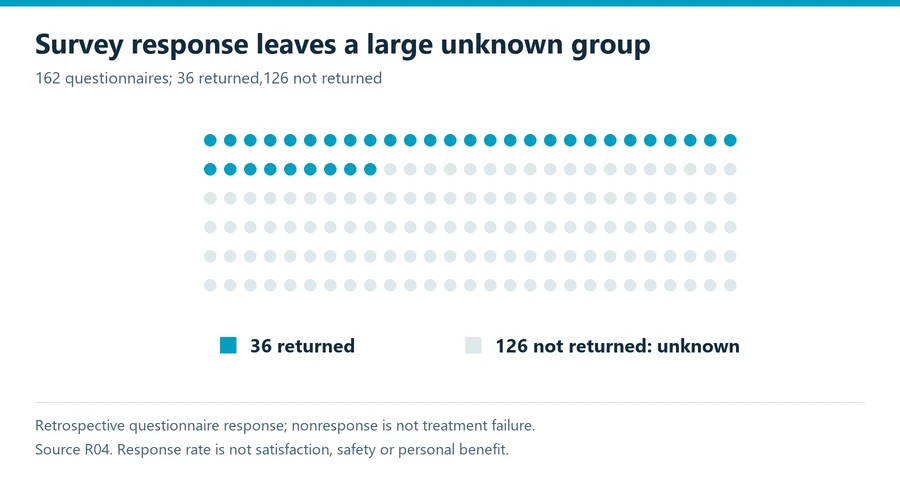
A separate study published in March 2026 reviewed 162 patients treated between 2019 and 2024. Only 36 returned FACE-Q questionnaires. Eight underwent subsequent surgical rhinoplasty. Its reported satisfaction average therefore describes respondents, not the entire group. The authors identified readiness for a more permanent result as an important motivation for surgery. Original retrospective satisfaction and progression study
Missing responses are not known outcomes. The response gap is visible without inventing a complication percentage: 162 minus 36 leaves 126 patients without a returned questionnaire in that report. Those missing responses cannot be assigned either satisfaction or dissatisfaction. Likewise, not having surgery during recorded follow-up is not the same as achieving every desired result. These are different outcomes with different reasons for missing information.
When reading a treatment claim, ask whether the denominator is people, visits, questionnaires or injection events. A person may have multiple treatments; an event count is not automatically a patient count. Ask whether follow-up was complete and whether the report applies to noses with previous surgery. The prospective study excluded important prior nasal procedures, so its findings should not be casually transferred to revision situations. The correct conclusion can be narrower than the authors’ promotional-sounding summary without dismissing the research.
Risks require an emergency plan, not reassurance alone
Filler complications include bruising, swelling, lumps, asymmetry, infection and unwanted correction. More serious complications can involve interrupted blood supply, skin injury or loss of vision. ASPS explains the relationship between a blocked vessel and the tissue affected. An absence of a serious event in a small cosmetic study does not establish that the event cannot occur. ASPS filler risks and vascular complications
For a reader, the important practical question is whether urgent symptoms would lead to an immediate medical response. A clinic’s preparedness should be discussed before any decision, including its after-hours contact and referral arrangements. A polished portfolio and a consent signature do not answer how an emergency is handled. Ask for the plan in ordinary language, including where you would go if the treating office could not provide the required care.
Seek immediate medical attention for unusual pain, vision changes, a white, gray or blue appearance of skin near an injection site, or signs of stroke during or shortly after treatment. Do not wait for a scheduled photograph review or try to correct the problem at home. This is the FDA’s urgent symptom guidance; it is not a home diagnostic test, and a reader should not delay care while deciding which complication name fits.
Keep the distinction between routine appearance concerns and urgent symptoms clear in your written instructions. “Contact us if unhappy with the shape” is not a substitute for instructions about visual or vascular symptoms. Nor should a claim that someone has never seen a complication be interpreted as evidence that they can recognize and manage one.
History and assessment are specific to the nose
The consultation should document prior nasal surgery, fillers, injuries and relevant facial treatments. Product records are particularly valuable when earlier filler is unidentified. Bring the date and location of treatment, the product name if available, and any subsequent symptoms or interventions. Do not guess a product because a clinic usually uses a certain brand.
ASPS recommends discussing medical conditions, allergies, medicines, supplements and previous minimally invasive treatments or surgery. Examination, measurements and photographs can support a discussion of available options and likely outcomes. These tasks are part of assessment, not proof that a preferred procedure must follow. ASPS filler consultation and treatment history
Prepare your own goal record before the appointment. Describe the feature in words, identify whether it bothers you in front view or profile, and state what you want to preserve. A reference photograph can start a conversation, but another person’s proportions are not a measurement of your anatomy. Ask whether the proposed additive change conflicts with another goal, such as wanting less projection. That question is more useful than requesting a standard amount of filler.
Questions about qualifications should include procedure-specific experience and handling complications, alongside current licensure and relevant credentials. ASPS also recommends asking about reasonable results, recovery, dissatisfaction and available alternatives. A directory listing or social media badge does not independently answer those questions. ASPS questions for a filler consultation
Recovery, durability and future surgery are separate timelines
An immediate contour is not necessarily the appearance after swelling settles. ASPS notes that early filler treatment can involve swelling, bruising, temporary redness, numbness and palpable areas, with recovery varying by product and patient. Arrange an individualized care plan before scheduling. Instructions about activity, touching the nose and follow-up should come from the treating clinician; generic social media massage advice is not an individualized recovery plan. ASPS recovery and early appearance
Durability also varies with the material and individual. General facial filler longevity is not a reliable expiration date for a particular nasal treatment. Ask how the clinician would distinguish fading correction from retained material or a new concern, and whether assessment is required before discussing another treatment. A scheduled subscription is a commercial arrangement, not evidence that retreatment is medically appropriate at that interval. ASPS variability of filler results
If surgery might be a future choice, preserve the original product and treatment records. Tell the surgical evaluator about every known nasal injection, even when the appearance seems to have faded. Do not assume that a cosmetic trial of filler is a perfect preview of structural surgery. The two approaches act differently, and a surgeon must assess the actual situation rather than an edited simulation. A future planning discussion should establish which records are needed and whether any additional assessment is appropriate, without promising a universal waiting period.
Compare complete costs rather than a single syringe price
ASPS explains that filler fees vary with the procedure, practitioner, time and location. Its general filler averages do not establish a complete liquid rhinoplasty price, and they are not used here as a nasal treatment estimate. Obtain a written description of what the quote covers and which possible later services are charged separately. ASPS filler cost factors
| Cost field | What to record | Why it changes the comparison |
|---|---|---|
| Initial assessment and treatment | Included services and exact product | A consultation fee and a treatment package may be separate |
| Review and adjustment | Timing, inclusion and decision process | A review does not necessarily include another treatment |
| Later maintenance | Individual reassessment and additional charge | An initial price does not describe long-term spending |
| Dissatisfaction or complication care | Available services, referral and financial terms | Cosmetic adjustments and urgent care are different tasks |
| Alternative treatment or no treatment | Separate assessment and complete scope | Equal prices do not imply equal goals, risks or durability |
For your own comparison, put each actual quote in the same columns. Do not assume the advertised price includes every service. If a cost projection uses future treatments, label the number of treatments as an assumption rather than a prescribed schedule. The honest calculation is the sum of quoted included charges plus separately identified services; unknown charges remain unknown. A lower initial figure can coexist with a different maintenance plan, and a higher price cannot guarantee freedom from complications.
A decision record that keeps the evidence in view
Before committing, write one short sentence for each of four fields: the desired change, the proposed mechanism, the regulatory status of the proposed use, and the unresolved concern. For example, a person seeking a straighter profile should still record that filler adds volume and that nasal use is unapproved. The record should not be softened into a general statement that “the product is approved.”
Add the source and date for any numerical claim being used to persuade you. If a satisfaction percentage is offered, ask who answered and when. If durability is promised, ask whether the supporting evidence concerns this product, location and patient group. If the answer changes from “everyone” to “respondents,” the narrower description is the one to retain.
Finally, give each option its own endpoint: changing surface contour, changing structure, investigating breathing, or accepting the current appearance. This avoids turning hesitation about surgery into automatic consent for an injection. A well-informed choice may be to seek further assessment, decline treatment or revisit a goal later. Liquid rhinoplasty should be evaluated as a particular medical intervention with particular limits, rather than as an effortless version of every change a nose operation can make.
For related reading, see the rhinoplasty guide, procedure cost planning and procedure library.
Sources and review scope
Plastic Surgery Editorial Team. Source records checked through October 12, 2026. Review scope: source and editorial checks for general education. No individual clinical assessment is represented.
- FDA exact indications and unapproved nasal use. fda.gov. Publication/update date not stated. Checked 2026-10-12.
- FDA consumer product/device distinctions. fda.gov. Publication/update date not stated. Checked 2026-10-12.
- Original prospective 33-woman trial. pmc.ncbi.nlm.nih.gov. Source date: 2023-07-12. Checked 2026-10-12.
- Original retrospective satisfaction and surgery progression. pubmed.ncbi.nlm.nih.gov. Source date: 2026-03-26. Checked 2026-10-12.
- ASPS original expert interview on additive reshaping. plasticsurgery.org. Source date: 2026-06-08. Checked 2026-10-12.
- ASPS structural and functional rhinoplasty scope. plasticsurgery.org. Publication/update date not stated. Checked 2026-10-12.
- ASPS material distinctions. plasticsurgery.org. Publication/update date not stated. Checked 2026-10-12.
- ASPS adverseevent and emergency preparedness. plasticsurgery.org. Publication/update date not stated. Checked 2026-10-12.
- ASPS treatment history and assessment. plasticsurgery.org. Publication/update date not stated. Checked 2026-10-12.
- ASPS procedure-specific questions. plasticsurgery.org. Publication/update date not stated. Checked 2026-10-12.
- ASPS recovery variability. plasticsurgery.org. Publication/update date not stated. Checked 2026-10-12.
- ASPS duration varies. plasticsurgery.org. Publication/update date not stated. Checked 2026-10-12.
- ASPS filler pricing factors. plasticsurgery.org. Publication/update date not stated. Checked 2026-10-12.
- Original publisher confirms firstonline and issue precision. journals.sagepub.com. Source date: 2023-07-12. Checked 2026-10-12.