
Nasal valve repair addresses an assessed valve-related contributor to nasal obstruction. It is not a diagnosis for every blocked nose, a synonym for cosmetic rhinoplasty or a promise that every breathing symptom will disappear. The useful decision identifies what the examination found, what treatment is proposed for that finding and whether other concerns need separate attention. A procedure name, device advertisement or online maneuver cannot supply that individual assessment.
Original controlled studies have evaluated different valve treatments, including temperature-controlled radiofrequency and a bioabsorbable support implant. These trials concern particular selected populations and protocols, rather than a universal repair technique. Ask the clinician to connect a proposed option to the actual findings and explain the alternatives, evidence limits and expected follow-up. Understanding that connection matters more than choosing the treatment with the most persuasive headline.
Describe the obstruction without assigning its cause
Record the situations in which breathing through the nose feels difficult. Note whether the experience is continuous or variable, whether one side seems more affected and which ordinary activities are limited. Mention previous nasal injuries, operations and treatments. These observations can help the clinician understand the history, but a symptom pattern or photograph does not establish that the nasal valve is the cause.
Bring details of treatment rather than only saying that a spray or device did not help. Record what was prescribed or used, how it was used and what changed. Let the clinician explain what that history means for the assessment. Do not stop, intensify or substitute medication as a home test of whether you need a valve procedure.
Define what meaningful improvement would look like in your own life. More comfortable nasal breathing during an ordinary activity is a clearer discussion point than expecting every congestion or sleep problem to vanish. Ask which expectations the proposed treatment can address and which require another evaluation. This makes the later assessment more useful than an undifferentiated statement that your breathing is better or worse.
Ask what the examination establishes
Request a plain-language description of the finding that supports the proposal. What area is involved, what is observed and how does that relate to your symptoms? If more than one contributor is identified, ask which treatment addresses each. Record the explanation without trying to select the anatomy or technique yourself from a diagram.
Discuss the difference between the valve-related work, septal work and any other nasal procedure being offered. The ASPS describes septoplasty as addressing the nasal septum, while rhinoplasty can concern shape and breathing-related changes. These descriptions help clarify the named components; they do not establish that one procedure necessarily includes the work required for a different examined finding. ASPS septoplasty scope ASPS rhinoplasty scope
If a combined or staged plan is suggested, ask why that sequence fits your case. What will be reassessed after the first component? Which later work is definitely planned and which is only a possibility? A useful explanation describes the actual relationship between findings and proposed treatment. It should not rely on the assumption that adding more named procedures automatically supplies a better answer.
| Planning question | Information to record | Shortcut to avoid |
|---|---|---|
| What limits daily life? | Symptoms, variability and affected activities | A symptom establishes one anatomical diagnosis |
| What did the examination find? | Site and clinician’s explanation | An online maneuver proves eligibility |
| What is proposed? | Named components and their purposes | Every nasal procedure does the same work |
| What else needs attention? | Separate concerns or contributing findings | Valve work resolves every blocked-nose complaint |
| How will it be assessed? | Outcome measure, visits and contact plan | A marketing success rate predicts your result |
Compare treatment options by purpose and commitment
If the discussion includes structural surgery, an implant or a device-based treatment, ask what each is intended to change in your case. Clarify the proposed setting, anesthesia, additional material or tissue work and follow-up. An office-based procedure and a combined operation may involve different commitments. Their labels alone do not determine effectiveness or suitability for an individual.
Ask what an option leaves untreated and what would prompt further assessment. If the clinician expects another procedure may be necessary, distinguish that possibility from an included stage. Discuss how a previous nasal operation affects the proposal and what records would help explain it. A second opinion is most useful when it addresses the same findings and priorities, so provide the same history rather than comparing quotations for unrelated plans.
Do not treat a device name as a clinical endpoint. Ask what evidence supports the exact proposed use and what the clinician regards as uncertain. A reduction in a symptom score is not proof that every cause of obstruction has been removed. You can find controlled evidence useful while still recognizing that selection, other findings and individual healing affect the discussion.
Read the randomized radiofrequency comparison accurately
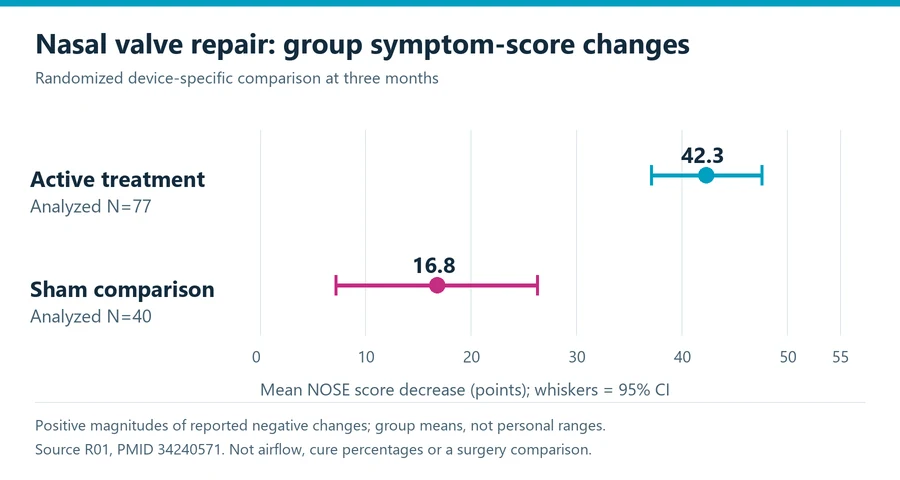
The original radiofrequency trial published online July 9, 2021, compared active treatment with a sham procedure. At three months, the reported mean NOSE symptom-score changes were minus 42.3 points for active treatment and minus 16.8 for sham. The primary-endpoint analysis included 77 and 40 participants respectively. A negative change means a lower symptom score; these are group means, not percentages cured, measured airflow or a prediction about your own operation. Original sham-controlled radiofrequency trial
The chart changes the sign, not the underlying endpoint
Our companion chart displays the magnitude of the reported score decreases as positive numbers to make improvement direction easy to read. The same source’s confidence limits are transformed consistently. This is a transparent display choice, not a new effect estimate. The caption names the questionnaire, timepoint and actual analysis denominators so the graphic does not imply that all enrolled participants supplied that result.
Confidence intervals describe uncertainty around an estimated group mean. They are not the range of outcomes individual patients experienced. A larger average decrease can support a trial comparison without establishing the amount of improvement you will have. Similarly, a sham comparison answers a different question from a head-to-head comparison with structural surgery or another device.
| Reported quantity | What it means here | What it should not become |
|---|---|---|
| NOSE score change | Reported symptom-score difference from baseline | Measured airflow or oxygenation |
| Mean decrease | An average for the analyzed group | The outcome every participant obtained |
| Confidence interval | Uncertainty around that estimated average | A personal best-to-worst range |
| Three-month timepoint | The controlled comparison’s stated interval | Lifelong durability |
| Active versus sham | One trial’s treatment comparison | A ranking of all repair techniques |
A responder is not necessarily free of symptoms
The radiofrequency trial defined response as at least a twenty-percent NOSE score reduction or improvement by at least one clinical severity category. Meeting that definition is different from having no obstruction. A favorable responder percentage should keep the actual definition beside it. Otherwise, a threshold-based result can be misunderstood as a count of people whose symptoms disappeared entirely.
Ask what outcome measure the clinician uses and how it connects to your stated daily-life goal. A questionnaire can preserve a consistent record of your experience, but it does not replace examination. Keep the symptom measure separate from an appearance assessment and from any other breathing or sleep-related test. Different measures may answer useful but different questions.
If a percentage is quoted, request its population, denominator and interval. Was it measured after the specific procedure being proposed? Did all treated people contribute? Was the definition the same across reports? You do not need to choose a statistical method to ask these questions. They help identify whether the number addresses your decision or merely appears relevant because it contains the word nasal.
Three ways to describe improvement are not interchangeable
A score-point decrease, a percentage decrease from a starting score and the percentage of participants meeting a response definition describe different quantities. The first uses the questionnaire’s units. The second needs a baseline score as its reference. The third counts people who cross a specified threshold. Calling all three an improvement rate hides their different meanings. Ask the person presenting a result to say which quantity they mean before comparing it with another report.
Likewise, a difference between two response percentages is a percentage-point difference, not automatically a percentage reduction in personal risk. A relative comparison needs an identified reference group and still concerns the studied groups. None of those arithmetic descriptions establishes how much air passes through a particular person’s nose. Keep the observed endpoint visible rather than treating a mathematical conversion as a new clinical measurement.
For your own assessment, ask how a questionnaire change will be interpreted alongside the examination and the daily-life goal you recorded. Someone may meet a response threshold while still having a bothersome symptom; a threshold therefore should not replace discussion of what remains difficult. A useful record can state the score, the interval and the concern separately. That is more informative than forcing the entire experience into a binary success label.
Understand crossover before interpreting longer follow-up
The twelve-month report from the same radiofrequency trial included people originally assigned active treatment and people who later crossed from sham to active treatment. It reports 108 actively treated participants overall, with 88 assessed at twelve months. This later treated cohort is not the same as maintaining the original untreated sham comparison throughout the year. The trial disclosed manufacturer sponsorship and involvement in its conduct and analysis. Original twelve-month follow-up and disclosures
Longer observation can provide information about persistence of benefit, but the comparison being made must remain clear. A treated group’s later change from baseline is not automatically a randomized estimate against an untreated control at that later interval. Nor should multiple reports from one trial be counted as entirely independent participant populations. Ask whether a headline concerns a new study or a later report on related participants.
A report published online January 17, 2025, extended observation to three years. Its abstract identifies 54 reaching that timepoint among 108 who received active treatment. The smaller later population should remain visible alongside any durability claim. We do not turn absent later observations into failures or successes, and we do not present that follow-up as a continued three-year sham comparison. Original three-year extension report
An implant trial is a separate comparison
A 2019 randomized implant study assigned 137 participants to treatment or sham and followed the comparison through three months. It used a responder definition based on a symptom-score or severity-category improvement. It evaluated a specific bioabsorbable support approach in selected patients. That result cannot be pooled casually with radiofrequency results or presented as a direct comparison between the two treatments. Original bioabsorbable implant sham-controlled trial
Two studies can report the same questionnaire while differing in eligibility, technique, follow-up and analysis. Comparing their headline percentages as if people were randomized between devices would create a comparison the studies did not perform. Ask which evidence actually informs the option being offered and why its population is relevant to your examination.
If an implant is proposed, clarify its intended role, what material will be used and what follow-up concerns the team discusses. If a graft or another structural component is proposed, ask the same concrete scope questions. A term such as minimally invasive should not replace a discussion of the intervention, risks or possible further treatment. Understanding the actual proposal is more useful than accepting a category label.
Keep appearance goals visible when surgery is combined
If the plan also includes rhinoplasty for appearance, make a separate list of desired changes and features to preserve. A preferred profile cannot demonstrate improved function, and a symptom questionnaire cannot capture every appearance preference. Ask how each component relates to the other and whether an appearance request introduces a limitation relevant to the functional plan.
Use unfiltered photographs and a clear description of priorities. Ask what a simulation illustrates and what it cannot guarantee. A drawn or digitally altered nose is a communication aid, not an observed outcome or proof of an airway result. Keep the functional explanation beside the appearance discussion so an attractive image does not become the sole basis for consent.
At later assessments, return to both records. If breathing improved but appearance remains concerning, or the reverse, preserve that distinction. Ask what is being evaluated and whether healing affects interpretation. An overall satisfaction score may conceal a problem that needs a separate explanation. The rhinoplasty guide expands that broader appearance-planning discussion.
Ask about risks and possible additional treatment
Discuss the risks of the exact proposed procedure rather than borrowing a percentage from a different device or combined operation. ASPS rhinoplasty guidance identifies breathing difficulty, healing concerns, unsatisfactory appearance and possible revision among surgical risks. Those categories are useful context for a combined rhinoplasty plan; they are not a numerical risk estimate for every office-based valve treatment. ASPS rhinoplasty risk discussion
Ask how the team evaluates persistent symptoms, an unwanted appearance change or a complication. Clarify who provides prompt assessment and how to reach that service outside routine appointment times. A report that adverse events resolved in a study does not establish that another procedure is risk-free or that every future concern can be handled with a message.
If further treatment may be needed, ask what would support that decision and how it affects the overall commitment. Distinguish managing a complication from considering a later elective adjustment. Do not schedule another intervention solely because a questionnaire result or calendar date differs from a marketing claim. The clinician’s assessment needs to explain what is known and what remains uncertain.
Recovery and outcome assessment have different tasks
Obtain written instructions specific to the procedure and any combined work. Ask how medications, nasal care, transport, activity and follow-up will be coordinated. Do not copy a device study’s protocol or another person’s recovery routine. Those sources do not provide individualized instructions for your operation or health history.
Describe relevant work and exercise demands so the team can address them concretely. Permission for one activity does not automatically establish permission for all. If equipment contacts the nose or prescribed treatment involves the area, ask the appropriate clinicians to coordinate instructions. A practical plan should name who will help when needed and how you will attend follow-up.
Keep early healing visits separate from the later evaluation of the intended result. Ask which symptoms or findings should prompt contact between appointments and what each routine assessment will measure. A well-organized record can include the same symptom questionnaire at agreed intervals without implying that a score establishes the diagnosis or alone determines the next treatment.
Request a complete estimate and coverage explanation
Ask for a quote that identifies the exact components, setting, anesthesia or facility charges, included visits and possible later expenses. If functional and elective appearance work are combined, request a separate description of how they are submitted and billed. Coverage requires the actual plan and insurer’s determination; a procedure name alone does not establish that every component is paid for.
| Estimate item | Written information to request | Assumption to avoid |
|---|---|---|
| Valve-related treatment | Named procedure, side and setting | All proposals called repair have identical scope |
| Combined work | Separate components and rationale | Authorization for one covers every component |
| Shared expenses | Anesthesia, facility and allocation | A surgeon’s fee is the entire bill |
| Follow-up | Included assessments and contact access | A device package includes every later need |
| Additional treatment | Possible reassessment and charges | Revision is guaranteed, necessary or free |
Compare complete proposals rather than adding unrelated national averages. Our cost guide helps organize an estimate without inventing a national valve-repair price. Before deciding, you should understand the examined contributor, proposed treatment, relevant evidence and uncertainties. The procedure library provides related topics while the clinician supplies the individual assessment an educational article cannot provide.
Sources and review scope
Plastic Surgery Editorial Team. Source records checked through October 12, 2026. Review scope: source and editorial checks for general education. No individual clinical assessment is represented.
- Original sham-controlled nasal-valve radiofrequency trial. pmc.ncbi.nlm.nih.gov. Source date: 2021-07-09. Checked 2026-10-12.
- Original twelve-month nasal-valve trial follow-up. jamanetwork.com. Source date: 2022-09-01. Checked 2026-10-12.
- Original three-year nasal-valve follow-up extension. pubmed.ncbi.nlm.nih.gov. Source date: 2025-01-17. Checked 2026-10-12.
- Original bioabsorbable nasal-valve implant randomized trial. pubmed.ncbi.nlm.nih.gov. Source date: 2019-06-21. Checked 2026-10-12.
- ASPS septoplasty scope. plasticsurgery.org. Publication/update date not stated. Checked 2026-10-12.
- ASPS rhinoplasty scope. plasticsurgery.org. Publication/update date not stated. Checked 2026-10-12.
- ASPS rhinoplasty risks. plasticsurgery.org. Publication/update date not stated. Checked 2026-10-12.