
A mini facelift is a surgical facial lift generally described as a limited-incision or short-scar procedure. It may suit selected people with less skin relaxation, but the label does not identify one standardized operation, guarantee a weekend recovery or establish that the neck will be fully treated. The important distinction is between the length of the incision and the work performed beneath it. Ask for the intended regions, underlying tissue treatment and any separate neck procedure before comparing a mini facelift with a more extensive lift. ASPS limited-incision guidance
For someone whose main concern is early jowling, a limited approach may be worth discussing. For someone focused on loose neck skin, visible neck bands or several facial regions, the name alone offers little useful information. Incision, tissue work and treated regions should be recorded separately. This guide explains how those three fields change the decision and why published short-scar results cannot be treated as a personal forecast.
“Mini” describes a scope, not a complete operative specification
ASPS contrasts traditional, limited-incision and neck-lift approaches in its procedure guidance. Its mini-lift description emphasizes shorter incisions and less skin relaxation. AAOMS also describes a limited-incision option that can involve tightening structural tissues in the cheeks. Together, these descriptions make an important point: a shorter incision does not necessarily mean that only skin is treated. AAOMS facelift and mini facelift guidance
The terminology varies in professional use. An ASPS May 2024 interview article acknowledges that surgeons may use their own techniques under the mini facelift name. That article is useful for understanding the term, but interview claims about faster recovery do not establish a controlled estimate for every operation sold under it. ASPS mini facelift terminology discussion
Do not assume that “mini,” “SMAS” and “deep plane” are three mutually exclusive categories on a single scale. Mini usually concerns limited access or scope; SMAS terminology concerns underlying support tissue and how it is managed. An original minimal-incision report, for example, explicitly describes lateral SMASectomy. Its existence demonstrates that short-scar surgery can include underlying tissue work; the report does not establish that technique as a universal winner. Original minimal-incision SMASectomy report
When a proposal uses more than one label, request an ordinary-language explanation of each. Which word describes the incision? Which describes tissue management? Which describes the area being addressed? This avoids comparing a regional operation with a tissue technique as if they were competing products. It also makes it possible to compare two surgeons’ proposals without relying on identical marketing names.
| Planning field | Specific description to request | What the mini label cannot establish |
|---|---|---|
| Incision | Planned location and extent around the ear or hairline | The exact scar location for your anatomy |
| Underlying tissue | Whether and how support tissue is addressed | That a short incision means skin-only surgery |
| Regions | Cheeks, jawline and neck concerns addressed separately | That every facial-aging concern is included |
| Additional procedures | Any separate neck, volume or skin treatment | That combined results come from the lift alone |
Start with the region you actually want to change
Make a short description of the concern that led you to consider surgery. A softened jawline, a particular neck contour and fine skin texture are different targets. ASPS explains that facelift surgery addresses facial and neck aging, while volume restoration, eyelid surgery and resurfacing may be considered separately. It also states that surgery does not stop aging or change the fundamentals of your appearance. ASPS facelift scope and limitations
A useful assessment connects each concern to a proposed action or an explicit limitation. If a neck concern is left untreated, it should appear as an expected remaining feature rather than emerge as a surprise afterward. If a skin treatment is added for texture, its contribution should be named separately. This is especially useful when examples show several procedures at once: an attractive combined result cannot reveal which component produced each change.
Prioritize what matters most before discussing the size of the operation. Choosing a smaller procedure only because the name sounds convenient may leave the primary concern outside its scope. Choosing a larger operation simply because it sounds more comprehensive can also miss the point if the additional treatment is not relevant to your goals. The decision should concern an identified problem, an achievable change and the responsibilities attached to that plan.
Consider what you would regard as an acceptable remaining feature. Some readers want a modest improvement while retaining familiar contours; others have a specific neck issue that dominates their decision. Neither goal can be resolved by selecting a label online. Describing the limit you would accept helps the clinician explain whether a limited approach fits the request, whether another plan deserves consideration or whether surgery should be deferred.
The neck is where a vague mini-lift description can break down
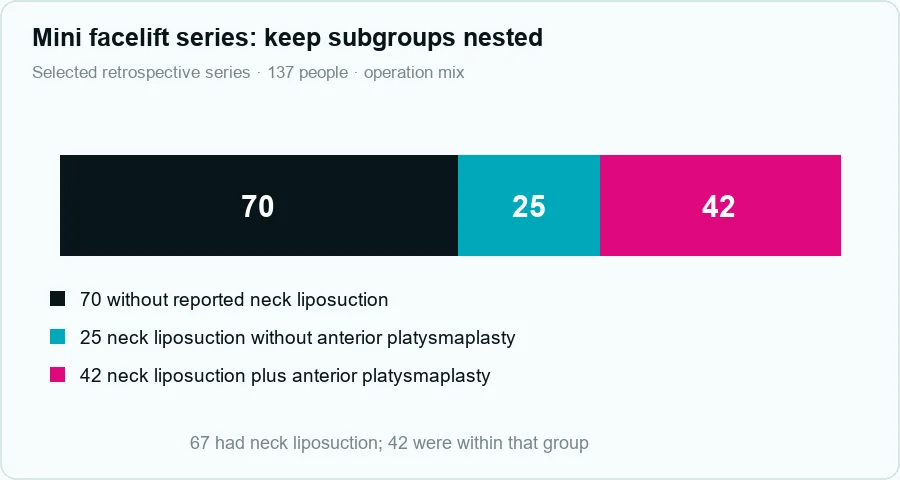
An original retrospective short-scar series published in May–June 2009 included 137 patients. Sixty-seven also had anterior neck liposuction, and 42 of those had an additional anterior platysmaplasty. The study therefore does not describe one isolated mini facelift performed identically in every patient. Its authors reported that particular neck features were not consistently corrected by the short-scar lift alone. Original short-scar series and added neck procedures
Those counts are useful as a treatment-scope illustration, not a recommendation that a particular proportion of today’s patients needs an additional procedure. The study reflects one approach and its selected patients. Without a comparable untreated or alternative-operation group, its treatment mix cannot determine which operation would be best for you. The practical lesson is to make the neck component visible in the proposal rather than hide it beneath a single package name.
Keep nested counts nested
The 42 patients with platysmaplasty were part of the 67 with neck liposuction. They were not a separate group to add to that count. An original chart can show three mutually exclusive categories: 70 without that neck-liposuction add-on, 25 with liposuction without the additional platysmaplasty, and 42 with both. The first two values are transparent subtraction calculations, not separately reported outcomes. The chart describes the operation mix, not satisfaction, complication risk or lasting improvement.
Ask whether an additional neck procedure changes the incision plan, anesthesia, care requirements and estimate. If it does, those changes belong in the same decision record as the facelift. A short facial incision does not make a combined operation equivalent to a stand-alone limited lift. Comparing scope first prevents a lower advertised price from becoming a misleading comparison with a more complete proposal.
What published technique reports do not prove
The literature contains several named short-scar approaches. A March–April 2007 MACS-lift report describes vertical suspension for the lower and middle face. Its abstract presents the authors’ claims about recovery and stability, but does not provide a verified controlled long-term comparison for this guide. It should not be converted into a promise that every mini facelift lasts as long as every extended technique. Original MACS-lift technique report
When reading a study, first identify the exact operation and any accompanying treatment. Then look for who was included, how the result was measured and when it was assessed. A surgeon’s retrospective series can document experience, but selection and additional procedures complicate comparisons. A technique paper may explain the method without answering a patient’s question about relative durability. These are different forms of evidence rather than interchangeable endorsements.
Be cautious with statements such as “no major complications” when the report also lists events requiring care. A study’s classification of major and minor does not tell you whether an event would matter to your work, appearance or comfort. Ask what events were counted and how follow-up captured them. This guide does not derive a personal complication rate from a small technique series or assume that the word mini removes the risks of surgery.
Candidacy depends on more than age
ASPS lists health, nonsmoking and realistic expectations among general facelift-candidacy considerations. It does not supply a universal age cutoff that determines whether a mini facelift is appropriate. ASPS candidacy guidance A younger person can have a concern outside a limited lift’s scope, and an older person may have a focused goal. Age is part of the history, not an online selector for the operation.
Discuss prior facial procedures, medicines, allergies and health conditions accurately. Bring available records rather than relying on a remembered brand name or calling everything a cosmetic treatment. ASPS consultation guidance includes history, examination, photographs and discussion of options. ASPS consultation assessment This information helps the clinician identify what is relevant to the plan; it does not mean you should independently change medicines or arrange another procedure first.
For men as well as women, the actual scar location matters in relation to the ear, hairline and usual hairstyle. Ask to see the proposed location on your own anatomy and discuss how it may look from the side. A scar described as hidden in someone else’s photograph is not necessarily positioned the same way for you. Include ordinary grooming and hairstyle preferences in the discussion without treating an illustrative image as a surgical map.
A smaller operation still needs a complete safety plan
Facelift risks identified by ASPS include bleeding, infection, nerve injury with weakness, changes in sensation, wound-healing problems, hair loss at incision sites and unfavorable scarring. Anesthesia and wider medical complications also belong in the consent discussion. ASPS facelift risks The limited-incision label does not create an exemption from these categories or supply a personal probability for them.
Separate questions about the operation from questions about where and how it is performed. Ask who provides anesthesia, what assessment is needed, how concerns after discharge are handled and where you would receive urgent evaluation if necessary. These are concrete responsibilities, not extras that disappear when an operation is presented as convenient. If sedation or local anesthesia is proposed, request the same clarity about monitoring and discharge arrangements.
Preparation should come from the treating team. ASPS includes clinician-directed testing, medication review and other preparation within its guidance. ASPS preparation guidance An online checklist cannot decide which instruction applies to your history. Keep the written plan available and ask for clarification if instructions from different offices appear inconsistent. Do not infer a medicine-change schedule from another person’s recovery account.
Recovery has several endpoints
ASPS recovery guidance discusses incision care, possible dressings or drains, medicines, follow-up and resuming activities. It encourages individualized questions about washing, makeup, exercise and hair care. ASPS recovery questions These are distinct decisions. Feeling comfortable enough to answer emails is not the same as being cleared for strenuous activity or feeling ready for a public event.
Avoid booking around the word weekend. Ask what the team expects for your particular operation and which additional procedures change that estimate. Describe the demands of your job: meetings, driving, physical work and travel create different planning questions. If a return date matters, discuss a realistic backup arrangement rather than relying on an especially quick recovery described in a testimonial.
Also separate an early healing review from final appearance assessment. ASPS notes that visible improvement emerges as swelling and bruising settle and that results cannot be guaranteed. ASPS results guidance A favorable early photograph should not become a claim about long-term durability. Ask when the team will assess the original concerns and how a persistent issue would be evaluated.
| Recovery question | Decision it informs | Avoid treating it as |
|---|---|---|
| What help and transport are needed? | Safe discharge and initial support | Proof that an outpatient operation is trivial |
| When can each activity resume? | Work, exercise and grooming planning | One universal recovery date |
| How are concerns assessed? | Contact and follow-up arrangements | An optional cosmetic extra |
| When is the result evaluated? | Fair assessment of the original goal | A guarantee from an early photograph |
Compare complete proposals and complete costs
ASPS explains that facelift fees do not include every related expense, such as anesthesia and operating facilities. A general facelift average cannot identify a verified total for a particular mini facelift. ASPS fee scope This guide therefore does not invent a mini-specific national price or assume a fixed discount because the incision is shorter.
Request a dated estimate that identifies the operation, any additional neck or facial procedures, anesthesia, facility charges and ordinary follow-up. Compare those fields across offers before comparing totals. A quote that excludes the neck concern you most want addressed is not equivalent to one that includes its assessment and treatment. Likewise, a combined package cannot be evaluated fairly against a stand-alone lift without separating its components.
Clarify the policy for unexpected additional care and for later reassessment or revision. Inclusion, eligibility and timing can differ, so request the actual terms rather than interpreting “follow-up included” broadly. Keep travel, time off and personal support expenses separate from medical charges. This shows the practical commitment without presenting your own budget as a national cost statistic.
| Quote field | What should be explicit | Why it changes comparison |
|---|---|---|
| Facial lift | Regions, incision scope and underlying tissue plan | Identical names can hide different operations |
| Neck component | Included treatment or expected remaining concern | A separate procedure changes scope |
| Anesthesia and facility | Included charges and responsible team | Surgeon fee is not automatically the total |
| Follow-up and additional care | Written inclusions and policies | Ordinary care and revision are not synonymous |
Separate the original result from a later decision
When someone says a lift “lasted,” ask what they mean. They might mean that a particular contour still looks improved, that they remain pleased with their appearance, or that they have not chosen another procedure. Those are different observations. The absence of another operation does not measure every aspect of the original result, and a later treatment does not by itself establish that the first operation failed. The endpoint needs a definition before it can support a useful comparison.
This matters particularly for a limited lift because some concerns may intentionally remain outside its scope. If a later procedure addresses an untreated region, count that separately from revision of the original operation. If a persistent issue involves the region that was treated, the clinician should assess it against the original plan and healing record. Keeping those distinctions prevents a combined sequence of treatments from being presented as the durability of one mini facelift.
Scar satisfaction deserves its own question as well. Ask whether an example is being used to illustrate contour, incision placement or both. An attractive frontal image can show little about the ear or hairline, and a close-up scar image can show little about the overall facial change. Request views that address the actual question rather than expecting one photograph to document every outcome. This is an assessment principle, not a claim that a particular scar will be visible or invisible.
Keep records of the agreed scope, any additional procedures and the assessment point. Those details make future conversations more accurate if your goals change. They also help distinguish an elective new preference from an unresolved concern about the first treatment, without promising that either situation can always be corrected surgically.
Decide whether limited treatment fits the priority
A useful final plan should be understandable without the marketing name. It should identify the principal concern, the regions being treated, how the limited approach addresses them and which features are expected to remain. It should also state the practical recovery arrangements and complete estimate. If those points remain unclear, the label mini facelift is doing more work than the explanation.
Compare the expected change with what matters to you, rather than with a different person’s face or a dramatic combined-procedure photograph. A modest goal can be legitimate, and deciding against surgery can be legitimate when the proposed scope does not address the priority. The aim is an informed choice about an identifiable operation, including its limits, rather than securing the smallest-sounding procedure or the broadest package.
For related planning, see the main facelift guide, eyelid surgery guide, complete cost planning and procedure library.
Sources and review scope
Plastic Surgery Editorial Team. Source records checked through October 12, 2026. Review scope: source and editorial checks for general education. No individual clinical assessment is represented.
- ASPS limited-incision scope. plasticsurgery.org. Publication/update date not stated. Checked 2026-10-12.
- AAOMS facelift and mini-lift guidance. myoms.org. Publication/update date not stated. Checked 2026-10-12.
- ASPS terminology interview. plasticsurgery.org. Source date: 2024-05-28. Checked 2026-10-12.
- Original minimal-incision lateral SMASectomy report. pubmed.ncbi.nlm.nih.gov. Source date: 2001-01. Checked 2026-10-12.
- ASPS facelift limits. plasticsurgery.org. Publication/update date not stated. Checked 2026-10-12.
- Original137-patient short-scar series. pubmed.ncbi.nlm.nih.gov. Source date: 2009-05/06. Checked 2026-10-12.
- Original MACS-lift technique report. pubmed.ncbi.nlm.nih.gov. Source date: 2007-03/04. Checked 2026-10-12.
- ASPS candidacy. plasticsurgery.org. Publication/update date not stated. Checked 2026-10-12.
- ASPS consultation assessment. plasticsurgery.org. Publication/update date not stated. Checked 2026-10-12.
- ASPS surgical risks. plasticsurgery.org. Publication/update date not stated. Checked 2026-10-12.
- ASPS preparation. plasticsurgery.org. Publication/update date not stated. Checked 2026-10-12.
- ASPS recovery decisions. plasticsurgery.org. Publication/update date not stated. Checked 2026-10-12.
- ASPS result maturation. plasticsurgery.org. Publication/update date not stated. Checked 2026-10-12.
- ASPS cost scope. plasticsurgery.org. Publication/update date not stated. Checked 2026-10-12.