
Microneedling recovery after professional mechanical treatment often involves a short period of visible color change and discomfort. The American Academy of Dermatology describes redness or darkening, a sunburn-like feeling and sometimes swelling that usually resolve over a few days to a week. It says people may return to work or school immediately, but should wait twenty-four hours before applying makeup. Those statements are general guidance, not a guarantee about your appearance or permission for every skin product. AAD microneedling guidance
This resource centers on professional mechanical microneedling. Radiofrequency microneedling adds energy and needs its own risk discussion. A home roller, an injection, a laser procedure or a combination treatment should not inherit the timetable here. Before using a recovery guide, find out exactly what device and procedure were used, which area was treated, and what the clinician’s written instructions say. The name microneedling alone does not settle those questions.
What should a microneedling recovery plan identify first?
Ask the treating clinician to name the procedure and whether radiofrequency energy was involved. Keep the device name and treatment record if they are available. You do not need to interpret technical settings yourself, but an accurate record helps another clinician understand your care if a concern arises. If a cream, blood product or another procedure was combined with treatment, ask how that affects the instructions rather than assuming the simplest mechanical timetable applies.
For microneedling recovery at home, obtain written advice on cleansing, approved products, sun exposure, makeup and when to contact the clinic. Ask the team to explain any word you do not understand. This article does not recommend a product, an exfoliating schedule or a home treatment routine. Your usual skincare products should not be presumed appropriate immediately after a procedure merely because you used them comfortably beforehand.
Separate your practical commitments into work tasks, appearance preferences and skin-care permissions. You may be able to perform a task yet prefer not to attend a photographed event. Conversely, being comfortable in public does not authorize a restricted product or activity. Make those differences explicit when asking the clinician for advice. The result is a more useful plan than a single number labeled downtime.
Choose a reliable contact method before leaving the appointment. Ask what response time to expect from a portal message and which concerns need a call or urgent assessment. If the treatment was performed away from home, clarify where you would obtain care afterward. A follow-up booking is useful for scheduled review; it is not a reason to wait when a new problem needs evaluation sooner.
How should microneedling recovery timing be read?
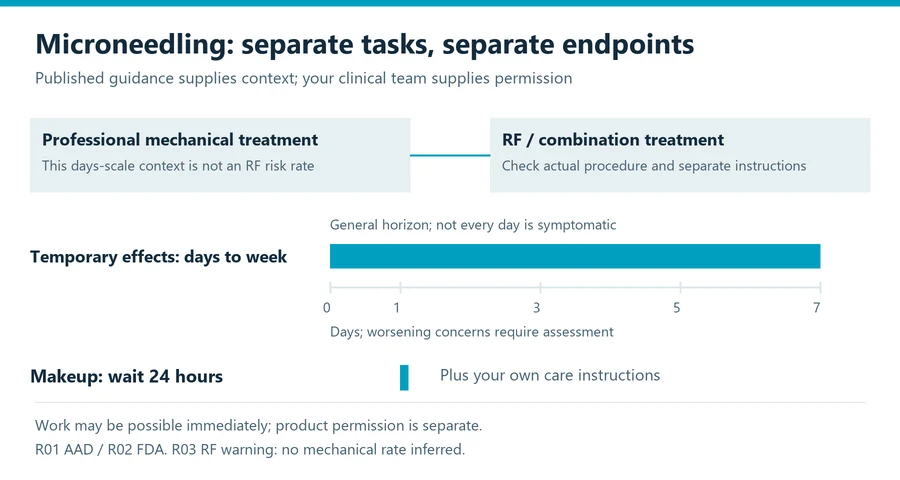
The source timeline describes common temporary effects rather than a personal outcome prediction. A few days to a week does not mean that any symptom occurring during that interval is routine, or that every person will look unchanged by its end. The companion visual shows a short days-scale context alongside separate permission questions. It contains no patient measurements, complication rates or guaranteed collagen-response curve.
| Microneedling recovery question | Source-backed general context | What remains individual |
|---|---|---|
| What temporary effects may be visible? | AAD: redness or darker color, discomfort and sometimes swelling | Your procedure, treated area and actual course |
| How long can those effects last? | AAD: commonly a few days to a week | Whether a change is improving or needs assessment |
| Can work or school resume? | AAD: immediate return may be possible | Job conditions, clinical instructions and appearance preferences |
| When can makeup be applied? | AAD: wait twenty-four hours | Your clinician may give additional restrictions |
| When should benefits be evaluated? | Improvement is a separate follow-up question | Your indication, treatment plan and assessment method |
Use the chart to identify conflicts in your calendar, not to choose a procedure solely because its expected downtime fits. If an event depends on looking a particular way, tell the clinician that in advance. Leave room to change the arrangement if your skin has not settled or the clinician advises otherwise. This is practical scheduling advice, not evidence that a specific buffer period prevents a complication or guarantees an event-ready appearance.
For microneedling recovery at work, explain conditions rather than only your job title. A desk task indoors, a hot kitchen, outdoor work and a role requiring facial products may raise different questions. Ask which features matter for your aftercare. No universal advice about sweat, exercise or protective equipment is supplied here because the inspected guidance does not establish one schedule for all procedures and workplaces.
Avoid treating the absence of visible redness as a complete recovery test. Some reactions are less obvious in different skin tones, and product permissions should still follow the written plan. The FDA lists pigmentation changes among possible risks of authorized microneedling uses. FDA device risks This guide does not predict a pigmentation outcome or tell you how to diagnose a change from a photograph.
How should cleansing and product questions be handled?
Bring the names of the products you normally use and ask which should be paused, which are permitted, and how the team will decide when others can resume. A clear product-specific answer is more useful than a vague instruction to use something gentle. If the instructions name a product you cannot obtain, ask for an approved alternative. Do not substitute a trending serum or a stronger active ingredient because its label promises repair.
Make a product-permission list, not a new shopping routine
For each item, record the clinician’s answer and any follow-up question. Examples of categories to ask about include cleanser, moisturizer, sunscreen, makeup and prescribed topical medicine. Listing a category here is not a recommendation to apply it at a particular time. The value of the list is to expose uncertainty before you use something. It also helps avoid conflicting advice from a retail counter, a salon and the treating clinician.
The FDA says microneedling devices are not approved to deliver cosmetics, medicines, vitamins or blood products into the skin, and that risks of device-product combinations have not been established in its review. FDA limits on combination use That regulatory statement should not be converted into a home instruction to add or remove a substance. Ask your clinician exactly what was used and discuss any resulting concern with a qualified medical professional.
If a product causes a problem, contact your clinician for advice rather than repeatedly applying it to test your tolerance. Describe the product, when you used it and what happened. Keep packaging or the ingredient list available if requested. This guide cannot determine whether a reaction comes from the product, the procedure or another cause, and does not provide a patch-testing protocol for recently treated skin.
Do not use home needling to speed up professional microneedling recovery or correct an unexpected result. The care plan should not be extended into another procedure without assessment. If you are considering a later treatment, keep it on a separate question list. A device sold for home use and a professional procedure do not necessarily have the same intended use, depth, risk profile or instructions.
How can work, makeup and social plans be organized?
Microneedling recovery scheduling should distinguish required tasks from preferences. A remote call may be easy to rearrange, while an on-camera event or job requiring makeup may create a specific conflict. Explain that conflict to the clinician before treatment. Do not conceal a product requirement and then assume a general return-to-work statement permits it. Work readiness and makeup permission answer different questions.
For an employer conversation, describe the practical adjustment you are asking for without making an unsupported medical claim. You might ask about switching a photographed task or changing an outdoor assignment if your clinician recommends it. Whether an adjustment is possible depends on the job and workplace policy. This article does not certify fitness for work, establish leave rights or promise that any particular arrangement will be clinically appropriate.
For social plans, consider what can be changed if your appearance is different from expected. A flexible meeting is different from a nonrefundable event. Ask the clinician how to think about those commitments, and make your own preference clear. There is no obligation to cover treated skin for someone else’s comfort, and a desire to use makeup should not override the care instructions.
If you routinely use specialized face protection, masks or equipment for work or sport, ask about that exact item. Describe contact, friction and the conditions in which it is worn. Do not assume that something labeled protective cannot affect a treated area. Your occupational requirements and the clinician’s instructions both need to be understood, rather than asking one party to guess the other’s needs.
For microneedling recovery away from home, keep the clinic’s contact details and procedure record accessible. Ask how a concern would be assessed if you cannot return promptly. A message with a photograph may help the team understand a change, but it should not be assumed adequate for every problem. Use a private, approved channel if images are requested, and do not post publicly as a substitute for seeking clinical advice.
Why does radiofrequency treatment need a separate discussion?
Radiofrequency microneedling uses energy as well as needles. In its October 15, 2025 safety communication, the FDA reported serious complications with certain uses, including burns, scarring, fat loss, disfigurement and nerve damage. It advises people with problems or concerns after RF treatment to seek care from a licensed health professional. FDA RF microneedling safety communication Those reports are not a complication percentage or a mechanical-needling outcome rate.
If your treatment included RF, do not use this page’s mechanical microneedling recovery context to dismiss a concern. Ask for the device name and the actual aftercare instructions, and obtain medical assessment if you are worried. This resource does not attempt to compare individual devices or identify a safe setting. A brand name alone cannot establish whether a symptom is expected or what response is appropriate.
The FDA communication specifically says RF devices should not be used at home. The warning also provides a route for reporting device problems, but reporting is distinct from obtaining care. FDA patient recommendations If you have a concerning problem, do not wait to submit a report before seeking assessment. A report may help regulatory monitoring; it does not treat an injury or replace your clinician.
Marketing may use the same short treatment name for procedures that differ substantially. That is why the first recovery question is what was actually done. If the answer is unclear, request your record rather than infer it from a before-and-after advertisement. Knowing the procedure allows a qualified professional to ask the right questions. It does not require you to interpret technical details or assign yourself a diagnosis.
What changes should prompt contact or urgent assessment?
Contact the treating clinician about an unexpected, worsening or concerning skin problem rather than assuming it is ordinary downtime. The FDA identifies possible risks including infection, pigment changes, discomfort and bleeding in its microneedling guidance. It recommends discussing the procedure’s risks and contacting a healthcare provider about problems. FDA patient guidance This article does not supply a home test to distinguish a temporary effect from a complication.
When contacting the team, describe the treated area, the procedure name if known, when the change began and whether it is progressing. Mention any products applied after treatment and advice you have already received. Ask whether an examination is needed and where you should obtain it. Keep that exchange separate from a request to book another session; the current concern should be assessed before an assumption about the next treatment is made.
Seek appropriate urgent medical help for a severe or rapidly worsening problem, or if the clinician directs you to do so. If you have an emergency such as new difficulty breathing or collapse, call emergency services; in the United States, call 911. This is an emergency response instruction, not a claim that these symptoms are common microneedling effects. A routine clinic message and its expected reply time should not delay emergency care.
If your team is unavailable, use an appropriate medical service rather than searching for a matching image online. Photographs can differ in lighting, skin tone, timing and procedure, and this guide cannot diagnose from them. Do not intensify skincare, repeat treatment or attempt to remove crusting as a way to find out what is happening. Medical assessment is the appropriate next step for a concern that needs evaluation.
How should the next appointment and result assessment be planned?
When the appointment ends, check that the instructions answer the tasks you actually need to manage. If a product is listed as paused, ask how its return will be decided. If a work requirement remains unresolved, describe it again rather than substituting a generic downtime figure. Keep the response and any later revision together. This makes a practical plan easier to follow when several people have offered advice.
If you seek another opinion about a concern, provide the treatment name, area, date and aftercare information you have. Avoid replacing an uncertain procedure name with a guess based on advertising. The clinician can request additional records if needed. Organizing the available facts is different from interpreting the device settings yourself, and a complete record should not become a prerequisite that delays urgent assessment.
At follow-up, ask which product and activity restrictions still apply and whether any concern requires further assessment. For microneedling recovery, the next practical decision may be a skincare permission rather than an appearance verdict. Record that answer clearly. If an item remains pending, leave it pending instead of replacing it with the general days-scale timeline from the chart.
Ask separately when the clinician intends to assess the reason for treatment and whether another session is appropriate. The AAD notes that visible improvement is gradual and that some people require a series, but that general observation does not prescribe your next appointment. Do not prepay for a schedule on the assumption that recovery and benefit will be identical after every session. The actual clinical plan should address both your response and your goals.
The planning graphic and task list help keep treatment type, temporary appearance effects and permissions separate. They are original organizational tools, not a validated method of reducing downtime. Microneedling recovery is better understood as a set of specific care questions with a reliable contact route than as a promise that everyone can return to every routine after the same number of hours.
For related procedure context, read microneedling and the plastic surgery recovery guide.
Sources and review scope
Plastic Surgery Editorial Team. Source records checked through October 12, 2026. Review scope: source and editorial checks for general education. No individual clinical assessment is represented.
- AAD microneedling patient guidance. aad.org. Publication/update date not stated. Checked 2026-10-12.
- FDA microneedling devices. fda.gov. Source date: 2025-10-15. Checked 2026-10-12.
- FDA RF microneedling safety communication. fda.gov. Source date: 2025-10-15. Checked 2026-10-12.