
Microneedling cost is most usefully compared by the actual device-based procedure, treated area, assessed session plan and included services. A single-session price cannot be compared fairly with a package until those fields match. Conventional microneedling and radiofrequency microneedling also need separate descriptions; a price difference between them is not simply a discount on the same service. No verified national microneedling price average is used in this guide. The worksheet instead reconciles the current written offers you receive.
Ask the clinician to define the appropriate procedure before asking the billing office to total it. Then identify assessment, each session, required supplies, reviews and package terms. Keep optional additions separate and unresolved services visibly unknown. A discounted bundle can cost less if every purchased session is appropriate and used, yet have a higher effective cost when only part of it is used. That is a financial scenario, not a reason to complete treatment that is no longer appropriate.
Define the procedure before comparing microneedling cost
The FDA consumer guidance distinguishes medical microneedling from superficial home products and explains that devices adding radiofrequency energy have different risks. Request the device name, treatment purpose and proposed area. “Skin rejuvenation package” does not identify enough scope for a useful comparison. A clinician should explain the plan’s relevance to your concern; a lower price is not evidence that a different procedure will address the same task.
Keep the device and treatment description in both the clinical plan and financial estimate. Ask whether a quoted face treatment includes the neck or another area, rather than assuming broader scope from a photograph in an advertisement. If the plan changes after examination, request a new quote describing that change. This preserves the basis for comparing offers and prevents an earlier promotional price from being used for a service it never actually covered.
Clinical assessment may show that treatment should be postponed, changed or declined. Ask how a prepaid package is handled in that situation before purchasing it. A bundle should not put you in the position of choosing between losing money and proceeding against updated advice. The appropriate number and timing of sessions are clinical decisions. The worksheet records the clinician’s proposed plan and its financial conditions without selecting a course for you.
Radiofrequency microneedling cost needs separate safety review
The FDA safety communication dated October 15, 2025 reports serious complications with certain RF microneedling uses, including burns, scarring, fat loss and nerve damage. The agency describes an ongoing evaluation and recommends discussing benefits, risks and the actual device with a trained licensed provider. The communication does not supply an individual complication probability or a price premium that makes treatment safe.
A quotation should not flatten that distinction into “standard versus upgraded” without explaining the actual procedure. Ask whether the compared offers use RF or conventional microneedling and what clinical reasons support the proposed option. Keep that information beside the price. A spreadsheet cannot establish equivalence between different devices, indications or techniques. If you are unsure what has been proposed, resolve that question before treating the lower quote as a saving.
Nor does device clearance alone answer every question about the proposed use. Ask the clinician to explain the device’s authorized indication and how it relates to the plan. A claim such as “medical grade” is not a substitute for that specific discussion. Do not extrapolate the warning into a claim that every procedure has the same risk, or use a lack of a quoted complication charge to assume that the practice has eliminated risk. Financial transparency and clinical evaluation address different uncertainties.
Microneedling cost per session requires a defined session
Ask how the practice defines one billable session: the area covered, device-based procedure and services included. An appointment that only evaluates your skin is different from a treatment appointment. A review assessment afterward may also be a separate service. Record each once. If a practice quotes a course of sessions, request the per-session scope and the total obligation, even when the package price is the only amount offered publicly.
A low per-session figure may exclude assessment or an area that another quote includes. Conversely, a package may include those services and have a higher headline but lower known total. Do not assume a topical product or other addition is clinically necessary because it appears in a package. Ask why it is proposed, whether it is optional and how it changes the price. The comparison should describe a chosen, assessed plan rather than quietly accepting every menu item as a requirement.
| Microneedling cost field | Written definition to obtain | Comparison consequence |
|---|---|---|
| Procedure | Device name and whether RF is used | Keeps different procedures distinct |
| Treatment area | Exact area included in each session | Prevents comparison of different scope |
| Session plan | Proposed course and reassessment points | Separates clinical plan from sale quantity |
| Assessment | Included, separate or credited | Changes the initial obligation |
| Review | Assessment scope and charge | Clarifies care after treatment |
| Additions | Purpose, evidence discussion and optional status | Avoids treating extras as automatic requirements |
What belongs in a complete microneedling cost worksheet?
Create one column for the practice’s confirmed charges and a separate column for your personal costs. Clinical charges may include assessment, treatment and confirmed separately billed items. Do not add a generic list of skincare purchases to every plan. Ask the clinician which aftercare items, if any, are actually recommended and the practice whether they are included or can be obtained separately. Your worksheet should follow the individualized plan rather than an invented universal kit.
Transport, parking and time away may matter when a course involves multiple appointments. Record those using your circumstances and show how many visits the scenario assumes. A personal travel allowance is not a national treatment charge, and a financial visit count is not a prescribed schedule. If a package requires more visits than you can realistically attend, investigate its expiration and cancellation conditions before treating its advertised saving as available to you.
Use confirmed included, confirmed additional and unresolved as explicit statuses. The unresolved category prevents a sparse quote from appearing cheaper solely because information is missing. Ask who bills each service and whether the charge is fixed, estimated or conditional. Keep the current dated estimate and mark earlier ones as superseded once the practice confirms a replacement. Mixing an old session rate with a new package creates an apparently precise total that no actual offer supports.
Worked example: microneedling cost for sessions and packages
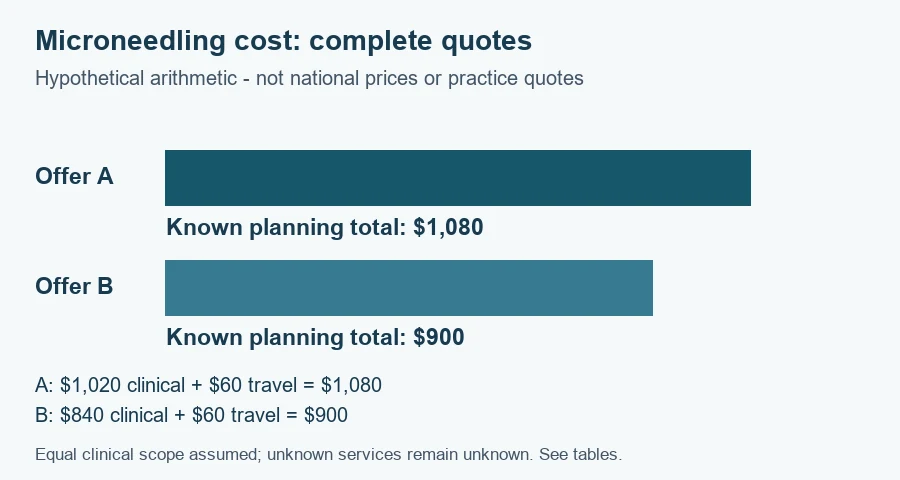
The following original US-dollar scenario uses invented inputs, not national prices or actual practice quotes. Assume the same assessed procedure, area and three-session clinical scope. Offer A charges $300 per session, giving $900, plus $75 assessment and $45 separately confirmed supplies. Personal travel adds $60 over the course. Its known planning total is $1,080. Offer B charges an $840 package including the same sessions, assessment and supplies, plus $60 travel, totaling $900.
Under those assumptions, the package produces a $180 lower known planning total. The chart does not recommend three sessions, endorse either offer or establish that the plans are clinically equivalent in real life. It demonstrates how a complete quote differs from a per-session headline. If supplies or assessment were included in A, change the inputs; if the procedure or area differed, resolve that scope difference before using the price result.
| Hypothetical microneedling cost item | Offer A: separate sessions | Offer B: documented package |
|---|---|---|
| Three illustrative sessions | 3 × $300 = $900 | Included in $840 package |
| Assessment | $75 | Included |
| Confirmed supplies | $45 | Included |
| Known clinical obligation | $1,020 | $840 |
| Personal course travel | $60 | $60 |
| Known planning total | $1,080 | $900 |
If a $75 assessment payment is credited toward A’s session charges, the clinical obligation becomes $945 rather than $1,020, and the planning total becomes $1,005. The package difference would then be $105. This alternate scenario changes only the accounting treatment of an existing payment. It illustrates why you should ask about consultation credits instead of inferring them. A credit is counted once; it is neither an extra charge nor a second discount from an obligation that already excludes it.
Unused sessions can change effective microneedling cost
A package’s advertised per-session rate assumes the purchased sessions are actually used under its terms. In the hypothetical $840 three-session package, the purchase price divided by three is $280. If only two sessions are used and there is no refund, the package expenditure divided by two used sessions is $420. Neither calculation says that two or three sessions are appropriate. It shows how unused prepaid services change the economic interpretation of a sale.
Ask what happens if reassessment leads to a different recommendation or you choose to stop. A practice may have refund conditions, retained assessment charges or cancellation fees. Request an explanation using a concrete scenario rather than accepting “unused sessions refundable” without knowing the calculation. If one session is used, which rate is applied to that session when the unused balance is refunded? A discounted package rate may not necessarily be the rate used for a partial refund.
Also ask whether credits expire, can be transferred or are tied to one location or clinician. Those restrictions affect usability, not clinical necessity. Do not accelerate appointments to meet an expiration date without discussing the plan with the clinician. If the timetable cannot accommodate appropriate care and your availability, the package may be unsuitable financially even if its arithmetic discount is substantial. Keeping control over treatment decisions has value that an advertised per-session saving does not measure.
Add-on services and microneedling cost
Ask a separate question about every proposed combination treatment: what it adds, why it is relevant and how its evidence and risks are discussed. The FDA consumer page states that the agency has not cleared microneedling devices for use with another product, such as creams or platelet-rich plasma, meaning it has not reviewed those combinations’ safety or effectiveness. Do not treat the presence of an add-on price as proof that the combination is authorized or beneficial.
Financially, show an optional addition separately from the assessed core procedure. If an invented $120 addition is charged at each of three appointments, it adds $360 to the course, not $120. That multiplication does not recommend the service; it simply prevents a repeated expense from being overlooked. If the quote describes the charge as a course-wide amount instead, use that documented denominator. A price cannot be compared until you know whether it is per visit, per area or per course.
Avoid claiming that a bundle makes an addition free when the package price includes a charge for it. Ask for an offer without the optional service if you want to understand its financial effect. The clinician can explain whether the revised plan is appropriate. A budget worksheet should make choices visible, not use a discounted total to pressure you into a combination you have not adequately discussed or would otherwise decline.
Maintenance scenarios are not microneedling cost forecasts
Future treatment, if considered, needs reassessment and your own decision. Do not turn a package brochure into a guaranteed long-term schedule or assume that more sessions ensure a desired result. The FDA guidance notes that outcomes may not meet expectations and maintenance may involve further procedures. That uncertainty belongs in your budget. Keep the initial obligation separate from a clearly labeled future scenario whose visit count and prices are assumptions.
For example, an invented $300 future appointment produces a $300 one-visit scenario and a $600 two-visit scenario before other charges. A change in price or assessed scope would require a new calculation. Avoid labeling either scenario an annual requirement, since the worksheet does not establish the interval or need. This gives you a way to think about affordability without manufacturing a standard frequency from a promotional estimate or another patient’s experience.
If considering a membership, account for its fee before calculating any savings. At an invented $150 annual fee and $50 reduction per eligible appointment, three independently chosen eligible visits recover the fee. Fewer do not, before other conditions. Do not add treatment to make the membership profitable. Check whether discounted sessions still require separate assessment and whether a package discount can be combined with membership; stacking discounts that the contract forbids creates a fictitious saving.
Deposits, refunds and microneedling cost financing
Read refund and cancellation terms before paying. A credited deposit reduces the balance of the agreed obligation, while a noncredited assessment charge remains separate. In a hypothetical $840 package with a $100 credited deposit, the remaining package balance is $740, and the package still costs $840. Keep the receipt and the written credit rule so the final bill can be reconciled. Do not count the deposit as an additional expense just because it was paid earlier.
If borrowing, compare the amount financed, annual percentage rate, fees and full repayment. The CFPB deferred-interest explanation describes how failure to meet promotional payoff conditions can trigger interest back through the promotional period. Read the actual agreement. This guide does not assess your finances or recommend a lender; it separates borrowing expense from the price of the assessed procedure.
| Final microneedling cost decision | Evidence to keep | Avoid assuming |
|---|---|---|
| Procedure identity | Device and assessed area | Conventional and RF offers are equivalent |
| Course obligation | Session scope and complete charges | Every advertised session is appropriate |
| Package usability | Expiry and partial-refund calculation | Unused prepaid services have full value |
| Additions | Separate purpose and pricing unit | A price proves benefit or authorization |
| Payment | Deposit credit and repayment terms | Monthly payment equals total cost |
Keep the microneedling cost calculation tied to actual documents
Keep a dated log of the assessment, proposed device, scope, quotation and payment receipts. When a plan or charge changes, ask for the reason and a current written version. Retain the earlier estimate as historical information instead of silently merging its lowest fields into the replacement. Your complete total should correspond to one actual available offer. A list assembled from incompatible promotions, expired session rates and assumed credits is not a price you can reliably purchase.
Use a separate note for each unresolved question and identify who can answer it. The clinician addresses the procedure and suitability; the practice explains package terms and charges; a lender explains its credit agreement. This keeps an administrative promise from being interpreted as medical advice and allows the calculation to be updated when the appropriate evidence arrives.
Before accepting a microneedling cost quote
Read the microneedling guide for procedure context and bring the device, area and package questions to your assessment. Ask for a revised quote if the clinician changes the plan. Your documents should agree on procedure identity, included visits, care arrangements, cancellation rules and payment responsibility. An offer with missing scope is not yet ready for a meaningful total-price comparison.
Use the worksheet to calculate confirmed obligations and test package assumptions while leaving clinical decisions with the individual assessment. A smaller complete total can be useful information once the proposed care and terms are clear. It cannot establish safety, predict results or justify using every prepaid visit. The practical goal is transparent payment responsibility and the freedom to accept, postpone or decline an appropriately discussed plan.
Sources and review scope
Plastic Surgery Editorial Team. Source records checked through October 12, 2026. Review scope: source and editorial checks for general education. No individual clinical assessment is represented.
- FDA microneedling consumer guidance. U.S. Food and Drug Administration. Publication/update date not stated. Checked 2026-10-12.
- FDA October15 2025 RF microneedling safety communication. U.S. Food and Drug Administration. Source date: 2025-10-15. Checked 2026-10-12.
- FDA microneedling medical-device scope. U.S. Food and Drug Administration. Source date: 2025-10-15. Checked 2026-10-12.
- CFPB deferred-interest credit explanation. Consumer Financial Protection Bureau. Source date: 2024-01-22. Checked 2026-10-12.