
A liquid facelift usually means a personalized combination of facial fillers and wrinkle-relaxing injections. It can address selected volume deficits and expression lines, but the name does not describe one standardized treatment or establish equivalence to a surgical facelift. The useful decision is whether each proposed component addresses your particular concern, with an acceptable risk and maintenance commitment. Ask for the product, facial region, intended change and evidence for every part of the plan.
Someone wanting softer expression lines and restored cheek fullness has a different task from someone wanting substantial loose skin removed. Combining several products does not erase that distinction. The American Society of Plastic Surgeons describes fillers as volume-restoring treatments and explains that minimally invasive rejuvenation cannot achieve the same results as surgical lifting. ASPS treatment boundaries
Translate the name into a treatment map
Begin with what bothers you in ordinary viewing conditions. Is it a hollow area, a line appearing during expression, a fold present at rest, a downward contour or excess skin? These observations organize an examination; they do not diagnose which treatment you need. A clinician should explain which parts of your appearance arise from volume, movement and tissue position before suggesting a combination.
The phrase full-face treatment can conceal considerable differences between plans. One proposal might involve cheek filler and forehead toxin. Another might add several filler materials, repeat appointments or a skin treatment. Counting the number of treated regions tells you little about whether the plan meets your original goal. Ask for a short written description of the intended result in each region, including what will remain unchanged.
| Concern to clarify | Outcome to discuss | Evidence or boundary to request |
|---|---|---|
| A hollow cheek contour | Selected volume restoration | Product-specific indication and realistic contour change |
| A line during expression | Reduced appearance during movement | Toxin product, approved indication and movement tradeoff |
| A persistent fold | Degree of softening at rest | Whether filling alone addresses its cause |
| Loose facial or neck skin | Tissue position and excess skin | Why injections would meet a lifting goal, or why surgical assessment is more appropriate |
| Several concerns together | Separate goals for each component | A component-by-component explanation rather than a package promise |
This map also creates a useful stopping rule. If an additional component has no clear connection to an agreed goal, request its rationale before consenting. A smaller initial plan and a later reassessment are options to discuss, rather than assuming that every available treatment should be purchased together. The decision belongs to you after examination and informed discussion.
Fillers and toxins have different jobs
Fillers are implanted materials used for selected soft-tissue changes. Botulinum toxin products are injectable drugs that reduce muscle tightening associated with certain facial lines. They are not the same substance, and one product category cannot simply substitute for the other. The FDA describes these different mechanisms and emphasizes that approved uses depend on the particular product. FDA explanation of fillers and toxins
A fuller contour, a softer expression line and repositioned loose tissue are different endpoints. A plan can produce improvement in one without achieving the others. For example, a satisfaction questionnaire can establish how participants felt about their appearance without measuring how much a facial structure moved. That distinction becomes especially important when a marketing name includes the word lift.
Material names also need unpacking. Hyaluronic acid, calcium hydroxylapatite and poly-L-lactic acid are different filler categories; the label filler does not make their behavior or removal options identical. ASPS provides separate descriptions of filler materials. Request the patient information for the actual proposed product, rather than accepting an explanation about fillers in general. ASPS filler material overview
Keep product names in your personal treatment record. A future clinician assessing swelling, a lump or a surgical plan needs the actual treatment history, not just the phrase liquid facelift. Ask the practice to document the product, treated region and treatment date and to provide a copy. This is particularly useful if you change practices or move before a later assessment.
FDA approval belongs to a product and indication
An FDA-approved ingredient or brand does not create FDA approval for an entire marketed package. The agency’s filler directory links approved products to their individual records and labeling. Use that information to ask whether the proposed product and location match its indication, and whether any component involves an unapproved use. A clinician’s explanation should address the distinction directly. FDA approved filler directory
Research and regulatory approval answer different questions. A published combination study does not authorize every product combination, location or technique appearing in an advertisement. Conversely, the existence of independent combination studies should not be erased by claiming that nobody has studied combinations. Ask whether the evidence concerns the same products, relevant patients and outcome you are being offered.
The FDA’s current filler guidance cautions against several unapproved injection locations and uses. A broad facial rejuvenation package should therefore never be interpreted as approval to inject any facial area. In particular, a study’s treatment map is not a self-treatment guide or a menu of automatically appropriate injection sites. Decisions about labeling and clinical justification require the actual product information and an individual medical assessment. FDA filler indications and warnings
What combination-treatment research actually measured
One original study published November 22, 2023 enrolled 22 women, with one lost to follow-up. After one treatment combining calcium hydroxylapatite, hyaluronic acid and incobotulinumtoxinA, mean FACE-Q facial-appearance satisfaction scores were 71.4 before treatment, 80.1 at one month and 77.9 at three months. These are questionnaire scores, not percentages of patients satisfied or millimeters of lift. The study had no control group, ended at three months and received Merz financial support. Its participants had Fitzpatrick skin types I–III; it does not directly establish results across all skin types or in men. Original single-treatment study
An April 2020 study followed initial randomized filler or toxin monotherapy with later combination treatments. Everyone subsequently received combination treatment; it did not maintain a separate monotherapy-only control throughout the full sequence. People with obvious facial sagging were excluded. Improvements therefore do not establish that the regimen substitutes for a surgical facelift in someone seeking substantial tissue lifting. Original sequential-treatment study
| Evidence question | What the studies can contribute | What remains unresolved |
|---|---|---|
| Can patients report improvement after a combination? | The small 2023 study recorded improved mean satisfaction through three months | A personal guarantee, rare-event rate or years of durability |
| Is later combination treatment the same as a controlled comparison? | The 2020 sequence describes results after repeated treatments | Isolating combination effects from cumulative treatment and time |
| Does filler volume behave identically everywhere? | A 2025 prospective study measured different regional volume maintenance | A universal whole-face maintenance schedule |
| Does a higher satisfaction score establish lifting? | It measures a reported experience | Anatomical repositioning or equivalence to surgery |
The important evidence gap is not merely that a study is small. It is whether its design could answer your question. If your concern is a loose jawline, a report emphasizing global satisfaction without a relevant positional measurement leaves a different uncertainty from a report assessing that contour directly. A good explanation states the uncertainty without dismissing the treatment or exaggerating what it proves.
Volume maintenance is not a percentage of successful patients
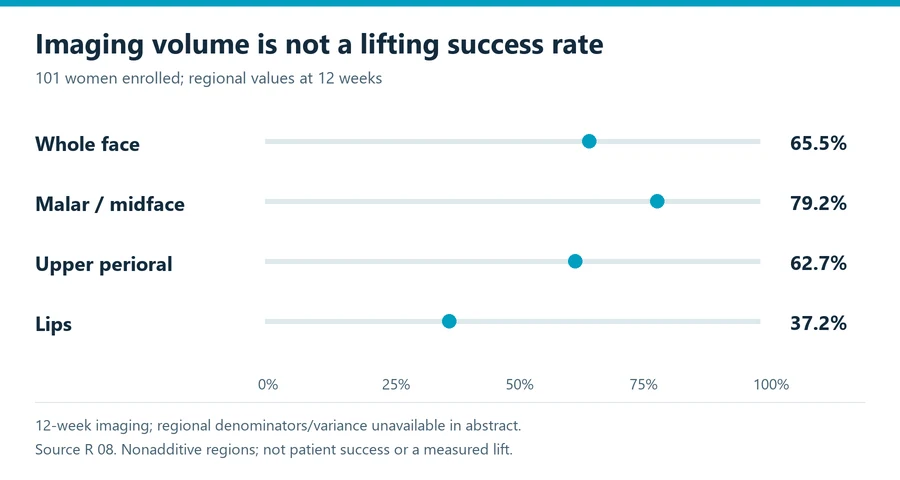
A prospective study first published online April 1, 2025 included 101 women and evaluated hyaluronic acid facial fillers over 12 weeks. Reported volume maintenance was 65.5% for the whole face, 79.2% for the malar and extended midface region, 62.7% for the upper perioral region and 37.2% for the lips. Those are regional imaging metrics, not patient success rates, and the abstract does not provide complete regional follow-up denominators. Different regions and products were involved, so these values do not rank products independently or forecast your maintenance needs. Original prospective volumetric study
Read any proposed chart with the endpoint in view. A bar labeled volume maintenance should not be relabeled lifting, satisfaction or filler still inside the body. Likewise, a twelve-week endpoint should not become a twelve-month promise. This prevents an appealing visual from answering a more ambitious question than the research actually tested.
Compare injections with the surgical goal
A surgical facelift addresses visible facial and neck aging through a different procedural approach. ASPS describes concerns including sagging, folds, jowls and loose skin. Injections may be relevant to selected accompanying goals, but that does not make an injectable package a surgical equivalent. Our facelift guide explains that separate decision in more detail. ASPS facelift scope
Write down the feature that would make treatment worthwhile. If it is removal of a hanging skin fold, ask how the proposed injection plan is expected to address that specific feature. If it is a modest restoration of fullness without surgery, ask what degree of change is reasonable and what tradeoffs come with adding volume. These are distinct preferences rather than steps everyone must follow in an aging treatment ladder.
Choosing no procedure is also a legitimate outcome of the comparison. The useful endpoint is an informed decision consistent with your goals, not completing every item in a facial rejuvenation package. Avoid planning around a claim that injections must prevent surgery later; the studies discussed here do not demonstrate that personal long-term prediction.
Safety: assess the combination component by component
ASPS lists filler risks including asymmetry, infection, lumps, swelling and under- or over-correction. Rare vascular complications can damage tissue or eyesight. Toxin injections have a different risk profile, including temporary weakness or drooping, and rare problems with swallowing or breathing. Combining categories does not make either category’s risks disappear. ASPS filler safety ASPS toxin safety
Ask how the practice handles a suspected urgent complication, who evaluates it and how to obtain help outside opening hours. A written contact route should be usable when you are distressed, rather than relying only on a social-media account or a routine appointment portal. Know which symptoms require emergency care rather than a later cosmetic review. FDA guidance calls for immediate medical attention for unusual pain, vision changes, abnormal pale, gray or blue skin near an injection site, or signs of stroke during or shortly after treatment.
Removal needs its own discussion. The FDA notes that reducing or removing filler can require additional procedures and that some materials can be difficult or impossible to remove. Do not treat reversible as a blanket promise that every component can be undone easily or without risk. Ask how the specific material changes the available response if the result is unsatisfactory.
Previous treatment and medical history matter
ASPS recommends discussing medical conditions, allergies, medications and previous fillers, toxin, facial procedures and surgery during consultation. Bring available records, even if you were pleased with a previous result. An unexplained treatment history is a reason to clarify the plan, not a reason to guess which product was used. ASPS consultation preparation
Make the history specific enough to be useful: approximate dates, regions treated, product names if known, unexpected reactions and any later treatment of those reactions. If records cannot be obtained, state that openly. Photographs can supplement the history, but a photograph cannot identify the material under the skin or replace an examination.
Ask whether the combination is proposed at one visit or in stages and why. Staging should have an identifiable purpose, such as evaluating an initial component before deciding about another; it is not automatically superior for everyone. Establish when you will reassess and which findings would lead to postponing further treatment. Do not change prescribed medicines independently to fit a cosmetic appointment.
Recovery and judging the result
ASPS explains that filler recovery varies by patient and material and that early swelling, bruising or an initially unfamiliar appearance may occur. Arrange a specific recovery plan for all the components being used, rather than applying instructions for one injectable to the whole package. Ask how activity restrictions and follow-up fit your work, travel or important event. ASPS filler recovery
Separate the first appearance from the scheduled assessment. Decide in advance how a concern will be evaluated and whether an additional treatment would be considered only after that assessment. This avoids judging every change from a different mirror, camera angle or moment of swelling. It also gives you a basis for discussing a disappointing result without immediately assuming more product is the answer.
Use comparable photographs when documenting your own appearance: similar lighting, distance, angle and expression. Keep relaxed and expression photographs separate if the goal concerns movement-related lines. A filtered image or a different head position cannot reliably show the change you agreed to assess. These are documentation principles, not instructions for diagnosing a complication from pictures.
Cost means an initial plan plus an explicit maintenance choice
ASPS publishes separate cost information for filler and toxin treatments. Neither statistic supplies a complete liquid facelift package price, and an undated average should not be converted into a local quote. Ask for an itemized proposal identifying the actual products, pricing basis, follow-up and which possible additional treatments would be charged separately. ASPS filler cost scope ASPS toxin cost scope
| Quote component | What to obtain in writing | Comparison mistake to avoid |
|---|---|---|
| Initial treatment | Named products, regions and total charge | Comparing package names without matching contents |
| Follow-up | Timing, included assessment and any additional charges | Assuming every extra injection is included |
| Maintenance | Optional future plan, price basis and reassessment criteria | Presenting a recurring plan as one lifetime purchase |
| An unsatisfactory result | Evaluation process and correction charges | Assuming removal or revision is simple and free |
| A surgical alternative | Separate complete proposal if relevant | Comparing a partial injectable price with a complete surgical bill |
You can compare initial and continuing commitments without inventing how often you will need treatment. Ask the practice to identify which future expenses are predictable and which depend on reassessment. Keep those categories separate on your budget sheet. The cost planning guide provides a broader framework for comparing complete proposals.
Decide how a combined result will be assessed
A combination can make attribution difficult. If cheek contour improves but an expression line still bothers you, the overall package label does not tell you which component succeeded or which concern remains. Ask the clinician to assess those outcomes separately. This makes the follow-up more informative than a single overall rating and avoids interpreting satisfaction with one feature as proof that every part of the proposal worked.
Your assessment sheet can have four entries for each region: the starting concern, the intended change, the agreed review point and the observation at that review. Include a place for adverse effects and a separate place for preferences about further treatment. Being satisfied with an initial result does not commit you to repeating it. Equally, deciding against maintenance does not mean the initial treatment necessarily failed; the continuing cost, procedure experience or goals may have changed. Keep those decisions distinct from measurements of the original result.
A meaningful review checks each agreed endpoint
Return to your original treatment map at the review visit. For each region, record the agreed concern, the treatment actually performed, the current appearance and whether the goal has been met. A general statement that you look refreshed may matter to you, but it should not replace assessment of a specific unresolved concern that prompted the appointment.
Ask what the clinician thinks explains a remaining concern. Is the original goal still realistic for injections, is assessment premature, or would another type of evaluation better match the problem? The answer should precede a proposal to add more components. Documenting this reasoning makes it easier to distinguish a considered adjustment from repeatedly expanding a package without a defined endpoint.
ASPS notes that filler results vary with the material and person. There is no single duration that applies to every component of a combination. A future maintenance appointment should therefore include reassessment of your goals and treatment history rather than automatically repeating the previous plan. ASPS filler results
Bring your region map, product record and questions to the appointment. A useful liquid facelift decision ends with a clear explanation of expected changes, remaining limitations, risks, follow-up and costs. It should leave you able to describe what you are choosing in ordinary terms, without needing the package name to stand in for the medical details. Explore the procedure guides for related decisions and compare the surgical lifting question separately when it is relevant.
Sources and review scope
Plastic Surgery Editorial Team. Source records checked through October 12, 2026. Review scope: source and editorial checks for general education. No individual clinical assessment is represented.
- ASPS filler scope and surgical boundaries. plasticsurgery.org. Publication/update date not stated. Checked 2026-10-12.
- FDA consumer explanation of filler and toxin categories. fda.gov. Publication/update date not stated. Checked 2026-10-12.
- ASPS material distinctions. plasticsurgery.org. Publication/update date not stated. Checked 2026-10-12.
- FDA product-specific approval records. fda.gov. Publication/update date not stated. Checked 2026-10-12.
- FDA filler indications, safety and removal. fda.gov. Publication/update date not stated. Checked 2026-10-12.
- Original single-treatment global rejuvenation study. pmc.ncbi.nlm.nih.gov. Source date: 2023-11-22. Checked 2026-10-12.
- Original sequential full-face combination study. pmc.ncbi.nlm.nih.gov. Source date: 2020-04. Checked 2026-10-12.
- Original prospective volumetric facial filler study. pubmed.ncbi.nlm.nih.gov. Source date: 2025-04-01. Checked 2026-10-12.
- ASPS surgical facelift scope. plasticsurgery.org. Publication/update date not stated. Checked 2026-10-12.
- ASPS filler consent and risks. plasticsurgery.org. Publication/update date not stated. Checked 2026-10-12.
- ASPS toxin risks. plasticsurgery.org. Publication/update date not stated. Checked 2026-10-12.
- ASPS prior-treatment and health history. plasticsurgery.org. Publication/update date not stated. Checked 2026-10-12.
- ASPS individualized filler recovery. plasticsurgery.org. Publication/update date not stated. Checked 2026-10-12.
- ASPS filler price scope. plasticsurgery.org. Publication/update date not stated. Checked 2026-10-12.
- ASPS toxin price scope. plasticsurgery.org. Publication/update date not stated. Checked 2026-10-12.
- ASPS filler result variability. plasticsurgery.org. Publication/update date not stated. Checked 2026-10-12.