
Lipedema surgery usually refers to liposuction considered for assessed lipedema symptoms, rather than ordinary cosmetic contouring or general weight loss. Its potential value should be judged by goals such as pain relief, function and treatment burden, alongside surgical risks. Removing tissue is not the same as proving a cure or ending every need for continuing care. The NHS describes lipedema as a chronic condition without a current cure and includes liposuction among options for particularly severe symptoms. NHS lipedema guidance
A randomized German trial published in September 2026 adds important comparative evidence about leg-pain reduction. Its findings need to be read with the selected population, defined endpoint and safety results intact. This guide explains those distinctions, how older follow-up studies differ, and what to record when comparing an assessed care plan. It does not diagnose lipedema from body shape or supply a surgical technique or compression regimen.
Diagnosis comes before an operation name
Lipedema and lipoedema are spelling variants used for the same condition. The NHS describes an abnormal buildup of fat, typically affecting legs and sometimes arms, with possible pain, tenderness, heaviness and easy bruising. It also identifies other reasons for large or swollen limbs, including lymphoedema and fluid-related oedema. These features require clinical assessment; a photograph or body proportion alone does not establish the diagnosis. Primary guidance on symptoms and differential assessment
If the diagnosis is uncertain, ask what has been assessed and which other explanations remain possible. The right next step may be clarification of the condition rather than selection of a liposuction method. A plan should identify whether it is addressing diagnosed lipedema symptoms, a separate contour preference or both. The existence of unwanted fat does not make every fat-removal procedure a treatment for lipedema.
Also describe the impact on everyday life. A useful history records which tasks are difficult, where discomfort occurs and how symptoms affect activities. This is different from an appearance-only judgment about limb size. It gives the team a clearer basis for discussing a meaningful treatment goal and evaluating change later. You do not need to prove that the problem matters by adopting a particular body-image narrative.
Separate symptom goals from appearance goals
Pain reduction, easier movement, reduced treatment burden and a preferred contour are different outcomes. A procedure can affect one without establishing all of the others. If pain is the main reason for considering surgery, a before-and-after silhouette is insufficient evidence of pain relief. If appearance is also important, it can be discussed openly without replacing the symptom question.
Write the priorities separately. For example, you might want to understand whether a proposed course could reduce an assessed pain problem while accepting that the visible contour remains uncertain. Someone else may prioritize function or the burden of ongoing care. The same intervention can be evaluated differently depending on those priorities. A clear goal makes the discussion more specific than the broad phrase “remove the lipedema.”
| Goal | Useful information to record | What cannot substitute for it |
|---|---|---|
| Pain relief | Defined symptom rating and review time | A slimmer appearance alone |
| Everyday function | Activities affected and relevant assessment | A general satisfaction headline |
| Care burden | Actual current treatments and later needs | A promise to stop all conservative care |
| Appearance | Assessed contour target and its limits | Proof of symptom cure |
| Safety | Relevant surgical assessment and outcome definitions | A favorable case photograph |
This planning table is not an eligibility checklist. It helps you ask whether the proposed operation is addressing the reason you sought care and whether the outcome will be assessed in a way that reflects that reason.
Conservative care belongs in the comparison
NHS guidance describes symptom management through approaches including assessed compression, skin care, activity and support, with surgery considered in some circumstances. Compression selection should be made by a trained clinician. The relevant comparison is therefore a real care plan, not a caricature in which every nonsurgical option means doing nothing. NHS treatment options
Tell the team what care you have actually received, how consistently it was feasible and what changed. Difficulty tolerating or obtaining a treatment is different from evidence that it had no effect. Likewise, improvement in one symptom does not establish that all concerns were resolved. A written record helps the discussion stay grounded in your experience without treating a single generic treatment sequence as mandatory for everyone.
Ask which elements would continue if surgery were selected and how those decisions would be reviewed. Do not stop compression or other prescribed care based on a favorable surgical study. A reduction in a group’s reported treatment burden is not an instruction for an individual to stop care. The postoperative plan should explain what is expected, what is reassessed and who coordinates those decisions.
What the 2026 randomized trial actually tested
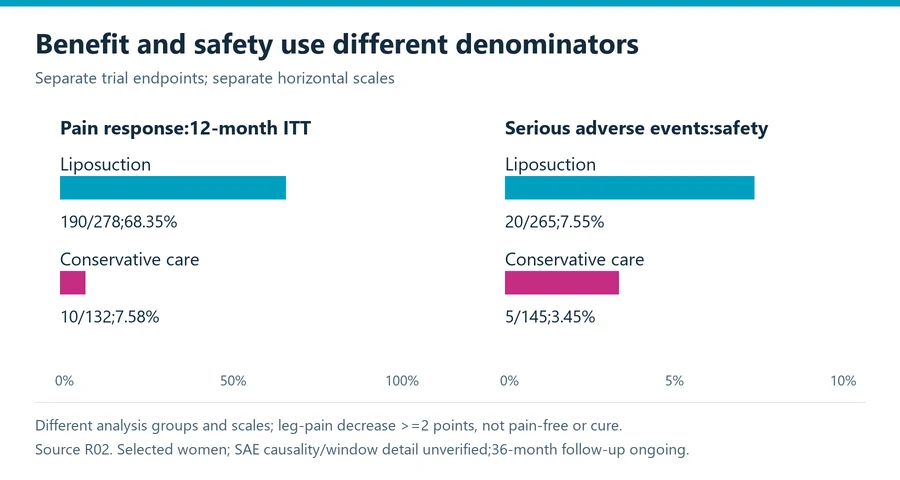
The German trial enrolled women with assessed stage I, II or III lipedema and qualifying leg pain after a conservative-care phase. At 12 months, 190 of 278 assigned to liposuction and ten of 132 assigned to conservative therapy met the endpoint: a reduction of at least two points on a ten-point leg-pain scale. Missing assessments counted as not meeting that endpoint. These are randomized-group denominators, not counts of operations. Original September 2026 randomized trial
The safety analysis used different denominators: serious adverse events were reported in 20 of 265 in the surgical group and five of 145 in the conservative group. A 36-month follow-up was still ongoing in the report. The result supports a comparative pain-relief finding in this trial while preserving the separate safety question; it is not a cure rate, a guarantee or an estimate for every person considering surgery.
The practical interpretation is to ask whether your assessed circumstances resemble the studied question and what the team expects regarding both benefit and harm. A randomized comparison is more informative about the treatment comparison than a selected success gallery, but it still cannot decide for an individual. It also cannot supply results that have not yet been reported. An ongoing long-term assessment should not be described as completed evidence.
Pain response is a threshold, not freedom from pain
Meeting a minimum change on a scale does not mean that all pain disappeared. A threshold can be valuable for a study because it defines the outcome consistently. It still leaves questions about residual symptoms, other forms of discomfort and the importance of that change to daily life. Those questions should remain visible when the endpoint is discussed.
Similarly, not meeting the threshold does not describe every aspect of a person’s experience. They might report a smaller change, a different functional outcome or a missing assessment. The trial defined how those situations entered its primary analysis. An educational chart should retain the definition rather than relabeling everyone as a success or failure in the broader sense of their entire care experience.
Benefit and safety charts need separate denominators
An accurate supporting graphic can use two panels. The first shows the published pain-response counts over randomized-group totals at 12 months. The second shows serious-event counts over the reported safety-group totals. Each panel should carry its own denominator, endpoint and time context. Combining the populations in one stacked bar would make the graphic look simpler while answering the question incorrectly.
These two outcomes also should not be subtracted to manufacture a “net success” percentage. A person can experience symptom improvement and an adverse event, so the outcomes need not be mutually exclusive. An event definition may encompass more than a reader assumes from a short label. A chart is useful when it explains those distinctions; it is misleading when it removes them to produce a single reassuring number.
The chart should use neutral colors and actual count labels rather than a green approval badge. It should identify the selected trial and avoid implying that the percentages describe all surgical techniques or current local practice. The numerical evidence becomes more useful, not less, when readers can see exactly what was counted.
| Evidence item | Population or unit to preserve | Interpretation to avoid |
|---|---|---|
| Randomized pain endpoint | People assigned to each group | Pain-free or cured percentage |
| Safety endpoint | People in the reported safety analysis | Reusing randomized totals automatically |
| Repeated operations | Procedures within a care course | Counting each as a new independent person |
| Long-term respondent study | People available for that later assessment | Guaranteed lifetime result for all patients |
| Appearance photograph | A documented individual and timepoint | Measured function or pain relief |
Older long-term studies answer a different question
A study published online August 26, 2020, followed a selected group of 60 people with questionnaires at approximately four, eight and twelve years after liposuction. It reported persistent improvements in several symptoms and care-related measures. This is useful longer-follow-up information, but it was a single-center observational group rather than a randomized comparison of everyone considering surgery. Original longer-term follow-up study
The distinction between duration and design matters. A long observation period does not automatically remove selection effects or establish that the same result will occur in a different population. Conversely, a randomized trial with a shorter reported follow-up does not answer every question about durability. These studies should be read alongside one another without pooling their outcomes into an invented lifetime success rate.
Ask what “lasting” means in the specific explanation you receive. Is it a reported symptom change at a defined visit, less need for a certain therapy or stable appearance? Is the claim based on all treated people or only those available at follow-up? A meaningful discussion names both the endpoint and the observation period rather than relying on the study title’s longest number.
A ten-year study window is not ten years of follow-up for everyone
A separate retrospective report published March 1, 2022, included 106 patients and 298 liposuction procedures performed within a ten-year treatment window. The reported median follow-up was 20 months. Those numbers illustrate two important distinctions: procedures are not people, and the period during which treatment occurred is not each person’s follow-up duration. Original multistage before-and-after study
The report examined symptoms and conservative-care needs without a concurrent randomized comparison. Its findings can inform questions about a staged course, but they do not establish that a particular number of operations is necessary for you. Nor should subgroup associations be turned into universal cutoff rules without an appropriate clinical and policy basis. An individual assessment should explain its own eligibility reasoning.
These reading habits also help evaluate clinic claims. If a claim says that a method was “studied for ten years,” ask whether that refers to recruitment, the operation period or follow-up. If it cites hundreds of procedures, ask how many people those procedures represent. A larger-sounding number is not necessarily a larger independent patient group.
Guidance dates and coverage decisions are different from new evidence
NICE moved its March 2022 liposuction-for-lipoedema guidance to the HealthTech numbering system in January 2026 and stated that the recommendations were unchanged. A new guidance number does not itself mean that the September 2026 trial had already been incorporated. The date of an administrative change and the date of a new clinical evidence assessment are different facts. NICE’s published migration notice
This guide does not present that notice as a current individualized eligibility or funding decision. Ask the relevant care service or insurer for the actual policy that applies to you, its effective date and the information needed for assessment. A study demonstrating a benefit does not automatically guarantee coverage, and a policy label does not replace explanation of the clinical evidence.
If the team references a guideline, ask which version it is using and how it interprets newer research. The answer may depend on jurisdiction and the service’s responsibilities. An educational article should not collapse international guidance, insurer requirements and clinical judgment into one universal rule. Written decisions are more useful than an assurance that surgery is always covered or never covered.
The operative course needs a safety and follow-up plan
The NHS notes that more than one operation may be needed. A proposed course should therefore distinguish the initial stage from possible later stages and explain the reason for the sequence. This is a clinical planning issue, not a reason to choose the largest amount of removal from a published paper. Tissue volumes, device settings and procedural details in a study are not personal treatment targets. NHS discussion of the treatment course
Ask how the team will assess readiness, review the result and decide whether another stage remains appropriate. Obtain a clear explanation of anesthesia, the facility, relevant medical assessment and aftercare for the actual plan. If multiple conditions or treatments are involved, understand who coordinates them. A series of separately advertised appointments should not obscure the responsibility for the whole course.
You also need written instructions and an urgent contact pathway. New or rapidly changing symptoms deserve medical assessment rather than automatic attribution to chronic lipedema. This guide does not supply a compression pressure, duration, massage routine or medicine adjustment. Those decisions belong to the assessed care plan and should be explained by the responsible team.
Compare the complete commitment, including continuing care
An estimate should identify what is being proposed and which stages it covers. A surgeon fee alone is not necessarily the total course cost. Ask about facility and anesthesia charges, assessed garments or therapy, follow-up, travel and possible future stages. Record what is included and what is only an estimate. No national total is supplied because the verified primary sources do not provide a current comparable pricing dataset.
| Planning item | Information to obtain | Why it matters |
|---|---|---|
| Assessed objective | Symptoms, function and appearance considered separately | Defines the relevant outcome |
| Proposed stages | Initial plan versus contingent later procedures | Clarifies the course and cost |
| Continuing care | Who reviews compression or other treatment | Avoids assuming surgery ends all care |
| Safety and contact | Assessment, facility and written response pathway | Establishes care responsibility |
| Financial decision | Itemized estimate and actual coverage determination | Separates a fee from total expense |
Use the cost planning guide to structure the estimate. The general liposuction guide explains the broader procedure but does not replace this condition-specific decision. Choosing surgery should be based on the assessed indication and care plan rather than treating a cosmetic contour quotation as automatically comparable.
Keep a baseline that reflects your own daily life
Before deciding, describe an ordinary day rather than only the worst day or the most favorable one. Record which activities are affected and what care already helps, using the same language when the plan is reviewed. If walking, standing at work or managing garments is the main concern, include that concern explicitly. A change in a photograph can then be discussed alongside, rather than instead of, the problem that led you to seek help.
Agree with the team on how those priorities will be reassessed. A pain score may be one part of the review, but it is not the whole of daily experience. Keeping your own priorities visible also makes a continuing-care decision easier to understand. You may value a partial improvement while still needing support, or decide that the expected change does not justify the proposed burden.
A sound decision keeps relief, risk and uncertainty together
Symptom improvement is meaningful without being called a cure. The current evidence supports more specific questions than whether surgery is simply good or bad: which people were studied, what improved, over what period, and what harms were recorded? Those questions help a team explain the relevance to your circumstances while preserving uncertainty where the evidence has limits.
You should leave the discussion understanding the diagnosis, the main goal, the proposed course and how continuing care will be assessed. You should also know which expectations are not guaranteed. A decision to proceed, seek further assessment or continue another approach can then reflect your priorities and circumstances. For preparation, see consultation questions and the procedure guide library.
Sources and review scope
Plastic Surgery Editorial Team. Source records checked through October 12, 2026. Review scope: source and editorial checks for general education. No individual clinical assessment is represented.
- NHS lipedema symptoms and treatment. nhs.uk. Source date: 2023-07-25. Checked 2026-10-12.
- Original2026GermanrandomizedLIPLEG trial. pubmed.ncbi.nlm.nih.gov. Source date: 2026-09-05. Checked 2026-10-12.
- Original4/8/12yearlipedemafollowup study. pubmed.ncbi.nlm.nih.gov. Source date: 2020-08-26. Checked 2026-10-12.
- Original multistage lipedema beforeafter study. pubmed.ncbi.nlm.nih.gov. Source date: 2022-03-01. Checked 2026-10-12.
- NICE guidance migration notice. nice.org.uk. Source date: 2022-03-29. Checked 2026-10-12.