
Latissimus flap reconstruction uses tissue from the back to rebuild breast shape. In the usual breast-reconstruction description, the flap retains its original blood supply as it is moved to the chest; this is called a pedicled flap. The decision needs to address both the reconstructed breast and the back donor site, including shoulder-related goals. Ask whether an implant or other later component is also part of the proposal.
NCI identifies the latissimus dorsi flap as a back-based option and distinguishes it from a free flap whose blood vessels must be connected to a new supply. These terms explain different reconstruction concepts; neither is a promise of a complication-free operation or a reason to choose an approach without assessment. A useful plan connects the tissue choice to the cancer-treatment context, anatomy and preferences. NCI back-flap reconstruction description
Understand the donor tissue and the intended breast shape
Gateshead Health describes a latissimus dorsi reconstruction using back skin and muscle while keeping the flap’s blood vessels attached near the underarm. Its patient guidance also describes an expander or implant as a possible additional component. Ask what tissue is proposed in your case and whether the breast mound will rely on the flap alone or a combination. The broad phrase using your own tissue does not settle that device question. Gateshead latissimus flap guidance
Request a plain explanation of what the flap is intended to provide: tissue coverage, breast volume or particular shape goals. If an implant is included, ask what additional role it has. A hybrid plan has both donor-site and device commitments, and neither should disappear from the discussion because the other component sounds reassuring. Do not infer the complete proposal from a single technique name.
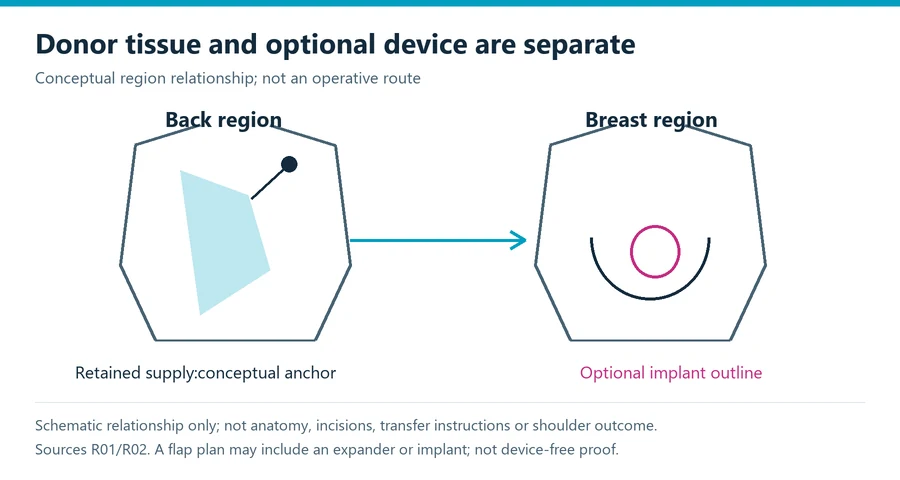
Ask the surgeon to distinguish the donor region from the breast region in the written plan. A diagram can help show that relationship, but it should not become a self-treatment instruction or a promised healed appearance. You need to understand where the tissue comes from and the general reconstruction concept, not learn an operative route from an illustration.
Explain the appearance priorities that matter to you. You may care most about clothing fit, a particular contour or the relationship to the other breast. Ask how the proposed tissue and any device address those priorities and what differences may remain. Rebuilding breast shape does not automatically answer every question about sensation, nipple appearance or symmetry.
Compare the back donor site with your actual daily demands
The back donor site deserves an independent assessment, not only a mention of a scar. Tell the team about existing shoulder symptoms, prior surgery and activities that use your arms and back. Describe the actions rather than using a broad label such as active lifestyle. Pulling, lifting, reaching and repetitive work may matter differently to you, and the discussion should reflect those priorities.
A prospective observational study assessed 20 women undergoing delayed LD reconstruction, with 17 completing follow-up. It measured shoulder-related outcomes before surgery and at three and twelve months, using both objective testing and reported daily activities. That design distinguishes a measured functional endpoint from a photograph of the breast result. The small selected cohort does not establish what will happen to a particular reader. Original prospective LD donor-site study
Ask how your baseline function will be considered and what kind of follow-up is planned. A statement that people manage daily activities does not answer whether a demanding sport or job will feel the same. Similarly, a measured strength change does not automatically mean inability to perform every ordinary task. These are separate outcomes, and a useful explanation avoids replacing one with the other.
| Donor-site priority | Specific question | Endpoint to keep separate |
|---|---|---|
| Existing shoulder symptoms | How will the baseline be assessed? | A pre-existing issue versus postoperative change |
| Heavy or repetitive work | Which actual tasks matter to planning? | Ordinary daily activities versus job demands |
| Sport or exercise | What movements should the team understand? | Range of motion versus strength or endurance |
| Back scar and sensation | What tradeoffs are included in consent? | Breast appearance versus donor-site experience |
| Follow-up support | Who evaluates function and guides progression? | A generic calendar versus individual assessment |
Use this record to make the donor discussion as concrete as the breast discussion. If you rely on a particular movement for work or recreation, say so before deciding. The guide does not prescribe an exercise routine, a lifting limit or a recovery deadline. It helps identify which functional questions the treating and rehabilitation teams need to answer.
Do not mix different shoulder-study populations
A separate prospective report followed 18 patients who underwent a pedicled latissimus muscle flap and postoperative radiation after breast-conserving surgery. It assessed shoulder movement and strength before treatment and through three years. That treatment context differs from the delayed reconstruction cohort described above. Its observations should not be pasted into a mastectomy reconstruction estimate as if every participant had the same pathway. Original shoulder and radiation follow-up study
The useful question is whether evidence matches the proposed operation, accompanying treatments and endpoint. A report after breast-conserving surgery, a delayed postmastectomy report and a general reconstruction study may each contribute information, but they are not interchangeable. Ask the team to identify the source behind a numerical claim and explain how it relates to your assessment.
Strength, motion and daily activities are different questions
An objective strength test measures a defined action under the study’s testing conditions. A motion measure describes how far a movement can be performed. A questionnaire asks about the person’s reported experience. One can change while another gives a different picture. A claim of normal function should specify which measure and follow-up it refers to rather than implying that all aspects are unchanged.
The checked 2022 abstract contains inconsistent wording about isometric strength: it reports losses in specified actions and also says isometric strength was unchanged. Without reconciling the full methods and results, this guide does not turn those percentages into a strength chart or a personal forecast. This is a source limitation, and the appropriate response is to keep the unresolved measurement detail out of a numerical promise.
The follow-up denominator also matters. Seventeen completed observations from twenty enrolled people should not be described as twenty complete twelve-month results. Nor should the three people without completed follow-up be labeled as having good or bad outcomes. Clear denominators make the research more useful without pretending that missing data reveal an answer.
| Evidence detail | What it helps establish | Interpretation to avoid |
|---|---|---|
| Twenty enrolled, seventeen completed in one study | The actual follow-up scope | Twenty complete twelve-month outcomes |
| Defined shoulder action | What an objective test measured | Every daily activity has the same change |
| Patient-reported daily activities | A different functional endpoint | Proof that strength is identical |
| Breast-conserving surgery plus radiation in another report | That study’s treatment context | A universal postmastectomy prediction |
| Unresolved abstract wording | A measurement gap needing clarification | A polished chart with an unverified conclusion |
Ask which uncertainties remain when discussing donor-site function. A candid account of source gaps is more informative than a guaranteed return to every activity. At the same time, the existence of a reported functional change does not decide against the procedure for everyone. It belongs in the assessment and preference discussion, with your actual demands stated clearly.
Separate the flap decision from an implant decision
A back-flap reconstruction that also uses an implant carries both sets of commitments. Ask whether an implant is already part of the proposed plan, might be considered after assessment or is not currently anticipated. Those descriptions mean different things. If the plan changes, request a revised explanation rather than assuming the original own-tissue description still covers the entire course.
FDA states that breast implants are not lifetime devices and that complications can lead to further surgery. Its guidance includes capsular contracture, rupture and changes in breast or nipple sensation. If a device is proposed alongside a latissimus flap, those concerns remain part of the discussion; tissue coverage does not establish that device risk is eliminated. FDA breast implant risks
Request the actual device’s patient labeling and monitoring information. If an expander is proposed first, ask what it contributes to the sequence and what later operation is intended. This guide does not choose an implant, prescribe a filling course or suggest a fixed replacement date. The relevant details depend on the device and the assessed reconstruction and treatment context.
If avoiding a device is a priority, discuss that preference explicitly and ask how the available alternatives relate to your goals. A device-free plan may have its own donor-site or staging considerations. Avoid treating no implant as a complete description of safety or suitability. The comparison should explain the whole pathway rather than selecting one attractive difference from each option.
Coordinate timing with the treating teams
Ask whether the reconstruction is proposed alongside mastectomy or after earlier treatment, and why that timing fits the clinical plan. If radiation is anticipated or has already occurred, request a coordinated explanation of how it affects the available options. This guide does not advise changing cancer treatment to obtain a preferred reconstructive sequence. The relevant discussion needs both oncology and reconstruction information.
If some decisions depend on information not yet available, identify them in the written plan. Ask which choice is needed now and which may be revisited. An uncertain future step should not be sold as a guarantee, but it should also not be left so vague that you cannot arrange care and support. The plan should explain what new assessment would inform that decision.
Discuss whether additional contour, nipple or opposite-side work is anticipated. A completed flap transfer is not automatically completion of every appearance goal. If later components are already expected, request their purpose and anticipated coordination. Keep a planned stage separate from an unplanned operation for a complication or a later elective revision.
Give the back wound and breast care their own arrangements
Gateshead guidance describes scars at the reconstructed breast and the back donor site and discusses fluid collections called seromas around the back wound. Ask how the team monitors and evaluates each region. This guide does not provide an individual event rate, drainage threshold or a home procedure for managing a collection. A new concern requires the treating team’s assessment rather than interpretation from an illustration.
Request a clear contact plan that states who will handle wound questions, functional concerns and device concerns if applicable. When several teams are involved, clarify how information is shared. You should not have to decide from symptoms alone which service owns the issue. A practical care plan remains important even when the operation is described as a familiar or established technique.
Describe the help available at home and the demands of caregiving, commuting and work. Ask the team which tasks require support and what assessment determines progression. A general return-to-work date cannot capture every physical duty. This guide does not replace discharge instructions or prescribe a rehabilitation routine; it identifies the practical questions those instructions should address.
Ask how existing shoulder limitations will be recorded so later assessment has an appropriate baseline. If rehabilitation is part of the plan, clarify who provides it and how it fits any other treatment. A generic exercise sheet from another hospital may have been written for a different operation or accompanying axillary procedure. Obtain advice that fits your own assessed course rather than assembling a routine from unrelated leaflets.
Compare complete plans and complete estimates
Consider two different planning priorities without assuming that they belong to actual patients. Someone whose leading concern is breast shape in a particular garment may ask first about the mound and opposite-side relationship. Someone who performs repeated pulling movements at work may place more weight on the donor-function assessment. Both need the full information, but their priorities can change which unanswered question deserves attention first. The same favorable breast photograph cannot answer both decisions.
For a demanding movement, write down the action, load, repetition and whether help or adaptation is available. You do not need to estimate a medical safe limit yourself. The purpose is to give the clinical team a concrete description of the task. Asking whether a person can return to exercise is less precise than asking how the proposed reconstruction will be assessed in relation to the action that person actually wants to resume.
For an appearance concern, distinguish a breast endpoint from a donor-scar preference. Ask how each will be documented and whether the proposed scar discussion covers the views that matter to you. A portrait of a relaxed shoulder is an illustration of a topic, not proof that your donor scar will have a particular appearance. Keeping that distinction clear prevents educational imagery from becoming an accidental outcome promise.
If the plan introduces an implant only after the first consultation, review the device questions again rather than treating the addition as a small technical detail. Ask whether the proposed course, monitoring and financial scope have changed. Likewise, if the team proposes further donor assessment, ask which unanswered functional question it addresses. A revised plan can be appropriate, but the reason for its revision should remain understandable.
The comparison becomes more useful when each option is described using the same priorities. Record the breast goal, donor region, possible device, expected stages and unresolved questions in parallel. Do not rank one option solely by a photograph and another solely by a complication statistic. They need comparable descriptions before their different tradeoffs can be weighed.
The checked primary sources do not establish a contemporary national total price for a latissimus flap reconstruction pathway. Obtain a dated explanation of the proposed course and included services. If an implant, expander, later contour procedure or opposite-side operation is involved, have those components identified rather than assuming they are included in a single quoted figure.
| Course component | Detail to record | What it prevents |
|---|---|---|
| Flap and donor site | Proposed tissue and assessed goals | Treating the breast result as the only endpoint |
| Device, if included | Implant or expander role and actual information | Assuming own tissue means device-free |
| Additional stages | Purpose and decision point | Confusing expected stages with unexpected care |
| Rehabilitation and follow-up | Responsible service and included arrangements | Missing donor-function support |
| Payer and further-care terms | Applicable authorization and charges | Treating a general coverage statement as a personal total |
When coverage is involved, verify the actual payer’s requirements and financial details with the team. A reconstructive indication and a quoted price do not independently settle all out-of-pocket amounts. Ask which stage or service the estimate describes and what needs separate authorization. The guide does not promise coverage or import a UK hospital’s arrangements into a US insurance decision.
Compare value using the whole pathway and your own priorities. A back-based proposal, an abdominal alternative and a device-based proposal can differ in clinical suitability, donor commitments and follow-up. A shorter operation label or a smaller initial estimate cannot establish which fits you best. Request the rationale and limitations for the actual options available after assessment.
Decide with both the donor and breast goals visible
Latissimus flap reconstruction is a back-to-breast tissue option that needs a two-region discussion: what the reconstructed breast is intended to achieve and what the back and shoulder assessment means for you. Clarify whether a device is included, how treatment timing is coordinated and which later components are anticipated. Read functional research by its actual population, measure and completed follow-up.
Before consenting, check that your important movement and appearance priorities are both represented in the written objectives. If the plan explains one region in detail and the other only as a minor scar, ask for the missing discussion. An informed choice rests on the complete proposed pathway and its tradeoffs, with source limitations and personal priorities made explicit.
For related preparation, see questions to ask a plastic surgeon, plastic surgery recovery and the procedure guide index.
Sources and review scope
Plastic Surgery Editorial Team. Source records checked through October 12, 2026. Review scope: source and editorial checks for general education. No individual clinical assessment is represented.
- NCI back-based breast reconstruction. cancer.gov. Source date: 2025-12-02. Checked 2026-10-12.
- Gateshead LD flap patient guidance. gatesheadhealth.nhs.uk. Source date: 2024-11-25. Checked 2026-10-12.
- Original prospective LD donor-site morbidity study. pubmed.ncbi.nlm.nih.gov. Source date: 2022-01-31. Checked 2026-10-12.
- Original prospective LD plus radiation shoulder study. pubmed.ncbi.nlm.nih.gov. Source date: 2016-07-05. Checked 2026-10-12.
- FDA breast implant risks. fda.gov. Publication/update date not stated. Checked 2026-10-12.