
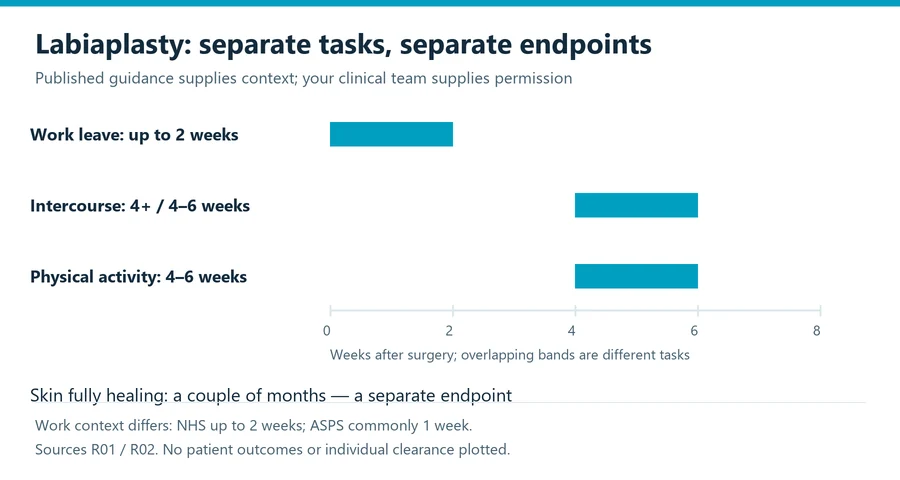
Labiaplasty recovery needs separate plans for sitting, clothing, work, exercise and intimacy. The NHS suggests allowing up to two weeks away from work, avoiding sex for at least four weeks and avoiding physical activity for four to six weeks. These are general planning windows, not permission to restart a particular task. Your own surgeon’s instructions take priority, especially if another operation is included. NHS labiaplasty guidance
This resource concerns adults recovering from surgery to the labia. It does not define an ideal genital appearance or suggest that naturally prominent labia need correction. Its purpose is to make an existing surgical plan easier to organize: what needs help, what should be clarified before discharge, and how to obtain assessment when something changes. A work date, a comfortable afternoon and healed skin are different milestones. Treating them as one deadline can leave important questions unanswered.
What should a labiaplasty recovery plan include?
Start with the exact name and scope of the planned operation. Ask whether your instructions concern labial tissue alone or include another area, and make sure the written discharge sheet matches that scope. An online account of someone’s recovery cannot tell you which incision, technique or additional procedure they had. You do not need a technical drawing to plan daily life, but you do need to know which activities your team wants you to avoid and when they will reassess them.
Create a practical list of your usual day: getting dressed, using the toilet, commuting, sitting through meetings, caring for children, preparing food and exercising. Beside each item, write the question you need answered rather than an assumed return date. For example, a short seated call and an entire shift at a desk create different demands. Ask about the duration, position and break opportunities of your actual task. This produces a more useful discussion than asking when everything will feel normal.
For labiaplasty recovery at home, establish who can help with errands and physically demanding chores while your clinical restrictions apply. Keep assistance specific. Someone bringing groceries is different from someone being available to take you to an urgent appointment. If you live alone, discuss that before surgery so the discharge arrangements reflect the support you have, rather than relying on last-minute improvisation. These household arrangements are planning suggestions, not evidence that a particular support schedule improves surgical outcomes.
Keep the clinic’s daytime and after-hours contact instructions together with your appointment details. Ask what to do if the usual clinician is unavailable and where to go for urgent assessment. A messaging portal may be appropriate for a routine administrative question, but its response time should not be assumed suitable for a worsening symptom. Clarify that distinction while you are well enough to take notes, and give the person helping you a copy of the relevant contact information.
How do the labiaplasty recovery milestones differ?
The useful distinction is between being able to do a task, being comfortable doing it and receiving permission to do it. Those can occur at different times. The planning table collects general guidance so you can discuss leave and commitments before surgery. It does not make an appointment, examination or your own postoperative instructions optional. Avoid converting the earliest point in a range into a promise to an employer or partner.
| Labiaplasty recovery question | Published general context | What still needs an individual answer |
|---|---|---|
| How much work leave should I discuss? | NHS: up to two weeks; ASPS: commonly a week | Sitting demands, commuting, available breaks and surgical scope |
| When can intercourse resume? | NHS: at least four weeks; ASPS: four to six weeks | Healing assessment and the specific activity intended |
| When can physical activity resume? | NHS: avoid for four to six weeks | Which movement, intensity and progression your surgeon permits |
| When is the skin fully healed? | NHS: a couple of months | Your actual incision and any concerns at follow-up |
The ASPS overview gives a shorter work estimate than the NHS and discusses intercourse within a four-to-six-week interval. That difference is a reason to obtain a personalized plan, rather than choose whichever number best fits an existing commitment. The pages describe general contexts, not a head-to-head study of recovery schedules. ASPS labiaplasty overview
An original planning diagram accompanies these milestones. Its separate lanes deliberately avoid a single finish line: leave from work, physical activity, intimacy and longer skin healing answer different questions. The chart contains guidance intervals, not observations from patients or probabilities of being ready. Use it to notice a missing conversation. If your discharge instructions discuss exercise but say nothing about a long commute, add that practical issue to the next call.
When scheduling something important, describe the consequence of being unable to attend. A flexible remote meeting can move. A nonrefundable trip, physically demanding shift or event with limited bathroom access may be harder to adjust. Discuss those constraints with your team before deciding on surgery timing. The value of this exercise is organizational: it makes the decision visible and allows an alternative arrangement. It does not establish a medical cutoff for travel or work.
How can sitting, toileting and clothing be discussed before discharge?
Labiaplasty recovery often raises questions that people feel awkward asking. Write them down in ordinary language. You can ask how you should use the toilet, what kind of washing instructions apply, and whether your usual underwear or work clothing may rub the treated area. There is no need to use a product name or follow another patient’s routine to make the question legitimate. Specific instructions should come from the team that knows your incision.
The NHS notes that sitting and passing urine can be uncomfortable initially and recommends loose clothing to reduce rubbing. It also describes soreness, bruising and swelling for up to two weeks. That broad description does not identify the cause of a new or worsening symptom. NHS recovery and side effects Ask your team how they want you to report a change and what would warrant contact sooner than your booked review.
Make a private, practical bathroom plan
Consider where the written instructions and approved supplies will be kept, whether you can reach them comfortably, and how you will obtain help without compromising privacy. Ask the clinic to explain its own cleaning and drying method and what to do if you are unsure about it. This article does not supply a home wound-care recipe, recommend a cleanser or suggest adding ointments. An ordinary household product should not be presumed appropriate for a surgical area because it is described as gentle.
If menstruation may occur during your recovery, ask about the team’s advice for the products you usually use and any restrictions that apply. Similarly, clarify whether a garment, dressing or stitch needs a scheduled review and who will change or remove it if necessary. Record the answer in the words your team uses. A follow-up instruction is easier to carry out when the item, responsible person and next step are clear, rather than summarized as general hygiene advice.
For clothes, identify the pressure or friction question rather than buying a special recovery wardrobe first. Bring examples of your usual work outfit into the consultation discussion. If uniform requirements are restrictive, consider asking your employer about a temporary adjustment without disclosing intimate surgical details. The aim is a workable arrangement that follows your clinical instructions. Comfort claims in clothing advertisements cannot establish whether a specific item is suitable for your operation.
How should work and everyday responsibilities be arranged?
Work planning for labiaplasty recovery should include the journey as well as the job. Explain whether you drive, use public transport, stand for long periods or sit without easy breaks. A return date may look reasonable on a calendar yet fail to account for those demands. Ask the surgeon what needs to be reassessed before that date and whether a staged arrangement would make sense in your circumstances. Do not treat working from home as automatic medical clearance.
A useful request to an employer describes temporary job functions rather than an anatomy discussion. Examples include flexibility around meetings, a shorter initial day or reassignment of demanding tasks, if your care team supports the arrangement. Employment policies differ; this guide does not establish your entitlement to leave or accommodations. Arrange the administrative conversation early enough that you know which documentation is required and which person will receive it.
List responsibilities outside paid work separately. Childcare may include lifting, bathing, floor play and overnight interruptions. Caring for another adult may require transfers or sustained standing. Pet care may involve pulling on a lead or carrying supplies. Give these examples to the team instead of assuming they count as light activity. If a task is restricted, arrange a named substitute and an alternative if that person cannot attend.
For labiaplasty recovery appointments, keep a transport plan that does not depend on an unconfirmed driving date. Ask how anesthesia, prescribed medicines, comfort and your actual ability to perform driving tasks affect the advice. A convenient appointment time does not establish readiness to drive yourself there. Confirm the plan with the treating team and check relevant insurer or legal requirements where applicable; no universal postoperative driving interval is asserted here.
Before resuming a longer day, ask which unresolved issues should be discussed first. If you still need a clinical answer about a particular task, mark it pending in your plan rather than filling the gap with a general timeline. This is especially helpful when someone else is coordinating your schedule: they can see that an invitation remains tentative. It also reduces the chance that a public commitment becomes the reason to override a private care instruction.
What should be clarified about exercise and intimacy?
Separate movement needed for daily life from a training session. Walking to the bathroom, carrying a laundry basket, cycling, lifting weights and a high-impact class are not interchangeable requests. Ask your surgeon to identify what is permitted and how it will be reconsidered. This resource does not prescribe an exercise program, a lifting weight limit or a method for testing an incision. Describe the activity accurately enough that the answer addresses its real demands.
During labiaplasty recovery, the word exercise may conceal pressure, rubbing or a prolonged position. Mention those features when discussing a bicycle seat, yoga movement, swimming or your usual sport. If your team gives a restriction, note whether it concerns all activity in that category or a particular movement. Clarify any ambiguity before restarting. A friend being comfortable with a sport after their surgery does not establish permission for your operation.
Intimacy deserves its own conversation, rather than being folded into a gym timeline. Ask about the activity you intend, the healing review required and what to do if discomfort occurs. You do not owe a partner a deadline based on a general web range. Arrange the conversation so you can communicate both a clinical restriction and your own preference without pressure. Permission from a clinician and willingness to participate are separate requirements.
Use the review visit to resolve unanswered questions about ongoing sensitivity, comfort or concerns about appearance. The purpose of that appointment is not simply to confirm the date has passed. Describe the issue and its effect on a real task. Avoid repeatedly manipulating the area to check readiness or attempting to correct a concern yourself. If your team recommends waiting or reassessment, ask when and how that next assessment will occur.
Which changes require medical assessment?
A worsening problem should be assessed on its own merits, not dismissed because you are still within an expected recovery interval. The NHS advises contacting the treating surgeon for complications after labiaplasty. If you are concerned about bleeding, possible infection, an unexpected change or difficulty with your recovery, use the contact route your team supplied. This guide cannot determine whether a symptom represents normal healing, a complication or another condition.
General postoperative gynaecology guidance from Gloucestershire Hospitals identifies problems such as worsening wound symptoms or difficulty passing urine as reasons to obtain advice. Its operations include broader gynaecological surgery; its timetable is not imported here as a labiaplasty timetable. Hospital postoperative warning guidance Tell the clinician what operation you had, when it occurred and what changed. Do not rely on a photo comparison to decide whether contact is necessary.
New breathing difficulty, chest pain or fainting requires immediate emergency help; in the United States, call 911. New limb swelling, pain, warmth or discoloration needs prompt medical assessment. These are general clot warning symptoms from CDC guidance, not a claim about the likelihood of a clot after labiaplasty. CDC clot warning symptoms An emergency call should not wait for a routine clinic message to be answered.
When calling about a non-emergency concern, say whether you can pass urine, whether the problem is getting worse, and what instructions you have already received. Keep the details factual. Do not change medication, remove stitches or add topical treatment to experiment with the cause. If you cannot reach your team and the problem needs urgent assessment, use an appropriate urgent medical service. A later follow-up appointment is not a substitute for attention to a current concerning change.
How can follow-up make the next decision clearer?
Bring a short task list to each review. Ask which activities are now permitted, which remain restricted and which need another assessment. For each unanswered question, record the next action and who will provide it. This makes labiaplasty recovery easier to coordinate without pretending that a universal chart can predict your healing. A simple note such as ask before returning to cycling is more useful than an unsupported green light.
If appearance is worrying you, explain the concern to your surgeon without assuming that a short work-leave interval also marks the final appearance. Ask when it is appropriate to assess that issue and what changes should be reported sooner. Keep private images secure if the clinic specifically requests them through an approved channel. Images used to communicate with your own team are different from public before-and-after marketing and should not be treated as a public obligation.
The practical endpoint is an organized plan that can change: the task, the clinical instruction, available help and the next review. Keep unresolved permissions visible rather than burying them in a hopeful return date. Labiaplasty recovery may involve more than one adjustment to work or social plans, and a clear explanation of what you still need answered helps everyone coordinate without forcing a prediction.
For related procedure context, read labiaplasty and the plastic surgery recovery guide.
Sources and review scope
Plastic Surgery Editorial Team. Source records checked through October 12, 2026. Review scope: source and editorial checks for general education. No individual clinical assessment is represented.
- NHS labiaplasty guidance. nhs.uk. Source date: 2023-09-27. Checked 2026-10-12.
- ASPS labiaplasty overview. plasticsurgery.org. Publication/update date not stated. Checked 2026-10-12.
- CDC: About venous thromboembolism. cdc.gov. Source date: 2025-03-05. Checked 2026-10-12.
- Gloucestershire Hospitals postoperative gynaecology guidance. gloshospitals.nhs.uk. Publication/update date not stated. Checked 2026-10-12.