
Labiaplasty cost should be quoted for the exact operation proposed after an individual consultation, with anesthesia, facility charges and related expenses identified separately. The ASPS page displays a $3,919 partial average, checked October 12, 2026; it does not establish your complete price or state the underlying fee year. A useful comparison also distinguishes labiaplasty from a package containing additional genital procedures. This guide offers an original worksheet for separating those services without treating a discounted bundle as a reason to have more surgery.
The decision to proceed deserves time and a discussion of your own concerns. A price list cannot determine whether surgery is appropriate, whether symptoms have another explanation or whether another service belongs in the plan. This financial guide does not define an ideal appearance or recommend a technique. Its purpose is to help an adult reader understand a written proposal, preserve the ability to decline an additional procedure and identify the charges that remain unresolved.
What does the published labiaplasty cost figure cover?
The ASPS labiaplasty page reports a $3,919 average that excludes anesthesia, operating facilities and related expenses. The displayed figure is useful as limited fee context. It is not a complete national total, an insurer’s allowed amount or a quote for a combined operation. The page does not identify the underlying fee year, so the date this guide checked it must not be presented as the year in which those fees were collected.
Ask an office whether its advertised labiaplasty cost is a professional fee or a package. If it is a package, ask for a list of what is included and which entity may send another bill. If the office says that other charges depend on the proposed setting, mark those items unknown until a written amount or a clear estimate is available. Do not add a guessed national anesthesia amount to the society average and call the result a verified total.
An individualized quote may sit above or below that displayed figure for reasons the average cannot resolve. The financial question is what the quote buys, not whether it matches an unsupported expectation. Record the clinician, location, date, scope and expiry. A promotional amount from before an examination may remain provisional; a later assessment can change the plan and require a new quotation.
Why does the exact labiaplasty cost scope matter?
ASPS describes labiaplasty as an operation concerning the labia minora and lists clitoral hood reduction, labia majoraplasty and other genital procedures separately. That distinction matters on a bill. A phrase such as intimate rejuvenation does not tell you which service is included. Ask for the ordinary anatomical and procedure names in the proposal, and ask the clinician to explain each additional operation independently rather than allowing a package name to stand in for consent.
For a purely financial comparison, keep the original proposed operation in one column and any clinician-proposed additional procedure in another. This preserves two questions: what does the base proposal cost, and what extra amount would be incurred if the additional proposal were chosen? It does not establish that both should be done together. Financial sharing of a facility charge is not clinical evidence that an additional operation benefits you.
The ACOG committee opinion issued January 2020, published online December 19, 2019, emphasizes normal anatomical variation, careful counseling and limits in high-quality effectiveness evidence for genital cosmetic surgery. It also discusses potential complications. Those cautions mean that satisfaction advertising or a bundle discount cannot establish medical benefit. Discuss your own symptoms and alternatives with a qualified clinician before deciding which service, if any, to purchase.
| Labiaplasty cost scope field | Obtain a separate answer | What the answer prevents |
|---|---|---|
| Proposed operation | Named service and clinician-confirmed scope | Treating a broad package name as a precise plan |
| Additional procedure | Reason, consent and incremental price | Assuming an extra operation is automatically necessary |
| Anesthesia and setting | Proposed arrangement and actual billers | Comparing unlike packages by their headline fees |
| Follow-up and another operation | Written inclusion and separate-charge policy | Mistaking included visits for a lifetime cost guarantee |
Can labiaplasty cost be compared across anesthesia arrangements?
The ASPS educational page describes local anesthesia with oral sedation and general anesthesia as possible arrangements. It does not prescribe one arrangement for every patient. The clinician must assess the proposed operation and individual circumstances. Once a plan is recommended, ask who provides and bills for the anesthesia, what the facility amount covers and whether the administrative estimate can change if the medically appropriate plan changes.
Do not select an arrangement simply because a worksheet makes it look cheaper. A proposal that excludes a qualified anesthesia provider when one is required cannot be repaired by a favorable subtotal. Likewise, do not assume that a local-anesthesia package includes every related service or that a general-anesthesia package necessarily contains an overnight stay. Ask for the actual inclusions rather than importing assumptions from another person’s experience.
If two offices propose different arrangements, save both as different scopes. Ask the clinicians to explain the reasons before trying to normalize the amounts. A financial table can display the difference, but it cannot decide whether the options are interchangeable. Make the proposed arrangement and any unresolved assessment visible beside the total so the comparison does not encourage a decision based on a missing clinical answer.
Original labiaplasty cost worksheet: base versus added scope
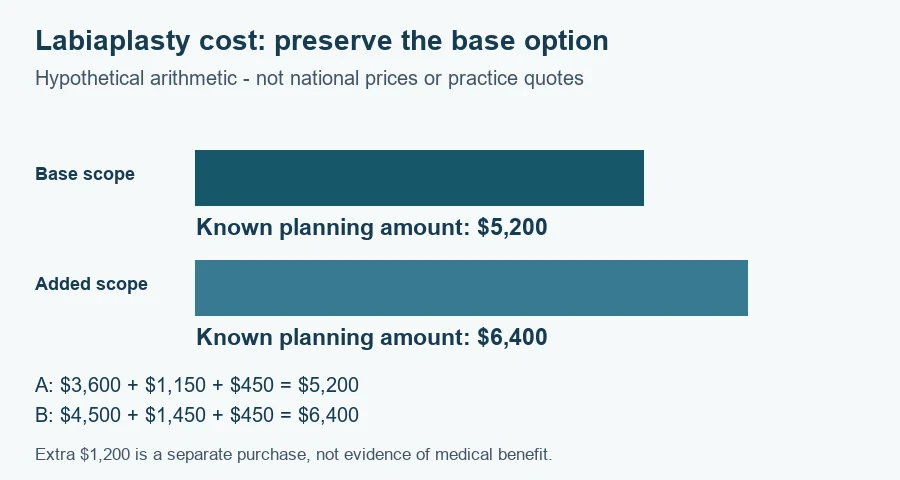
All figures here are hypothetical US-dollar inputs for an accounting example, not observed prices, a recommended budget or advice to add another procedure. Scenario A includes a clinician-confirmed base labiaplasty proposal only. We assign $3,600 to the professional service, $700 to the facility, $450 to anesthesia, $150 to specified supplies and medication planning, and $300 to practical support. The resulting known planning amount is $5,200.
Scenario B starts with that same base proposal but includes a separately discussed and separately consented additional procedure. Its hypothetical incremental professional amount is $900, its additional facility amount is $200 and its additional anesthesia amount is $100. We assume supplies and practical support remain the same only for this example. That assumption would need confirmation in a real quote. B’s known planning amount is therefore $6,400, with a $1,200 incremental difference.
| Hypothetical worksheet component | A: base scope only | B: base plus separately proposed scope |
|---|---|---|
| Professional service | $3,600 | $3,600 + $900 = $4,500 |
| Facility and anesthesia | $700 + $450 = $1,150 | $900 + $550 = $1,450 |
| Supplies, medication and practical support planning | $150 + $300 = $450 | $450, assumed unchanged |
| Known planning amount | $5,200 | $6,400 |
The supporting chart shows $5,200 and $6,400. Its purpose is to keep the incremental service visible instead of burying it in a package total. The $1,200 difference is $900 plus $200 plus $100. It is not a price estimate for a named additional genital operation. No clinical benefit, risk reduction or recovery saving is assigned to the larger amount. The model demonstrates how to read a quote, not how to design an operation.
Now imagine an advertisement describes B as saving $400 compared with buying the two services separately. That claim might be arithmetically correct under the advertiser’s terms, yet B still requires $1,200 more than A in this example. Savings against a different reference purchase do not turn an unwanted service into a lower-cost base operation. Ask for both the base-only amount and the combined amount so the actual extra commitment is explicit.
How do you avoid double-counting shared facility fees?
Ask for the actual total within each scenario instead of adding two full standalone packages together. If a proposal shares one facility episode, the practice should identify which charges are shared and which increase. Do not subtract an assumed anesthesia or facility saving on your own. The amount may depend on time, setting or minimum billing terms, and a combined plan could have additional charges rather than the simple shared amount you expected.
In the example, B’s facility charge is $900, not the $700 base charge plus a second full $700 charge. That is a stated hypothetical input, not a universal rule. Its extra $200 represents the assumed incremental charge. A real comparison must replace all three numbers with the actual written terms. If the office cannot yet confirm the shared amount, label it estimated or unknown and preserve the unresolved condition.
This accounting distinction also protects against an exaggerated discount. A comparison that first adds two complete standalone facility fees, then subtracts one, may produce a large apparent saving without explaining whether the standalone services were ever a relevant alternative. Ask which reference plan the discount uses. The financial decision should be based on the plan you are actually considering, not a constructed larger purchase you did not request.
What should a labiaplasty cost quote say about follow-up?
Request the number or scope of included scheduled visits, how concerns are handled and which expenses remain outside the package. A vague aftercare included statement needs clarification. Ask whether tests, prescriptions, outside evaluations or a visit to another facility can produce separate bills. This is a planning question, not a prediction that those expenses will occur or a reason to delay appropriate care if a concern develops.
If the proposal includes a revision policy, read its conditions separately. A waived professional fee may leave anesthesia, facility and supplies payable. The policy may also distinguish an adjustment from medically necessary care or apply only under particular circumstances. Ask who makes that determination and how the policy is documented. An included review is not an assurance that another operation would be free or appropriate.
Avoid turning uncertain future care into a precise expected expense. There is no verified individual complication probability in this price worksheet. Keep a general financial contingency separate from the known total and explain that it is your chosen reserve, not a modeled medical bill. The clinician can discuss risks and response plans; the administrative office can explain charges; neither answer should be inferred from a lower package price.
Does insurance change the labiaplasty cost worksheet?
Do not assume coverage from the presence of discomfort, a referral or a procedure name. Ask your insurer about the actual diagnosis, proposed service, clinician, setting and relevant authorization requirements. A discussion of clinical indications in an educational source is not a benefit determination. If coverage is being considered, obtain the insurer’s terms and the office’s billing proposal before treating the amount as an insured rather than a cash transaction.
Separate covered and uncovered services if the plan contains both. An additional cosmetic service should not disappear into an assumed insured base amount. Ask how the office allocates charges, whether each biller participates in your plan and what happens if the claim is denied. Do not compare an insured allowed amount with the society’s cosmetic partial fee as if they measured the same financial obligation.
If authorization remains pending, maintain two clearly labeled provisional scenarios: the documented cash proposal and the insurer-based estimate with its unresolved conditions. Neither should be described as your final amount. This approach prevents a promising conversation about possible coverage from becoming an unsupported zero-dollar entry and helps you recognize when a new insurer answer actually changes the worksheet.
What payment and privacy questions belong in a labiaplasty cost consultation?
A deposit needs a credit rule, refund conditions and rescheduling terms. If it is credited toward the agreed price, it changes the remaining balance rather than adding another charge. Ask whether a consultation fee is credited too, and keep that answer separate from the deposit terms. Save the dated policy you receive so a later recollection does not replace the actual written conditions.
Privacy questions also belong in the transaction discussion. Ask how estimates and bills are delivered, which billing entities may contact you and what communication choices are available. If using insurance, ask the insurer about its communications directly. Do not assume that paying cash, using a particular card or asking the practice for discretion controls every outside biller’s correspondence. Obtain the relevant answer without sharing more personal information in a shopping worksheet than necessary.
The ASPS consultation page supports discussing goals, health, options, risks and anesthesia with the clinician. Bring financial questions alongside those topics, while allowing separate time for clinical discussion. A person should be able to ask for clarification, obtain a copy of the proposal and pause a purchasing decision without an expiring promotion becoming the reason to proceed.
How do you compare a labiaplasty cost discount with the actual base price?
Write down the reference purchase used in a discount claim. If the discount compares a combined package with two standalone operations, it answers a different question from the price of the base operation alone. Keep both comparisons visible. The first may describe a saving within a larger purchase; the second describes the extra cash commitment relative to the smaller proposal. Neither comparison establishes that the additional operation belongs in your clinical plan.
Also check whether the reference and sale amounts contain the same charges. A discount on the professional service may leave the facility and anesthesia amounts unchanged. A package that appears to reduce the whole bill may instead reduce one line while adding another. Recalculate the known total from the actual inclusions rather than subtracting the advertised percentage from every expense in your worksheet.
For an expiring offer, request the precise conditions in writing: consultation deadline, payment date, treatment scheduling terms and what happens if the clinician recommends a different plan. A discount that depends on paying before an assessment may carry a different financial commitment from a quotation made after that assessment. Record the conditions beside the amount so a lower number does not hide an unresolved cancellation or transfer rule.
Keep the original quote when the office issues a revision. Label the new scope and amount separately so an additional service cannot silently replace the base-only option in your records. This also makes any transferred deposit easier to reconcile against the correct balance.
A practical labiaplasty cost comparison before paying
| Decision checkpoint | Document to retain | Unresolved condition to keep visible |
|---|---|---|
| Base-only and combined proposals | Separate itemized scopes and totals | Additional operation not independently assessed |
| Shared versus incremental charges | Actual facility and anesthesia terms | Shared savings assumed without confirmation |
| Deposit and communication | Credit, cancellation and delivery policies | Financial or privacy terms incomplete |
| Follow-up and separate care | Included visits and another-operation policy | Free future treatment implied without written scope |
Read each quote in two passes. First, confirm that every listed operation has been discussed and that you understand the option to decline it. Second, sum the professional, facility, anesthesia and external planning amounts without duplicating shared charges or deposits. These passes answer different questions and should remain separate even if the office presents a single attractive package figure.
The useful labiaplasty cost result is a complete, dated proposal with defined scope and visible uncertainties. The ASPS partial average supplies context; the original worksheet supplies a way to expose an additional purchase rather than conceal it. Return to the labiaplasty guide for procedure context and bring unanswered questions to an individual consultation before making a financial commitment.
Sources and review scope
Plastic Surgery Editorial Team. Source records checked through October 12, 2026. Review scope: source and editorial checks for general education. No individual clinical assessment is represented.
- ASPS labiaplasty fee, exact service and anesthesia scope. American Society of Plastic Surgeons. Publication/update date not stated. Checked 2026-10-12.
- ACOG Committee Opinion 795: elective female genital cosmetic surgery. American College of Obstetricians and Gynecologists. Source date: 2019-12-19. Checked 2026-10-12.
- ASPS aesthetic genital surgery consultation. American Society of Plastic Surgeons. Publication/update date not stated. Checked 2026-10-12.