
Inverted nipple correction aims to bring a nipple that turns inward into a more outward position. Before considering an elective procedure, separate a longstanding appearance concern from a new change that needs breast-health assessment. Then define what matters to you: projection, comfort, sensation, future breastfeeding or a combination. A technique described as duct-preserving is not a personal guarantee of feeding ability, and an attractive early photograph does not establish lasting projection.
The National Cancer Institute describes nipple inversion as a nipple turning inward or lying flat rather than projecting. It can have several causes. If the appearance has recently changed, arrange clinical assessment rather than assuming that cosmetic correction is the appropriate first treatment. This guide explains how to compare the goals, evidence and commitments of an elective correction after that distinction has been addressed. NCI definition
Start with the history of the change
The first useful record is a timeline, not a self-assigned severity grade. Write down when you first noticed the appearance, whether it involves one or both nipples, and whether it has changed. Note previous breast operations, pregnancy or feeding history, and any accompanying symptoms. Bring the record to the clinician who is assessing breast health. It helps explain the concern without treating an internet photograph as a diagnosis.
NCI includes a newly flattened nipple or a change in its direction among breast changes worth checking. Discharge, a lump and skin changes also deserve attention. Most breast changes are not cancer, but a recent normal mammogram does not mean that a new symptom should be ignored. Assessment is particularly important before an elective procedure changes the area you want examined. The appropriate examination or testing depends on the individual situation. NCI breast symptoms
For an established, assessed appearance concern, doing nothing remains a valid option. You do not need to make a normal variation look like a particular photograph. If correction interests you, describe the situations in which the appearance bothers you and what improvement would feel worthwhile. That account can be more useful than asking for a universal ideal nipple shape. Someone focused on future feeding may make a different choice from someone whose sole priority is appearance.
Keep breast-health questions and aesthetic questions in separate parts of your notes. The first asks why something has changed and whether investigation is needed. The second asks whether an elective intervention serves your preferences. Combining them into a single request to fix the nipple can leave the underlying concern insufficiently discussed. A clear consultation should explain what has been assessed and what remains uncertain before moving on to an appearance plan.
Define the feature you actually want changed
Projection is the distance the nipple stands outward. Areola size concerns the surrounding pigmented skin. Nipple position concerns its location on the breast mound. Breast volume and breast droop are separate features again. ASPS distinguishes procedures addressing these different concerns; a correction of inversion is not automatically an areola reduction or a breast lift. Asking for all of them under the word correction can obscure the scope of the operation. ASPS nipple and areola education
Use a plain description of the feature before discussing a named technique. For example, you might want more projection while keeping the areola’s existing size, or you might want to understand why the two sides appear different. These are descriptions of goals, not findings from an examination. The clinician can explain whether they correspond to one concern, several concerns or an issue that should be assessed elsewhere first.
| Reader concern | Feature to discuss | Question that keeps the scope clear |
|---|---|---|
| Nipple turns inward | Projection and the reason for inversion | What has been assessed before an elective correction is considered? |
| Pigmented area seems too large | Areola size and shape | Is this a separate procedure with a separate scar and consent? |
| Nipple sits lower on the breast | Position relative to the breast mound | Would changing projection leave the position concern unresolved? |
| Future breastfeeding matters | Intended preservation and functional evidence | What was actually measured after the proposed technique? |
| One side differs | Baseline asymmetry and realistic endpoints | Will the plan address one nipple or both, and how will results be assessed? |
A request for symmetry also needs a definition. Is the concern the resting appearance, the outline under clothing or a difference between the areolas? Establish the comparison before treatment so that a change in one feature is not mistaken for resolution of every concern. It is reasonable to ask what the plan is unlikely to change. That answer helps you decide whether the proposed intervention matches the problem that prompted the consultation.
Understand the duct-preservation tradeoff
ASPS explains that releasing the tissue underlying an inverted nipple may require cutting milk ducts, which could prevent future breastfeeding. That possibility should be discussed explicitly when future feeding is important. A reassuring label alone is insufficient. Ask whether the intended technique preserves ducts, whether circumstances during the operation could change that plan, and what the proposed consent says about that uncertainty.
Duct preservation describes an intended anatomical approach; successful breastfeeding is a functional outcome that must be assessed separately. A report of retained projection cannot answer the feeding question by itself. Nor does a small number of people who later lactated establish what would happen to every future patient. Distinguishing the promise being made is central to informed comparison, especially when promotional language combines appearance, sensation and feeding into one claim of success.
Ask how the operator defines the priorities of the procedure. If preserving feeding potential is your leading concern, record it clearly rather than assuming it follows from the chosen technique’s name. If the information is uncertain, ask how that uncertainty affects timing or the option of deferring an elective operation. This is a discussion about your preferences and the limits of evidence, not a reason to assume that everyone should follow the same sequence.
Sensation deserves its own conversation. Ask what baseline information will be recorded, what postoperative sensation will be assessed, and whether the evidence being cited used a defined test or a simple report. Appearance, sensation and function should not be bundled into a single satisfaction number. A person may be pleased with projection while still having unanswered questions about another endpoint, so a result assessment needs to preserve those distinctions.
Read surgical evidence by its denominator
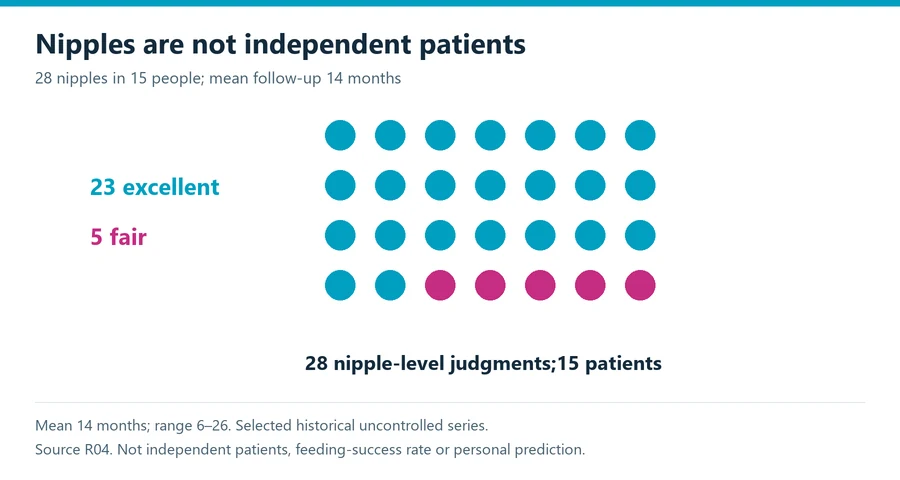
An original 2007 case series reported 28 treated nipples in 15 patients. At a mean follow-up of 14 months, ranging from six to 26 months, 23 nipples were judged excellent and five fair. Four patients experienced lactation afterward. These are different units and endpoints. The first counts nipple-level judgments; the second reports people who lactated. Neither should be presented as a current personal probability of success. Original endoscope-assisted correction study
The distinction matters because two nipples in one person do not represent two independent people’s experiences. A chart can accurately show the 23 and five nipple judgments while still misleading readers if it labels them patients. Likewise, dividing the four lactation reports by all 15 people would create a percentage without establishing how many were eligible, became pregnant, attempted feeding or had the same follow-up opportunity. A clean calculation is not enough when the denominator does not answer the question.
Projection and feeding need separate endpoints
A randomized study published in its 2019 journal issue included 230 women with inverted nipples and 30 women with normal nipples as a reference group. It compared an operation with a distractor against daily exercises for selected grade I and II inversion. Its primary endpoint concerned breastfeeding for four months after a full-term pregnancy. That is a more specific functional question than whether a nipple appeared more prominent after treatment. Original breastfeeding-focused correction trial
The trial does not turn every technique advertised as duct-preserving into the studied intervention. Its selected grades, treatment course, comparison group and feeding endpoint all matter. This guide does not reproduce the abstract’s subgroup percentages as a personal forecast because the full group denominators and applicability would need careful assessment. Instead, use the study to ask whether the evidence behind a proposed plan actually measured the function you care about.
| Evidence question | What the checked research provides | What remains unresolved for an individual |
|---|---|---|
| How many people were studied? | The 2007 series reports 15 patients and 28 nipples | Whether their histories and technique match yours |
| Was appearance assessed? | Nipple-level excellent and fair judgments at reported follow-up | Your preferred appearance and its durability beyond follow-up |
| Was feeding reported? | Four lactation reports in the series; a defined feeding endpoint in the trial | Your future pregnancy, feeding opportunity and outcome |
| Was a comparison made? | The later trial compared selected treatment and exercise groups | Whether its specific intervention applies to the proposed operation |
| Was the result lifelong? | The sources report bounded observation periods | Long-term persistence or future changes outside those periods |
When someone cites a success rate, request the underlying paper and identify its endpoint before discussing the number. Success might mean projection, an aesthetic rating, lack of recurrence, satisfaction or feeding. Ask whether follow-up includes everyone initially treated or only those who returned. These questions do not dismiss the research; they help you understand what it can reasonably contribute to your decision without making it answer a different question.
Compare plans without choosing by a technique name
Names can help locate a research paper, but they are a weak substitute for a clear explanation of the proposed operation. Ask what the technique is intended to release or support, how the ducts are treated, where the incision will be, and whether temporary equipment is involved. You do not need an operating tutorial. You need enough information to understand what is changing and what commitments follow from the plan.
Ask how the plan accounts for your particular history. A published report may focus on selected inversion grades, while your concern may follow another operation or involve a newly changed nipple. The clinician should explain which features of the evidence are relevant and which are not. A technique can have published results without those results establishing that it is appropriate for every cause of inversion.
If a device is proposed, clarify whether it is part of the studied operation, a temporary support or a separate nonsurgical approach. Ask about its intended purpose, monitoring and removal arrangements. A product photograph should not replace that explanation. Do not infer from a clinical study that a home suction device, exercise or modification of household equipment offers the same intervention or outcome. This guide does not provide a self-treatment recipe.
It is also reasonable to ask what an alternative would trade away. An approach described as offering more projection may involve a different preservation priority; a less interventionist plan may leave the appearance concern unresolved. The useful comparison is between your priorities and the actual plan, with uncertainties stated, rather than a league table of branded procedures. If the explanation remains vague, an additional independent clinical opinion can help clarify the decision.
Make recovery and follow-up concrete
For inverted nipple correction, a recovery plan should explain how the treated area will be protected, what dressings or temporary supports are intended, and who will review it. Ask for written instructions from the treating team rather than adopting an online calendar. The appropriate plan depends on the operation and your circumstances. Terms such as minor or quick do not tell you how clothing, work or everyday activities will fit around the actual instructions.
Think through the contact and pressure involved in your own routines. What clothing do you normally wear? Does your job involve physical contact, lifting, changing facilities or protective equipment? Are you caring for a child or planning travel? Bring those specifics so the team can give relevant instructions. The point is not to assume that each activity is prohibited; it is to replace an abstract downtime promise with a plan you can understand and follow.
Ask which changes the team wants reported and how to contact them during and outside usual hours. Clarify where an assessment would occur if you are away from the clinic. A routine follow-up date does not replace access when something unexpected happens. Keep the postoperative information with the procedure details so that another clinician can identify what was done if you need care elsewhere.
Follow-up should also distinguish early healing from the longer-term assessment of projection. Ask when photographs or measurements will be taken and how recurrence or a change in sensation would be documented. A photograph made immediately after correction answers a different question from a later assessment under consistent conditions. If only early images are available, regard them as early images rather than evidence of permanence.
For a two-sided correction, request a record for each nipple rather than only an overall satisfaction rating. The two sides may begin with different concerns, and an overall favorable judgment could conceal a feature that remains unresolved on one side. A side-specific record of the intended change, assessment date and remaining concern makes a later conversation more precise without inventing a numerical threshold for an acceptable result.
Price the exact commitment
There is no verified contemporary national total-price estimate in the sources checked for this guide. A single advertised amount should therefore be treated as a quote to clarify, not an established market average. Ask whether it covers one nipple or both, the planned anesthesia and facility, any equipment, routine follow-up and the arrangements for problems or revision. Those details define the purchase more accurately than the headline number.
If correction is proposed alongside a breast lift or another operation, ask for a written description of each component. A combined fee can make it difficult to see whether the nipple-specific concern is actually addressed. Separate the scope of treatment from the billing format: a package price does not mean every possible aesthetic concern is included, and an itemized fee does not by itself establish quality.
| Quote or consent item | Information to request | Why it matters |
|---|---|---|
| Treated side or sides | One or both nipples, with the intended goal for each | Avoids confusing nipple count with a whole-patient package |
| Intended technique | Duct treatment, incision and any temporary device | Connects the price to the actual preservation and recovery plan |
| Setting and anesthesia | Responsible team, facility and separately billed services | Identifies the full financial and care arrangement |
| Follow-up | Included visits and longer-term outcome assessment | Separates an early check from evidence of persistence |
| Revision or unexpected care | Written financial policy and care responsibility | Makes an uncertain future commitment visible before booking |
Do not infer coverage from whether a concern feels important to you or whether the procedure is described as reconstructive. If an insurer or other payer is involved, request a decision for the actual procedure and circumstances. If payment is entirely private, compare written scopes rather than assuming the least expensive quote buys the same intervention. This is financial organization, not a suggestion that a higher price produces a better clinical result.
Decide what information you still need
A useful decision record has four parts: the breast-health assessment, the feature you want changed, the functions you want considered, and the evidence behind the proposed plan. Add the recovery and financial commitments once the clinical scope is clear. If one of these parts is missing, the next step is to obtain that information rather than fill the gap with a photograph or a generic satisfaction claim.
You can take time to consider an elective appearance decision after the necessary health assessment. Choosing to proceed, defer or leave an established appearance unchanged should reflect your priorities. The strongest plan is one that explains the intended change, respects preservation concerns and gives a realistic account of what the available evidence cannot promise. Keep those explanations in writing so that your later assessment compares the outcome with the goals you actually chose.
For related planning, see breast lift, breast augmentation and questions to ask a plastic surgeon.
Sources and review scope
Plastic Surgery Editorial Team. Source records checked through October 12, 2026. Review scope: source and editorial checks for general education. No individual clinical assessment is represented.
- NCI inverted nipple definition. cancer.gov. Publication/update date not stated. Checked 2026-10-12.
- NCI breast symptoms. cancer.gov. Source date: 2025-12-02. Checked 2026-10-12.
- ASPS nipple and areola education. plasticsurgery.org. Source date: 2018-05-11. Checked 2026-10-12.
- Original endoscope-assisted nipple correction series. pubmed.ncbi.nlm.nih.gov. Source date: 2007-04-01. Checked 2026-10-12.
- Original breastfeeding-focused correction randomized trial. pubmed.ncbi.nlm.nih.gov. Source date: 2019-05-16. Checked 2026-10-12.