
Implant-based breast reconstruction rebuilds breast shape after mastectomy using a device. The plan may begin with a tissue expander followed by an implant, or use an implant directly in selected circumstances. Choosing it requires more than choosing size: the remaining tissue, cancer-treatment sequence, radiation discussion, planned stages and continuing device care all matter. Ask the reconstructive and cancer-treatment teams to explain the same coordinated plan.
NCI describes reconstruction as an option using implants, a person’s own tissue or sometimes both. It also recognizes choosing no breast reconstruction and discussing flat closure. These are decisions about a reconstruction pathway, not requirements to restore a particular appearance. This guide focuses on understanding the device-based option and its commitments without recommending it over another option for an individual reader. NCI breast reconstruction after mastectomy
Put the cancer-treatment plan and reconstruction discussion together
Ask what is known about the mastectomy plan, anticipated cancer treatment and the tissue available for reconstruction. If some treatment decisions will depend on information obtained during surgery, ask how that uncertainty affects the reconstruction proposal. A plan described as immediate should still explain what is established and what may need to be reconsidered. This guide does not suggest delaying or changing cancer treatment to meet an appearance goal.
Bring the relevant records to the discussion and ask who will coordinate questions between teams. You should not have to reconcile two unexplained calendars on your own. If the reconstructive surgeon and radiation oncologist are discussing different sequences, request an explanation of the proposed sequence and its rationale. The useful endpoint is a coordinated understanding, not selecting a calendar from an online example.
NCI identifies radiation as a factor in reconstruction timing and choice because of its effects on reconstructed tissue and healing. That does not establish a universal ban on implants or a single mandatory sequence. Ask how your assessed treatment context changes the options being offered and what uncertainties remain. A radiation-related study can inform that discussion, but it cannot determine your cancer-treatment needs.
Explain the practical commitments you can accommodate: appointments, support at home, work and travel for care. Those concerns matter when comparing pathways, but they should be addressed alongside clinical considerations. A plan requiring fewer initial visits is not necessarily the same as one requiring less lifetime care. Ask the team to distinguish immediate arrangements from the continuing commitments of a device.
Understand an expander-to-implant pathway
NCI describes a common two-stage pathway in which an expander is placed first and filled during later visits before it is exchanged for an implant. The expander and the eventual implant have different roles. Ask which device is planned at each stage and what assessment will determine readiness for the next step. Do not infer that the first operation completes every part of the reconstruction.
Request a description of the planned visits and the decisions they support. If expansion is proposed, ask who will conduct those appointments, how questions or concerns will be assessed and how the sequence fits the treatment plan. This guide does not provide a filling volume, interval, pressure target or home-management instruction. Those details require the treating team’s device and clinical plan.
Ask what the exchange operation is intended to accomplish and which additional appearance goals, if any, are included. Changing a temporary device to an implant is not automatically the same as completing every contour, nipple or symmetry objective. If other components are anticipated, have them stated separately. That makes the course understandable and avoids an expectation that all decisions end at one milestone.
| Pathway element | Question to resolve | Distinction to retain |
|---|---|---|
| Initial operation | Expander or implant, and why? | First device placement versus completed course |
| Expansion visits | What assessment and care are planned? | A clinical sequence versus a universal calendar |
| Exchange | What changes are included? | Device exchange versus every appearance goal |
| Other planned components | Are nipple, contour or opposite-side procedures anticipated? | Planned stages versus unplanned care |
| Long-term follow-up | Who provides monitoring and evaluates concerns? | Initial reconstruction versus lifetime device care |
Keep the written sequence accessible to you and the people helping with recovery. If it changes, ask what new information prompted the change. An adjustment may reflect assessment or treatment needs rather than a failure, but it should still be explained. The plan should not rely on you interpreting a temporary device as the final result or predicting when tissue will be ready from someone else’s experience.
A direct implant is a different sequence, not a guarantee
NCI notes that an implant can sometimes be placed without a tissue expander at the mastectomy operation. Ask why that option is being considered in your assessed case and what limits remain. Avoid treating direct-to-implant as synonymous with one operation for life. The absence of a planned expander exchange does not remove future assessment, device risks or possible additional procedures.
If comparing a direct-implant and a staged proposal, ask whether they address the same starting circumstances and objectives. A headline about fewer operations may refer only to the initial reconstruction sequence. Request an explanation of what is included in the comparison and what is not. The decision should account for tissue and treatment context rather than a preference for the shortest-sounding package.
Ask what circumstances could change the proposed operation and how that possibility will be handled in consent. This is not an invitation to predict every intraoperative decision. It makes the boundaries of the agreed plan clearer. You should understand the intended approach and the discussion process if assessment indicates that a different sequence is needed.
Distinguish breast shape from the whole reconstructed experience
ASPS describes breast reconstruction as a process that may involve more than one procedure and considers different techniques according to the individual’s circumstances. Ask which goals are part of the proposed mound reconstruction and which will be addressed separately. The broad word reconstruction does not establish that nipple appearance, symmetry, sensation and every contour objective will be achieved at once. ASPS breast reconstruction overview
Describe what matters to you: breast shape in clothing, a particular contour, fewer donor-site operations or a preference about devices. Ask how the proposal addresses each priority and where expectations need qualification. Two people choosing the same technique may value different aspects of the result. A useful discussion makes those priorities visible rather than assuming that an attractive breast photograph captures the entire experience.
If an opposite-side procedure is being considered, ask what it is intended to change and whether it is part of the current or a later stage. Matching a reconstructed side involves its own goals and tradeoffs. A bilateral label should not conceal different operations or expectations on each side. Request side-specific explanations so follow-up can return to the same objectives.
Ask separately about sensation and function rather than assuming that rebuilding shape restores everything removed or changed during mastectomy. This guide does not predict a particular sensory outcome. A realistic proposal should state what is being rebuilt and what remains uncertain, with advice appropriate to the actual mastectomy and reconstruction plan.
Read radiation-related outcome data with the correct denominator
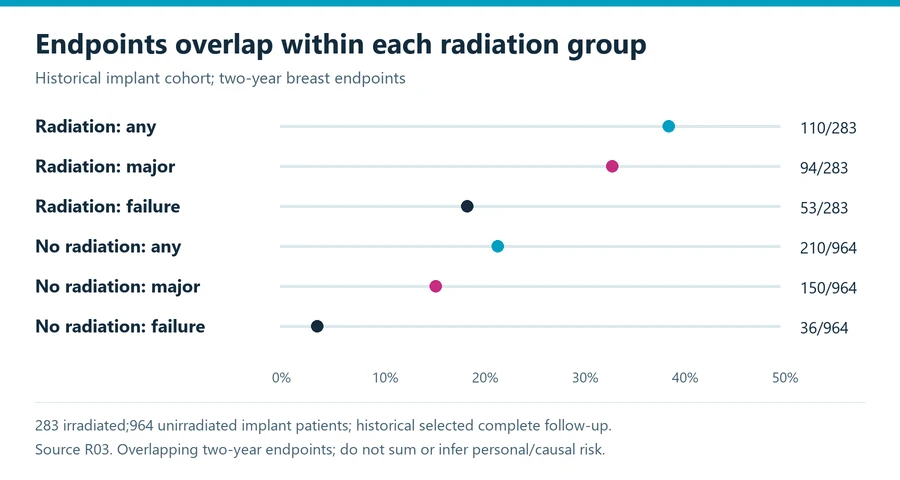
A prospective multicenter study recruited reconstruction patients during 2012–2015 and examined radiation-related outcomes. Its original two-year table included 1,778 participants with complete two-year follow-up. Among those with implant reconstruction, 110 of 283 irradiated participants had at least one breast complication, compared with 210 of 964 unirradiated participants. These are cumulative two-year observations in selected groups, not today’s national rates or personal predictions. Original reconstruction and radiation study
The corresponding reported percentages were 38.9% and 21.8%. The groups were not randomly assigned to radiation, so the raw comparison should not be described as the exact additional risk that radiation causes for every person. A clinical discussion should consider the cancer-treatment need and assessed circumstances. The study’s larger one-year population cannot be used as the denominator for its two-year outcomes.
Complication and failure are different endpoints
The study defined major complications as requiring rehospitalization or reoperation. Reconstruction failure was a separate definition involving device removal without immediate replacement or loss of an autologous flap. A planned exchange is therefore not automatically a failure. Nor is every recorded complication identical to permanent loss of the reconstruction. Ask which endpoint supports a numerical claim you encounter.
A percentage needs its outcome, denominator and timepoint before it can inform a decision. If a consultation uses a figure labeled risk, ask what event it counts. Does the number concern any breast complication, an unplanned operation, device removal or satisfaction? These questions prevent unlike outcomes from being pooled into a single score and keep the evidence tied to the actual concern.
The study also examined patient-reported outcomes, but those analyses had their own eligibility and response details. A complication chart is not a satisfaction chart. Do not subtract complications from 100% and label the remainder happy patients or successful reconstructions. A person may report satisfaction while having required additional care, and the absence of a listed complication does not establish every appearance or functional goal.
| Research detail | Interpretation question | Claim to avoid |
|---|---|---|
| Two-year complete-follow-up group | Is this the denominator for the plotted endpoint? | Using the larger one-year population |
| Any complication | Which events were included? | Every event means reconstruction failure |
| Major complication | Was rehospitalization or reoperation required? | Every appointment or planned stage counts |
| Reconstruction failure | What removal or tissue-loss definition was used? | Planned exchange equals failure |
| Observational radiation groups | How were treatment and patient differences handled? | Raw difference is each person’s causal risk |
This historical evidence offers a concrete discussion point about treatment context. It does not decide whether a device-based plan is appropriate or imply that another method has no risks. Ask the team how the study relates to the particular device, sequence and tissue assessment being proposed today. Different procedures and follow-up windows need their own evidence.
Make continuing device care part of the initial decision
FDA states that breast implants are not lifetime devices and that complications can require additional surgery. Its risk guidance includes capsular contracture, rupture and changes in breast or nipple sensation. A reconstruction plan using a device introduces those continuing considerations even when the first operation’s purpose differs from cosmetic augmentation. FDA implant risks and additional surgery
Ask for the specific implant’s patient labeling and recommended monitoring information. The device name and type should be recorded so future clinicians can identify what was used. This guide does not prescribe an imaging calendar or a fixed replacement year. The treating team should explain the current information applicable to the actual device and how it fits cancer follow-up.
Clarify the difference between checking a device and following up after cancer treatment. These discussions may overlap, but one should not be assumed to replace the other. Ask who handles each question and how new findings should be evaluated. A generic promise of annual follow-up is less informative than a clear account of responsibility and the purpose of each assessment.
If future device removal or another reconstructive approach becomes relevant, ask how the decision would be assessed rather than assuming one predetermined sequence. A current choice does not predict every later event. It should, however, acknowledge that a device’s continuing care and possible operations are part of the tradeoff you are considering now.
Compare alternatives using the same goals
An autologous option uses tissue from another body region and introduces a donor-site discussion. A device-based option has its own continuing commitments. Ask how the alternatives relate to your goals, treatment context and assessed suitability, with the scope and uncertainty of each made clear. Avoid comparing only the absence of a donor scar with only the absence of an implant, as if each difference described the entire pathway.
If flat closure or delayed decision-making interests you, raise that preference explicitly. NCI recognizes these choices within the reconstruction discussion. You should not have to express certainty about a device plan merely because an early appointment is available. Ask which decisions need to be made now, what can remain open and how your treatment team will explain the implications of waiting.
Emotional and practical preferences deserve a place alongside clinical assessment. You may value minimizing certain commitments or retaining a particular option, while another person values a different endpoint. The guide does not assign a correct preference. A sound consultation connects the actual alternatives to the concerns you express without promising that surgery will necessarily resolve every emotional difficulty.
Define care responsibilities and financial scope
Ask for the anticipated course in writing, with responsibilities for routine questions, unexpected concerns and later stages. Clarify how care is arranged if you live far from the operating facility or if your usual team changes. This is especially useful when cancer treatment and reconstruction occur through several services. A clear contact plan prevents you from having to decide which team owns an unfamiliar concern.
Describe the physical demands of work and caregiving so the team can plan support for the actual operation. Request individualized instructions about progression rather than using a generic implant timeline. This guide does not supply a medication change, lifting limit or rehabilitation routine. Those instructions must fit the clinical sequence and your assessed circumstances.
The checked sources do not establish a contemporary national total price for this entire pathway. Obtain an estimate identifying planned stages and included services, and check coverage with the actual payer and team. Reconstruction coverage and out-of-pocket amounts need applicable information; neither a general internet figure nor a cosmetic augmentation price settles them.
| Financial and care component | Detail to obtain | What it clarifies |
|---|---|---|
| Initial device placement | Operation, device and included services | Scope of the first stage |
| Expansion and exchange | Anticipated appointments and procedures | Planned course beyond the initial operation |
| Other reconstruction components | Side-specific contour or later goals | What is included and what remains separate |
| Device monitoring | Responsible service and possible charges | Continuing care arrangement |
| Unexpected or further surgery | Written policy and payer requirements | Remaining financial uncertainty |
Compare proposals by their goals, tissue and treatment context, complete sequence and care arrangement. A shorter estimate or fewer named stages does not by itself prove a better fit. The plan should explain why its approach is being considered, what it will and will not address and how further assessment will occur. That clarity makes the decision more useful than a comparison of device size alone.
Choose a pathway whose purpose and commitments are clear
Implant-based breast reconstruction is a coordinated pathway after assessment, with device, stage and treatment-context questions that extend beyond the first operation. Understand the reason for an expander or direct implant, the role of radiation discussion, the separate goals of later components and the continuing device care. Read research figures with their actual outcome, denominator and follow-up window intact.
Before deciding, check that the written plan answers your own priorities and matches the coordinated treatment discussion. If the sequence or responsibility remains unclear, resolve that question with the teams rather than choosing from an online calendar. The decision should reflect an understood option and its tradeoffs, with alternatives and uncertainty discussed plainly.
When an estimate uses the term implant based breast reconstruction, ask whether it refers to the whole anticipated course or only one device-placement operation. Record that answer beside the stage plan. The same phrase can describe a treatment category while leaving the included services unspecified. Resolving the financial and clinical scope together helps prevent an expander visit, exchange or later component from becoming an unexpected commitment merely because the original label sounded complete.
For related preparation, see questions to ask a plastic surgeon, plastic surgery recovery and the procedure guide index.
Sources and review scope
Plastic Surgery Editorial Team. Source records checked through October 12, 2026. Review scope: source and editorial checks for general education. No individual clinical assessment is represented.
- NCI reconstruction after mastectomy. cancer.gov. Source date: 2025-12-02. Checked 2026-10-12.
- ASPS reconstruction overview. plasticsurgery.org. Publication/update date not stated. Checked 2026-10-12.
- Original multicenter radiation/reconstruction prospective cohort. pmc.ncbi.nlm.nih.gov. Source date: 2017-09-13. Checked 2026-10-12.
- FDA implant risks and continuing surgery. fda.gov. Publication/update date not stated. Checked 2026-10-12.