
Hairline design is the planning of the visible border and character of restored hair, not simply choosing the lowest line a transplant could reach. The consultation needs to connect your appearance goals with assessed anatomy, existing hair, available donor resources and possible future change. A drawing communicates a proposed border; it does not guarantee the final density, direction, growth or satisfaction. Agree what the design means before treating a graft count or technique name as the decision.
This guide focuses on design consent rather than harvesting methods, transplant pricing or correction of an earlier operation. It supplies an original five-component discussion map and a record for comparing proposed drawings. The purpose is to make preferences, assessed limits and unresolved questions visible. It does not provide surgical measurements, a self-designed transplant pattern or a formula for deciding how many grafts you should receive.
What should hairline design communicate?
Begin with the appearance problem you want to discuss. You may want a more visible frontal frame, a different temple transition or a border that looks less abrupt with your usual hairstyle. These are different goals. Describe where you notice the concern and how you normally wear your hair. A request to look younger is less specific than explaining which part of the frame matters and what change would be worthwhile.
Also describe what you want preserved. You might prefer some recession, an existing asymmetry or a familiar shape rather than a uniformly low border. There is no requirement to adopt another person’s contour. Bring examples to explain a preference, but identify the feature you like instead of asking the surgeon to reproduce an entire face or hairstyle. Different anatomy and hair characteristics can make the same drawing mean different things.
Hairline design should become a shared explanation: the proposed border, its relationship to adjacent hair and the visual effect expected after treatment. Ask the surgeon to distinguish the drawn position from the anticipated appearance of the growing hair. That distinction matters when a clean pen line creates an impression of solidity that a real transition zone will not duplicate. A design discussion should make those limits clearer rather than leave them to be discovered afterward.
Five components to discuss separately
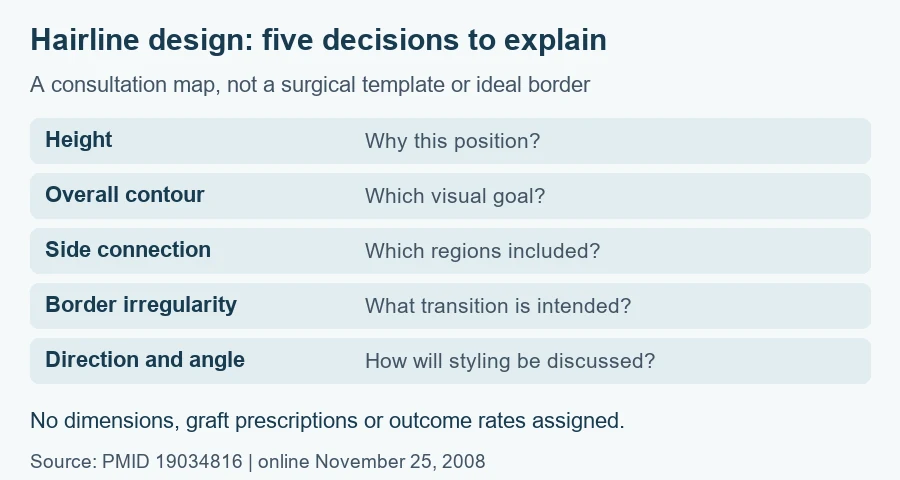
A 2008 clinical design article discusses five components: height, general contour, connection to the side fringe, larger and smaller irregularities, and hair direction and angulation. It is a professional design discussion containing the author’s preferences, not a randomized comparison establishing one ideal outline. The original graphic below translates those components into consultation questions. It does not copy the paper’s operative drawings or instruct you to mark surgical landmarks.
| Hairline design component | Question for the consultation | What it does not establish |
|---|---|---|
| Height | Why does this proposed position fit the assessed plan and my priorities? | A universal distance or lowest safe line |
| Overall contour | What feature of this shape matches the effect I want? | One ideal outline for every adult |
| Side connection | How will the front relate to the temples and existing side hair? | That frontal grafts automatically change every adjacent region |
| Border irregularity | How is an abrupt edge distinguished from a softer transition? | A pattern that can be prescribed from an online diagram |
| Direction and angle | How should the restored hair behave with my usual styling? | A growth or styling guarantee |
Discuss the components one at a time before judging the proposal as a whole. A border can be at a position you like while connecting to the temples in a way you do not understand. Another design can have a pleasing contour but imply a scope of treatment you had not requested. Separating those features helps identify the actual disagreement instead of describing every uncertain detail as a bad hairline.
Why isn’t a drawing the same as a result?
A drawing records a boundary on the skin. A result includes hair characteristics, distribution, growth and how the hair is worn. Ask how the practice explains that difference during consent. If a mock-up uses a dense filled area, clarify whether it represents an illustrative shape, a target or an expected appearance. A persuasive image should not become an unqualified promise of density or a replacement for discussion of uncertainty.
Compare the proposed drawing in the views the clinician considers relevant, rather than relying only on one flattering photograph. Explain how you usually part, sweep or expose the front. If you often change hairstyles, say so. A design that is discussed only with hair combed forward may leave unanswered questions about its appearance when the border is exposed. Those are appearance goals to discuss; they are not instructions about implantation direction.
For hairline design, ask what the agreed drawing records and whether the practice keeps a dated version. If alternatives were discussed, identify which one you selected and why. You do not need to dictate surgical technique to document a preference. A useful record can state the intended height and contour in ordinary language, the areas included, and the limitations explained by the surgeon.
A lower line is a different resource decision
The 2013 review of frontal hairline restoration discusses locating the border in relation to the donor-to-recipient balance and the characteristics of different zones. This is design reasoning, not a patient-specific calculator. It supports asking how an expanded recipient area changes the assessed plan. It does not establish that every person should choose a particular height or that a published design can be applied without examination.
Keep appearance preference separate from the capacity to pursue it. You can prefer a lower line while learning that the assessed resources or long-term plan support a different choice. Ask what changes when two proposed positions are compared. Does the difference affect area, intended density, another region’s priority or the possibility of later treatment? The clinician should explain the tradeoff without treating your willingness to pay as proof that enough source hair exists.
Avoid doing your own graft arithmetic from a traced photograph. A photographed area, an advertised density and a quoted graft count do not establish viable donor supply or an appropriate recipient plan. The useful hairline design question is which assessed assumption changes between proposals. If one drawing is much lower than another, ask each surgeon to explain the same appearance goal and resource boundary rather than deciding that the largest count must be best.
Distinguish the frontal border from temples and other regions
A frontal design can interact visually with the temple region without including treatment there. Ask which areas actually belong to the proposal. A drawing may suggest a continuous frame while the written plan describes only part of it. Clarify that difference before comparing outcomes or fees. Any additional region should have its own purpose, assessment and limitations rather than enter the plan through an attractive illustration.
You may decide that the central front is the main priority, that the side connection matters more, or that preserving available resources is preferable to expanding the border. Those are choices to discuss, not instructions for placement. Explain whether your concern is visible in ordinary styling or mainly in a particular close-up. This helps the clinician connect a proposed change to your actual experience rather than to an imagined standard of perfection.
Hairline design also needs a distinction between the existing hair and proposed restored hair. Ask how those elements are represented in a drawing or simulation. A shaded area should not conceal that the surrounding native hair is part of the current appearance. If its future course is uncertain, record that uncertainty separately instead of assuming that every part of the illustrated frame will remain the same.
Think about future appearance without a compulsory second operation
Ask how the agreed design is discussed in relation to possible later change. This is a planning scenario, not a prediction that you will necessarily need another operation. You may want to understand what the appearance could mean if you later choose no further surgery. The answer should distinguish what is assessed now, what cannot be predicted and what choices would remain open.
A 2025 review of hair transplantation considers patient selection, design and the broader management of hair loss. Its methods reviewed 1,030 abstracts from 2019 through 2024. That number is a literature-screening unit, not 1,030 treated people or proof that a particular border performs best. The review offers context for an integrated assessment, but does not turn a design drawing into a durability guarantee.
Future planning in hairline design should not become a reason to make every possible intervention part of today’s consent. Ask which components are actually proposed now and which are contingent ideas. A possible later option should have a reason for reassessment rather than be treated as a prepaid inevitability. Keep medical management questions with the treating clinician; this guide does not prescribe a medicine or determine whether it is appropriate for you.
What does natural-looking mean to you and to the practice?
Natural-looking is an appearance judgment that needs explanation. Ask whether the surgeon is referring to the overall frame, the transition at the border, the way hair is distributed or its behavior when styled. A person may be pleased with one of these features while finding another less satisfactory. Define the feature you care about rather than accepting the word natural as a complete outcome measure.
Ask how the practice presents and evaluates examples. Are the photographs taken in comparable views and at a stated interval after treatment? Does the example include other procedures or styling changes? A selected image can explain an appearance concept, but it cannot establish every patient’s satisfaction or an individual likelihood of obtaining the same result. Do not treat a photograph of another person’s hair as a consent contract for your own.
Hairline design should allow room for personal taste without becoming a demand for impossible precision. Explain which asymmetry or contour you would accept and which feature would concern you. Ask the surgeon to identify where expectations need adjustment. An honest discussion may produce a different target, continued assessment or a decision not to proceed. Those outcomes can be useful if they resolve the mismatch between the proposed plan and what you actually want.
A record for comparing hairline design proposals
Use the same goals at each consultation so different drawings can be compared fairly. Record the clinician’s explanation rather than guessing from the picture alone. Two borders may look similar on paper but imply different adjacent regions, priorities or expectations. Conversely, two different outlines may be attempts to address the same goal under different assessed assumptions. Identify those assumptions before choosing.
| Hairline design record | Proposal A | Proposal B |
|---|---|---|
| Main appearance goal | Write the feature discussed | Use the same goal for comparison |
| Included regions | Front, temples or other assessed areas | Identify scope differences |
| Height and contour explanation | Record the clinician’s reason | Record the alternative reason |
| Border and styling expectations | What the drawing represents and cannot promise | Same questions, not image-only judgment |
| Resource tradeoff | Which priority changes if the border expands? | Compare the assessed assumption |
| Future uncertainty | What remains unknown if no later procedure is chosen? | Keep possibilities separate from commitments |
When explanations differ, ask whether the disagreement is about anatomy, resources, the expected appearance or your stated preference. That is more useful than deciding which surgeon drew the most appealing line. If a practice cannot explain a substantial difference, the unresolved item belongs in your notes. You can postpone a decision while obtaining clarification rather than treating uncertainty as a reason to commit quickly.
Review the final design as part of consent
| Hairline design checkpoint | Record before treatment | Clarify if it changes |
|---|---|---|
| Agreed border | Dated drawing and stated appearance goal | Whether the new outline changes the goal |
| Included areas | Regions actually assessed and planned | Any added temple or other recipient area |
| Expected appearance | What the drawing represents | Difference between illustration and anticipated result |
| Limitations | Accepted resource and appearance uncertainty | Any stronger promise than previously discussed |
| Open question | Who will answer it and when | Whether consent can proceed while it remains unresolved |
Ask when the final design will be discussed, who will explain it and how changes from an earlier consultation are documented. A proposal that changes near the time of treatment should still be understandable to you. Clarify whether the border, included regions or expected effect has changed. Do not assume that a new drawing is merely an administrative step when it represents a different scope or appearance goal.
The ASPS consultation guidance addresses evaluation, goals and discussion of expectations. Its candidacy resource notes that existing hair supplies the transplant and that the result may not match an ideal. These are educational boundaries, not a personal eligibility determination. If the design discussion exposes a concern about whether you are a candidate, return to that assessment rather than settling the border first and assuming the medical decision will follow.
Before signing, try to restate the hairline design in plain language: the main visual goal, the regions included, the limitations and the uncertainty discussed. Ask the clinician to correct the restatement. This simple check is not a surgical blueprint. It helps ensure that your consent concerns the plan actually proposed, rather than a remembered photograph, a branded device or a graft count that answered a different question.
Keep a copy of the written explanation where the practice can provide one. Note any remaining question and the person responsible for answering it. If your preferred appearance changes after the consultation, tell the team before treatment rather than assuming a previous consent discussion covers a new target. A changed preference deserves clarification just as a changed proposed scope does.
What if the concern is an earlier transplant result?
If you already have transplanted hair and want the border changed, that is a repair assessment. A new drawing alone cannot show whether an existing line can be altered or what resources remain. Bring the prior records and describe the specific feature you want reconsidered. The existing hair transplant repair guide addresses that separate task; do not treat first-procedure design advice as a way to reverse an earlier operation.
Similarly, choosing between harvesting methods is a different question from agreeing the appearance goal. The hair transplant guide explains the broader donor, recipient and remaining-hair plan. Keep those assessments connected, but do not let a preferred extraction or implantation name stand in for design consent. A technically described operation still needs a clear agreement about the visible border it is intended to create.
When is the design discussion complete enough to decide?
You should understand what the drawing represents, why that scope was proposed and what it cannot guarantee. Identify the unresolved question that could change your choice. It may concern the side connection, the expected border character, the resource tradeoff or whether the proposal fits your priorities at all. Name that question and request an explanation instead of repeatedly comparing photographs without a common decision framework.
Hairline design does not require you to commit to surgery. A useful consultation can lead to a revised goal, another assessment or no procedure. The appropriate endpoint is a documented choice that you understand, with the broader candidacy and treatment questions addressed by the clinician. An agreed line is one part of that decision, not a promise that every future styling preference or change in native hair has been solved.
Sources and update record
Sources checked October 12, 2026. Historical design discussions contain professional preferences, not universal appearance standards. The ASPS resources are undated; their check date is not a publication year. No human or clinical review is claimed.
| Source | Observed date | Scope |
|---|---|---|
| Hairline design in hair replacement surgery | Online November 25, 2008; November issue | Five design components; professional discussion, not a technique trial |
| Hairline design and frontal restoration | August 2013 issue | Border, zones and donor-to-recipient balance; no patient calculator |
| Hair transplantation state-of-the-art review | May 12, 2025 record | Broader assessment and design context; abstracts are not treated patients |
| ASPS hair-transplant candidacy | Undated | Existing-hair resources and expectations |
| ASPS hair-transplant consultation | Undated | Assessment and expectation discussion |
Sources and review scope
Plastic Surgery Editorial Team. Source records checked through October 12, 2026. Review scope: source and editorial checks for general education. No individual clinical assessment is represented.
- Hairline design: five components in a professional discussion. pubmed.ncbi.nlm.nih.gov. Source date: 2008-11-25. Checked 2026-10-12.
- Frontal restoration: zones and resource balance. pubmed.ncbi.nlm.nih.gov. Source date: 2013-08. Checked 2026-10-12.
- 2025 hair-transplantation review: broader design context. pubmed.ncbi.nlm.nih.gov. Source date: 2025-05-12. Checked 2026-10-12.
- ASPS candidacy and expectation limits. plasticsurgery.org. Publication/update date not stated. Checked 2026-10-12.
- ASPS consultation: individualized plan and expectations. plasticsurgery.org. Publication/update date not stated. Checked 2026-10-12.