
Gynecomastia surgery cost should be quoted after the underlying concern and proposed operation have been assessed. The ASPS cost page displays a $5,587 partial average, checked October 12, 2026, excluding anesthesia, facilities and related expenses. It does not establish your complete price or state the underlying fee year. A useful worksheet separates assessment expenses from the surgical proposal and identifies which earlier payments, if any, are actually credited if you later proceed.
This guide’s original model shows why the amount spent evaluating a concern and the incremental amount needed for surgery are different figures. It does not recommend testing, a surgical technique or proceeding after a consultation. All example quantities and US-dollar amounts are hypothetical financial inputs. Clinical evaluation can lead to a different plan or a decision not to operate; the fact that an assessment has been paid for does not make surgery an obligation.
What does the average gynecomastia surgery cost include?
The ASPS cost page displays $5,587 and identifies anesthesia, operating facilities and related expenses as outside that partial average. It also notes that insurance eligibility varies by policy. The page does not establish an individual covered benefit or provide an underlying fee year. Keep its number as limited context rather than treating it as the complete price of an operation or a guaranteed patient payment.
Ask each office for the actual professional amount, proposed facility, anesthesia arrangement and separate charges. A price that includes those items is a different denominator from a professional fee alone. Record whether the quote includes one side or both sides and whether any listed service remains provisional. A single advertised male breast reduction amount cannot answer these questions without an individualized proposal.
Do not create a complete national gynecomastia surgery cost by adding guessed external amounts to the society figure. Nor should the fee average be divided into an assumed rate for gland removal, liposuction or skin work. The source does not supply those component denominators. The actual plan and written quote are the evidence for the services you are considering.
Why is assessment a separate gynecomastia surgery cost stage?
The ASPS consultation guidance describes health and medication discussion, examination and possible diagnostic testing to assess the underlying cause, including endocrine evaluation when relevant. That is a reason to obtain individual assessment before comparing operative packages. It is not a recommendation that every reader purchase a fixed panel of tests or have the same evaluation pathway.
Ask which clinician handles assessment, whether a separate referral is appropriate and who bills for any actually requested testing. Keep those answers distinct from a surgical deposit. If another clinician or laboratory bills independently, a practice’s consultation credit may not apply to that bill. Mark the actual amount and coverage status rather than assuming every preoperative expense is part of a cosmetic package.
An assessment can produce useful information without leading to surgery. For financial planning, record what would remain payable if you pause or decline the operation. Do not label that expenditure a penalty or suggest that the only way to recover its value is to purchase treatment. A consultation’s clinical purpose and its contractual credit terms are separate questions.
Does the gynecomastia surgery cost scope match the proposed technique?
The ASPS procedure description distinguishes liposuction, excision and combined approaches depending on the tissue and proposed correction. It also describes circumstances involving skin, glandular tissue or nipple and areola position. Those distinctions prevent assuming that every operation advertised under the same general name is equivalent. They do not let a financial worksheet diagnose the concern or choose the approach.
Have the clinician specify the proposed work and both-side status. If one quotation is for fat removal alone and another includes excision or skin work, preserve them as different scopes. Ask the clinicians to explain the difference before comparing their amounts. A cheaper proposal that addresses another issue is not established as the same result for less money.
Also ask whether tissue analysis or another service is proposed and, if so, who bills for it and whether it is included. Do not assume that it is always needed or always excluded. Its clinical role needs the clinician’s judgment; its financial role needs an actual written inclusion or separate amount. The society average cannot resolve either question.
| Gynecomastia surgery cost stage | Written answer to obtain | Avoid this assumption |
|---|---|---|
| Assessment | Clinician, requested tests and billers | Every reader needs the same paid test package |
| Operative scope | Proposed technique, tissue work and sides | Every male breast reduction quote buys identical work |
| Earlier payment credits | Which amounts transfer and under what conditions | Every assessment or laboratory bill reduces the surgical price |
| Follow-up and separate services | Included visits and outside charges | A package covers every future expense |
Original gynecomastia surgery cost worksheet: assessment versus commitment
Imagine a hypothetical assessment stage comprising a $250 initial consultation, $150 of individually requested testing and a separately chosen $350 second opinion. Its cash amount is $750. Those inputs do not establish that such testing or a second opinion is required. We assume the same assessment history in the two financial offers below solely to isolate the effect of different credit terms.
Offer A then quotes a complete $6,500 clinical amount for a confirmed operative scope and credits only the $250 initial consultation. Offer B quotes $6,600 for that same confirmed scope and, under its written hypothetical terms, credits both the $250 consultation and the $150 testing amount. Neither credits the second opinion. We add the same $300 of external practical planning to each offer.
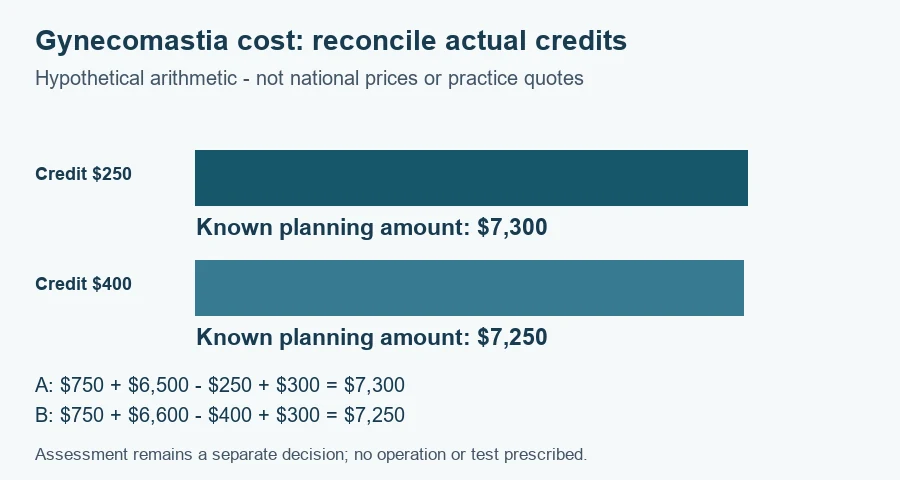
The complete episode amount in A is $750 already spent plus $6,500 quoted, minus $250 credited, plus $300 external planning: $7,300. In B it is $750 plus $6,600 minus $400 credited plus $300: $7,250. B’s quoted clinical amount is $100 higher, yet its complete episode amount is $50 lower under those specific credit assumptions. These are invented examples, not observed office policies.
| Hypothetical gynecomastia surgery cost input | Offer A | Offer B |
|---|---|---|
| Assessment-stage cash already spent | $750 | $750 |
| Complete clinical quote | $6,500 | $6,600 |
| Confirmed earlier credits | Minus $250 | Minus $400 |
| External practical planning | $300 | $300 |
| Complete known episode amount | $7,300 | $7,250 |
The chart compares the complete known amounts, not the remaining surgery balance alone. At the point after assessment, the additional amount to fund A is $6,500 minus $250 plus $300, or $6,550. B needs $6,600 minus $400 plus $300, or $6,500. Adding the already-spent $750 reconciles those remaining amounts with the complete episode totals.
If the operation is not undertaken, the stated assessment expenditure remains $750 under this example’s nonrefundable assumptions. That is a third financial outcome, not a surgical recommendation or an equal clinical alternative. It shows why an evaluation and an operation are separate purchasing stages. The earlier expenditure should not be used as pressure to proceed, and a credit cannot establish that the operation is appropriate.
Which credits actually transfer into gynecomastia surgery cost?
Request the credit rule in writing and identify the entity receiving the payment. A practice may credit its own consultation but cannot be assumed to credit a separately billed laboratory expense. The worksheet’s $150 testing credit in B is an explicit hypothetical contract input. A real offer needs to state whether such a credit exists, which payment it concerns and whether it depends on a particular booking date or plan.
Check that the credit has not already been deducted from the displayed quote. If an office presents a net amount after consultation credit, subtracting the consultation again would understate the remaining payment. Ask whether the quoted number is gross or net of credits, then reconcile it against the receipt. A clear credit ledger is more useful than a vague statement that consultation is free with surgery.
If you saw two clinicians, do not assume the first clinician’s fee becomes a credit at the second practice. Each transaction has its own terms. Keep an independently chosen second opinion visible in the assessment column even when you ultimately choose another clinician. Its presence is not evidence of unnecessary care or a reason to select whichever office offers the largest credit.
How should insurance uncertainty enter gynecomastia surgery cost?
Ask the insurer about the actual diagnosis, proposed service, clinical documentation, clinician and setting. The ASPS page’s discussion of policy variation does not guarantee coverage for a reader’s condition. A clinician can assess indications, while the insurer establishes the applicable benefit terms. A procedure’s name, duration of concern or a consultation referral cannot substitute for an individual policy answer.
If some evaluation is covered but the proposed operation is not, separate those financial pathways. Do not treat a covered consultation as approval of the surgical bill. Record the actual covered-service cost sharing and the cash surgical quote independently. Likewise, authorization of one named service does not establish that every additional cosmetic component is covered.
Maintain a cash scenario while a coverage estimate remains provisional. Identify which amounts depend on authorization, network participation or claim processing rather than presenting them as final. This guide supplies no policy-specific eligibility threshold or reimbursement code. Use the insurer’s current written terms and the office’s billing proposal before replacing a cash amount with an insured estimate.
What happens if evaluation changes the operation or delays it?
Obtain a new named proposal and quote when the clinical plan changes. A prior estimate for liposuction alone cannot silently become the price of an excision or combined operation. Ask how existing credits and deposits transfer, whether the new setting introduces another biller and whether a quote expiry affects the revised amount. Record the new version instead of mixing its scope with an earlier price.
If the team recommends further evaluation or a pause, ask the relevant clinician about the medical next step and the office about payment terms. These are different conversations. An expiring consultation credit should not decide when an operation occurs. Keep the amount of any conditional credit visible while acknowledging that clinical appropriateness governs the plan.
Additional assessment expenses also need their own row. Do not put an unsupported lump sum into the worksheet because another patient described extensive testing. Use actual requested services and quoted or billed amounts. When an amount is unknown, say unknown. This preserves the value of the comparison without pretending the financial model predicts the clinical evaluation pathway.
How do bilateral and additional-service terms affect the quote?
Ask whether the clinical amount covers the proposed work on both sides and whether any asymmetry-related difference changes the scope. Do not double a one-side price until the office confirms its billing rule, and do not assume a broad package includes both sides merely because the procedure commonly concerns the chest. The written proposal should state the service being purchased.
If the quote separates liposuction and excision amounts, ask whether facility and anesthesia are shared or separately increased. Adding two standalone packages could duplicate charges; subtracting a guessed shared amount could omit them. Use the actual total for the recommended plan. The price average does not establish component rates or a universal rule for combining services.
An added skin or nipple-related proposal deserves a separate clinical explanation and a clear incremental amount. A discount on additional work does not establish its necessity. Preserve the ability to compare the base and larger scopes without implying that they are clinically interchangeable. The clinician must explain what each would and would not address for your concern.
Which follow-up and practical costs remain separate?
Ask what scheduled reviews are included and how concerns are assessed. Identify separately billed garments, prescriptions, tests or outside visits where applicable. The original model’s $300 practical amount is not a universal allowance and does not represent an expected complication bill. Replace it with actual transport and support arrangements based on the treating team’s plan and your circumstances.
A revision policy should identify its boundaries. If a professional amount is waived, anesthesia or facility charges may still remain under the actual terms. Do not assume that an included review guarantees another operation or a particular result. The worksheet does not assign an individual risk or estimate a corrective expense; those uncertainties remain outside the known episode sum.
If work absence affects your finances, distinguish actual income loss from time needed away. Paid leave can change cash impact without changing the clinical restriction. Do not count both full lost wages and the value of the same paid leave as two expenses. Practical planning should use your actual arrangements rather than an advertised universal recovery timetable.
How can you check the credit arithmetic independently?
Start with the receipt for each assessment payment and match it to the exact credit described in the operative quotation. Mark a payment as credited only once and only against the entity that accepts it. Then calculate the uncredited assessment amount: in A, $750 minus $250 equals $500; in B, $750 minus $400 equals $350. Adding those amounts to the respective complete clinical quotes and the $300 external input reproduces $7,300 and $7,250.
This second calculation checks the result without pretending a credit is free money. It simply reallocates part of an earlier payment into the agreed operation amount. If a quote already deducts a credit, restore the gross figure for the reconciliation or use the documented net amount without subtracting it again. Keep the method consistent across both offers so a difference in how an invoice is presented does not create an artificial saving.
Ask the office to resolve any mismatch before treating the numbers as final. A missing laboratory receipt, an expired credit or an estimate changed after assessment can explain a discrepancy. Record the confirmed correction beside the earlier assumption. This makes the worksheet reusable when the plan evolves and prevents a favorable but unsupported credit from surviving unnoticed in the total.
The arithmetic still cannot decide whether surgery is appropriate. A correctly credited consultation might accompany an unsuitable operative proposal, while a noncredited evaluation can provide useful clinical information. Review the medical plan and transaction terms separately; neither should be inferred from the size of a credit.
A gynecomastia surgery cost checklist before commitment
| Reconciliation question | Evidence to retain | Keep unresolved if missing |
|---|---|---|
| What has assessment established? | Clinician-confirmed proposed scope | Operative package selected before evaluation |
| What was paid and credited? | Receipts and gross versus net quote | Consultation or testing credit deducted twice |
| What is the remaining commitment? | Complete episode and additional-payment sums | Already-spent money confused with future balance |
| Which services are insured or excluded? | Actual policy and billing answers | Evaluation coverage mistaken for surgery approval |
The useful gynecomastia surgery cost answer separates evaluation, the proposed operation and the actual payment terms. The partial society average cannot provide that complete ledger. The original worksheet makes credits and remaining commitment visible while preserving the option to pause after assessment. Return to the gynecomastia surgery guide for procedure context and discuss individual concerns with a qualified clinician before deciding to proceed.
Sources and review scope
Plastic Surgery Editorial Team. Source records checked through October 12, 2026. Review scope: source and editorial checks for general education. No individual clinical assessment is represented.
- ASPS gynecomastia partial fee and policy variation. American Society of Plastic Surgeons. Publication/update date not stated. Checked 2026-10-12.
- ASPS gynecomastia assessment and possible diagnostic testing. American Society of Plastic Surgeons. Publication/update date not stated. Checked 2026-10-12.
- ASPS liposuction, excision and combined gynecomastia scope. American Society of Plastic Surgeons. Publication/update date not stated. Checked 2026-10-12.