
Functional rhinoplasty addresses assessed structural problems that contribute to nasal breathing difficulty. It is not simply a cosmetic nose operation described with a different name. The decision should explain which part of the nasal structure is involved, what the examination establishes and how the proposed treatment addresses the obstruction. Septum, nasal valve, surrounding tissues and external shape can raise different questions. A breathing goal and an appearance goal may be considered together, but neither should be assumed to answer the other.
Start by describing the problem you experience rather than diagnosing its cause. Is the obstruction constant or variable? Does it affect one side, both sides or a particular activity? Has it changed after an injury or previous treatment? These observations help you communicate with the clinician, but they do not establish that a particular graft or operation is needed. The examination and treatment assessment have to supply that connection.
This guide focuses on the breathing-related decision and its evidence. It does not provide a home valve test, an operative recipe or a guarantee that changing the nose will resolve every breathing or sleep concern. Its tools separate the assessed structure, the proposed procedure, the outcome measure and the course of care so that a familiar label does not replace an actual explanation.
Septum and valve are different parts of the discussion
University Hospitals Sussex describes the septum as cartilage and bone separating the two nasal sides and explains that septal surgery may be combined with rhinoplasty. It also distinguishes treatment of a bent septum from medication that may address swelling contributing to blockage. Its leaflet is guidance for that service, not a diagnosis for every person with a blocked nose. NHS septoplasty and septorhinoplasty information
An original functional-rhinoplasty study identifies nasal valve insufficiency as distinct from other anatomical causes of obstruction. That distinction matters when interpreting a recommendation. Ask which structure is thought to be contributing and which findings support the assessment. Do not treat a diagnosis involving the septum as proof that every other part of the breathing problem has been explained.
Use the procedure words carefully. Septoplasty refers to work on the septum; septorhinoplasty combines septal and nose-shape work in the described course. Functional rhinoplasty can involve structural support or reconstruction associated with breathing. The terms can overlap within a plan, but they are not interchangeable explanations of why every component is needed. Ask the clinician to identify the actual included work in plain language.
| Question area | Explanation to request | Shortcut to avoid |
|---|---|---|
| Septum | Whether a septal finding contributes to the obstruction | Assuming a bent septum explains every symptom |
| Valve or sidewall | Which assessed support or narrowing problem is relevant | Diagnosing valve problems from a photograph or home maneuver |
| Swelling or other conditions | Whether a separate contributor needs assessment or treatment | Assuming every blocked nose requires structural surgery |
| External appearance | Which visible change is proposed and why | Assuming functional intent means no appearance change |
| Combined course | Purpose of each included component | Treating several procedures as one unexplained label |
Bring a symptom history that preserves uncertainty
Write a short timeline of the problem, any injury, previous nasal procedures and treatments you have actually used. Separate a remembered event from an uncertain date. If an earlier clinician supplied a diagnosis, bring the record if available. That allows the new team to understand what was assessed rather than rely on a conclusion passed through several conversations.
Describe what matters in daily life. A problem during exercise, a persistent sense of blockage and a concern about sleep can lead to different questions. Explain the situations without assuming that one intervention will address all of them. Ask whether any symptom falls outside the proposed operation’s intended scope and which clinician should assess that concern.
Bring your actual medication information and tell the team what changed with previous treatment, including no clear change. Do not interpret failure to improve as proof of a particular anatomical diagnosis. Likewise, a temporary benefit does not establish that surgery is unnecessary or necessary. The history contributes to an assessment; it should not become a self-directed treatment algorithm.
If you have previous photographs, operative reports or imaging, ask which material is useful. A clinician may need different information for a structural assessment than for an appearance discussion. Do not assume that an attractive external contour means the airway has been evaluated, or that an internal finding supplies a complete cosmetic plan. Keep the questions and the available records matched.
State the breathing and appearance goals separately
You may want to breathe more comfortably and also dislike a visible feature. Write those goals on separate lines. Ask what the proposed course is intended to do for each, which compromises need discussion and what is outside its scope. A combined plan is easier to understand when both goals remain explicit rather than being absorbed into a general promise of a “better nose.”
For an appearance goal, describe the feature you want discussed without assuming that a particular image is achievable. For a breathing goal, describe the difficulty and the outcome you hope to improve. Ask how the team would assess each outcome. A photograph can show shape; a symptom measure asks a different question. Neither should be used as a substitute for the other.
A favorable photograph cannot measure nasal obstruction
When reviewing documented examples, ask what procedures were included and when the images were taken. An example of visible change does not supply a breathing score or prove that the person had no complications. A diagram may clarify a structural relationship but cannot establish your diagnosis. The purpose of visual material should be stated clearly, especially when editorial illustrations are used alongside clinical information.
If the recommendation changes during assessment, ask which finding prompted the change. The revised plan should still explain the breathing and appearance components separately. Do not assume that adding a component automatically improves both outcomes or that declining an optional appearance change necessarily invalidates the functional discussion. Those are questions for the treating team to explain in your situation.
Understand graft discussions without selecting the operation yourself
The original study described reconstruction with cartilage grafts in people whose nasal valve insufficiency was assessed as the primary obstruction cause. That describes the study’s treatment context, not a universal prescription for a blocked nose. If a graft is proposed, ask its intended purpose, the source under consideration and what additional assessment informs that choice. The guide does not specify where tissue should be taken or placed.
Ask whether the proposal includes more than valve support. Septal or other work may be part of a particular course, and each component deserves an explanation. A list of technique names is less useful than a description connecting the components to the findings. You should know which decisions are settled before surgery and which are conditional on additional information.
The terms open and closed describe approaches, not a complete ranking of breathing outcomes. Ask why the proposed approach fits the actual work. Do not choose solely on an incision label, a claim of easier recovery or a broad comparison unrelated to your assessed problem. The clinical reasoning should address the planned reconstruction rather than use a technique label as evidence that the result is guaranteed.
What the main comparison study actually measured
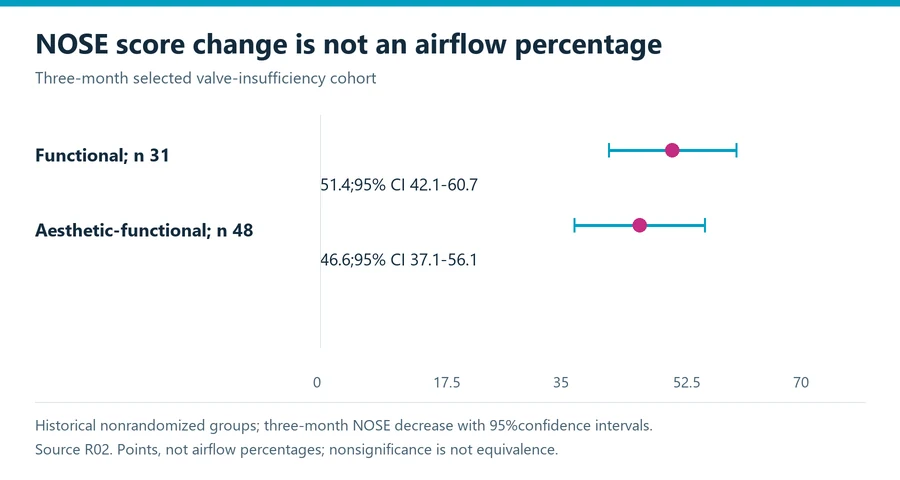
An original prospective multicenter cohort enrolled seventy-nine people with nasal valve insufficiency identified as their primary obstruction cause: thirty-one had functional surgery and forty-eight had combined aesthetic-functional surgery. On the NOSE scale, zero to one hundred with higher scores indicating worse obstruction, mean three-month score decreases were 51.4 points and 46.6 points, with 95% confidence intervals of 42.1–60.7 and 37.1–56.1 respectively. The between-group comparison was not statistically significant. Data were collected in 2006–2008; this is historical selected-cohort evidence, not a current national result. Original nasal-valve outcome study
A decrease in NOSE score points is not the percentage of breathing restored. The questionnaire measures reported obstruction burden on its defined scale. A group average does not establish an individual’s change or the fraction of people with a successful result. Keep the units visible on a chart, and do not convert the numbers into success percentages merely because the scale also runs to one hundred.
The comparison also does not prove that combining cosmetic and functional work is always equivalent to functional surgery alone. Lack of a statistically significant difference is not the same as a formal demonstration of equivalence. The groups received assessed treatment in a selected observational cohort; they were not randomly assigned to every possible combined course.
The original paper identifies three months as the primary endpoint and cautions about missing data at longer follow-up. This guide therefore plots the three-month group changes with their intervals rather than presenting the later observations as complete lifetime evidence. A longer label such as “followed for a year” should not conceal which timepoint supplied the main result or which later records were missing.
| Evidence feature | What is reported | What it cannot establish |
|---|---|---|
| Population | Selected people with assessed valve insufficiency | Every cause of nasal obstruction |
| Groups | Functional versus combined aesthetic-functional course | A universal ranking of all techniques |
| Primary measure | NOSE score change at three months | Percentage airflow restored or personal success probability |
| Comparison | No statistically significant group difference | Guaranteed equivalence for every combined operation |
| Longer observations | Additional follow-up with missing data cautioned | Complete lifetime outcome or absence of later care |
Follow-up should match the question being asked
Ask what baseline assessment is recorded and when the treating team plans to review the breathing outcome. A symptom score may be useful when used consistently, but it does not replace examination or explain every cause of difficulty. You should understand which outcome is being followed and how the team will respond if the symptom and examination accounts do not align.
Keep early recovery separate from the planned outcome assessment. Cambridge University Hospitals’ information describes temporary blockage and discomfort after septorhinoplasty and explains that dressings or splints may be used in its care pathway. Those observations are not a personalized recovery timetable or permission to ignore a concerning change. NHS septorhinoplasty aftercare information
Request your own written instructions and contact route. Ask which devices or dressings, if any, are expected in your course and who removes or reviews them. Do not manipulate them based on an online account. If you are traveling, explain where you will be during early recovery and how an assessment would be arranged if you need one before the next booked visit.
When recording progress, use the same question at the same kind of timepoint. “It felt clearer on one afternoon” is different from a standardized outcome review. Both can be reported to the clinician, but they should not be combined into an invented score. If the team uses a questionnaire, complete it according to its instructions rather than interpreting it as a test you need to pass.
Discuss risks in relation to the actual course
ASPS lists rhinoplasty concerns including anesthesia risks, infection, altered sensation, breathing difficulty, septal perforation, healing or scarring problems and possible revision. Its information also recognizes an unsatisfactory appearance as a separate outcome. A functional intention does not remove the need to discuss those concerns. ASPS rhinoplasty safety information
Ask the team which risks apply to the proposed components and how your circumstances affect the discussion. If several procedures are included, do not assume that a risk description for one isolated procedure covers the entire course. Ask what the team can say from relevant evidence and what remains uncertain. The answer should not depend on an unsupported promise that a particular approach has no complications.
You should also know how postoperative concerns are assessed. The Sussex leaflet describes bleeding, infection and septal issues in its surgical discussion, but a webpage is not a diagnosis of what you are experiencing. Follow the treating service’s instructions for contacting care. Use emergency assessment for an immediate emergency rather than waiting for an article to decide whether a symptom is normal.
If revision is discussed, ask what it means in context. An additional procedure for a persistent breathing problem, a later appearance concern and treatment of a complication are different endpoints. A single revision percentage may combine them. Do not subtract such a percentage from one hundred and call the remainder the probability that you will breathe normally or like the appearance.
Cost and coverage require a defined scope
Ask for a written estimate that separates the actual functional and appearance components where relevant. It should explain the proposed operation, billing parties, facility and anesthesia services, and included follow-up. The word functional does not establish that every charge will be covered. A clinical recommendation and a payer decision are different records that should both be obtained and understood.
This guide does not offer a national price because an accurate comparison needs a dated source and matched treatment scope. A quote for isolated septal work should not be treated as a price for a combined reconstruction. Likewise, a cosmetic rhinoplasty figure does not define your functional course. Record what is included, what remains conditional and how changes would be communicated.
Consider practical commitments as well. Travel, assistance, time away from work and follow-up attendance depend on your situation and the actual instructions. Explain constraints before treating an estimate as workable. If coverage is uncertain, ask the payer what documentation is needed and confirm the decision for the proposed services rather than relying on a general description of medical necessity.
| Quote component | Clarification to request | Misinterpretation to avoid |
|---|---|---|
| Functional work | Assessed problem and included procedures | Every breathing concern is covered by one generic operation |
| Appearance work | Which changes are included and their billing scope | Functional intent makes every appearance change reimbursable |
| Facility and anesthesia | Actual billing parties and included fees | The professional fee is the complete total |
| Follow-up and contingencies | Included care and policy if plans change | The first estimate guarantees a final lifetime course |
Leave with an explanation, not only a procedure name
Keep an outcome record that separates symptoms from photographs. Before treatment, describe the activities affected and the questions you want assessed. At the agreed review, use the same categories rather than replacing them with a new impression of how the nose looks. If a questionnaire is used, ask whether the baseline and follow-up versions are comparable. A change measured with one tool cannot automatically be compared with an unrelated rating from another clinic.
An unexpected combination also deserves explanation. For example, a person might be pleased with appearance while reporting persistent obstruction, or describe better breathing while still having an appearance concern. These are illustrative decision scenarios, not reported patient outcomes. They show why a plan should define both goals and a way to assess each, rather than compressing everything into one satisfaction label. Keep uncertainty visible when the available evidence does not measure your particular concern.
A useful plan identifies the assessed breathing problem, explains each proposed component and records the appearance goals separately. It should also state the intended outcome measure, review point, practical instructions and unresolved questions. If you cannot explain why the recommendation addresses your symptoms, ask for clarification before relying on a technique acronym or a dramatic photograph.
Functional rhinoplasty is best considered through the relationship between findings, reconstruction and measured breathing outcomes. The evidence can inform that discussion without diagnosing you or predicting a personal result. Keep the septum and valve questions distinct, preserve the study’s actual population and timepoint, and ask for a course that can explain both its goals and its limitations.
For related planning, see the rhinoplasty main guide, consultation questions and recovery planning.
Sources and review scope
Plastic Surgery Editorial Team. Source records checked through October 12, 2026. Review scope: source and editorial checks for general education. No individual clinical assessment is represented.
- Sussex NHS septoplasty and septorhinoplasty. uhsussex.nhs.uk. Source date: 2026-01-22. Checked 2026-10-12.
- Original functional rhinoplasty obstruction outcomes. pubmed.ncbi.nlm.nih.gov. Source date: 2016. Checked 2026-10-12.
- Cambridge NHS septorhinoplasty aftercare. cuh.nhs.uk. Source date: 2023-11-20. Checked 2026-10-12.
- ASPS rhinoplasty risks. plasticsurgery.org. Publication/update date not stated. Checked 2026-10-12.