
Facial reanimation is treatment intended to address assessed loss of facial movement or function. The plan may involve nerves, muscles, support procedures, rehabilitation or a combination, depending on the condition and goals. Resting symmetry, movement during a smile, eye protection and everyday function are separate tasks. An operation that addresses one does not automatically solve them all, and a smile photograph is not a complete outcome assessment.
This guide concerns an established condition that has been medically assessed. Sudden facial weakness, particularly with speech problems or arm weakness, needs emergency assessment rather than a routine reanimation consultation. NHS paralysis guidance identifies sudden weakness and one-sided facial weakness among reasons for immediate emergency care. Contact your local emergency service; do not use this article to diagnose the cause or delay care. NHS paralysis guidance
For longer-term planning, start with what has been diagnosed, what movement remains and which activities or concerns matter to you. The team should connect those findings to each proposed treatment. This article does not provide a nerve-transfer technique, exercise program, injection plan or prediction that a particular procedure will create a spontaneous smile.
Assessment comes before a procedure family
University Hospital Southampton’s facial-nerve information describes a multidisciplinary assessment involving movement, nerve function, imaging where appropriate and photographic or video evaluation. Its treatment overview distinguishes static support, dynamic techniques, nerve work, eye care and rehabilitation. These are service descriptions, not a requirement that every person receive every test or treatment. NHS facial-nerve assessment and treatment information
Ask what the diagnosis explains and what remains uncertain. The cause, history and actual findings matter to the plan; a visible asymmetry alone does not identify which nerve or muscle treatment is appropriate. Provide previous records where available and describe changes in function rather than attempting to reproduce a diagnostic test from an online video.
Use everyday tasks to describe priorities. Eating, speaking, facial expression, eye-related concerns and appearance at rest can raise different questions. These categories do not establish a diagnosis, but they help the team explain whether a proposed treatment addresses your main concern. A broad statement that the face will improve should not silently substitute for the particular task you want assessed.
Keep the timing history factual. Record when the change started, relevant treatment and whether the pattern has changed, using dates you know rather than estimates presented as certainty. This guide does not supply a universal duration that selects a nerve or muscle operation. Ask how the actual examination and history influence the recommendation.
If several specialties are involved, understand who explains the combined plan. A nerve assessment, an eye-care discussion and rehabilitation can relate to the same condition without being interchangeable visits. Ask which unanswered questions each team is addressing and how information is shared. A multidisciplinary label is useful only when the course and responsibilities are clear.
| Goal | Explanation to request | What does not establish it |
|---|---|---|
| Resting position | Which support or symmetry task is intended | A moving-smile measurement alone |
| Smile movement | What movement is targeted and how measured | A still portrait without comparable conditions |
| Eye protection | Actual assessment and care responsibilities | Improvement of the mouth corner |
| Daily function | Which eating, speech or expression concerns are addressed | A single overall appearance score |
Static support and dynamic movement are different tasks
Southampton’s overview describes static techniques aimed at support or position and dynamic techniques involving muscle action. This distinction helps interpret a proposal without choosing an operation yourself. A support procedure can have an intended resting-position goal, while a dynamic procedure has an intended movement goal. Ask which task is being addressed and what the plan cannot promise.
A familiar incision or procedure word does not make reanimation equivalent to a cosmetic facelift. The assessed condition, intended function and outcome measures are different. Do not judge a proposal by whether its name appears in an appearance-focused treatment list. Ask for the rationale in relation to your diagnosis and goals.
Nerve-related and muscle-related work also need their own explanation. Ask what the team is trying to enable and how it expects that to be evaluated. This guide deliberately does not map which nerve should be joined to which structure for an individual. A conceptual diagram can show that signals and muscle action are related without becoming an operative plan.
If tissue from another body area is discussed, ask what that introduces into the course. The proposed facial change and the donor-area commitments are distinct matters. A claim about facial movement does not answer every question about another site. Obtain the actual assessment and explanation rather than assuming a procedure name captures the entire burden.
Some plans are staged. Ask the purpose of each stage, what depends on earlier assessment and which decisions remain conditional. A small stage count does not establish a short recovery or simple course. Conversely, more than one stage is not itself proof that treatment failed. The relevant question is what each stage is intended to do.
Eye care should remain visible in the plan
The NHS facial-nerve overview identifies eye-closure and protection concerns and describes coordinated eye care. That is a separate responsibility from treatment of smile movement. Ask who evaluates the eye-related question and supplies your instructions. Do not assume that a mouth-focused reanimation proposal includes every eye intervention or removes the need for follow-up.
This guide does not prescribe drops, taping, eyelid weights or a home protection routine. Those instructions need to come from the relevant team for your actual condition. If there is a new eye concern, obtain appropriate assessment rather than waiting for a general reconstruction discussion to resolve it. A still photograph cannot establish the health of the eye surface.
Keep eye-related goals in the written record even if appearance is the reason you first sought information. A plan can have several priorities, and documenting them helps avoid confusion about what a particular procedure addresses. If a goal remains outside the proposed course, ask which assessment or service should explain it.
Rehabilitation is a course of care, not a copied exercise list
Southampton describes rehabilitation as tailored to individual needs and movement patterns. Treat that as a reason to ask for relevant instruction, not as permission to copy an exercise sequence from another person’s treatment. An online demonstration cannot establish whether the same activity is appropriate for your condition or stage of care.
Ask who guides rehabilitation, how it relates to the proposed treatment and how progress is assessed. Those are practical course questions that should be answered before you assume an operation is the complete treatment. If an instruction is unclear, seek clarification from the actual team rather than increasing repetitions or adding a device on your own.
Discuss the practical commitments as well. Appointments, travel, assistance and work demands may affect whether the proposed course is workable. Explain constraints early and ask how the team plans around them. A treatment decision includes attendance and follow-up, not only the operating-room event or the name of a procedure.
A measured smile is only one kind of outcome
An original retrospective comparison examined 28 adults with unilateral facial paralysis, divided into two groups of 14 for different dynamic lower-face procedures. It measured mouth-corner symmetry and excursion. That is useful evidence about a defined movement endpoint in a selected clinical series, not proof that one technique is the best choice for every person. Original authors’ facial reanimation research record
Excursion is a movement measure. It is not identical to spontaneity, ease of expression, eye protection, everyday function or satisfaction. A larger measured change in one endpoint should not be interpreted as improvement in every aspect of the face. Ask which outcome was measured and whether it matches the concern you want addressed.
A spontaneous smile and a voluntary movement are separate questions
An original patient-experience study examined nerve-to-masseter-driven smile reanimation through a questionnaire. Its questions distinguished voluntary smiling, smiling without biting and spontaneous smile. Those distinctions are useful because a single phrase such as smile improvement can hide several different experiences. Original patient-experience study
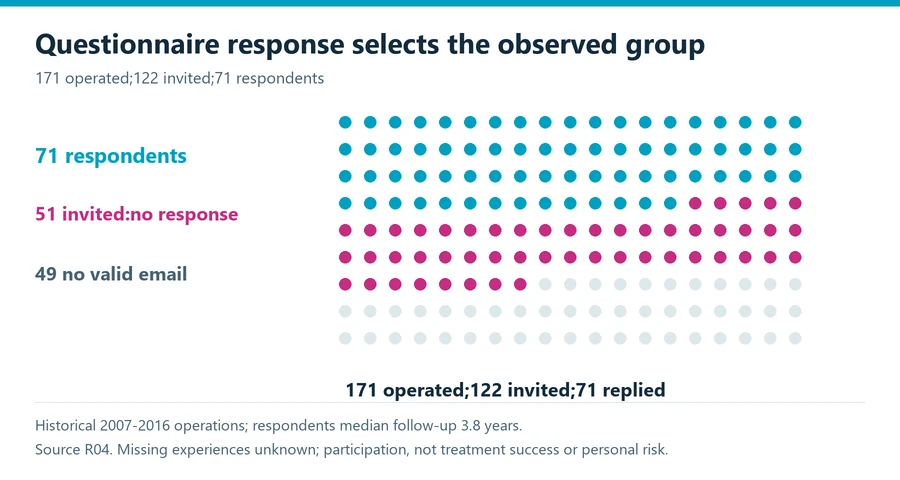
The study reported 171 operated patients, 122 with valid email addresses invited and 71 respondents. Median follow-up among respondents was 3.8 years. The supporting visual shows this selection pathway, not a success rate. It keeps people who could not be contacted or did not respond visible rather than classifying them as satisfied or dissatisfied.
A mouth-corner movement measurement is not the percentage of normal facial function restored. Likewise, a questionnaire response about one kind of smile is not a guarantee about every expression. These endpoints can inform a discussion while remaining distinct. Avoid a chart that combines millimeters, satisfaction ratings and spontaneous-smile answers into one invented improvement score.
Selection matters when reading the questionnaire. Respondents are not all operated people. A response group can offer valuable accounts without representing every uncontacted or nonresponding person’s experience. This guide therefore does not use the reported response percentages as your probability of a result. It also does not assume that median follow-up means every respondent was assessed at exactly the same time.
| Evidence type | What it helps describe | What should remain separate |
|---|---|---|
| Movement measurement | A defined change in position or excursion | Spontaneity and all daily functions |
| Photograph or video | Appearance or movement under recorded conditions | Diagnosis and every personal priority |
| Patient questionnaire | Reported experience among respondents | Uncontacted people and nonrespondents |
| Procedure comparison | Outcomes in the actual selected groups | Universal technique ranking or personal forecast |
Read the comparison design before selecting a winner. A retrospective series is not random assignment, and patients may differ in relevant ways. The clinical recommendation needs the actual assessment and appropriate evidence, not only a favorable numerical result. A useful consultation can explain what the study supports and where it does not answer the individual decision.
Define an outcome record before treatment
Ask how your main goals will be documented before and after the course. If movement is measured, understand the movement being requested and the method used. If photographs or videos are compared, ask how conditions are kept comparable. If a questionnaire is used, keep its specific domains visible rather than remembering only an overall impression.
An illustrative outcome record might have separate entries for resting position, voluntary movement, spontaneity, eye-related care and a daily task. This is a planning example, not a report of clinical results. It shows why one positive change can coexist with an unanswered concern in another domain. The record should allow both to be discussed accurately.
Do not choose an arbitrary date or photograph to declare the entire course complete. Ask which review points the team uses and what is still being assessed at each. This guide does not prescribe a recovery or nerve-response calendar. The actual plan should explain the intended course and how uncertainty is handled without requiring a guarantee of complete function.
If your priorities change, make that part of the discussion. A measured endpoint may remain the same while the everyday goal that matters to you becomes clearer. This does not mean the earlier measurement was useless. It means the decision should continue to connect clinical findings and evidence with the task you want addressed.
Use a consistent description when reviewing an expression. Was the person asked to make a movement, or was the expression observed without that request? Was the comparison made at rest or during an activity? These details matter because the endpoint being discussed changes. A visually impressive prompted movement cannot, by itself, establish what happens during an unprompted emotional expression. Likewise, a resting image is not evidence of the distance moved during a smile.
The questionnaire flow also deserves a precise reading. The difference between 171 operated people and 122 invitations is 49, and the difference between 122 invitations and 71 responses is 51. These are source-derived subtractions describing selection, not additional observed clinical events. The two groups should not be assigned an outcome merely because they are absent from the questionnaire results. Keeping them in the illustration makes the available evidence easier to understand without inventing their experiences or weakening the value of the actual responses.
Risks need the actual treatment scope
Ask for a discussion of risks and limits for each proposed component, including nerve, muscle, support, donor-site or eye-related work where applicable. This article does not calculate individual event probabilities because the chosen course and assessment determine which evidence is relevant. A small selected series cannot supply a universal risk calculator for every reanimation approach.
Clarify what would count as an unexpected concern and how it would be assessed. Persistent weakness, an unwanted movement, a donor-site concern and an appearance preference are different questions. Ask who handles each and how to make contact. A general article cannot decide whether a new symptom is normal or whether a further procedure is needed.
The consent discussion should also describe limits. Intended movement, resting support and an hoped-for expression are not promises that all function will match the unaffected side. Ask what cannot be predicted and what alternatives have been discussed. A clear explanation should keep uncertainty visible without making your goals seem unimportant.
Cost should include the course beyond surgery
A cost comparison needs the actual assessment, procedures, stages, donor-site work where relevant, anesthesia, facility care, rehabilitation and follow-up included in each estimate. A professional surgical fee alone cannot be compared fairly with another service’s total course. Ask for the billing parties and which items remain conditional.
This guide does not supply a national price because no current, matched total-course dataset was verified. A cosmetic facelift figure is not the cost of facial reanimation. A quote for one component also does not represent every staged or combined course. Keep uncertain expenses recorded as questions rather than adding an invented average.
Coverage requires the actual payer and proposed services. A medical recommendation does not establish a particular approval, benefit or out-of-pocket amount. Ask which records are needed and confirm the decision for the relevant components. Educational NHS descriptions used here do not determine US insurance eligibility or payment.
| Course field | Clarification to request | Why it matters |
|---|---|---|
| Assessment | Relevant teams and evaluation included | A surgery quote may omit earlier work |
| Procedures and stages | Actual components and conditional decisions | One name may describe different courses |
| Rehabilitation and eye care | Responsibilities, visits and billing scope | Surgery is not every care task |
| Follow-up and contingencies | Included review and policy for concerns | Initial cost does not guarantee every future expense |
A plan that explains each goal
Leave with a record of the diagnosis, your priorities, the proposed components and the purpose of each. Keep resting support, smile movement, spontaneity, eye care and everyday function separate enough to be assessed honestly. If a question is unanswered, record which next assessment or discussion is intended to address it.
Facial reanimation should be considered through its actual functional goals and evidence. A striking smile photograph or a technique name cannot answer every part of the decision. Read studies by their populations, endpoints and response groups, and ask for a course that explains both its intended changes and its limitations.
For broader planning, see the procedure guide library, consultation questions and recovery planning.
Sources and review scope
Plastic Surgery Editorial Team. Source records checked through October 12, 2026. Review scope: source and editorial checks for general education. No individual clinical assessment is represented.
- NHS paralysis and urgent assessment. nhs.uk. Source date: 2023-07-17. Checked 2026-10-12.
- NHS facial nerve assessment and treatments. uhs.nhs.uk. Publication/update date not stated. Checked 2026-10-12.
- Original authors dynamic lower facial reanimation record. pure.johnshopkins.edu. Source date: 2018-12. Checked 2026-10-12.
- Original nerve-to-masseter patient-experience study. sciencedirect.com. Source date: 2019-08. Checked 2026-10-12.